avatarOliver Ding

Free AI web copilot to create summaries, insights and extended knowledge, download it at here

18827

Abstract

odynamics of Identity” for the Developmental Project Model</li></ul><figure id="2175"><img src="https://cdn-images-1.readmedium.com/v2/resize:fit:800/1*7J7ovOyAs9hdaZVafV6O_Q.png"><figcaption></figcaption></figure><p id="c53f">On Sept 14, 2023, I sent the following message to a friend of mine via Gmail:</p><blockquote id="1118"><p>I feel that I am building a micro identity of becoming a theoretical psychologist. Moreover, I used the knowledge I learned from theoretical sociologists to run this project.</p></blockquote><blockquote id="bfb5"><p>I made a tiny “Creative Life Curation” reflection and made several diagramming notes about this experience.</p></blockquote><blockquote id="7fc3"><p>I used “the Microdynamics of Identity” to name my feelings. It echoes the “Person Dynamics” framework which emphasizes the “Persona — Activity” fit.</p></blockquote><blockquote id="f7e0"><p>I also used the three-container model to describe my “Creative Life” experience. The “Mindset” project is a process of entering the creative container and exiting it.</p></blockquote><blockquote id="cecb"><p>I need to write a new article.</p></blockquote><p id="2b3d">In the article, I made the diagram below to represent the “<b>Microdynamics of Identity</b>” theme.</p><figure id="a711"><img src="https://cdn-images-1.readmedium.com/v2/resize:fit:800/1*8gxn5s7IXHpoU4-tVh_rmg.png"><figcaption></figcaption></figure><p id="69fd">Your identity is about how others view “what you do” and “who you are”. It’s also part of your self-knowledge. From the perspective of the Project Engagement approach, Identity is an element of a Developmental Project Model and it’s related to other elements.</p><p id="3f34">Every time, you join a Project or leave a Project, your identity always changes. This is what I call <b>the Microdynamics of Identity</b>.</p><p id="167a">Life is a chain of projects, it is also a projection of social life.</p><p id="b46d">By adopting the Developmental Project model, we have a way to reflect on the development of personal life and social life in one unit of analysis. We can connect psychology, sociology, and others.</p><p id="1914">I adopted the Developmental Project model for the Life Strategy Center in 2022. The theme of “Microdynamics of Identity” was a small piece of the framework.</p><p id="f77e">I also used <b><i>the ECHO Way</i></b> to discuss the Mindset project. See the diagram below.</p><figure id="e2ea"><img src="https://cdn-images-1.readmedium.com/v2/resize:fit:800/1*zTSu2u9qe-mj1jDOeSuBDA.png"><figcaption></figcaption></figure><p id="a87e">For the Mindset project, I used the “Creative Life” Container Z as the creative space.</p><p id="ad02">I made a demo of theoretical integration by curating Carol S. Dweck’s version of Mindset theory and Peter Gollwitzer’s version of Mindset theory together.</p><p id="9b10">In order to represent the outcome, I developed the <b>Mental Tuning</b> framework.</p><p id="6e5b">I have applied <b><i>the ECHO Way</i></b> to the Life Strategy Center many times. The Mindset project inspired me to conduct a new case study of the ECHO Way.</p><h1 id="c105">3.4 Dec 7, 2023 — Two Principles of Strategic Changes</h1><p id="ac90">On Dec 5, 2023, I published an article titled <a href="https://readmedium.com/social-moves-b18d61b54b2a"><i>Social Moves: An Integrated Ecological Approach to Social Cognition</i></a>. This is a major milestone of the Social Moves project.</p><p id="abb1">The article reviewed the concept of “Ecological Formism” and used it to develop a new knowledge framework. This decision caused a series of changes in my knowledge projects.</p><figure id="f97a"><img src="https://cdn-images-1.readmedium.com/v2/resize:fit:800/0*_MmC_iArFj4hJWX4.png"><figcaption></figcaption></figure><p id="6a4f">The above diagram represents these changes.</p><p id="b855">On Dec 7, 2023, I considered it as an example of the theme of “Strategic Change” and conducted a case study about it. You can find more details in <a href="https://readmedium.com/social-moves-weaving-the-mind-and-clarifying-the-order-7619ea2bb4b7?sk=289a4e714e6cf5b4ef0c482d9356aedf"><i>Social Moves: Weaving the Mind and Clarifying the Order</i></a>.</p><p id="183f">The primary knowledge center is <b>Curativity Center</b> while the primary knowledge project is the <b>Social Moves</b> project.</p><ul><li><b>Objective</b>: Develop an Integrated Ecological Approach to Social Cognition</li><li><b>Outcome</b>: Reflec on the development of the Social Moves project</li></ul><figure id="93a1"><img src="https://cdn-images-1.readmedium.com/v2/resize:fit:800/1*TQCdRdvOTl1SpKB722BaWw.png"><figcaption></figcaption></figure><p id="873d">In the article, I developed two principles of <b>Strategic Change in the context of knowledge engagement.</b></p><ul><li>Emergence First</li><li>Solidification First</li></ul><p id="1693">At the beginning of the <b>Knowledge Discovery Activity</b>, we can apply the <b>Emergence First</b> principle.</p><p id="9be8">At the end of the Knowledge Discovery Activity, we can apply the <b>Solidification First</b> principle.</p><p id="5e4c">I also connected these ideas with the <b>Anticipatory Activity System (AAS)</b> framework. See the diagram below.</p><figure id="28c6"><img src="https://cdn-images-1.readmedium.com/v2/resize:fit:800/1*FFvYCfiU9yP618Ln7QpsxQ.png"><figcaption></figcaption></figure><p id="efca">From the perspective of AAS, there are two types of activities in the World of Activity:</p><ul><li>First-order Activity: Knowledge Performance Activity</li><li>Second-order Activity: Knowledge Discovery Activity</li></ul><p id="25a7"><b>Knowledge Discovery Activity</b> is about developing Tacit Knowledge, discovering possible themes, developing concept systems, etc. It is more about <b>Subjectification</b>.</p><p id="8700"><b>Knowledge Performance Activity</b> is about making solid things of knowledge such as writing an academic paper, publishing a book, making a speech, developing software, etc. It is more about <b>Objectification</b>.</p><p id="1b94">I used “Curate Strategic Intents” for the <b>Emergence First</b> principle. The term was used for the “Strategic Thematic Exploration” Framework.</p><h1 id="96de">3.5 Jan 29, 2024 — Discovery as Second-order Activity</h1><p id="539a">From Jan 18, 2024, to Jan 26, 2024, I wrote a series of posts and edited two possible books: <i>Meaning Discovery</i> and <i>Situational Note-taking</i>.</p><ul><li>Jan 18, 2024 — <a href="https://readmedium.com/tale-thematic-triangles-and-life-discovery-c604a3d4e0c2"><i>TALE: Thematic Triangles and Life Discovery +</i></a></li><li>Jan 19, 2024 — <a href="https://readmedium.com/the-meaning-discovery-model-v1-2024-30002ab90fa2"><i>The Meaning Discovery Model (v1, 2024)</i></a></li><li>Jan 23, 2024 — <a href="https://readmedium.com/meaning-discovery-book-v1-2024-2a22eca19252"><i>Meaning Discovery (book, v1, 2024)</i></a></li><li>Jan 24, 2024 — <a href="https://readmedium.com/situational-note-taking-book-v1-2024-460cbeef5b52"><i>Situational Note-taking (book, v1, 2024)</i></a></li><li>Jan 25, 2024 — <a href="https://readmedium.com/a-tree-of-thoughts-oliver-ding-v2-jan-25-2024-65fa3c63d511"><i>A Tree of Thoughts (Oliver Ding, v2, Jan 25, 2024)</i></a></li><li>Jan 26, 2024 — <a href="https://www.callfordive.com/en/discovery"><i>The Foolish Explorer: A Trilogy for “Discovery”</i></a></li></ul><p id="5508">This marks a great milestone in my creative journey! <i>Meaning Discovery</i> follows <a href="https://readmedium.com/knowledge-discovery-4092d0695ad4?sk=d3f694ed99c1e454d3a2b62b2b036e23"><i>Knowledge Discovery: Developing Tacit Knowledge with Thematic Space Canvas</i></a> (May 2022) and <a href="https://readmedium.com/biography-journey-program-ii-28df1b327d3e?sk=509c293d8793456abba97eb389642e7e"><i>Life Discovery: The Life-as-Project Approach</i></a> (July 2022). Together, they form a trilogy.</p><figure id="d59f"><img src="https://cdn-images-1.readmedium.com/v2/resize:fit:800/1*MD7GEcfsrJAZuEevtABnWw.png"><figcaption></figcaption></figure><figure id="c9e0"><img src="https://cdn-images-1.readmedium.com/v2/resize:fit:800/1*hIFa_0v0loDMytMeMjHpTA.png"><figcaption></figcaption></figure><figure id="8fd3"><img src="https://cdn-images-1.readmedium.com/v2/resize:fit:800/1*sMk45EGytM7RWb0OQd2m-Q.png"><figcaption></figcaption></figure><p id="c8e0">On Jan 29, 2024, I wrote a post titled <a href="https://readmedium.com/the-foolish-explorer-a-trilogy-about-discovery-a6581fe517b8"><i>The Foolish Explorer: A Trilogy about “Discovery”</i></a>. It marked the <b>#15 move</b> in the journey of developing the AAS framework.</p><p id="ea3b">The primary knowledge center is <b>Curativity Center</b> while the primary knowledge project is the <b>Meaning Discovery</b> project.</p><ul><li><b>Objective</b>: Develop the “Meaning Discovery” canvas and write a book (draft)</li><li><b>Outcome</b>: Discover the theme of “Discovery as Second-order Activity”</li></ul><figure id="1366"><img src="https://cdn-images-1.readmedium.com/v2/resize:fit:800/1*S3E7QwWHhJQ3EFn1mqUuZw.png"><figcaption></figcaption></figure><p id="d66b">The trilogy shares a set of ideas in mind, life, activity, and discovery.</p><ul><li><a href="https://readmedium.com/f9a5579212e6"><i>The “Discovery as Development” Principle</i></a></li><li><a href="https://readmedium.com/aspects-of-early-discovery-d450ccde8ff1"><i>The Art of Early Discovery</i></a></li><li><a href="https://readmedium.com/second-order-activity-d24f75ca79be?sk=84cb18d368f26618997e347509dc0e11"><i>Discovery as Second-order Activity</i></a></li><li><a href="https://readmedium.com/the-curated-mind-b7882698a8da?sk=acad26ce4b14785d8c45bc50e1ea0b1d"><i>The Curated Mind</i></a></li></ul><figure id="198b"><img src="https://cdn-images-1.readmedium.com/v2/resize:fit:800/1*HsZQzPVinNy7EaAAZsZKhQ.png"><figcaption></figcaption></figure><p id="5529">The trilogy sees “Knowledge Discovery”, “Life Discovery”, and “Meaning Discovery” as three types of <b>Second-order Activity</b>.</p><ul><li>Knowledge Discovery Activity</li><li>Life Discovery Activity</li><li>Meaning Discovery Activity</li></ul><p id="b3bd"><b>Second-order Activity</b> is a core concept of the <b>Anticipatory Activity System</b> (AAS) framework which is inspired by Anticipatory Systems Theory, Activity Theory, and other theoretical resources.</p><p id="18d0">From the perspective of the AAS, the most important thing is not the distinction between First-order Activity and Second-order Activity, but the connection between the two types of Activities because they form a meaningful system.</p><p id="99da">The outcome of Second-order Activity is <b>Significant Insights</b> that lead to Objects and Objects that define further First-Order Activity. The outcome of the First-order Activity is <b>Significant Achievements</b> that lead to Results and Rewards that support Second-order Activity.</p><p id="fa0e">Inspired by March’s ideas, I used “<b>The Foolish Explorer</b>” to name the trilogy about “<b>Discovery</b>” and associate it with “<b>Subjectification</b>” and “<b>Slow Cognition</b>”.</p><figure id="8824"><img src="https://cdn-images-1.readmedium.com/v2/resize:fit:800/1*GMgsGvvQK23JKNz3DNtd7w.png"><figcaption></figcaption></figure><p id="e3d0">I used the term “<b>Subjectification</b>” in the <b>Creative Life Curation framework</b>. It refers to “<b>turning the world into a person’s experience</b>”. In contrast, the term “<b>Objectification</b>” refers to “<b>turning the person’s experience into artifacts for the world</b>”.</p><p id="b29f"><b>The Foolish Explorer</b>” is only about Subjectification (Experience 1).</p><h1 id="ee75">Part 4 The Development of My “Life” Thematic Space</h1><p id="3f8b">In 2022, I used a unique technique to develop the concept of “<b>Life Strategy</b>”:</p><p id="7032" type="7">The “Double Theme” Strategy</p><p id="8228">The “Double Theme” Strategy means connecting two Knowledge Discovery Canvases and forming a new process of developing tacit knowledge. You can find more details in <a href="https://readmedium.com/double-theme-b102b95a17?sk=b0cb7cba5074a9b8ecc56474d06103a3"><i>Knowledge Discovery: The “Double Theme” Strategy</i></a>.</p><p id="6ee2">In 2023, I didn’t directly work for the Life Strategy Center, but my “Life” thematic space was changed with several new ideas.</p><h1 id="a127">4.1 The “Life—Strategy” Thematic Dialogue</h1><p id="f4c3">On Feb 3, 2022, I published <a href="https://readmedium.com/strategy-757232dc53a7"><b><i>Thematic Space: The “Strategy” thematic space</i></b></a><i> and mentioned my focus on the “<b>Toolkit</b>” and the “<b>Dialogue</b>”.</i></p><blockquote id="062b"><p><i>Originally, I was busy dealing with friends’ requests about practical suggestions about strategy. So, I framed the notion of “Life Strategy” as a practical toolkit. However, I realized that I could detach from <b>the “toolkit”</b> and attach to <b>the “dialogue”</b> which is mentioned above.</i></p></blockquote><p id="327c">What is the dialogue?</p><blockquote id="5f13"><p><i>My notion of “Life Strategy” can be understood as a dialogue between <b>my “Life” thematic space</b> and <b>my “Strategy” thematic space</b>.</i></p></blockquote><blockquote id="d4bb"><p><i>If we jump out of my thematic spaces, we can consider the concept of “Life Strategy” as a dialogue between <b>the field of “Developmental Psychology”</b> and <b>the field of “Strategic Management”</b>.</i></p></blockquote><blockquote id="f527"><p><i>I called this method <b>Double Dialogues</b> which is a technique of the Knowledge Curation framework.</i></p></blockquote><p id="5b69">On Feb 4, 2022, I shared <a href="https://www.linkedin.com/posts/oliverding_the-life-strategy-framework-v10-oliver-activity-6895419648821604352-TYYp">the Life Strategy Framework (v1.0)</a> and <a href="https://www.linkedin.com/posts/oliverding_curation-knowledgemanagement-strategicthinking-activity-6895493720758734848-Xt49">a knowledge curation canvas</a> about the framework on Linkedin.</p><p id="4613">On Feb 17, 2022, I wrote a post titled <a href="https://readmedium.com/c158080d1f27"><b><i>Mapping Thematic Space #6: The “Life” thematic space</i></b></a>.</p><p id="38c3">Later, I made a mini-site to host <a href="https://coda.io/@oliverding/the-life-strategy-thematic-dialogue">the “Life—Strategy” Thematic Dialogue</a> on Coda.</p><figure id="14f8"><img src="https://cdn-images-1.readmedium.com/v2/resize:fit:800/1*Uzq3FvdZszsVeT8IYA01pw.png"><figcaption></figcaption></figure><p id="2cc2">From June 2022 to Dec 2023, I focused on applying the Anticipatory Activity System (AAS) framework to study Life Strategy. The outcome was the book <a href="https://www.activityanalysis.net/advanced-life-strategy-anticipatory-activity-system-and-life-achievements/"><i>Advanced Life Strategy</i></a>.</p><figure id="801d"><img src="https://cdn-images-1.readmedium.com/v2/resize:fit:800/1*CSA5XpxOrvZg3aRDNT1sAg.png"><figcaption></figcaption></figure><h1 id="ddeb">4.2 My “Life” Thematic Space in 2023</h1><p id="1c84">In 2023, my primary knowledge center was <b>TALE (Thematic Analysis Learning Engagement). </b>I also worked on some projects which were related to <b>CALL (Creative Action Learning Lab)</b> and <b>Curativity Center</b>.</p><p id="a3f5">However, I found that the changes in <b>my “Life” thematic space</b> could impact to Life Strategy Center.</p><figure id="f385"><img src="https://cdn-images-1.readmedium.com/v2/resize:fit:800/1*vYlKW8md_QDA5d1V3jJyuA.png"><figcaption></figcaption></figure><p id="4c7e">As mentioned above, my “Life” thematic space was developed by working on several knowledge projects under CALL, TALE, and Curativity Center.</p><p id="ce5b">Let’s see related articles I wrote in 2023:</p><ul><li>Jan 5, 2023 — <a href="https://readmedium.com/design-as-creative-life-e346e9c2587e"><i>[CALL] Design as Creative Life</i></a></li><li>Jan 6, 2023 — <a href="https://readmedium.com/life-stories-6a27c378d832"><i>TALE: Find 100 People’s Life Stories and Creative Themes</i></a></li><li>Jan 30, 2023 — <a href="https://readmedium.com/tale-a-strategic-designers-creative-journey-cc796ce7618b"><i>TALE: A Strategic Designer’s Creative Journey</i></a></li><li>Feb 2, 2023 —<a href="https://readmedium.com/biographical-engagement-bc2fd7a8f801"> <i>TALE: The Biographical Engagement Project</i></a></li><li><b>Feb 16, 2023 —<a href="https://readmedium.com/possible-personas-d4add73e2660"> <i>TALE: A Possible Theme called “Possible Personas”</i></a></b></li><li>Feb 25, 2023 — <a href="https://readmedium.com/founder-as-curator-eb26c7d56cda"><i>TALE: A Possible Theme called “Founder as Curator”</i></a></li><li>March 30, 2023 — <a href="https://readmedium.com/life-coordinate-f9a23434ae07"><i>TALE: A Possible theme called “Life Coordinate”</i></a></li><li>April 28, 2023 — <a href="https://readmedium.com/tale-a-possible-theme-called-possible-discipline-1c2c1ac6e7df"><b><i>TALE: A Possible Theme called “Possible Discipline”</i></b></a></li><li>May 25, 2023 — <a href="https://readmedium.com/intellectual-experience-48a68aa2de0c"><i>Slow Talk #2: A Thematic Conversation about “Intellectual Experience”</i></a></li><li>May 30, 2023 — <a href="https://readmedium.com/self-agency-and-activity-968d8ad9c21c"><b><i>Themes in the Field: Self, Agency, and Activity (Part I)</i></b></a></li><li>June 2, 2023 — <a href="https://readmedium.com/self-agency-and-activity-part-ii-609035fbddd6"><b><i>Themes in the Field: Self, Agency, and Activity (Part II)</i></b></a></li><li>June 6, 2023 — <a href="https://readmedium.com/self-agency-and-activity-part-iii-a595910710f3"><b><i>Themes in the Field: Self, Agency, and Activity (Part III)</i></b></a></li><li>June 17, 2023 — <a href="https://readmedium.com/call-for-dive-2-how-to-develop-a-theory-of-your-life-13c8dc1ea8a9"><i>CALL for DIVE #2: How to Develop a Theory of Your Life</i></a></li><li>June 20, 2023 — <a href="https://readmedium.com/context-mind-3820fe4582dd"><i>TALE: A Possible Theme called “Context (Mind)”</i></a></li><li>July 17, 2023 — <a href="https://readmedium.com/life-self-c194533e0597"><b><i>TALE: A Possible Theme called “Life (Self)”</i></b></a></li><li>July 27, 2023 — <a href="https://readmedium.com/the-echo-trip-65d99497e15c"><i>The ECHO Trip: A 10-day Road Trip and Creative Life Curation</i></a></li><li>August 21, 2023 — <a href="https://readmedium.com/the-hermeneutics-of-creative-life-20c2511c6c64"><b><i>Knowledge Engagement: The Hermeneutics of Creative Life</i></b></a></li><li>Sept 30, 2023 — <a href="https://readmedium.com/call-the-development-of-creative-life-theory-2020-2023-part-1-2ff3fcc4a7f3"><i>CALL: The Development of Creative Life Theory (2020–2023, Part 1)</i></a></li><li>Sept 24, 2023 — <a href="https://readmedium.com/microdynamics-identity-a466089f7929"><b><i>Advanced Lif

Options

e Strategy: The Microdynamics of Creative Identity</i></b></a></li><li>Oct 5, 2023 — <a href="https://readmedium.com/the-landscape-of-creative-life-theory-v2-2023-1d72449d0763"><i>The Landscape of Creative Life Theory (v2, 2023)</i></a></li><li>Oct 6, 2023 — <a href="https://readmedium.com/creative-life-theory-v2-book-2023-03b569e20910"><b><i>Creative Life Theory (v2, book, 2023)</i></b></a></li><li>Oct 17, 2023 — <a href="https://readmedium.com/situational-note-taking-the-idea-of-meaning-maxtix-2c8eee12cb08"><b><i>Situational Note-taking: The idea of “Meaning Matrix”</i></b></a></li><li>Nov 2, 2023 —<b> <a href="https://readmedium.com/creative-life-curation-discover-thematic-spaces-of-creative-life-6aafbdf41fa1"><i>Creative Life Curation: Discover Thematic Spaces of Creative Life</i></a></b></li><li>Nov 17, 2023 — <a href="https://readmedium.com/psychological-knowledge-engagement-and-robert-kegans-knowledge-enterprise-baa61f20c392"><i>Psychological Knowledge Engagement and Robert Kegan’s Knowledge Enterprise</i></a></li><li>Nov 20, 2023 — <a href="https://readmedium.com/four-mindsets-of-knowledge-engagement-and-aai-as-mental-tuning-ca25548eaa31"><b><i>Four Mindsets of Knowledge Engagement and “AAI as Mental Tuning”</i></b></a></li><li>Dec 11, 2023 — <a href="https://readmedium.com/set-41ea3e5cec5d?sk=6994f05497cfa31ee61e5cd8ab070ee4"><i>[Creative Diagramming] The “Identity — Program — Action” Thematic Space and the “SET” Projects</i></a></li><li>Dec 12, 2023 — <a href="https://readmedium.com/clue-4d5a8f449fc5?sk=ecf90791c0069a91f34b0090dbfdd390"><i>[Creative Diagramming] The “Social — Theme — Identity” Thematic Space and the “CLUE” Projects</i></a></li><li>Dec 16, 2023 — <a href="https://readmedium.com/thematic-zones-thematic-areas-and-social-territory-c1e32bd76ec4?sk=f18b25c4f12bb924110479b7a9635352"><b><i>Social Moves: Thematic Zones, Thematic Areas, and Social Territory</i></b></a></li></ul><p id="dda9">What can we find from these articles? See the picture below.</p><figure id="953f"><img src="https://cdn-images-1.readmedium.com/v2/resize:fit:800/1*qL8BS1dTsvMx4KsehLRr3A.png"><figcaption></figcaption></figure><p id="e3c7">I found there are six themes behind these articles:</p><ul><li>Life (Self)</li><li>The Persona — Activity Fit</li><li>The Mindset — Action Fit</li><li>The Meaning — Experience Fit</li><li>The Mental System — Behavioral System Fit</li><li>The Thematic Space — Social Territory Fit</li></ul><p id="dedc">What does it mean?</p><p id="b40e">It means that I was working on developing <b>a new ontology of “Life”</b> in 2023.</p><h1 id="1b82">4.3 Life, Freedom, and Life (Self)</h1><p id="4770">In 2022, I used the Life Discovery Orientation model to define the concept of “Life” for the Life Discovery Project and the Life Strategy Project.</p><figure id="b998"><img src="https://cdn-images-1.readmedium.com/v2/resize:fit:800/0*KnL-poMZxT_jRQaR.png"><figcaption></figcaption></figure><p id="30a0">I use three dimensions of the concept of “Life” to develop the above model. There are at least three ways to understand the concept of “Life”.</p><ul><li><b>Life as Organism</b>: this is the perspective of biological theories.</li><li><b>Life as Practice</b>: this is the perspective of social theories.</li><li><b>Life as Ideal Type</b>: this is the perspective of humanities.</li></ul><p id="12bc">These three perspectives can be called Biological Life, Sociocultural Life, and Spiritual Life. I also defined three types of Freedom.</p><ul><li><b>Material Freedom</b>: Independence of both Sociocultural Life and Biological Life.</li><li><b>Mental Freedom</b>: Independence of both Spiritual Life and Biological Life.</li><li><b>Cultural Freedom</b>: Independence of Sociocultural Life and Spiritual Life.</li></ul><p id="993d">This model leads to a challenge: What’s Freedom? My rough answer is the following diagram.</p><figure id="8184"><img src="https://cdn-images-1.readmedium.com/v2/resize:fit:800/0*BdtoLWPHtMx1w9Ey.png"><figcaption></figcaption></figure><p id="eb2b">I use a simple formula to define “Freedom”. The pair of concepts of “Supply — Demand” is inspired by economics. Also, I was inspired by the developmental psychologist Robert Kegan’s 1994 book <a href="https://www.amazon.com/Over-Our-Heads-Mental-Demands/dp/0674445880"><i>In Over Our Heads: The Mental Demands of Modern Life</i></a>.</p><p id="eeca"><i>In Over Our Heads</i> focuses on the fit or lack of fit between <b>what the culture demands of our minds</b> and <b>our mental capacity to meet these demands</b>. According to Robert Kegan, “The psychological phenomenon is the evolution of consciousness, the personal unfolding of ways of organizing experience that are not simply replaced as we grow but subsumed into more complex systems of mind…The cultural phenomenon is the ‘hidden curriculum,’ the idea that to the list of artifacts and arrangements a culture creates and the social sciences study we should add the claims or demands the culture makes on the minds of its constituents.” (1994, p.9)</p><p id="79b4">Kegan’s “psychological—cultural” dialogue approach is the seed of my ideas about the above three types of freedoms. I want to expand the “psychological — cultural” dialogue to the “psychological—biological” dialogue and the “cultural—biological” dialogue.</p><p id="5502">The above diagram is my intuitive idea about the model which leads to a slogan: <b>Being by Doing</b>. It looks like this is a dialogue between <b>Humanistic Psychology</b> and <b>Activity Theory</b>.</p><ul><li>Activity Theory: Doing means delivering “Value” as Offers to others.</li><li>Humanistic Psychology: Being means maintaining “Equilibrium” as Order for self.</li></ul><p id="ef9e">If a person wants to offer values to satisfy others’ demands, he or she should keep a good order for internal equilibrium in order to maintain the supply system.</p><p id="acd5">This is an interesting idea. However, it requires more in-depth work. To deliver a toolkit to my friends and other indie creators, I decided to directly adopt a module from <a href="https://www.activityanalysis.net/toolkit/"><b>the Project Engagement Toolkit</b></a>. I kept the “Being by Doing” idea for the theoretical dialogue project.</p><p id="e68b">The above idea was developed in Feb 20222. You can find more details in <a href="https://readmedium.com/c158080d1f27"><i>Mapping Thematic Space #6: The “Life” thematic space</i></a> and <a href="https://readmedium.com/being-by-doing-4eb1fda4b926?sk=28c6771a81caf20fc2d9dea71ee50454"><i>Life Discovery: The “Being by Doing” Principle</i></a>.</p><p id="dad0">From May 2023 to June 2023, I worked on developing the <b>Strategic Thematic Exploration</b> framework. The third stage of the framework is called “Themes in the Field”. In order to explain the stage, I used the <b>Persona Dynamics</b> Framework as an example.</p><p id="0002">On June 2, 2023, wrote a piece about the idea of Life(Self) in an article titled <a href="https://readmedium.com/self-agency-and-activity-part-ii-609035fbddd6"><i>Themes in the Field: Self, Agency, and Activity (Part II)</i></a>. On July 17, 2023, I detached the piece from the original article and published it as a new post: <a href="https://readmedium.com/life-self-c194533e0597"><i>TALE: A Possible Theme called “Life (Self)”</i></a>.</p><figure id="de65"><img src="https://cdn-images-1.readmedium.com/v2/resize:fit:800/0*PF_pjrqJxSeIdA2-.png"><figcaption></figcaption></figure><p id="234a">Originally, the idea of <b>Life (Self)</b> was the outcome of a rough literature review on <b>Self</b> theories in the field of psychology. From the perspective of the Ecological Practice Approach, We can’t understand the “Self” without understanding the “Life”.</p><p id="0f99">This is a significant insight! It means I can develop a theory about both “<b>Self</b>” and “<b>Life</b>”.</p><h1 id="60c9">4.4 The Persona — Activity Fit</h1><p id="edfb">The Persona — Activity Fit is the core idea of the <b>Persona Dynamics</b> framework.</p><p id="43de">The above discussion has offered more details about the framework.</p><h1 id="e6a3">4.5 The Mindset — Action Fit</h1><p id="8910">From Sept 2023 to Nov 2023, I worked on the Mindset project which inspired me to explore the Mindset — Action Fit.</p><figure id="5cc1"><img src="https://cdn-images-1.readmedium.com/v2/resize:fit:800/0*NMBviuMdiAGPELKG.png"><figcaption></figcaption></figure><p id="60a0">I made a demo of theoretical integration by curating Carol S. Dweck’s version of Mindset theory and Peter Gollwitzer’s version of Mindset theory together.</p><p id="94f6">You can find more details in <a href="https://readmedium.com/knowledge-engagement-the-concept-of-mindset-and-theoretical-integration-c35531ab9051"><i>Knowledge Engagement: The Concept of Mindset and Theoretical Integration</i></a>.</p><h1 id="dab1">4.6 The Mental System — Behavioral System Fit</h1><p id="6346">Based on the above notion of <b>Life (Self)</b>, I adopted Robert Rosen’s Anticipatory Systems theory to develop the following schema:</p><ul><li>Life = Behavioral System</li><li>Self = Mental System</li><li>Life(Self) = Behavior System (Mental System)</li></ul><p id="93f5">I have connected Anticipatory System Theory and Activity Theory and moved from the abstract level to the concrete level. The outcome is a framework called the “Anticipatory Activity System (AAS)” framework.</p><p id="13d4">However, the “Anticipatory Activity System (AAS)” framework is inspired by Activity Theory. It only focuses on the “Project” level and the “Activity” level.</p><p id="6e1f">The Behavior System (Mental System) schema aims to apply Anticipatory Systems Theory to the “Action” level.</p><p id="950e">The diagram below is the basic model of Anticipatory Systems Theory.</p><figure id="7a7b"><img src="https://cdn-images-1.readmedium.com/v2/resize:fit:800/0*VA5joZ9Hu2ww8BuT.png"><figcaption></figcaption></figure><p id="596d">Let’s apply it to our framework.</p><ul><li>Life = Behavioral System = Natural System</li><li>Self = Mental System = Formal System</li></ul><p id="9dc9">A core idea of Anticipatory System Theory is the <b>Predictive Model</b>. According to Robert Rosen, “An <b>anticipatory system</b> is a natural system that contains <b>an internal predictive model</b> of itself and of its environment, which allows it to change state at an instant in accord with the model’s predictions pertaining to a later instant.” In contrast, a <b>reactive system </b>only reacts, in the present, to changes that have already occurred in the causal chain, while an anticipatory system’s present behavior involves aspects of past, present, and future.</p><p id="13f1">I claimed that the <b>Mindset</b> is the <b>Predictive Model</b> of <b>Behavior System (Mental System)</b>.</p><p id="fe6e">This rough idea led to the Mental Tuning framework.</p><figure id="e635"><img src="https://cdn-images-1.readmedium.com/v2/resize:fit:800/0*UNkTLhZO5Qbq9czG.png"><figcaption></figcaption></figure><p id="aca3">The new framework used “<b>Life Domains</b>” and “<b>Life Experiences</b>” as two operational concepts.</p><p id="04da">You can find more details in <a href="https://readmedium.com/knowledge-engagement-the-concept-of-mindset-and-theoretical-integration-c35531ab9051"><i>Knowledge Engagement: The Concept of Mindset and Theoretical Integration</i></a>.</p><h1 id="e586">4.7 The Meaning — Experience Fit</h1><p id="39d5">On Sept 16, 2023, I made a note about a rough idea for a brand new Theoretical Psychology. See the diagram in the upper right corner of the picture below.</p><figure id="9e01"><img src="https://cdn-images-1.readmedium.com/v2/resize:fit:800/0*n9JM7G7IBIZX3goj.jpeg"><figcaption></figcaption></figure><p id="773b">I reflected on these diagrams and used the “Ontology — Realism — Hermeneutics” schema to generate a new idea:</p><ul><li>Ontology: <b>Human — Meaning Matrix</b></li><li>Realism: <b>Actor — World of Activity</b></li><li>Hermeneutics: <b>Mindset — Life Domains</b></li></ul><p id="9b91">The Realism part is inspired by the <a href="https://readmedium.com/the-landscape-of-creative-life-theory-v2-2023-1d72449d0763">Creative Life Theory</a> while the Hermeneutics part refers to the <b>Mental Tuning</b> framework.</p><p id="649b">You can find more details in <a href="https://readmedium.com/situational-note-taking-the-idea-of-meaning-maxtix-2c8eee12cb08"><i>Situational Note-taking: The idea of “Meaning Matrix”</i></a>.</p><p id="d62b">On Oct 25, 2023, I made a new canvas called “<a href="https://readmedium.com/situational-note-taking-the-thematic-matrix-canvas-and-meaning-discovery-canvas-141ff352f8de"><b>Meaning Discovery Canvas</b></a>” for developing tacit knowledge about “Meaning”. The canvas led to the <b>Meaning Discovery Model</b> and a possible book (draft). <a href="https://readmedium.com/the-meaning-discovery-model-v1-2024-30002ab90fa2">On Jan 19, 2024</a>, I introduced the Meaning — Experience Transformation with the diagram below.</p><figure id="e0db"><img src="https://cdn-images-1.readmedium.com/v2/resize:fit:800/0*JAxiQJbP3WhhRjw7.png"><figcaption></figcaption></figure><p id="4964">The “Meaning — Experience” Transformation is located in the <b>Behavior System (Mental System)</b>.</p><p id="d608"><b>Experience</b> is based on <b>Action</b>. A set of curated Actions form a <b>Project</b>. Both Actions and Projects could generate Experience as raw <b>Material</b> for our <b>Mental System</b>.</p><p id="0ee6">The Mental System could interpret each <b>Material</b> and generate <b>Meaning</b>. A <b>Project</b> could be explained as a <b>Meaningful Story</b>.</p><p id="5310"><b>Mindset</b> (<a href="https://dictionary.cambridge.org/us/dictionary/english/mindset"><i>a person’s way of thinking and opinions</i></a>) is the <b>instrument</b> for driving the interpretation which leads to <b>Meaning Discovery</b> and <b>Story Telling</b>.</p><h1 id="45f5">4.8 The Thematic Space — Social Territory Fit</h1><p id="f2d3">While the Mental System — Behavior System Fit is about Anticipatory Systems theory, the AAS framework, and Action Psychology, I also worked on the Thematic Space — Social Territory fit. which is about the connection between the Ecological Practice approach and Ping-keung Lui’s theoretical sociology.</p><p id="72b5">The term “<b>Thematic Space</b>” came from the Ecological Practice approach.</p><p id="4b8c">The term “<b>Social</b> <b>Territory</b>” was inspired by Ping-keung Lui’s term “Social Territory” and his <b>Subjectivist Structuralism</b> which is part of his theoretical sociology.</p><p id="aa23">In 2023, I worked on the Mental Moves project and the Social Moves project. If we put “Mental Moves” and “Social Moves” together, we see a new unit of analysis of Social Cognition.</p><p id="8b9a"><b>While “Social Moves” are about Social Actions, “Mental Moves” are about related Mental Activities.</b></p><blockquote id="f994"><p><i>Social Cognition = Social Moves (Mental Moves)</i></p></blockquote><p id="2139">Both “Mental Moves” and “Social Moves” shared the concept of “Thematic Space” and the concept of “Attachance”.</p><figure id="3093"><img src="https://cdn-images-1.readmedium.com/v2/resize:fit:800/0*f9fQmUSct-Ln04_E.png"><figcaption></figcaption></figure><p id="3b29">You can find more details in <a href="https://readmedium.com/social-moves-38922d0f308d?sk=92f80dd3b84b4a00103b7c6e28428439"><i>Social Moves (book, v1, 2023)</i></a>.</p><p id="f743">While the “Persona — Activity” Fit is about individual life, the “Thematic Space — Social Territory” Fit is more about social life.</p><h1 id="b388">Part 5 Creative Swapping</h1><p id="fa5d">In summary, the Indirect Activity of Life Strategy Center in 2023 is more about <b>Creative Swapping</b>.</p><p id="5027">In 2023, I did several case studies about ecological cognition and wrote a book titled <i>Mental Moves</i>.</p><p id="6cb5">One technique I discovered from case studies is called “Creative Swapping”.</p><p id="dcc1">Swapping means interchanging.</p><p id="81cb">For example, the diagram below is a Mental Configuration that refers to a nested structure: Platform[Project(People)].</p><figure id="43d4"><img src="https://cdn-images-1.readmedium.com/v2/resize:fit:800/1*4xP-1phmsrZJLdgDODYACw.jpeg"><figcaption></figcaption></figure><p id="25a0">I used the above Mental Configuration for two projects and I found there is a <b>Creative Swapping</b> between these two projects.</p><ul><li>2020: The Platform Ecology Approach</li><li>2022: The Project Engagement Approach</li></ul><p id="3fa1">In the Platform Ecology Approach, the theme of “Project” was used to support the theme of “Platform”.</p><p id="2b25">In the Project Engagement Approach, the theme of “Platform” was used to support the theme of “Project”.</p><p id="8167">Each project refers to a thematic space. Then this case means a Creative Swapping between two thematic spaces.</p><div id="7134" class="link-block"> <a href="https://readmedium.com/creative-swapping-214307b636e2"> <div> <div> <h2>Mental Moves #2: Creative Swapping of Mental Elements</h2> <div><h3>“Project”, “Platform”, and Creative Swapping</h3></div> <div><p>medium.com</p></div> </div> <div> <div style="background-image: url(https://miro.readmedium.com/v2/resize:fit:320/0*wHpXm9kkdV-thy7W.png)"></div> </div> </div> </a> </div><p id="def7">We can find a Creative Swapping between my “Strategy” thematic space and my “Life” thematic space from 2022 to 2023.</p><ul><li>2022: Life “Strategy”</li><li>2023: “Life” Strategy</li></ul><p id="30f0">In 2022, I focused on the “Strategy” thematic space for the Life Strategy Center because the primary work was the Anticipatory Activity System framework.</p><p id="0121">In 2023, I didn’t directly work for the Life Strategy Center. However, some projects belonging to other knowledge centers indirectly contributed to the development of the Life Strategy Center.</p><p id="64c3">Why?</p><p id="c979">Because they contributed to the development of my “Life” thematic space. In 2023, I inadvertently developed a new ontology of “Life”.</p><h1 id="4b15">Related Links</h1><ul><li><a href="https://readmedium.com/indirect-activity-fedda2029522?sk=7422bd337c28a056ac902439a573dc39"><i>Value Circle #6: The Indirect Activity of Platform Ecology Center</i></a></li><li><a href="https://readmedium.com/a-tree-of-thoughts-oliver-ding-v3-feb-8-2024-eaf4c3c9089e"><i>A Tree of Thoughts (Oliver Ding, v3, Feb 8, 2024)</i></a></li><li><a href="https://readmedium.com/tale-a-possible-theme-called-strategic-moves-449a45441663"><i>TALE: A Possible Theme called “Strategic Moves”</i></a></li></ul></article></body>

Value Circle #7: The Indirect Activity of Life Strategy Center

The Synergy Effects of Networked Knowledge Centers
This article is part of the Value Circle project. You can find more related articles below:

The Value Circle project aims to reflect on the development of several knowledge centers and explore the dynamics of networked knowledge centers. It follows the Mental Moves project, especially the idea of “Mental Moves between Knowledge Centers”.

Originally, the “Networked Knowledge Centers” refers to the following knowledge centers. You can find more details in TALE: A Possible Theme called “Knowledge Center”.
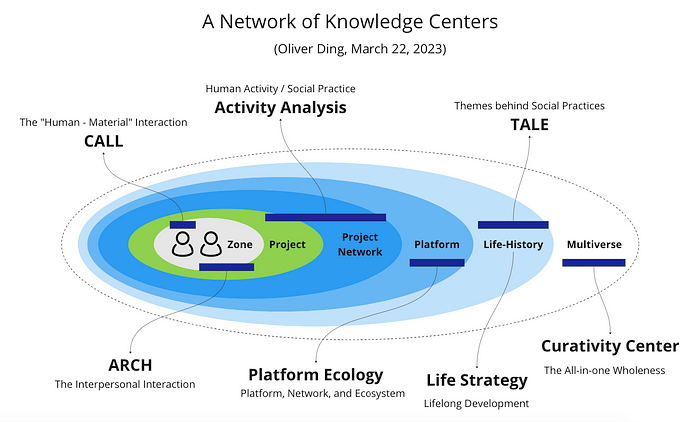
1. CALL(Creative Action Learning Lab) Center The “Human — Material” Interaction

2. ARCH Center The Interpersonal Interaction

3. Activity Analysis Center Human Activity/Social Practice

4. Platform Ecology Center Platform, Network, and Ecosystem

5. Life Strategy Center Lifelong Development

6. TALE (Thematic Analysis Learning Engagement) Center Themes behind Social Practices

7. Curativity Center: The All-in-one Wholeness

The above seven knowledge centers are built by myself. All knowledge frameworks and related books are created by me. I didn’t work on all knowledge centers at the same time.

In 2023, Platform Ecology Center and Life Strategy Center were inactive knowledge centers. However, I made progress in Platform Ecology Center and Life Strategy Center by working on knowledge projects belonging to other knowledge centers.

In order to highlight such a type of Synergy Effects of Networked Knowledge Centers, I used the following terms for the Value Circle project:

  • Direct Activity
  • Indirect Activity

You can find more details in Value Circle #6: The Indirect Activity of Platform Ecology Center.

This article will discuss the indirect activity of Life Strategy Center in 2023.

Contents

Part 1 Background

1.1 A Brief of Life Strategy Center 1.2 The Indirect Activity of Life Strategy Center in 2023

Part 2 The Development of Creative Life Theory

Part 3 The Development of the AAS Framework

3.1 Feb 16, 2023 — Persona Dynamics Framework 3.2 April 28, 2023 — Possible Discipline 3.3 Sept 24, 2203 — Microdynamics of Creative Identity 3.4 Dec 7, 2023 — Two Principles of Strategic Changes 3.5 Jan 29, 2024 — Discovery as Second-order Activity

Part 4 The Development of My “Life” Thematic Space

4.1 The “Life — Strategy” Thematic Dialogue 4.2 My “Life” Thematic Space in 2023 4.3 Life, Freedom, and Life (Self) 4.4 The Persona — Activity Fit 4.5 The Mindset — Action Fit 4.6 The Mental System — Behavioral System Fit 4.7 The Meaning — Experience Fit 4.8 The Thematic Space — Social Territory Fit

1.1 A Brief of Life Strategy Center

The Life Strategy Center represents my passions on two themes:

  • Lifelong Development
  • Strategic Cognition

In the past several years, I developed several models to guide my reflections on practical experiences on these two themes. For example, I was attracted to biographical studies since I wrote my first learning autobiography in 2015. To help a friend, I developed a framework called Career Landscape inspired by Activity Theory, Communities of Practice, and other ideas in 2016. I recently reconstructed the framework with more theoretical resources and the outcome is a new method named the Life-as-Activity approach.

A major development of my thoughts on these two themes is the Anticipatory Activity System (AAS) framework which was developed from Jan 2021 to Jan 2024.
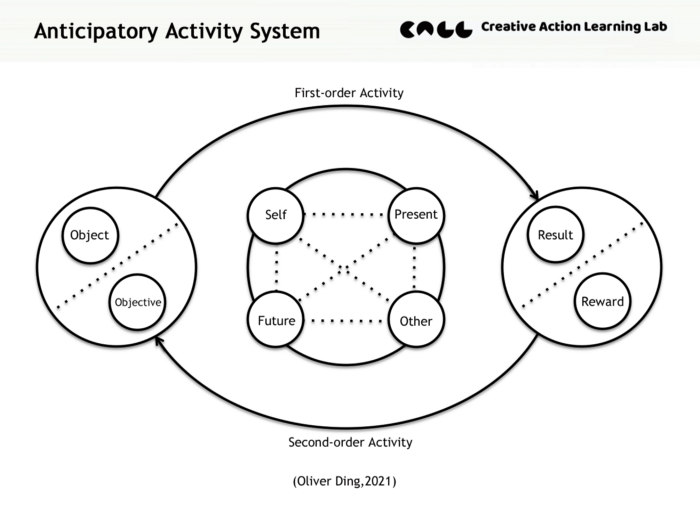
The Anticipatory Activity System (AAS) framework is inspired by Activity Theory, Anticipatory System theory, Relevance theory, and other theoretical resources. The framework is about modeling a specific structure: “Self, Other, Present, Future”.

An Anticipatory Activity System is formed by two parts: First-order Activity and Second-order Activity.

While the AAS framework belongs to the Activity Analysis Center, I also applied it to the field of Life Strategy. This step aimed to test the framework.

The outcome was a possible book titled Advanced Life Strategy: Anticipatory Activity System and Life Achievements.
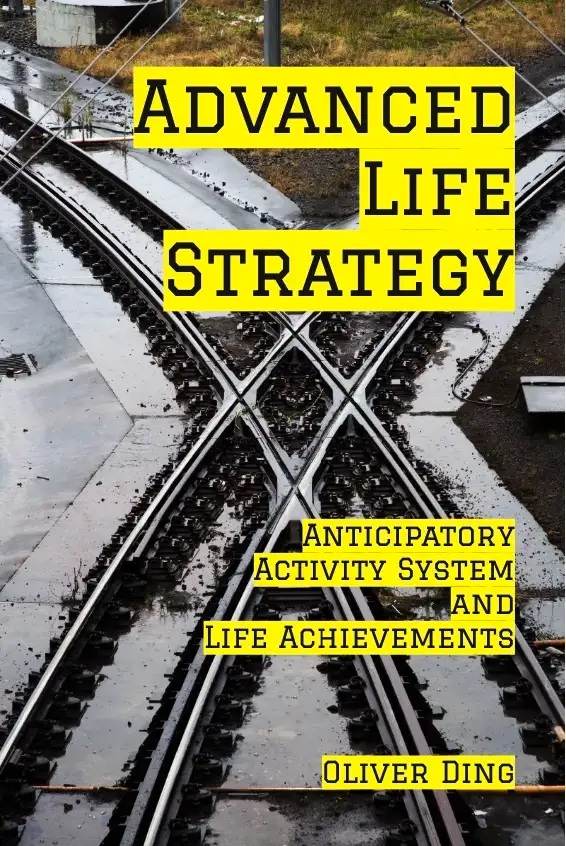
You can find more details in the following articles:

The Life Strategy Center was launched in June 2022 as a mini-site on Coda.
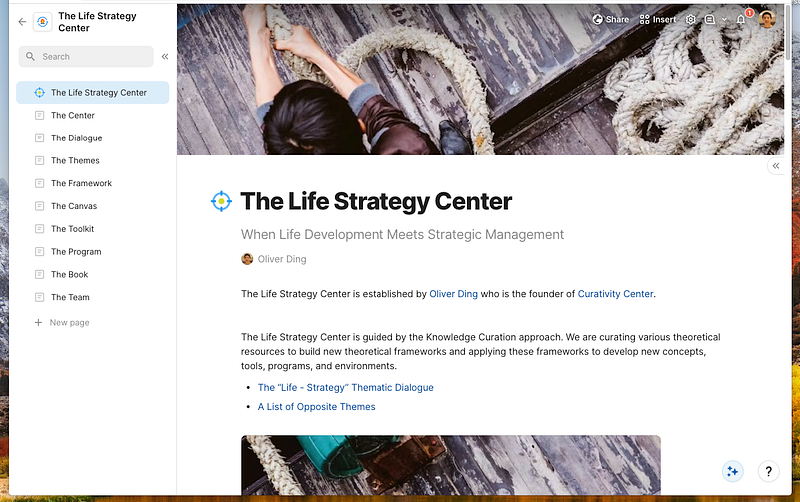
Life Strategy Center @ Coda

From Jan 2022 to June 2022, I worked on the Life Discovery Project and developed a set of tools for the Life Discovery Activity.

The Life Strategy Center also hosts these tools.

In addition, the Life Strategy Center also hosts a mini-site about the “Life — Strategy” Thematic Dialogue.
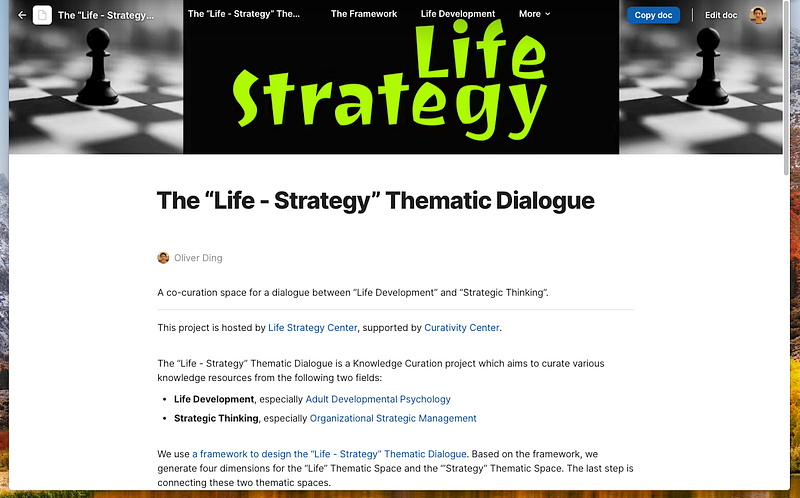
In 2023, my primary knowledge center was TALE (Thematic Analysis Learning Engagement). I also worked on some projects which were related to CALL (Creative Action Learning Lab) and Curativity Center.

So, I didn’t directly work on the Life Strategy Center.

1.2 The Indirect Activity of Life Strategy Center in 2023

To my surprise, there are three lines of indirect activity about Life Strategy Center in 2023.

  • The development of Creative Life Theory
  • The development of the AAS framework
  • The development of my “Life” thematic space

The following sections will offer more details.

Part 2 The Development of Creative Life Theory

The Creative Life Theory project was hosted by CALL and Curativity Center.
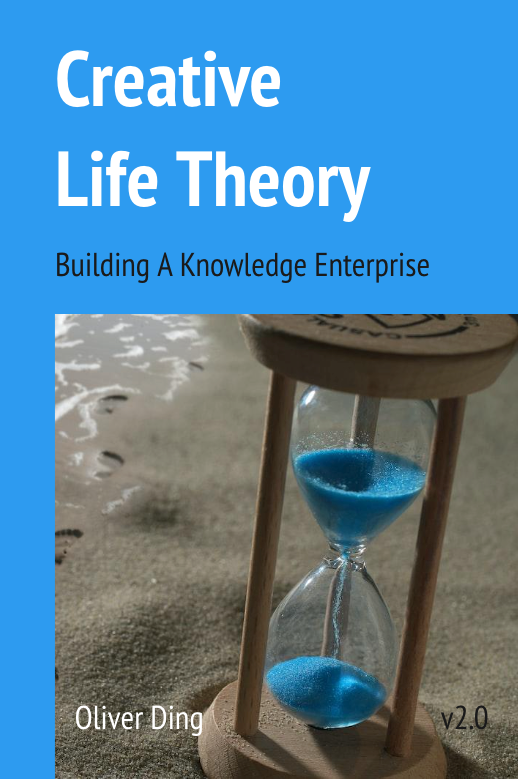
The above picture was designed for a possible book titled Creative Life Theory: Building A Knowledge Enterprise.

My primary interest is located in the intersection between Knowledge, Creativity, and Adult Development. I use Creative Life to name this focus.

I don’t want to develop a general framework about adult development for everyone. I only consider Knowledge Workers and Creators as my target audience.

The Creative Life Theory is a large knowledge enterprise that includes multiple units of analysis, a series of frameworks, and a set of tools. I also wrote several books about it.

You can find more details in Creative Life Theory (v2, book, 2023).

To be honest, I didn’t consider it as a project of Life Strategy Center. However, it can be seen as a meta-theory for the center.

Why?

The Creative Life Theory (v1.0) was framed with the “Ontology — Realism — Hermeneutics” schema in Oct 2022. See the diagram below.
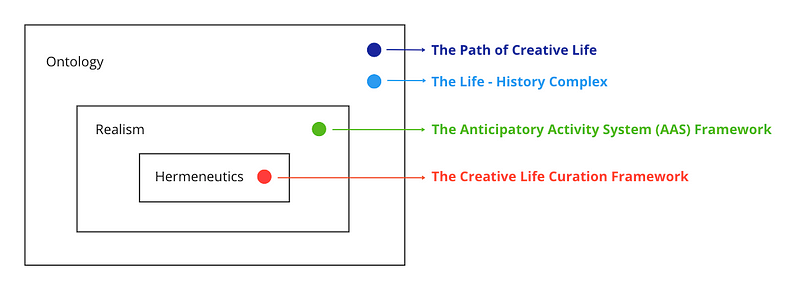
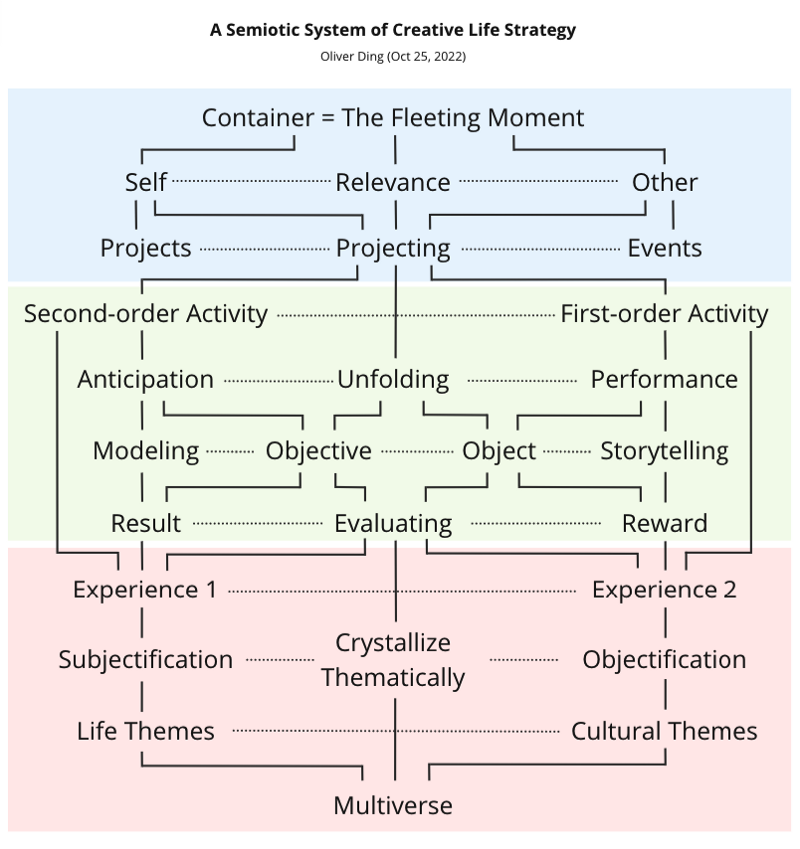
The AAS framework belongs to the Realism part of the whole. You can find more details in the semiotic system diagram below.
From Jan 2023 to April 2023, I worked on developing the Creative Life Theory (v2.0).

The Creative Life Theory (v2.0) can be seen as a new social theory for understanding knowledge creators’ life course. In this way, I adopted Ping-keung Lui’s subjectivist structuralism to generate the Creative Course framework.
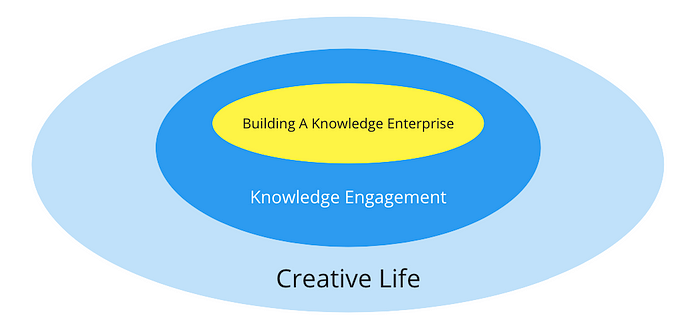
On the other side, I also collected a set of tools for building a knowledge enterprise.

For knowledge workers, the development of Creative Life Theory offers a systematic approach to discussing different levels of knowledge workers’ creative life course.

It will impact the development of the Life Strategy Center.

Part 3 The Development of the AAS Framework

The development of the AAS is highlighted in the diagram below.
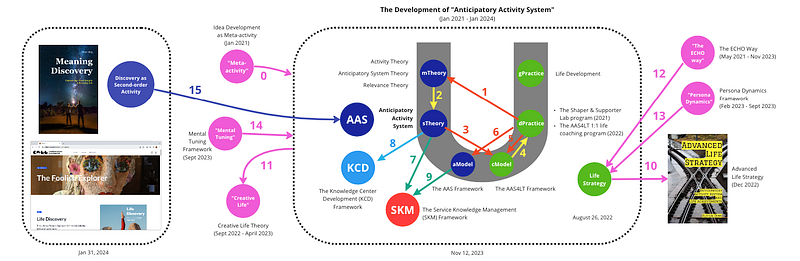
On August 28, 2022, I wrote a long article to review the development of AAS from August 21, 2020 to August 26, 2022. I used the Theme U diagram to identify nine moves.

On Nov 12, 2023, I reviewed the development of AAS from August 2022 to Nov 2023 and added the following moves to the above diagram.

  • #0 move: Idea Development as Meta-activity (Jan 2021)
  • #10 move: Edited a book (draft) titled Advanced Life Strategy (Dec 2022)
  • #11 move: Developed Creative Life Theory (Sept 2022 to April 2023)
  • #12 move: Applied the ECHO Way to the Life Strategy project (May 2021 to Nov 2023)
  • #13 move: Developed the Personas Dynamics framework (v2.0) (Feb 2023 to Sept 2023)
  • #14 move: Developed the Mental Tuning framework and used it to connect AAS and Action Psychology (Sept 2023)

In Jan 2024, I added the newest move to the diagram.

  • #15 move: Developed the Meaning Discovery canvas and edited a possible book (draft), also used “The Follish Explorer” to name a trilogy about “Discovery” (Jan 2024)

I will use the Direct Activity/Indirect Activity model to discuss the details of the following stories.

  • Feb 16, 2023 — Persona Dynamics Framework
  • April 28, 2023 — Possible Discipline
  • Sept 24, 2203 — Microdynamics of Creative Identity
  • Dec 7, 2023 — Two Principles of Strategic Changes
  • Jan 29, 2024 — Discovery as Second-order Activity

3.1 Feb 16, 2023 — Persona Dynamics Framework

On Feb 16, 2023, I wrote an article titled TALE: A Possible Theme called “Possible Personas”.

The primary knowledge center is TALE (Thematic Analysis Learning Engagement) while the primary knowledge project is the Thematic Exploration project.

  • Objective: Develop a set of themes as examples of the Thematic Exploration framework
  • Outcome: Develop the theme of “Possible Personas”
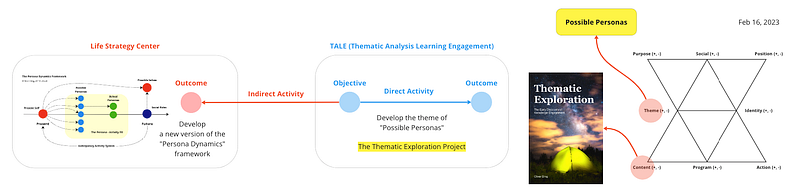
In this article, I also reviewed the concept of “Personas Dynamics” which is part of my 2019 work SET. The outcome is a new version of the Personas Dynamics framework.
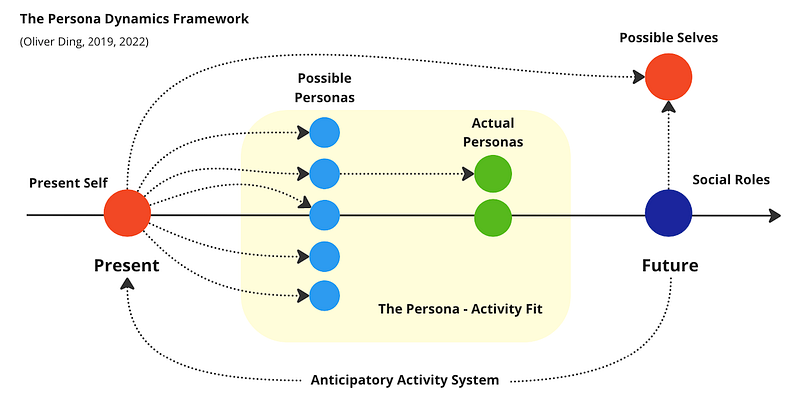
The new version of Persona Dynamics connects the AAS framework with Possibe Selves theory.

In 2022, I wrote a book (draft) titled Advanced Life Strategy: Anticipatory Activity System and Life Achievements. However, I didn’t discuss the “Self—Personas — Role” issue in the book.

In this way, the Persona Dynamics framework contributes to the development of AAS and the Life Strategy Center.

3.2 April 28, 2023 — Possible Discipline

On April 28, 2023, I wrote an article titled TALE: A Possible Theme called “Possible Discipline”.

The primary knowledge center is TALE (Thematic Analysis Learning Engagement) while the primary knowledge project is the Thematic Exploration project.

  • Objective: Develop a set of themes as examples of the Thematic Exploration framework
  • Outcome: Develop the theme of “Possible Discipline”
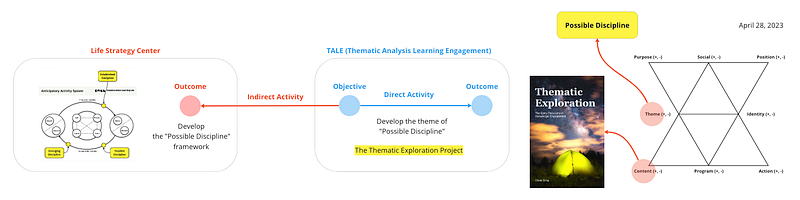
In this article, I also discussed the relationship between the AAS framework and Possible Discipline. See the diagram below.
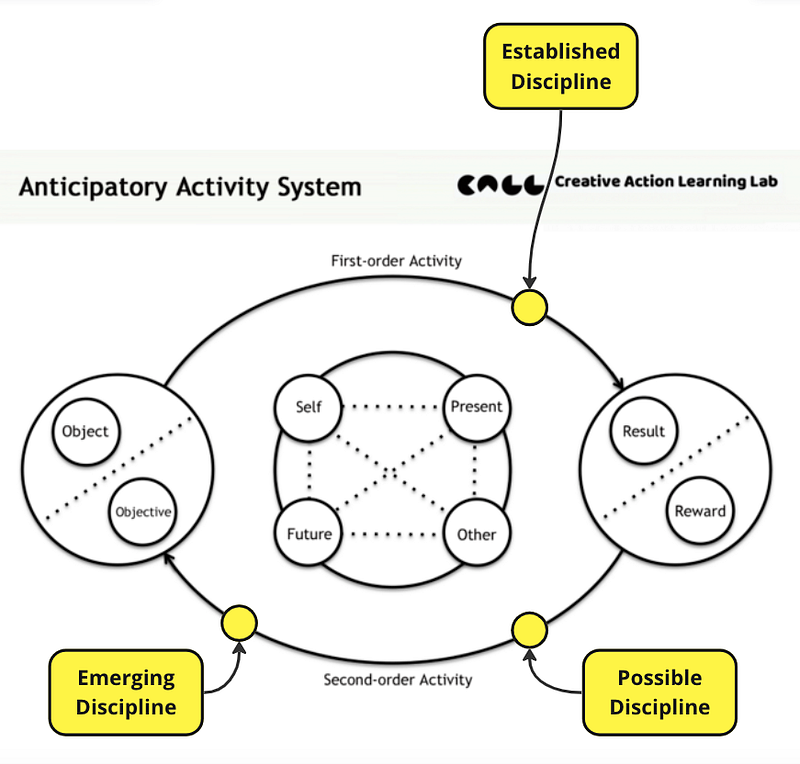
For the life strategy project, Second-order Activity means Life Discovery Activities. First-order Activity means Life Performance Activities.

Life Discovery Activities aim to discover something new, try something for the future, detect possible themes, and Explore Disciplines. In the early phase of Life Discovery, we can try several Possible Disciplines. In the late phase of Life Discovery, we can focus on one Emerging Discipline.

On the other hand, Life Performance Activities echo Established Disciplines. We can focus on running low-risk projects and produce outcomes that are easily perceived by others.

This is a small contribution to the Life Strategy Center.

3.3 Sept 24, 2203 — Microdynamics of Creative Identity

On Sept 9, 2023, I applied some techniques I learned from Theoretical Sociologists to run a theoretical integration project about the concept of Mindset. You can find more details in Knowledge Engagement: The Concept of Mindset and Theoretical Integration.

The outcome is fantastic!

I made a Configurational Theory of Mindset and a new meta-framework called the Mental Tuning Framework.

On Sept 24, 2023, I adopted the ECHO Way to reflect on the project and discussed a new theme called “Microdynamics of Identity”. You can find more details in Advanced Life Strategy: The Microdynamics of Creative Identity.

The primary knowledge center is Curativity Center while the primary knowledge project is the Mindset project.

  • Objective: Use the ECHO Way to reflect on the project and conduct a case study
  • Outcome: Develop the theme of “Microdynamics of Identity” for the Developmental Project Model
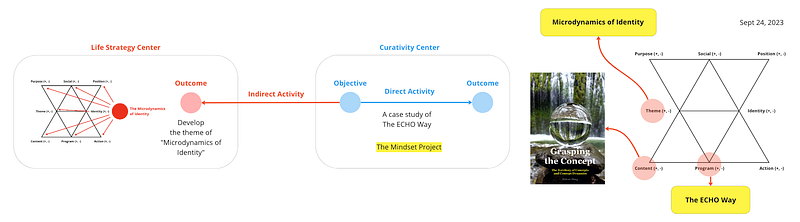
On Sept 14, 2023, I sent the following message to a friend of mine via Gmail:

I feel that I am building a micro identity of becoming a theoretical psychologist. Moreover, I used the knowledge I learned from theoretical sociologists to run this project.

I made a tiny “Creative Life Curation” reflection and made several diagramming notes about this experience.

I used “the Microdynamics of Identity” to name my feelings. It echoes the “Person Dynamics” framework which emphasizes the “Persona — Activity” fit.

I also used the three-container model to describe my “Creative Life” experience. The “Mindset” project is a process of entering the creative container and exiting it.

I need to write a new article.

In the article, I made the diagram below to represent the “Microdynamics of Identity” theme.
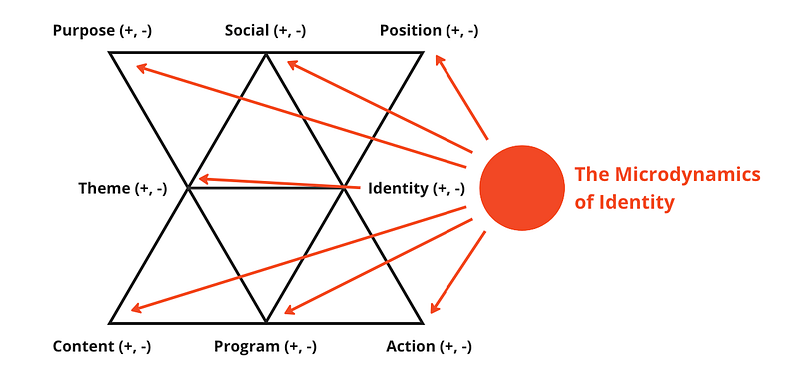
Your identity is about how others view “what you do” and “who you are”. It’s also part of your self-knowledge. From the perspective of the Project Engagement approach, Identity is an element of a Developmental Project Model and it’s related to other elements.

Every time, you join a Project or leave a Project, your identity always changes. This is what I call the Microdynamics of Identity.

Life is a chain of projects, it is also a projection of social life.

By adopting the Developmental Project model, we have a way to reflect on the development of personal life and social life in one unit of analysis. We can connect psychology, sociology, and others.

I adopted the Developmental Project model for the Life Strategy Center in 2022. The theme of “Microdynamics of Identity” was a small piece of the framework.

I also used the ECHO Way to discuss the Mindset project. See the diagram below.
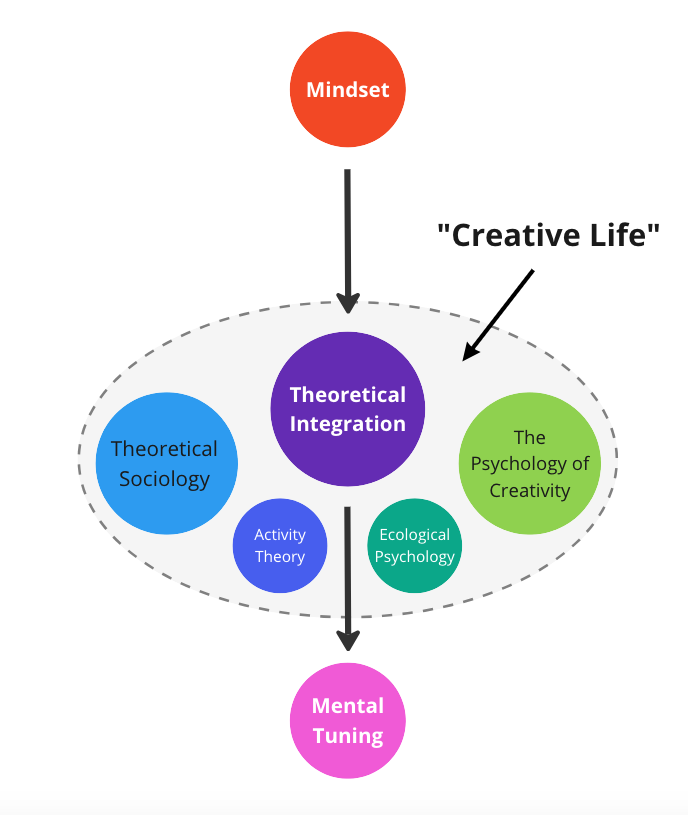
For the Mindset project, I used the “Creative Life” Container Z as the creative space.

I made a demo of theoretical integration by curating Carol S. Dweck’s version of Mindset theory and Peter Gollwitzer’s version of Mindset theory together.

In order to represent the outcome, I developed the Mental Tuning framework.

I have applied the ECHO Way to the Life Strategy Center many times. The Mindset project inspired me to conduct a new case study of the ECHO Way.

3.4 Dec 7, 2023 — Two Principles of Strategic Changes

On Dec 5, 2023, I published an article titled Social Moves: An Integrated Ecological Approach to Social Cognition. This is a major milestone of the Social Moves project.

The article reviewed the concept of “Ecological Formism” and used it to develop a new knowledge framework. This decision caused a series of changes in my knowledge projects.
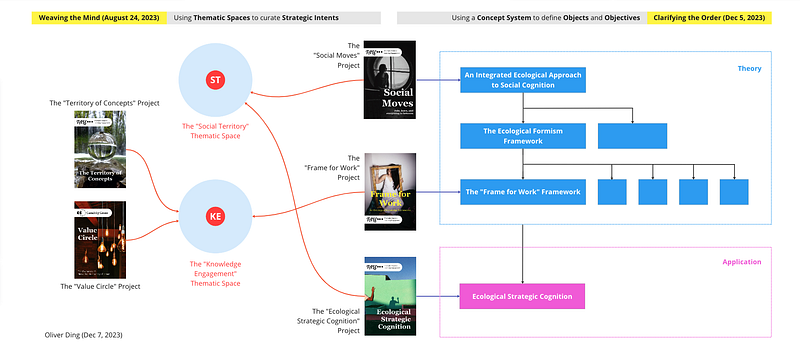
The above diagram represents these changes.

On Dec 7, 2023, I considered it as an example of the theme of “Strategic Change” and conducted a case study about it. You can find more details in Social Moves: Weaving the Mind and Clarifying the Order.

The primary knowledge center is Curativity Center while the primary knowledge project is the Social Moves project.

  • Objective: Develop an Integrated Ecological Approach to Social Cognition
  • Outcome: Reflec on the development of the Social Moves project
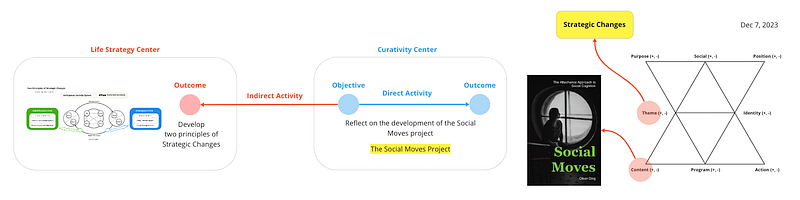
In the article, I developed two principles of Strategic Change in the context of knowledge engagement.

  • Emergence First
  • Solidification First

At the beginning of the Knowledge Discovery Activity, we can apply the Emergence First principle.

At the end of the Knowledge Discovery Activity, we can apply the Solidification First principle.

I also connected these ideas with the Anticipatory Activity System (AAS) framework. See the diagram below.
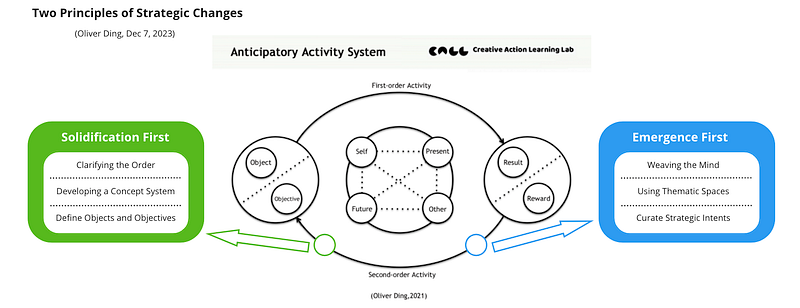
From the perspective of AAS, there are two types of activities in the World of Activity:

  • First-order Activity: Knowledge Performance Activity
  • Second-order Activity: Knowledge Discovery Activity

Knowledge Discovery Activity is about developing Tacit Knowledge, discovering possible themes, developing concept systems, etc. It is more about Subjectification.

Knowledge Performance Activity is about making solid things of knowledge such as writing an academic paper, publishing a book, making a speech, developing software, etc. It is more about Objectification.

I used “Curate Strategic Intents” for the Emergence First principle. The term was used for the “Strategic Thematic Exploration” Framework.

3.5 Jan 29, 2024 — Discovery as Second-order Activity

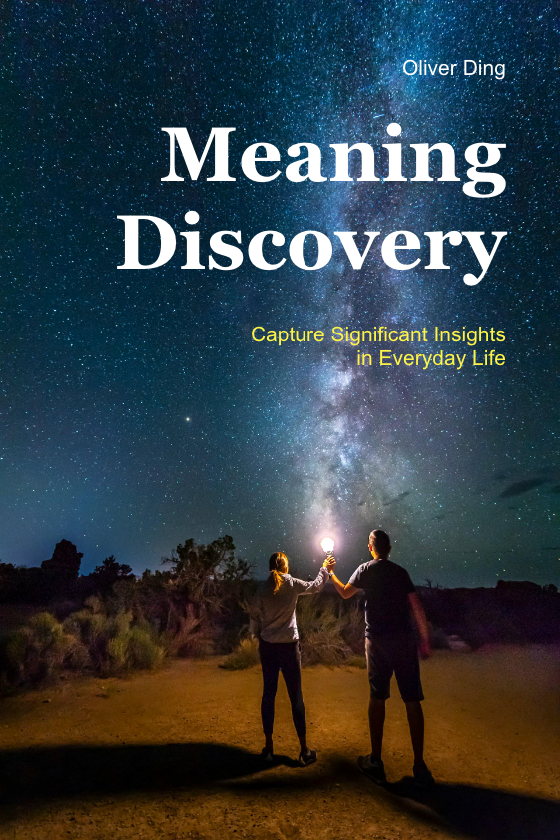
From Jan 18, 2024, to Jan 26, 2024, I wrote a series of posts and edited two possible books: Meaning Discovery and Situational Note-taking.

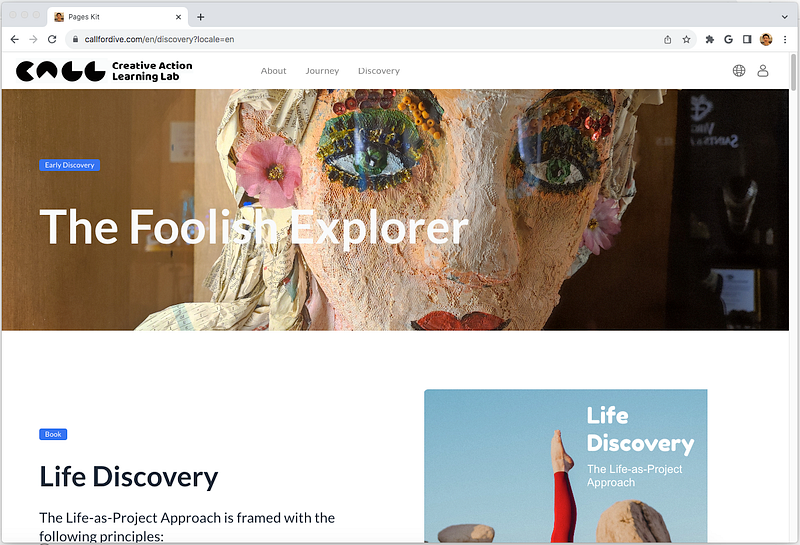
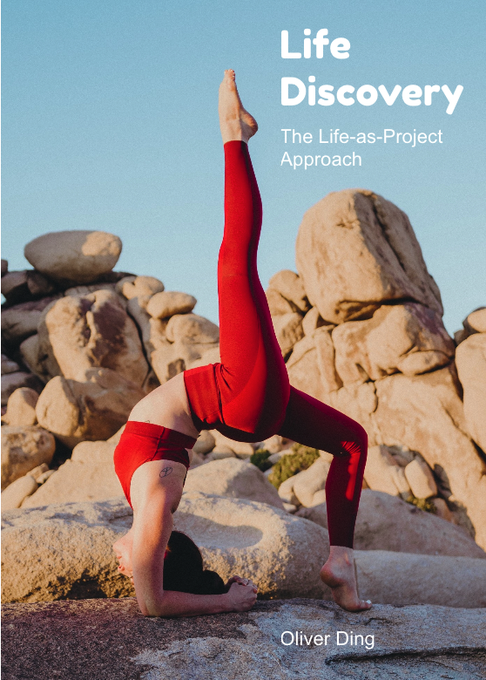
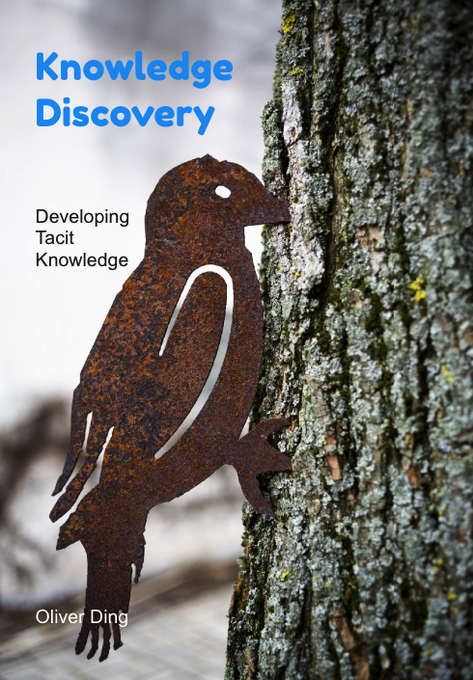
This marks a great milestone in my creative journey! Meaning Discovery follows Knowledge Discovery: Developing Tacit Knowledge with Thematic Space Canvas (May 2022) and Life Discovery: The Life-as-Project Approach (July 2022). Together, they form a trilogy.
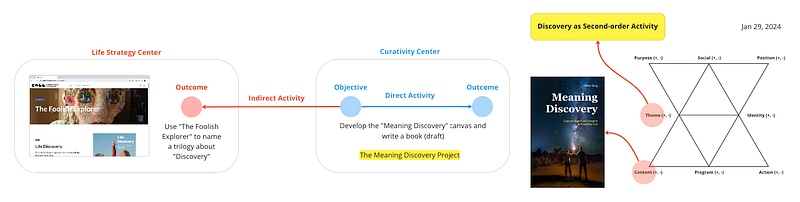
On Jan 29, 2024, I wrote a post titled The Foolish Explorer: A Trilogy about “Discovery”. It marked the #15 move in the journey of developing the AAS framework.

The primary knowledge center is Curativity Center while the primary knowledge project is the Meaning Discovery project.

  • Objective: Develop the “Meaning Discovery” canvas and write a book (draft)
  • Outcome: Discover the theme of “Discovery as Second-order Activity”
The trilogy shares a set of ideas in mind, life, activity, and discovery.

The trilogy sees “Knowledge Discovery”, “Life Discovery”, and “Meaning Discovery” as three types of Second-order Activity.

  • Knowledge Discovery Activity
  • Life Discovery Activity
  • Meaning Discovery Activity

Second-order Activity is a core concept of the Anticipatory Activity System (AAS) framework which is inspired by Anticipatory Systems Theory, Activity Theory, and other theoretical resources.

From the perspective of the AAS, the most important thing is not the distinction between First-order Activity and Second-order Activity, but the connection between the two types of Activities because they form a meaningful system.

The outcome of Second-order Activity is Significant Insights that lead to Objects and Objects that define further First-Order Activity. The outcome of the First-order Activity is Significant Achievements that lead to Results and Rewards that support Second-order Activity.

Inspired by March’s ideas, I used “The Foolish Explorer” to name the trilogy about “Discovery” and associate it with “Subjectification” and “Slow Cognition”.
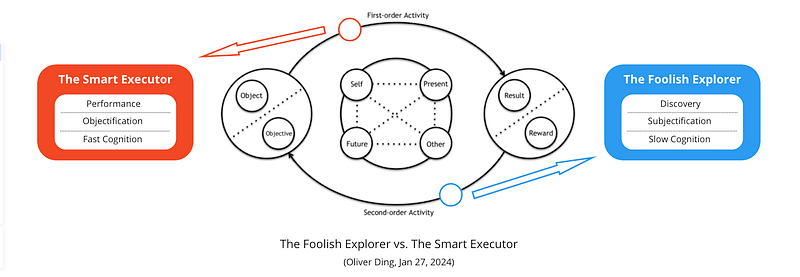
I used the term “Subjectification” in the Creative Life Curation framework. It refers to “turning the world into a person’s experience”. In contrast, the term “Objectification” refers to “turning the person’s experience into artifacts for the world”.

The Foolish Explorer” is only about Subjectification (Experience 1).

Part 4 The Development of My “Life” Thematic Space

In 2022, I used a unique technique to develop the concept of “Life Strategy”:

The “Double Theme” Strategy

The “Double Theme” Strategy means connecting two Knowledge Discovery Canvases and forming a new process of developing tacit knowledge. You can find more details in Knowledge Discovery: The “Double Theme” Strategy.

In 2023, I didn’t directly work for the Life Strategy Center, but my “Life” thematic space was changed with several new ideas.

4.1 The “Life—Strategy” Thematic Dialogue

On Feb 3, 2022, I published Thematic Space: The “Strategy” thematic space and mentioned my focus on the “Toolkit” and the “Dialogue”.

Originally, I was busy dealing with friends’ requests about practical suggestions about strategy. So, I framed the notion of “Life Strategy” as a practical toolkit. However, I realized that I could detach from the “toolkit” and attach to the “dialogue” which is mentioned above.

What is the dialogue?

My notion of “Life Strategy” can be understood as a dialogue between my “Life” thematic space and my “Strategy” thematic space.

If we jump out of my thematic spaces, we can consider the concept of “Life Strategy” as a dialogue between the field of “Developmental Psychology” and the field of “Strategic Management”.

I called this method Double Dialogues which is a technique of the Knowledge Curation framework.

On Feb 4, 2022, I shared the Life Strategy Framework (v1.0) and a knowledge curation canvas about the framework on Linkedin.

On Feb 17, 2022, I wrote a post titled Mapping Thematic Space #6: The “Life” thematic space.

Later, I made a mini-site to host the “Life—Strategy” Thematic Dialogue on Coda.

From June 2022 to Dec 2023, I focused on applying the Anticipatory Activity System (AAS) framework to study Life Strategy. The outcome was the book Advanced Life Strategy.

4.2 My “Life” Thematic Space in 2023

In 2023, my primary knowledge center was TALE (Thematic Analysis Learning Engagement). I also worked on some projects which were related to CALL (Creative Action Learning Lab) and Curativity Center.

However, I found that the changes in my “Life” thematic space could impact to Life Strategy Center.
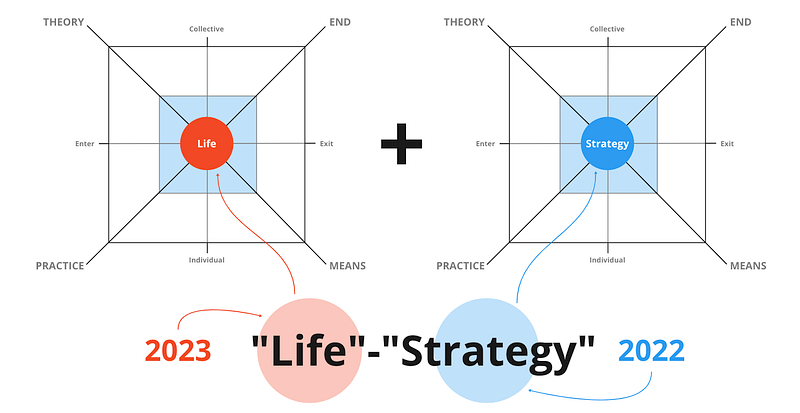
As mentioned above, my “Life” thematic space was developed by working on several knowledge projects under CALL, TALE, and Curativity Center.

Let’s see related articles I wrote in 2023:

What can we find from these articles? See the picture below.
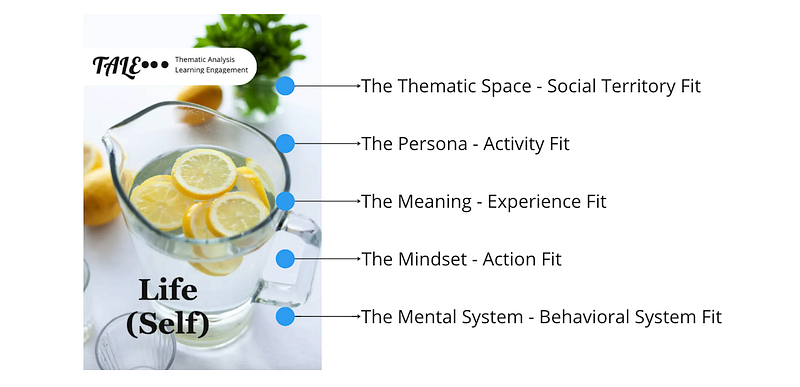
I found there are six themes behind these articles:

  • Life (Self)
  • The Persona — Activity Fit
  • The Mindset — Action Fit
  • The Meaning — Experience Fit
  • The Mental System — Behavioral System Fit
  • The Thematic Space — Social Territory Fit

What does it mean?

It means that I was working on developing a new ontology of “Life” in 2023.

4.3 Life, Freedom, and Life (Self)

In 2022, I used the Life Discovery Orientation model to define the concept of “Life” for the Life Discovery Project and the Life Strategy Project.
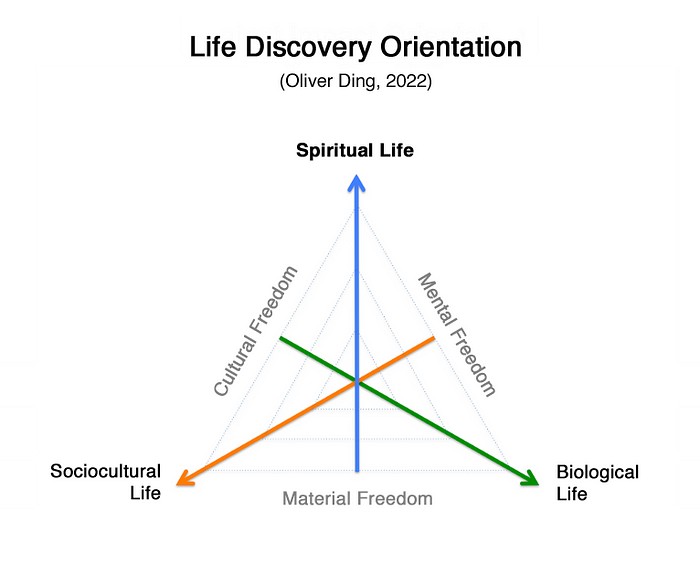
I use three dimensions of the concept of “Life” to develop the above model. There are at least three ways to understand the concept of “Life”.

  • Life as Organism: this is the perspective of biological theories.
  • Life as Practice: this is the perspective of social theories.
  • Life as Ideal Type: this is the perspective of humanities.

These three perspectives can be called Biological Life, Sociocultural Life, and Spiritual Life. I also defined three types of Freedom.

  • Material Freedom: Independence of both Sociocultural Life and Biological Life.
  • Mental Freedom: Independence of both Spiritual Life and Biological Life.
  • Cultural Freedom: Independence of Sociocultural Life and Spiritual Life.

This model leads to a challenge: What’s Freedom? My rough answer is the following diagram.
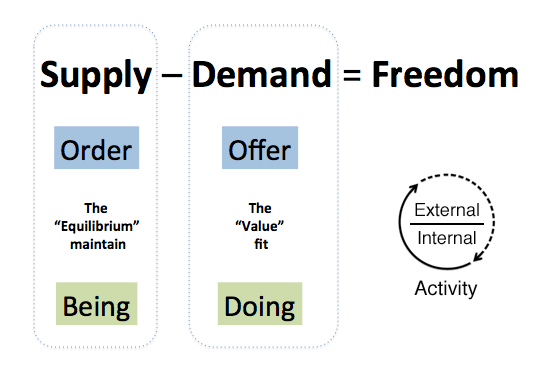
I use a simple formula to define “Freedom”. The pair of concepts of “Supply — Demand” is inspired by economics. Also, I was inspired by the developmental psychologist Robert Kegan’s 1994 book In Over Our Heads: The Mental Demands of Modern Life.

In Over Our Heads focuses on the fit or lack of fit between what the culture demands of our minds and our mental capacity to meet these demands. According to Robert Kegan, “The psychological phenomenon is the evolution of consciousness, the personal unfolding of ways of organizing experience that are not simply replaced as we grow but subsumed into more complex systems of mind…The cultural phenomenon is the ‘hidden curriculum,’ the idea that to the list of artifacts and arrangements a culture creates and the social sciences study we should add the claims or demands the culture makes on the minds of its constituents.” (1994, p.9)

Kegan’s “psychological—cultural” dialogue approach is the seed of my ideas about the above three types of freedoms. I want to expand the “psychological — cultural” dialogue to the “psychological—biological” dialogue and the “cultural—biological” dialogue.

The above diagram is my intuitive idea about the model which leads to a slogan: Being by Doing. It looks like this is a dialogue between Humanistic Psychology and Activity Theory.

  • Activity Theory: Doing means delivering “Value” as Offers to others.
  • Humanistic Psychology: Being means maintaining “Equilibrium” as Order for self.

If a person wants to offer values to satisfy others’ demands, he or she should keep a good order for internal equilibrium in order to maintain the supply system.

This is an interesting idea. However, it requires more in-depth work. To deliver a toolkit to my friends and other indie creators, I decided to directly adopt a module from the Project Engagement Toolkit. I kept the “Being by Doing” idea for the theoretical dialogue project.

The above idea was developed in Feb 20222. You can find more details in Mapping Thematic Space #6: The “Life” thematic space and Life Discovery: The “Being by Doing” Principle.

From May 2023 to June 2023, I worked on developing the Strategic Thematic Exploration framework. The third stage of the framework is called “Themes in the Field”. In order to explain the stage, I used the Persona Dynamics Framework as an example.

On June 2, 2023, wrote a piece about the idea of Life(Self) in an article titled Themes in the Field: Self, Agency, and Activity (Part II). On July 17, 2023, I detached the piece from the original article and published it as a new post: TALE: A Possible Theme called “Life (Self)”.
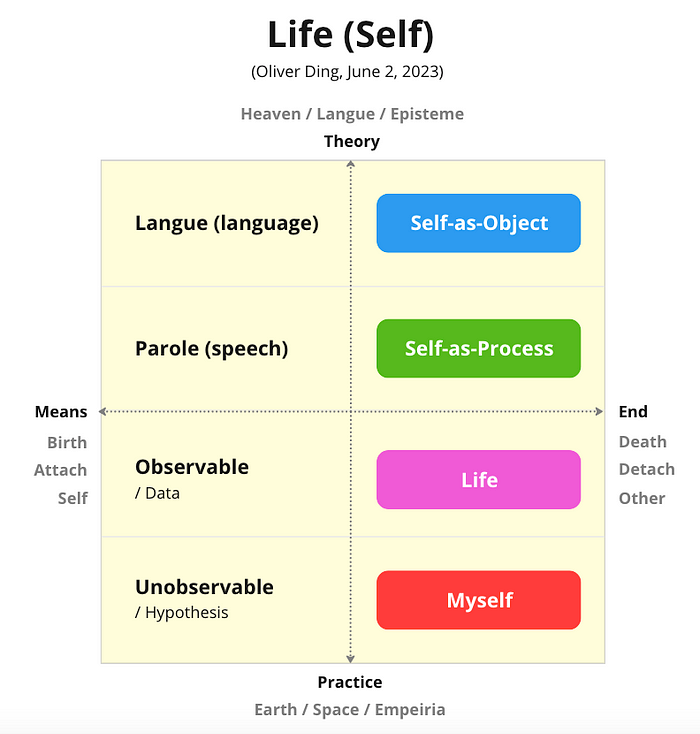
Originally, the idea of Life (Self) was the outcome of a rough literature review on Self theories in the field of psychology. From the perspective of the Ecological Practice Approach, We can’t understand the “Self” without understanding the “Life”.

This is a significant insight! It means I can develop a theory about both “Self” and “Life”.

4.4 The Persona — Activity Fit

The Persona — Activity Fit is the core idea of the Persona Dynamics framework.

The above discussion has offered more details about the framework.

4.5 The Mindset — Action Fit

From Sept 2023 to Nov 2023, I worked on the Mindset project which inspired me to explore the Mindset — Action Fit.
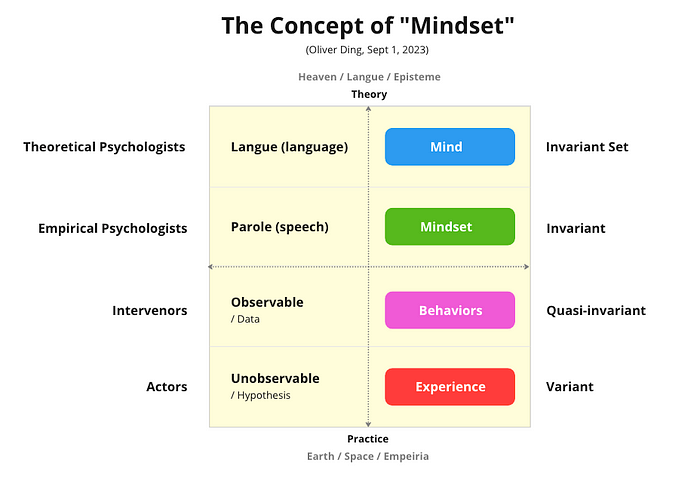
I made a demo of theoretical integration by curating Carol S. Dweck’s version of Mindset theory and Peter Gollwitzer’s version of Mindset theory together.

You can find more details in Knowledge Engagement: The Concept of Mindset and Theoretical Integration.

4.6 The Mental System — Behavioral System Fit

Based on the above notion of Life (Self), I adopted Robert Rosen’s Anticipatory Systems theory to develop the following schema:

  • Life = Behavioral System
  • Self = Mental System
  • Life(Self) = Behavior System (Mental System)

I have connected Anticipatory System Theory and Activity Theory and moved from the abstract level to the concrete level. The outcome is a framework called the “Anticipatory Activity System (AAS)” framework.

However, the “Anticipatory Activity System (AAS)” framework is inspired by Activity Theory. It only focuses on the “Project” level and the “Activity” level.

The Behavior System (Mental System) schema aims to apply Anticipatory Systems Theory to the “Action” level.

The diagram below is the basic model of Anticipatory Systems Theory.
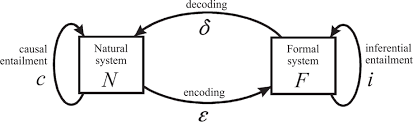
Let’s apply it to our framework.

  • Life = Behavioral System = Natural System
  • Self = Mental System = Formal System

A core idea of Anticipatory System Theory is the Predictive Model. According to Robert Rosen, “An anticipatory system is a natural system that contains an internal predictive model of itself and of its environment, which allows it to change state at an instant in accord with the model’s predictions pertaining to a later instant.” In contrast, a reactive system only reacts, in the present, to changes that have already occurred in the causal chain, while an anticipatory system’s present behavior involves aspects of past, present, and future.

I claimed that the Mindset is the Predictive Model of Behavior System (Mental System).

This rough idea led to the Mental Tuning framework.
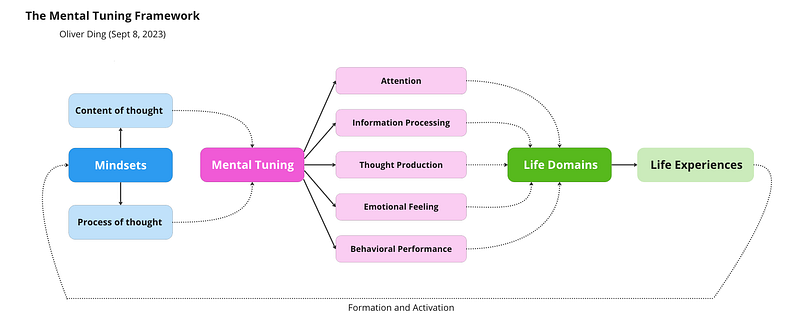
The new framework used “Life Domains” and “Life Experiences” as two operational concepts.

You can find more details in Knowledge Engagement: The Concept of Mindset and Theoretical Integration.

4.7 The Meaning — Experience Fit

On Sept 16, 2023, I made a note about a rough idea for a brand new Theoretical Psychology. See the diagram in the upper right corner of the picture below.
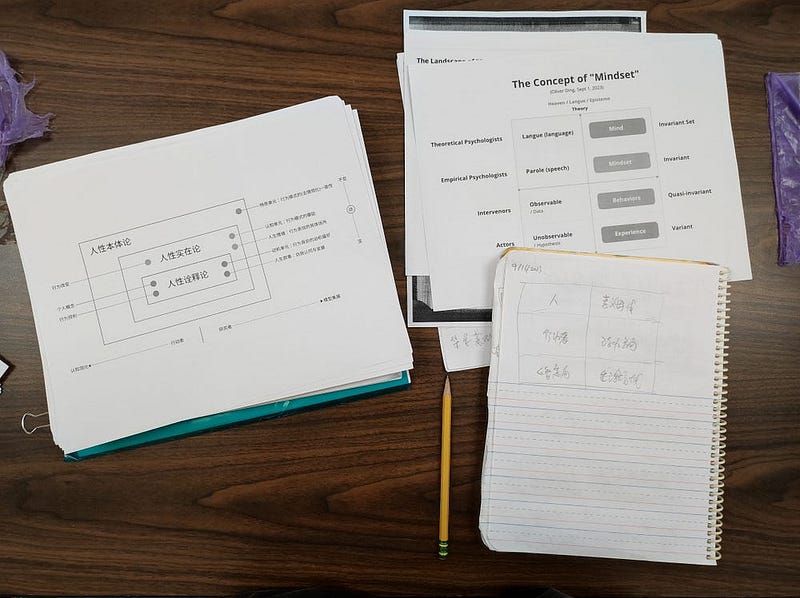
I reflected on these diagrams and used the “Ontology — Realism — Hermeneutics” schema to generate a new idea:

  • Ontology: Human — Meaning Matrix
  • Realism: Actor — World of Activity
  • Hermeneutics: Mindset — Life Domains

The Realism part is inspired by the Creative Life Theory while the Hermeneutics part refers to the Mental Tuning framework.

You can find more details in Situational Note-taking: The idea of “Meaning Matrix”.

On Oct 25, 2023, I made a new canvas called “Meaning Discovery Canvas” for developing tacit knowledge about “Meaning”. The canvas led to the Meaning Discovery Model and a possible book (draft). On Jan 19, 2024, I introduced the Meaning — Experience Transformation with the diagram below.
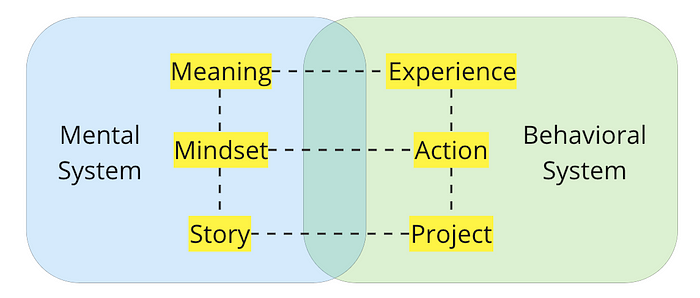
The “Meaning — Experience” Transformation is located in the Behavior System (Mental System).

Experience is based on Action. A set of curated Actions form a Project. Both Actions and Projects could generate Experience as raw Material for our Mental System.

The Mental System could interpret each Material and generate Meaning. A Project could be explained as a Meaningful Story.

Mindset (a person’s way of thinking and opinions) is the instrument for driving the interpretation which leads to Meaning Discovery and Story Telling.

4.8 The Thematic Space — Social Territory Fit

While the Mental System — Behavior System Fit is about Anticipatory Systems theory, the AAS framework, and Action Psychology, I also worked on the Thematic Space — Social Territory fit. which is about the connection between the Ecological Practice approach and Ping-keung Lui’s theoretical sociology.

The term “Thematic Space” came from the Ecological Practice approach.

The term “Social Territory” was inspired by Ping-keung Lui’s term “Social Territory” and his Subjectivist Structuralism which is part of his theoretical sociology.

In 2023, I worked on the Mental Moves project and the Social Moves project. If we put “Mental Moves” and “Social Moves” together, we see a new unit of analysis of Social Cognition.

While “Social Moves” are about Social Actions, “Mental Moves” are about related Mental Activities.

Social Cognition = Social Moves (Mental Moves)

Both “Mental Moves” and “Social Moves” shared the concept of “Thematic Space” and the concept of “Attachance”.
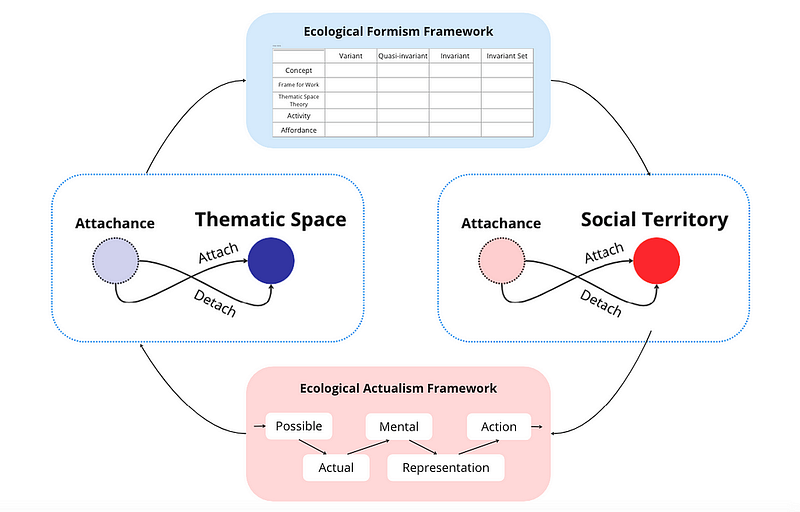
You can find more details in Social Moves (book, v1, 2023).

While the “Persona — Activity” Fit is about individual life, the “Thematic Space — Social Territory” Fit is more about social life.

Part 5 Creative Swapping

In summary, the Indirect Activity of Life Strategy Center in 2023 is more about Creative Swapping.

In 2023, I did several case studies about ecological cognition and wrote a book titled Mental Moves.

One technique I discovered from case studies is called “Creative Swapping”.

Swapping means interchanging.

For example, the diagram below is a Mental Configuration that refers to a nested structure: Platform[Project(People)].
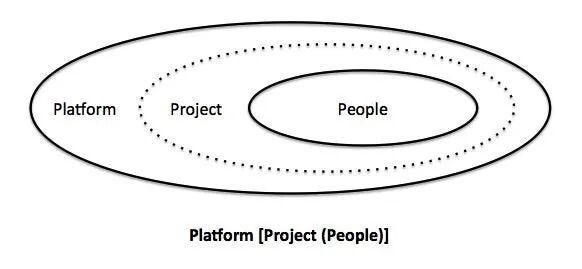
I used the above Mental Configuration for two projects and I found there is a Creative Swapping between these two projects.

  • 2020: The Platform Ecology Approach
  • 2022: The Project Engagement Approach

In the Platform Ecology Approach, the theme of “Project” was used to support the theme of “Platform”.

In the Project Engagement Approach, the theme of “Platform” was used to support the theme of “Project”.

Each project refers to a thematic space. Then this case means a Creative Swapping between two thematic spaces.

We can find a Creative Swapping between my “Strategy” thematic space and my “Life” thematic space from 2022 to 2023.

  • 2022: Life “Strategy”
  • 2023: “Life” Strategy

In 2022, I focused on the “Strategy” thematic space for the Life Strategy Center because the primary work was the Anticipatory Activity System framework.

In 2023, I didn’t directly work for the Life Strategy Center. However, some projects belonging to other knowledge centers indirectly contributed to the development of the Life Strategy Center.

Why?

Because they contributed to the development of my “Life” thematic space. In 2023, I inadvertently developed a new ontology of “Life”.

Related Links

Life
Life Strategy
Life Development
Recommended from ReadMedium