
Life Discovery: The “Being by Doing” Principle
The Starting Point of the Life Discovery Toolkit
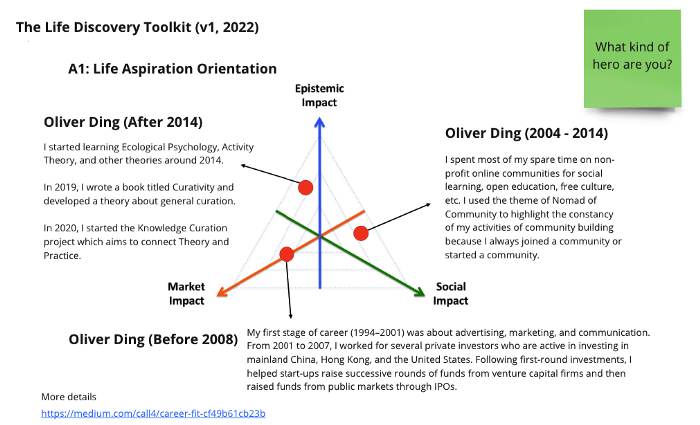
The Life Discovery Toolkit (v1.0) uses Life Aspiration Orientation as the starting point. I use the three dimensions to start the difficult conversation for life development:
- Epistemic Impact (Knowledge Heroes)
- Market Impact (Business Heroes)
- Social Impact (Social Change Heroes)
The toolkit is not for discussing traditional career development, but life as a meaningful whole. We care about the real impact you can make. You can make an impact through a paid job or other activities.
These three dimensions don’t mean there are only three choices. It just highlights the directions of free space. You can find a dot in the space and move around since life is a continuous flow.
You can also use it for long-term biographical reflection. For example, the attached diagram is my own story.
- Market Impact: Before 2008
The first stage of my career (1994–2001) was about advertising, marketing, and communication.
From 2001 to 2007, I worked for several private investors who are active in investing in mainland China, Hong Kong, and the United States. Following first-round investments, I helped start-ups raise successive rounds of funds from venture capital firms and then raised funds from public markets through IPOs.
- Social Impact: 2004–2014
I spent most of my spare time on non-profit online communities for social learning, open education, free culture, etc. I used the theme of Nomad of Community to highlight the constancy of my activities of community building because I always joined a community or started a community.
- Epistemic Impact: After 2014
I started learning Ecological Psychology, Activity Theory, and other theories around 2014. In 2019, I wrote a book titled Curativity and developed a theory about general curation. In 2020, I started the Knowledge Curation project which aims to connect Theory and Practice.
The Life Aspiration Orientation module is adapted from the Project Engagement Toolkit.
In fact, I had a new idea for the Life Discovery Toolkit on Jan 23, 2022. See the diagram below.
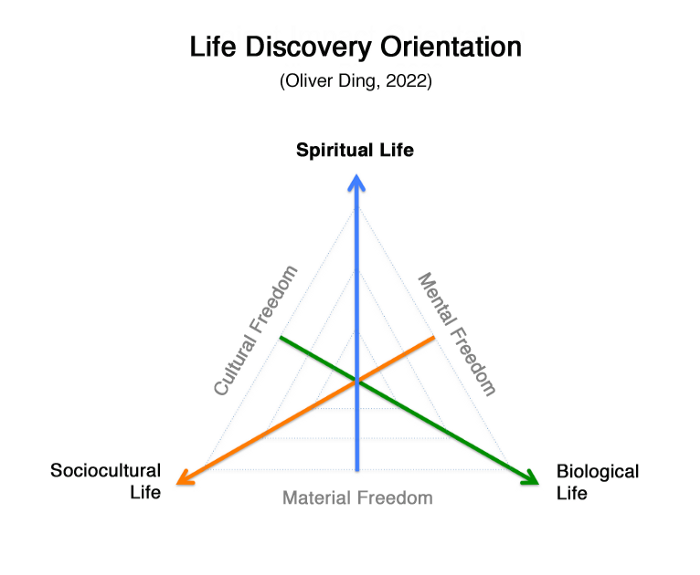
I use three dimensions of the concept of “Life” to develop the above model. There are at least three ways to understand the concept of “Life”.
- Life as Organism: this is the perspective of biological theories.
- Life as Practice: this is the perspective of social theories.
- Life as Ideal Type: this is the perspective of humanities.
These three perspectives can be called Biological Life, Sociocultural Life, and Spiritual Life. I also defined three types of Freedom.
Why did I choose “Freedom” as a core concept for this idea? On Jan 1, 2022, I designed the Strategist’s Mandala and used “Degrees of Freedom” as its primary theme. I learned the term from the Japanese strategy consultant Kenichi Ohmae’s writings.
However, “Degrees of Freedom” is a traditional term of strategic thinking in the context of business competitions. For individual life development, I don’t consider competitions as the first thing.
- Material Freedom: Independence of both Sociocultural Life and Biological Life.
- Mental Freedom: Independence of both Spiritual Life and Biological Life.
- Cultural Freedom: Independence of Sociocultural Life and Spiritual Life.
This model leads to a challenge: What’s Freedom? My rough answer is the following diagram. I use a simple formula to define “Freedom”. The pair of concepts of “Supply — Demand” is inspired by economics. Also, I was inspired by the developmental psychologist Robert Kegan’s 1994 book In Over Our Heads: The Mental Demands of Modern Life.
In Over Our Heads focuses on the fit or lack of fit between what the culture demands of our minds and our mental capacity to meet these demands. According to Robert Kegan, “The psychological phenomenon is the evolution of consciousness, the personal unfolding of ways of organizing experience that are not simply replaced as we grow but subsumed into more complex systems of mind…The cultural phenomenon is the ‘hidden curriculum,’ the idea that to the list of artifacts and arrangements a culture creates and the social sciences study we should add the claims or demands the culture makes on the minds of its constituents.”(1994, p.9)
Kegan’s “psychological — cultural” dialogue approach is the seed of my ideas about the above three types of freedoms. It’s clear that I want to expand the “psychological — cultural” dialogue to the “psychological — biological” dialogue and the “cultural — biological” dialogue.
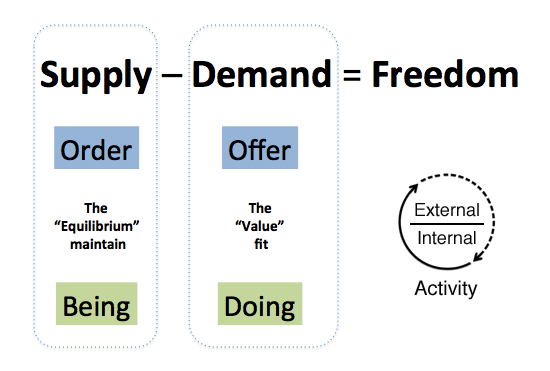
The above diagram is my intuitive idea about the model which leads to a slogan: Being by Doing. It looks like this is a dialogue between Humanistic Psychology and Activity Theory.
- Activity Theory: Doing means delivering “Value” as Offers for others.
- Humanistic Psychology: Being means maintaining “Equilibrium” as Order for self.
If a person wants to offer values to satisfy others’ demands, he or she should keep a good order for internal equilibrium in order to maintain the supply system.
This is an interesting idea. However, it requires more deep work. In order to deliver a toolkit to my friends and other indie creators, I decided to directly adapt a module from the Project Engagement Toolkit. I will keep the “Being by Doing” idea for the theoretical dialogue project.
You are most welcome to connect via the following social platforms:
Linkedin: https://www.linkedin.com/in/oliverding Twitter: https://twitter.com/oliverding Polywork: https://www.polywork.com/oliverding Boardle: https://www.boardle.io/users/oliver-ding