
Diagram Explained: Activity, Knowledge, and Moving on Diagrams
Diagram-in-Use and Creative Diagramming
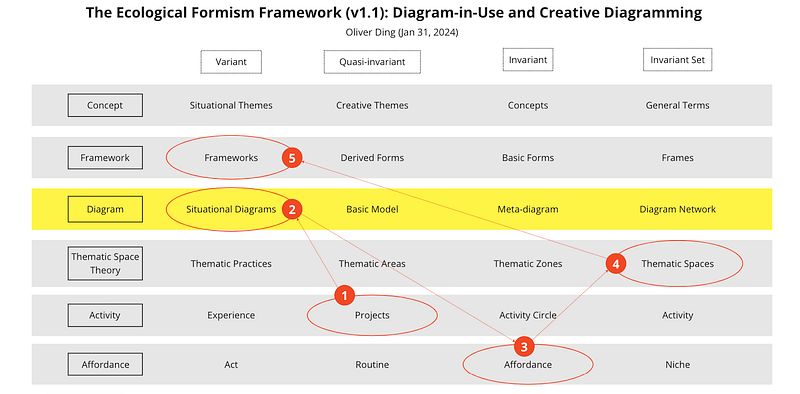
In the previous articles, I discussed two themes about knowledge diagrams: the theme of “Hierarchy” and the theme of “Network”.
This post aims to discuss the theme of “Path”.
The above diagram shows a “Path” which shows several moves between different Units of Analysis of the Ecological Formism framework.
1 Projects → 2 Situational Diagrams → 3 Affordance → 4 Thematic Spaces → 5 Framework
Let’s translate this path to a real process:
1 We start a Project about a theme or a problem…
2 … we use a Diagram that represents a knowledge framework in a situation such as a meeting, or thinking about an idea …or we just look at some diagrams in Miro … or just play some ideas with diagrams…
3 … sometimes, we perceive the Graphic Space Affordances …
4 … these Affordances could lead to some Thematic Spaces of some diagrams …
5 … these Thematic Spaces could lead to a new Path that shows moves between different thematic spaces, and the path could lead to a new Knowledge Framework…these Thematic Spaces also could lead to some related Knowledge Frameworks…
This story echoes the Ecological Actualism framework of Knowledge Frameworks. You can find more details in Frame for Work: The Ontology of Knowledge Frameworks and Ecological Actualism.
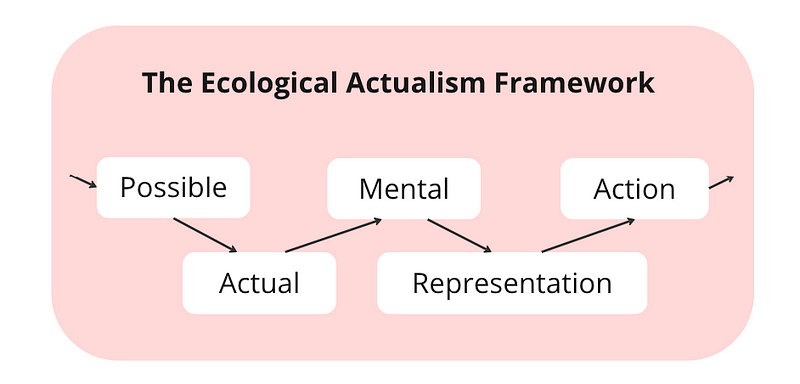
- From Possible to Actual
- From Logical to Representation
- From Mental to Action
- From Make to Use
- From Use to Possible
The Ecological Actualism framework sees a diagram as no longer a static knowledge representation, but a developmental dynamic process.
The process is a dynamic creative territory for exploring, reflecting, and curating.
The core idea of this view is the “Representation — Thematic Space — Perceiver” structure. A user could perceive Graphic Space Affordances of a representation (a diagram) of a knowledge framework, and discover some potential thematic spaces which could lead to new Paths and new Knowledge Frameworks.
While we can use it to understand Diagram-in-Use, we can also use it as the theoretical foundation of Creative Diagramming.
Let’s see an example.
Activity and Knowledge
This example is about the development of the Anticipatory Activity System (AAS) framework.
I started the AAS project in August 2021 and reflected on its development from August 2021 to August 2022 with the Theme U diagram.
- Activity: the project of developing the Anticipatory Activity System (AAS) framework.
- Knowledge: the Theme U diagram represents six levels of knowing
In this section, I will briefly introduce the AAS framework and the Theme U diagram as the background of the present case study.
The Anticipatory Activity System (AAS) framework is inspired by Activity Theory and Anticipatory System theory. It aims to offer an abstract model for understanding “Self, Other, Present, Future”. While the traditional Activity Theory focuses on “Exploitative Activity”, the AAS framework is more about “Exploratory Activity”.
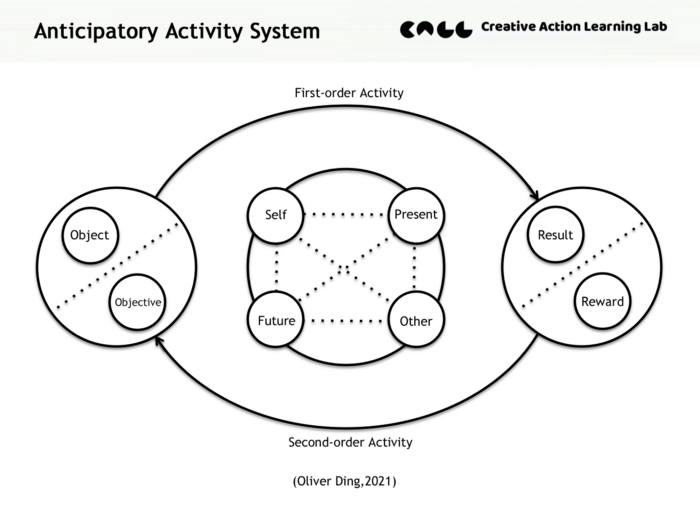
The above diagram is the Basic Model of the AAS framework.
I also made several Situational Diagrams. For example, the diagram below highlights five movements of the AAS framework: Unfolding, Discovering, Producing, Modeling, and Storytelling.
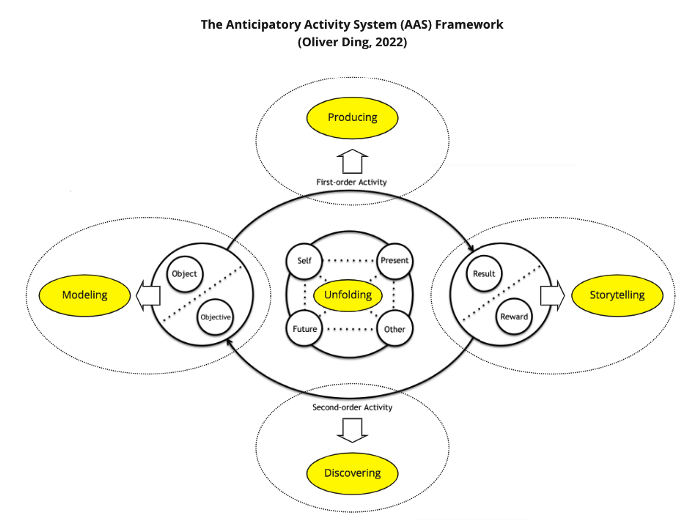
The diagram below is used to discuss the theme of “Discovery” and “Second-order Activity”.
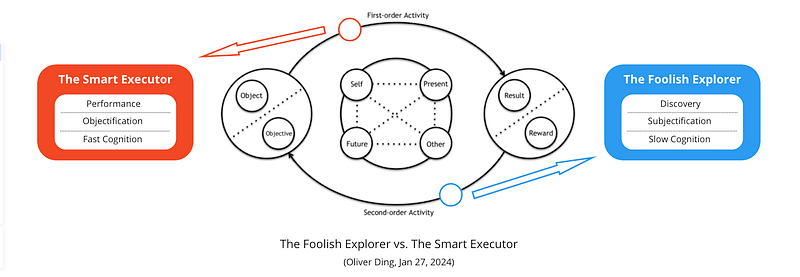
You can find more details in the links below:
- Strategy as Anticipatory Activity System — Sept 15, 2021
- Life Discovery: The AAS Framework — May 20, 2022
- Anticipatory Activity System (AAS) and A Possible Book — August 12, 2022
- The Development of AAS (August 21, 2021 — August 26, 2022) — August 28, 2022
- Advanced Life Strategy: Anticipatory Activity System and Life Achievements — Dec 15, 2022
- The Foolish Explorer: A Trilogy about “Discovery” — Jan 29, 2024
The Theme U diagram is also called HERO U. See the diagram below.
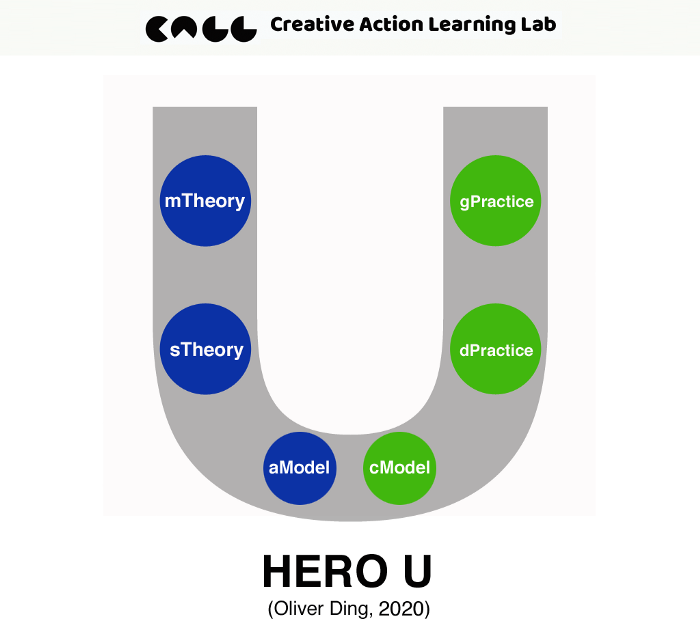
The above diagram is the first tool of the Knowledge Curation Project: Theme U. It was developed for Single-theory Curation.
Single-theory Curation is defined as a special type of activity that aims to understand the landscape of a theory, a theoretical concept, or a theory/concept-related practice such as learning, teaching, creating, etc. It is different from Multiple-theory Curation.
The HERO U diagram defines six types of objects of knowing:
- mTheory: Meta-theory
- sTheory: Specific Theory
- aModel: Abstract Model
- cModel: Concrete Model
- dPractice: Domain Practice
- gPractice: General Practice
You can find some case studies in The Knowledge Curation Toolkit #1: Theme U for Single-theory Curation.
Though the HERO U diagram is designed for curating existing theories and their applications, it can be used as a tool for developing new theoretical frameworks.
On August 26, 2022, I used the HERO U diagram to reflect on the development of the AAS framework. This is the beginning of the present case.
2022: Nine Moves between Six Thematic Spaces
What did I find on August 26, 2022?
See the diagram below.
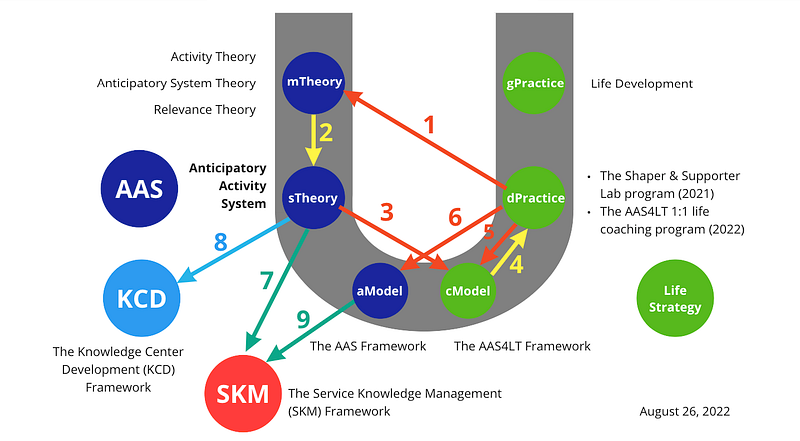
The above diagram represents the development of the Anticipatory Activity System (AAS) from August 21, 2021, to August 26, 2022.
There are 9 moves in 12 months!
I use the Theme U framework to manage the development of the Anticipatory Activity System (AAS) framework.
For the ASS project, I consider the following “Objects of Knowing” for connecting THEORY (AAS) and PRACTICE (Life Strategy).
- Meta-theory: Activity Theory, Anticipatory System Theory, Relevance Theory, etc.
- Specific Theory: Anticipatory Activity System
- Abstract Model: The AAS Framework
- Concrete Model: The AAS4LT Framework
- Domain Practice: The AAS4LT 1:1 life coaching program
- General Practice: Life Development
You can find more details in Life Discovery: The AAS Framework.
Let’s see the summary of 9 moves.
#1 Move from Domain Practice to Meta-theory #2 Move from Meta-theory to Specific Theory #3 Move from Specific Theory to Concrete Model #4 Move from Concrete Model to Domain Practice #5 Move from Domain Practice to Concrete Model #6 Move from Domain Practice to Abstract Model #7 Move from Specific Theory to a New Domain #8 Move from Specific Theory to a New Domain again #9 Move from Abstract Model to a New Domain
This is a wonderful journey.
This is not a linear journey.
The HERO U diagram can be used for Knowledge Curation and Knowledge Creation.
If I use the HERO U diagram for Knowledge Curation, the object is static academic knowledge. I, as the subject, can detach from the object. I can’t make any change to selected academic knowledge, what I can do is make a new container that can be a new context for understanding selected academic knowledge.
However, when I use the HERO U diagram for knowledge creation, the object is dynamic tacit knowledge. I, as the subject, can attach to the object. The possible knowledge is in the process of making. The Subject-Object is a whole and they are mediated by the HERO U diagram.
Since I am the only person running the process, I can decide on any move between these six levels. For example, I didn’t make an Abstract Model and use it to generate a Concrete Model. I directly moved from the level of Specific Theory to the level of Concrete Model. After closing the first round test at the level of Domain Practice, I moved from Concrete Model to Abstract Model.
From the perspective of Thematic Space Theory (TST), six types of knowing refer to Six Thematic Spaces. The 9 moves are moving between 6 thematic spaces.
Since I used the diagram and the model to manage the development of the AAS project, these moves also correspond to my real actions of running the AAS project (Social Moves)!
In this case, we see a match between Mental Moves and Social Moves.
2023: Graphic Space Affordances of White Space
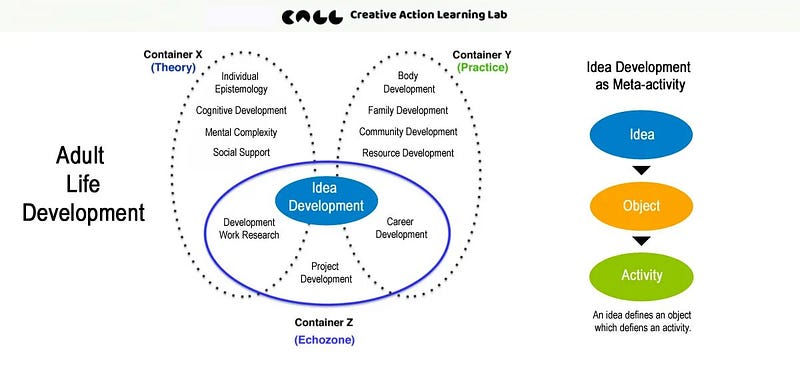
On Nov 10, 2023, I realized that the seed of AAS should be a post I wrote on Jan 20, 2021, because I discussed an idea called “Idea Development as Meta-activity”. See the original article titled Activity U (XII): 136 Ideas for Impact Projects and Micromovements.
I shared this insight on Twitter and added more tweets about the newest development of AAS in 2023. See the original thread on Twitter.
Then, I faced a challenge.
How do I update the U-shape diagram?
On Nov 12, 2023, I found a solution. See the diagram below.
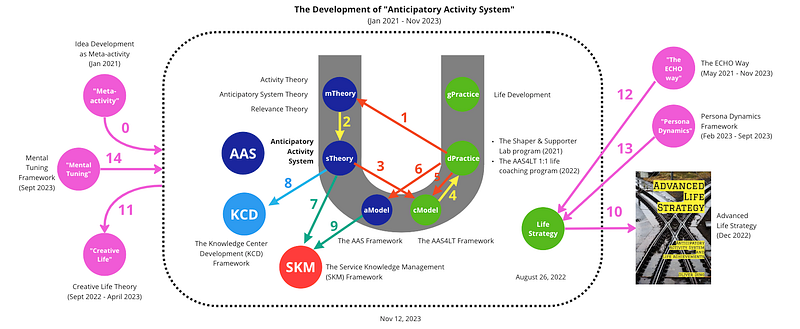
I used a rectangle to frame the original U-shape diagram, then added new circles outside the rectangle.
At the “Thematic Space” level, the rectangle frames a thematic space which is a container. Then, I can apply the “Attachance — Thematic Space” perspective to the creative action.
Why can I make the rectangle on the original diagram?
At the “Affordance” level, the explanation is about the Graphic Space Affordances of White Space of the Situational Diagram.
Initially coined by Gibson, the term Affordance has been adopted by scholars from various domains such as psychology, human factors, design, communication, sociology, neuroscience, artificial intelligence, etc. The renowned philosopher Daniel Dennett (2017) even suggested that “Affordances” should be more widely known by the general public.
For readers who are not familiar with the term Affordance and Gibson’s Affordance Theory, I’d like to share the following picture as a starting point. You can find more details here: Hammer, Hammering, and Affordance.
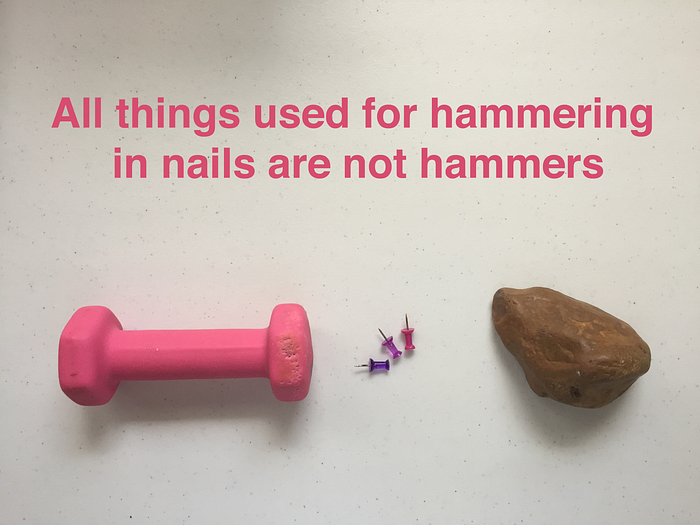
Traditionally, psychologists assumed that objects are composed of their qualities. Gibson rejected this view, “…But I now suggest that what we perceive when we look at objects are their affordances, not their qualities…The fact that a stone is a missile does not imply that it cannot be other things as well. It can be a paperweight, a bookend, a hammer, or a pendulum bob. It can be piled on another rock to make a cairn or a stone wall. These affordances are all consistent with one another. The differences between them are not clear-cut, and the arbitrary names by which they are called do not count for perception. If you know what can be done with a graspable detached object, what it can be used for, you can call it whatever you please.”(p.126)
How to adopt Affordance Theory to discuss Diagrams and Diagramming?
The answer is we need to consider both diagrams and their environments. Thus, the perspective of the “Ecological Situation” encourages us to pay attention to the real-world environments of diagram-in-use. The primary question is not what a diagram is about, but where the diagram is.
Where is the diagram?
The diagram is in mind! Our first perspective Cognitive Representation is about this answer. The present discussion doesn’t want to repeat it.
The diagram is in books, papers, walls, whiteboards, floors, napkins, slides, canvases, tweets, blog posts, digital boards, etc. The “Ecological Situation” perspective aims to study opportunities behind these situations.
I used the term Graphic Space Affordances to discuss Diagram-in-Use and Creative Diagramming. It considers the affordances of white space in a graphic. In graphic design, white space means the space that surrounds the elements. Graphic Space Affordance asks a simple question:
What can I do with the white space of a diagram?
In graphic design, white space means the space that surrounds the elements. By focusing on the affordances of white space of diagrams, we can find some constraints for design and some opportunities for innovation.
I perceived the white space of the U-shape diagram about nine moves and used a rectangle to frame two areas. The inside area is for the original U-shape diagram while the outside area is for presenting the new ideas.
On Oct 30, 2023, I used the same creative technique to connect the Project Engagement approach and the Ecological Practice approach.
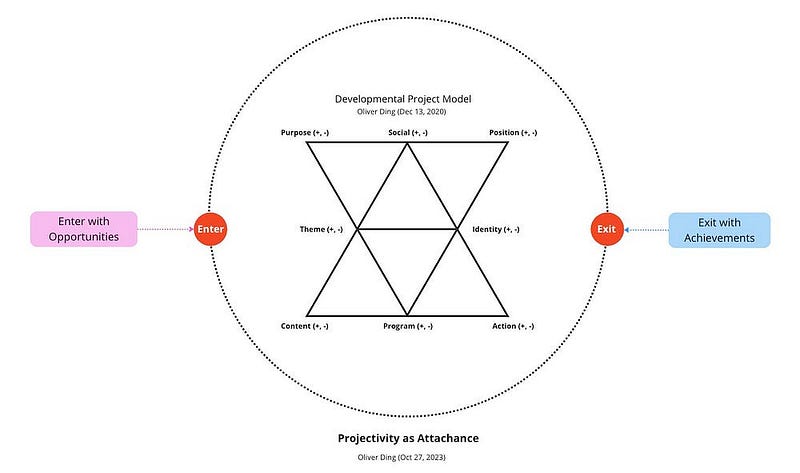
You can find more details in the links below:
- Activity U (XII): 136 Ideas for Impact Projects and Micromovements — Jan 20, 2021
- The Original Thread on Twitter — Nov 10, 2023
- The Original Post on Linkedin — Nov 12, 2023
- Projectivity as Cultural Attachance — Oct 30, 2023
- Hammer, Hammering, and Affordance — July 31, 2020
- [Creative Diagramming] Graphic Space Affordances, Thematic Space, and Possible Paths — Oct 31, 2023
- Frame for Work: The Ontology of Knowledge Frameworks and Ecological Actualism — Dec 13, 2023
2024: Discovery as Second-order Activity
In the past two weeks, I worked on the Meaning Discovery project and launched the Foolish Explorer series.
These projects are not part of the AAS project. However, they can be used to support the concept of “Second-order Activity”.
From Jan 18, 2024, to Jan 26, 2024, I wrote a series of posts and edited two possible books: Meaning Discovery and Situational Note-taking.
- Jan 18, 2024 — TALE: Thematic Triangles and Life Discovery +
- Jan 19, 2024 — The Meaning Discovery Model (v1, 2024)
- Jan 23, 2024 — Meaning Discovery (book, v1, 2024)
- Jan 24, 2024 — Situational Note-taking (book, v1, 2024)
- Jan 25, 2024 — A Tree of Thoughts (Oliver Ding, v2, Jan 25, 2024)
- Jan 26, 2024 — The Foolish Explorer: A Trilogy for “Discovery”
This marks a great milestone in my creative journey! Meaning Discovery follows Knowledge Discovery: Developing Tacit Knowledge with Thematic Space Canvas (May 2022) and Life Discovery: The Life-as-Project Approach (July 2022). Together, they form a trilogy.



The trilogy shares a set of ideas in mind, life, activity, and discovery.
- The “Discovery as Development” Principle
- The Art of Early Discovery
- Discovery as Second-order Activity
- The Curated Mind
According to the Merriam-webster dictionary, the word Discover has two meanings: 1) to make known or visible; 2) to obtain sight or knowledge of for the first time.
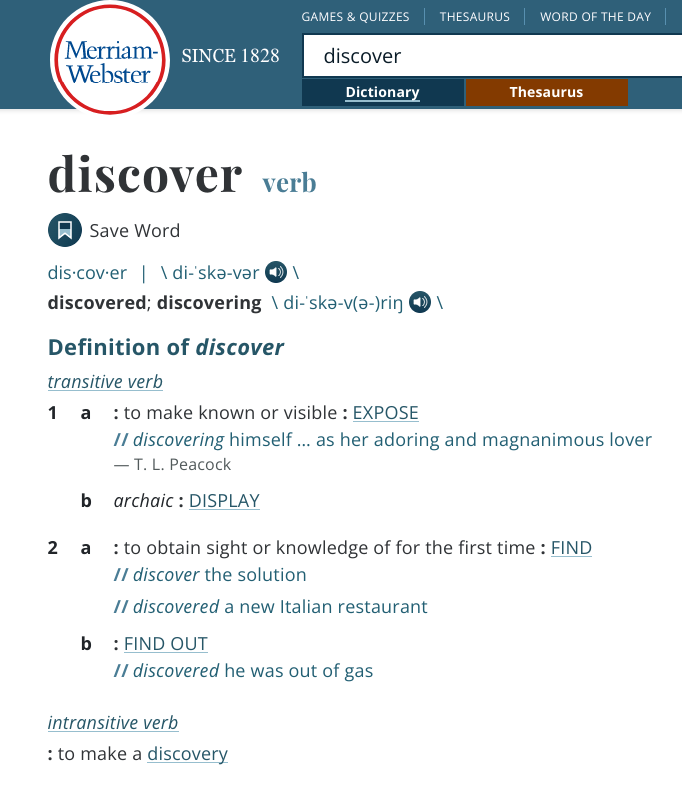
The trilogy sees “Knowledge Discovery”, “Life Discovery”, and “Meaning Discovery” as three types of Second-order Activity.
- Knowledge Discovery Activity
- Life Discovery Activity
- Meaning Discovery Activity
Second-order Activity is a core concept of the Anticipatory Activity System (AAS) framework which is inspired by Anticipatory Systems Theory, Activity Theory, and other theoretical resources.
How did I update the U-shape diagram?
I see “Discovery as Second-order Activity” as the 15th move! See the diagram below.
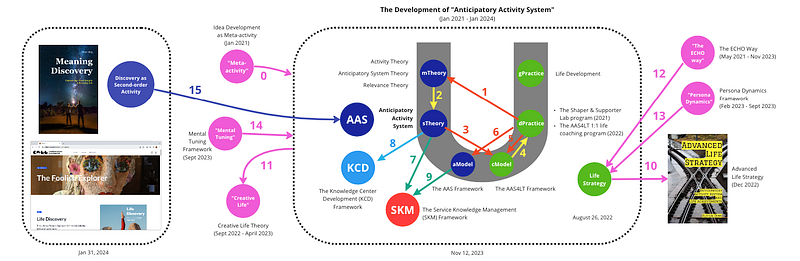
If we see the whole diagram, it is not only about the original six types of knowing and six thematic spaces. We could consider each circle as a thematic space.
Or, we can use “Thematic Areas” and “Thematic Spaces” to frame this case.
The original six types of knowing refer to Six Thematic Areas while other circles refer to Ten Thematic Spaces. Some thematic spaces are inside in some thematic areas.
You can find more details in the link below:
- Meaning Discovery (book, v1, 2024) — Jan 23, 2024
- The Foolish Explorer: A Trilogy about “Discovery” — Jan 29, 2024
- The Foolish Explorer Series
Affordances, Thematic Spaces, and Moving on Diagrams
On July 31, 2023, I edited a book (draft) titled Mental Moves: The Attachance Approach to Ecological Creative Cognition (Introduction, Table of Contents).
In the book, I discussed several examples of moving between thematic spaces. I used knowledge frameworks as concrete examples of thematic spaces.
What’s the significant insight behind the Mental Moves project?
It offers us a new view of diagrams and diagramming and knowledge frameworks in general.
In this view, a diagram and a knowledge framework are no longer a static knowledge representation, but a dynamic creative territory for exploring, reflecting, and curating.
From my research and real-life experiences, this view can guide us in the following actions:
- Explore Graphic Space Affordances
- Explore Potential Thematic Spaces of a diagram or a knowledge framework
- Explore Possible Connections of Diagram Networks
- Explore the Spatial Structure of a diagram or a knowledge framework
- Explore Possible Paths of moving between thematic spaces
I’d like to call these actions Creative Diagramming. You can find more details in the link below:
- [Creative Diagramming] Graphic Space Affordances, Thematic Space, and Possible Paths — Oct 31, 2023
- Mental Moves #7: Mental Focus and Moving between Thematic Spaces — Jun 17, 2023
- Social Moves: Thematic Zones, Thematic Areas, and Social Territory — Dec 15, 2023
I am going to edit a new possible book about Creative Diagramming and Early Discovery. This post is part of the project.