
Diagram Explained: The Ecological Formism Approach to Diagrams
A New Framework of Knowledge Diagrams
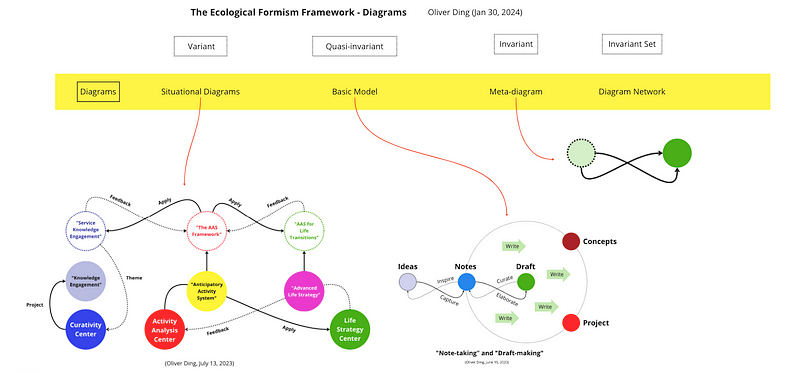
The above diagram applied the Ecological Formism framework to explain the hierarchy of knowledge diagrams with an example.
In 2018, I wrote a 108-page thesis titled Diagram Explained. I developed a framework for understanding multiple layers of diagrams and wrote a list of topics about diagramming. You can find the framework (see the picture below) on a board.
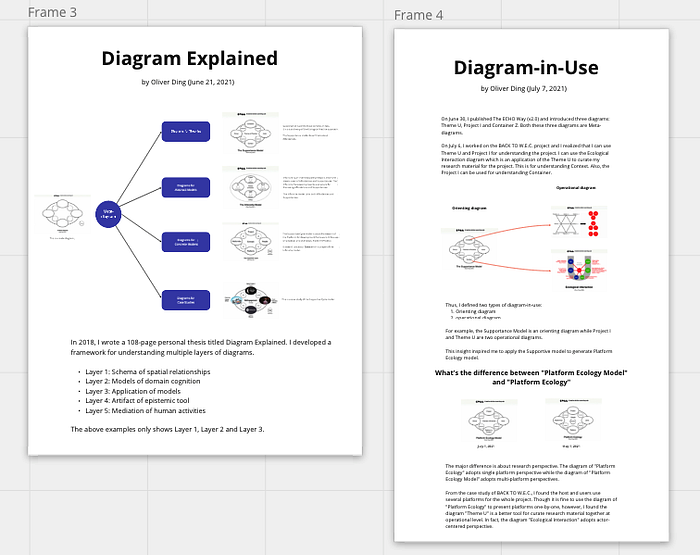
In the thesis titled Diagram Explained. I developed a framework for understanding multiple layers of diagrams.
- Layer 1: Schema of spatial relationships
- Layer 2: Models of domain cognition
- Layer 3: Application of models
- Layer 4: Artifact of epistemic tool
- Layer 5: Mediation of human activities
In June 2021, I conducted a case study about the development of a diagram of the Supportance Model. To help readers understand my creations. I used five types of diagrams for the case study.
- Layer 1: Meta-diagram
- Layer 2: Diagrams for Theories, Diagrams for Abstract Models, and Diagrams for Concrete Models.
- Layer 3: Diagrams for Case Studies
Layer 4 refers to the Artifact of the epistemic tool. For example, the Developmental Project Canvas is a Layer 4 artifact for the Developmental Project Model which refers to a Layer 2 diagram.
Layer 5 refers to diagram-in-use situations such as a workshop.
You can find more details in Diagram Explained: The Supportance Model and Its History (June 22, 2021).
Today I will use the Ecological Formism framework to develop a new framework for understanding the hierarchy of knowledge diagrams.
The Secret of Hierarchy
The concept of “Hierarchy” refers to a way of organizing multiple-level meaning of abstractness. Each level has its degree of abstraction.
In Sept 2020, I conducted a case study about the hierarchy of knowledge by reviewing several perspectives on the hierarchy of human activity and social practice. I summarized them in the following table. You can also view its original file on Google Spreadsheet.

Based on perspectives from activity theorists and other researchers, I found there are eight levels of the hierarchy of activity and practice. The six mid-levels are adopted from activity theorists. The top level is adopted from anthropologist Morris Opler (1945). The low level is adopted from ecological psychologist James J. Gibson (1979).
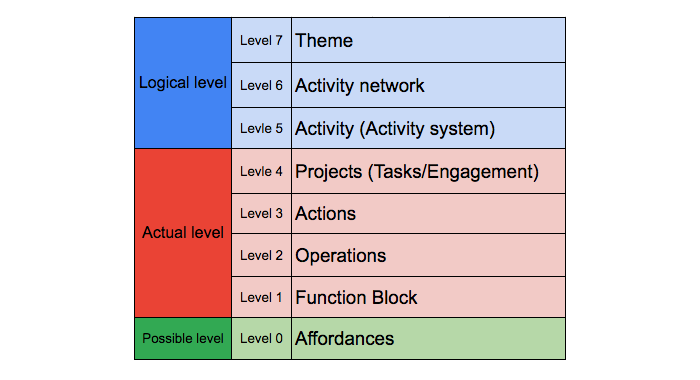
Is this the truth?
What I learned from this case study is that there is no right answer to a hierarchical structure of knowledge. A knowledge creator could discover many levels of a hierarchical structure and make a knowledge framework. On the other side, the users could only use some levels of the framework.
The hierarchy is a heuristic tool!
We also have to notice that there are some creative ways to represent the hierarchical structure. For example, Kant’s Fractal Tree.
In a 2001 book Chaos of Disciplines, Andrew Abbott started an insight that claims many social structures look the same on a large scale and on a small scale. He called this insight “Self-similar social structure.” and applied it to discuss academic social science in general and sociology in particular. He also found there is a classical example from Kant, “…Kant obviously does not think there is an infinite gradation from absolute pure reason through some proportionately mixed varieties of reason to absolute practice reason. He has done something else. He has created what I shall call a ‘fractal distinction.’ The name capture the fact that such a distinction repeats a pattern within itself, as geometric fractals do…There are, of course, dozens of general sources on fractals…I have tended to focus on fractals that are nested dichotomies. There is no necessary restriction to this case; it is simply the most familiar and hence makes for the easiest exposition.”(p.9)
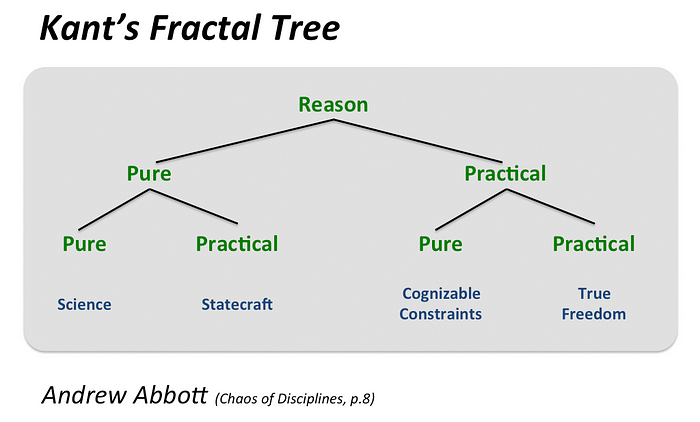
The above diagram is adopted from Andrew Abbott and it represents Kant’s fractal tree. After reviewing Kant’s writing, Abbott summarized that “Kan has first split pure and practical reason and then, under each of those headings, has split pure and practical reason once again.” (p.8)
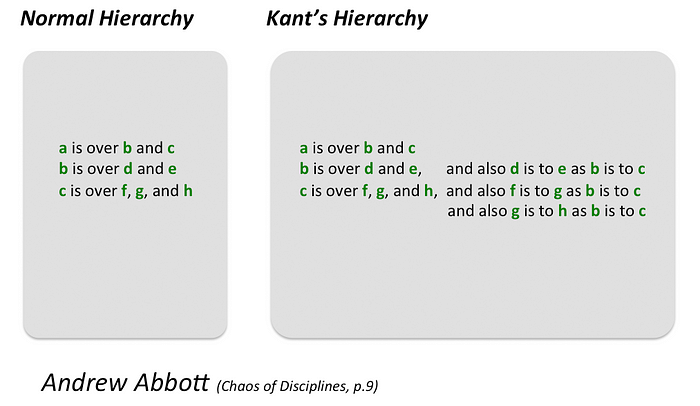
Abbott also pointed out Kant’s approach is not a normal hierarchy, “…Kant has made a relational judgement at one level and then repeated it at the next…the relation of the general terms is recapitulated in the specific ones…This is not a simple hierarchy.” (p.9) Further, Abbott claimed that the power of fractal distinction, “The concept of fractal distinctions not only proves useful in understanding the external location of the social sciences generally. It also provides an essential tool for understanding relations within them. Indeed, as I shall show, both the external and the internal structures are produced by the same mechanism.” (p.10)
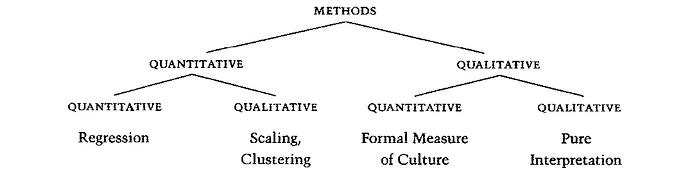
The above diagram shows an example of the fractal distinction of the methodological approaches. Abbott said, “For about sixty years, sociology has been divided into two broad methodological strands, usually called quantitative and qualitative. Put starkly, the quantitative position recognizes only those social phenomena measurable on univocal scales. The qualitative side attributes multivocality to all social phenomena and therefore denies strong measurability. This sounds like a simple opposition. But within each one of these strands can be distinguished ‘quantitative’ and ‘qualitative’ positions. On the quantitative side, for example, the admired ‘causal’ methods like regression contrast with the denigrated ‘descriptive’ methods like scaling and clustering. On the qualitative side, there are relatively formalized measurement procedures that are used by some sociologists of culture and by most practitioners of conversational analysis, while strongly interpretive strategies characterize much of the new sociology of science.” (p.10)
What a simple but powerful heuristic tool!
In Nov 2022, I used the Kant’s Fractal Tree to make the Kind of Actors framework. See the diagram below.
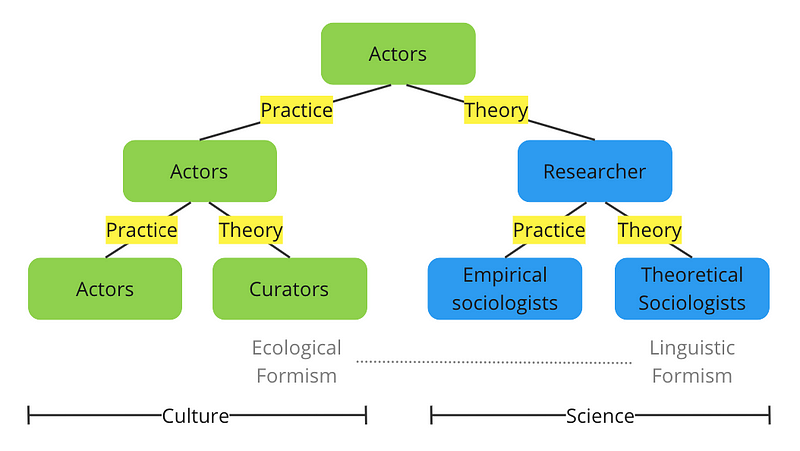
You can find more details in Creative Life Curation: Kinds of Actors.
Recently, I developed a new solution for mapping the hierarchical structure: the Ecological Formism framework. This article will apply it to understand the hierarchy of knowledge diagrams.
The Ecological Formism Framework
In Dec 2023, I worked on the Social Moves project and made the Ecological Formism framework.
The Ecological Formism framework is an epistemological framework that frames five units of analysis from four types of knowing.
The “Variant > Quasi-invariant > Invariant > Invariant Set” schema defines four types of knowing.
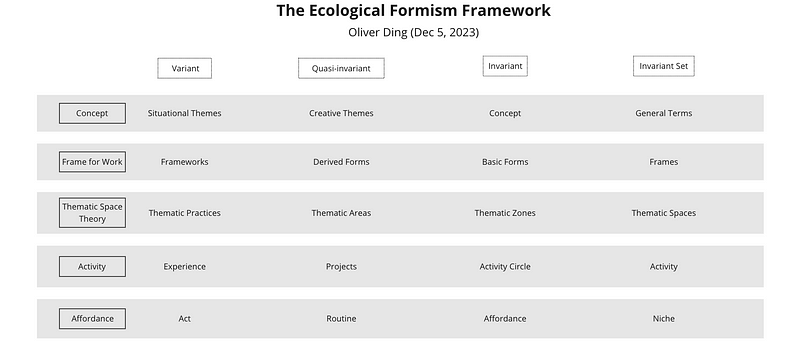
In the above diagram, we see five levels of analysis:
- Concept
- Frame for Work
- “Thematic Space Theory” (TST)
- Activity
- Affordance
The “Concept” level is about the transformation between themes and concepts.
The “Frame for Work” level is about the emergence of knowledge frameworks.
The TST level (the “Thematic Space” level) is a middle level that connects “Activity” and “Frame for Work”.
The “Activity” level is about different patterns of actions.
The “Affordance” level is related to the Operation level of Activity.
You can find more details in Social Moves: An Integrated Ecological Approach to Social Cognition.
Let’s use the “Frame for Work” level as an example. The Ecological Formism Framework uses “Variant > Quasi-invariant > Invariant > Invariant Set” as the foundation to define four types of entities for knowing:
- Invariant: Basic Forms
- Invariant Set: Frames
- Quasi-invariant: Derived Forms
- Variant: Frameworks
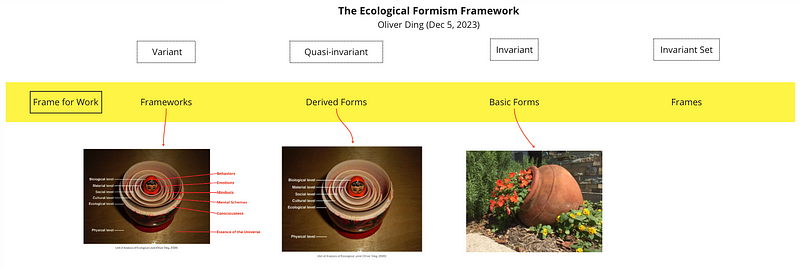
The above diagram uses “Container Thinking” as an example to showcase the differences between “Basic Forms”, “Derived Forms”, and “Frameworks”.
The “Frame for Work” level focuses on Knowledge Frameworks. The diagram below shows more details of using the Basic Form of “Container(Containee)” to generate many knowledge frameworks for different projects.
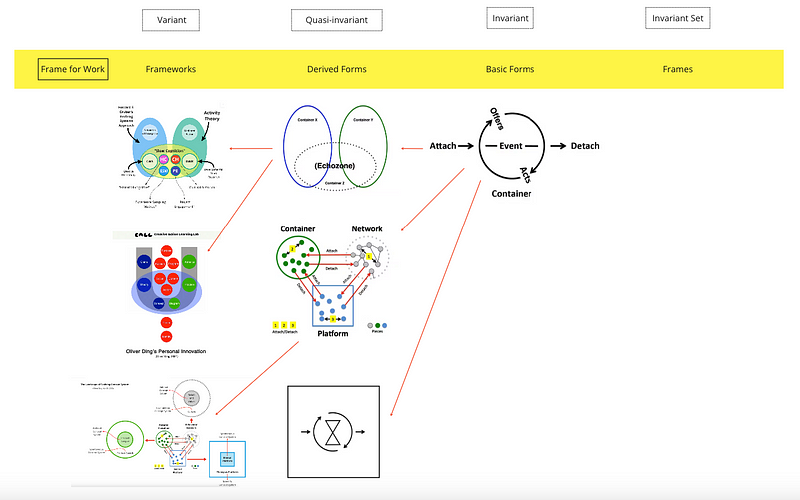
You can find more details in Frame for Work: The Hermeneutics of Knowledge Frameworks and Ecological Formism.
In many articles, I used knowledge diagrams, knowledge models, and knowledge frameworks interchangeably.
However, I’d like to point out the difference between knowledge diagrams and knowledge frameworks.
Knowledge Diagrams are External Representations of Knowledge Frameworks.
In this way, we could add “Diagrams” as a new level to the Ecological Formism Framework.
Four Levels of Knowledge Diagrams
The Ecological Formism framework uses “Variant > Quasi-invariant > Invariant > Invariant Set” to frame four levels of a thing. Let’s apply it to knowledge diagrams.
- Invariant: Meta-diagram
- Invariant Set: Diagram Network
- Quasi-invariant: Basic Model
- Variant: Situational Diagrams
The notion of “meta-diagram” considers a special type of diagram as an independent thing that doesn’t have to be a representation of an existing theory or model. For example, the 2x2 matrix diagram is a meta-diagram that doesn’t refer to any concrete theory or model such as BCG’s Growth-share matrix.
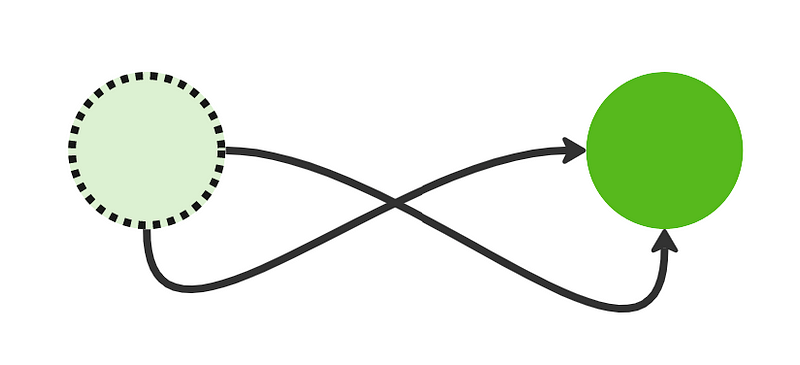
The above diagram is a meta-diagram I made in Jan 2023. It doesn’t have any text! It was called “Dance”. You can find a story about the above “Dance” meta-diagram in Creative Action: The Attachance of Moving Mental Elements.
In Feb 2023, I used the above meta-diagram to make the “Product as Thing” framework. See the diagram below. Each model is a sub-model of the framework. Each model has its special theoretical concepts.
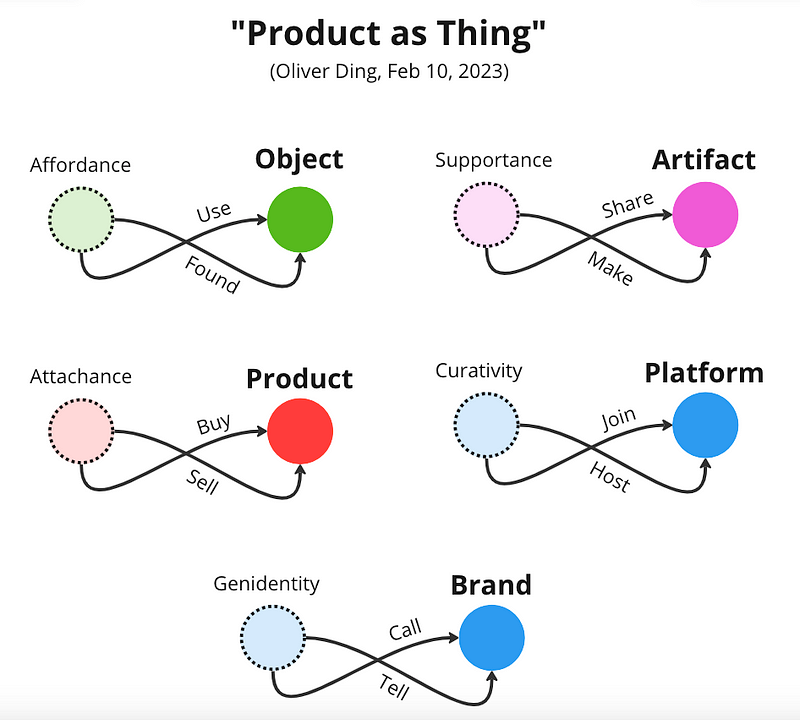
Each model is a Basic Model.
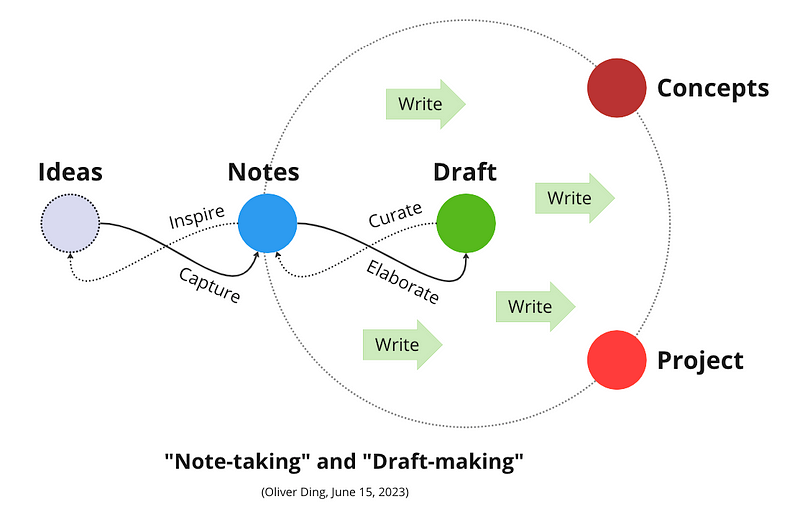
In June 2023, I used the meta-diagram to make a model about note-taking. This model can be seen as a Basic Model too. You can find more details in Situational Note-taking: Capture Significant Insights Outside the Room.
I also used the Basic Model to generate more applications. See the example below. You can find more details in Mental Moves #9: Mental Moves between Knowledge Centers.
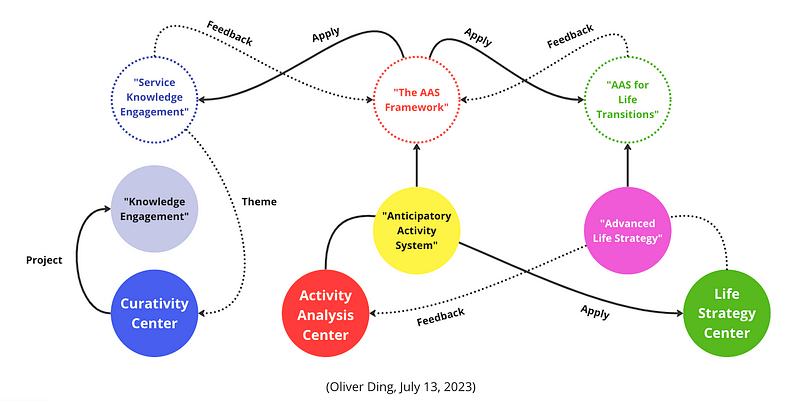
This type of application is called Situational Diagram.
Finally, a set of networked diagrams is called Diagram Network. For example, see the diagram below:
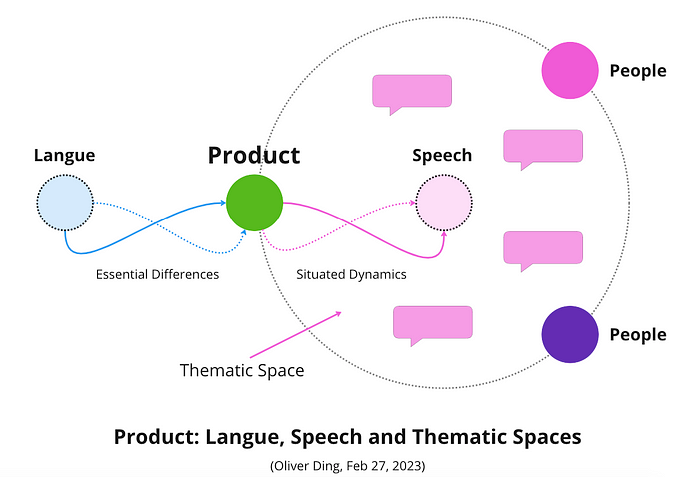
You can find more details in TALE: Product, Langue, and Speech.
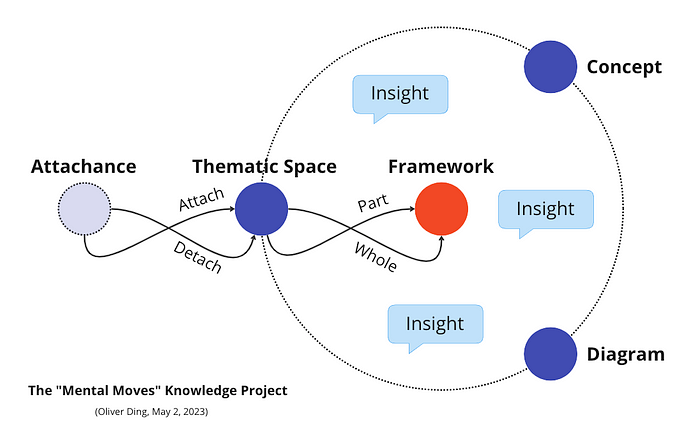
You can find more details in Mental Moves #3: Attachance, Thematic Space, and Framework.
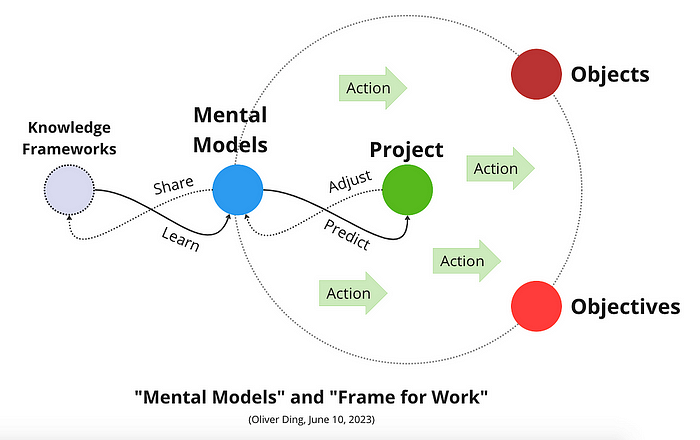
You find more details in Mental Moves #6: Mental Models and the Attachance of Multiple Moves.
The above set of diagrams shares a set of terms such as “Project”, “Mental Models”, “Knowledge Frameworks”, “Notes”, and the same basic model. We can see them as a Diagram Network.
From 2018 to 2024
In the above discussion, I present three solutions to understanding the hierarchy of knowledge framework.
In 2018, I developed a five-layer framework in Diagram Explained.
- Layer 1: Schema of spatial relationships
- Layer 2: Models of domain cognition
- Layer 3: Application of models
- Layer 4: Artifact of epistemic tool
- Layer 5: Mediation of human activities
In 2021, I the following five types of diagrams for a case study.
- Layer 1: Meta-diagram
- Layer 2: Diagrams for Theories, Diagrams for Abstract Models, and Diagrams for Concrete Models.
- Layer 3: Diagrams for Case Studies
- Layer 4 refers to the Artifact of the epistemic tool. For example, the Developmental Project Canvas is a Layer 4 artifact for the Developmental Project Model which refers to a Layer 2 diagram.
- Layer 5 refers to diagram-in-use situations such as a workshop.
We can put them into the 2024 version:
- Invariant: Meta-diagram (2018: Layer 1; 2021: Layer 1)
- Invariant Set: Diagram Network
- Quasi-invariant: Basic Model (2018: Layer 2; 2021: Layer 2)
- Variant: Situational Diagrams (2018: Layer 3–5; 2021: Layer 3–5)
On the other side, we can see the 2018 version and the 2021 version as the expanded versions of the 2024 version. If we need more details on Situational Diagrams, we can return to 2018 and 2021.
Related links
- The Hierarchy of Human Activity and Social Practice — Sept 29, 2020
- Life Discovery: The “Experience — Theme” Ladder and Meaning — Feb 25, 2022
- Mental Moves #8: The Hierarchy of Knowledge Centers — July 13, 2023
- A Universal Reference for Knowledge Engagement — Nov 9, 2022
- Diagram Explained: The Supportance Model and Its History — June 22, 2021
- Diagram Blending: Building Diagram Networks (Introduction) — Dec 22, 2021
- Diagram Blending: Building Diagram Networks (Table of Contents) — Dec 28, 2021
- The D as Diagramming Project — August 10, 2021
- The Diagramming as Practice Framework — Dec 16, 2021
- A Twitter thread about Meta-diagrams — Nov 12, 2023
- Frame for Work: The Ontology of Knowledge Frameworks and Ecological Actualism — Dec 13, 2023
- Frame for Work: The Hermeneutics of Knowledge Frameworks and Ecological Formism — Dec 18, 2023


