
Activity U (VI): The Hierarchy of Human Activity and Social Practice
Perspectives from A. N. Leontiev and others.
This article is part of a case study: Activity U. I apply the HERO U framework and Diagram U to discuss the development of a large knowledge enterprise: Activity Theory or (Cultural-historical activity theory, CHAT).
- Activity U (I): The Landscape of Activity Theory
- Activity U (II): Unit of Analysis, Niches of Analysis, Levels of Analysis
- Activity U (III): Bonnie Nardi’s Choices and Boundary Knowledge Work
- Activity U (IV): The Engeström’s Triangle and the Power of Diagram
- Activity U (V): Typology of Activities and Other Practical Tools
This time I will focus on a key notion of activity theory: A. N. Leontiev’s three-level hierarchical structure of activity.
If you follow this series, you may notice there is an emergent pattern in my writing: HERO — IDEA — OTHER— ECHO. Each time I focus on an activity theorist (HERO) and one related notion of activity theory (IDEA), I then expand the scope of discussion by adding related resources from other activity theorists and other disciplines (OTHER), I also share my own experience and reflection on some topics (ECHO).
Contents
0. The Landscape of Activity Theory
Part 1: Leontiev’s hierarchy of activity
1.1 General structure of activity 1.2 Three levels of scope 1.3 Four levels of the hierarchical structure of activity 1.4 Multiple levels of the hierarchical structure of activity
Part 2: Applications of Leontiev’s framework
2.1 Different aspects of users interface 2.2 The HAM model and artifact ecologies 2.3 Levels of collaborative activity 2.4 “Tuning” collaborative activity
Part 3: Other Perspectives
3.1 The hierarchy of social practice 3.2 The hierarchy of cultural theme 3.3 The hierarchy of life goals
Part 4: Discussions
4.1 A universal hierarchy of activity and practice 4.2 HCI as a cross-disciplinary 4.3 SSAT and Ergonomics 4.4 CHAT and social context 4.5 Possible Practice and Creative Actions 4.6 Hierarchy and Fractal Heuristics 4.7 Beyond the hierarchy
0. The landscape of Activity Theory
Activity Theory or the “Cultural-historical activity theory (CHAT)” is an interdisciplinary philosophical framework for studying both individual and social aspects of human behavior. From the perspective of Activity Theory, human activity or ‘what people do’ represents the basic unit of analysis when studying human behavior. The most important aspect of Activity Theory is understanding both individual and collective aspects of human practices from a cultural and historical perspective.
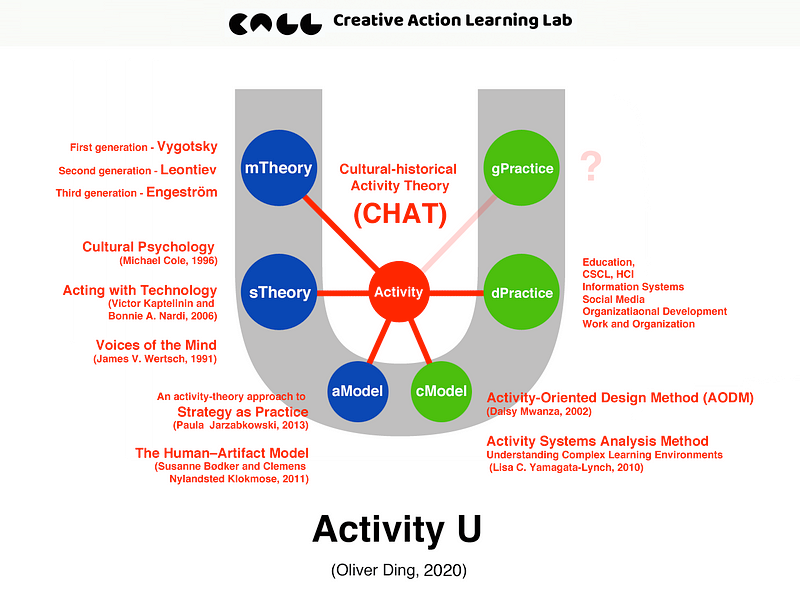
Activity Theory is a perfect case for making use of HERO U’s framework and Diagram U because we can find various usages of activity theory. I selected some examples and placed them on Diagram U and made the above diagram which is the foundation of my case study. Part I has provided more details behind the diagram. If you are not familiar with Activity Theory, you can find relevant information in Part I. If you want to know the HERO U framework and Diagram U, you can read this article: HERO U — A New Framework for Knowledge Heroes.
PART 1: Leontiev’s hierarchy of activity
This part introduces A. N. Leontiev’s three-level hierarchy of activity.
1.1 General structure of activity
In 2012, Kaptelinin and Nardi summarized five basic principles of Leontiev’s activity theory:
- Object-orientedness
- Hierarchical structure of activity
- Mediation
- Internalization and externalization
- Development
The hierarchical structure of activity was originally conceptualized by A. N. Leontiev (1978). We have to notice that its goal of Leontiev was developing a psychological theory at the individual level with the concept of Activity. Thus, we will see three levels of activity correspond to three levels of psychological notions.
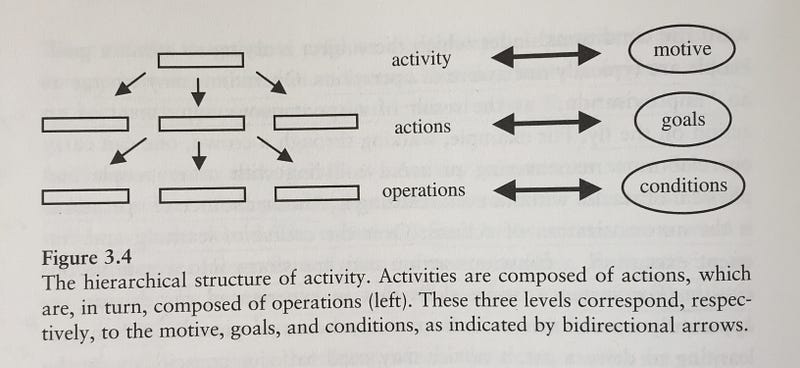
Let’s see a diagram first. I found the following diagram from Victor Kaptelinin and Bonnie A. Nardi’s book Acting with Technology (2006, p.64). The three levels of activity are activity, actions, and operations. The three levels of psychological notions are motive, goals, and conditions.
According to Leontiev, “Separate concrete types of activity may differ among themselves according to various characteristics: according to their form, according to the methods of carrying them out, according to their emotional intensity, according to their time and space requirements, according to their physiological mechanisms, etc. The main thing that distinguishes one activity from another, however, is the difference in their objects. It is exactly the object of an activity that gives it a determined direction.” (1978, p.98)
So, what’s the object of activity?
The answer from Leontiev is the motive of activity. Leontiev claimed, “According to the terminology I have proposed, the object of an activity is its true motive. It is understood that the motive may be either material or ideal, either present in perception or exclusively in the imagination or in thought. The main thing is that behind activity there should always be a need, that it should always answer one need or another.” He also added a note about the term motive, “Such restricted understanding of motive as that object (material or ideal) that evokes and directs activity toward itself differs from the generally accepted understanding”.(1978, p.98)
After defining the “activity — motive” level, Leontiev moved to its sub-level: the “action — purpose” level. He said, “We call a process an action if it is subordinated to the representation of the result that must be attained, that is, if it is subordinated to a conscious purpose. Similarly, just as the concept of motive is related to the concept of activity, the concept of purpose is related to the concept of action.” (1978, p.99)
Leontiev also used “goal-directed processes” and “actions” interchangeably. For example, he said, “We call a process an action if it is subordinated to the representation of the result that must be attained, that is, if it is subordinated to a conscious purpose. Similarly, just as the concept of motive is related to the concept of activity, the concept of purpose is related to the concept of action.”(1978, p.99)
Gregory Z. Bedny and Steven R. Harris argued that there are translation issues of activity theory-related terms. For example, they pointed out, “No exact equivalent of the English word ‘purpose’ exists in the Russian language, and the concepts of purpose and goal carry clearly differentiated meanings within activity-theoretical psychology... The word tcel’ can be translated as goal and namerenie as intention or purpose. Soviet activity theorists expended great effort clarifying the differences and similarities between these ideas, and in particular distinguishing tcelesoobraznost’, — purposefulness, purposeful behavior — from tcelenapravlennost’, ‘the intention to reach the conscious goal…As a consequence of these various considerations, we consider the concept of ‘purpose’ as open to misinterpretation, and thus cannot endorse its use as a basic concept within AT-HCI.” (2008)
I think this is a reason why the diagram shows “action — goal” for the middle level, not “action — purpose”.
The third level refers to “operation — condition”. According to Leontiev, “Every purpose, even one like the ‘reaching of point N,’ is objective-ly accomplished in a certain objective situation. Of course, for the consciousness of the subject, the goal may appear in the abstraction of this situation, but his action cannot be abstracted from it. For this reason, in spite of its intentional aspect (what must be achieved), the action also has its operational aspect (how, by what means this can be achieved), which is determined not by the goal in itself but by the objective-object conditions of its achievement. In other words, the action being carried out is adequate to the task; the task then is a goal assigned in specific circumstances. For this reason the action has a specific quality that ‘formulates’ it specifically, and particularly methods by which it is accomplished. I call the methods for accomplishing actions, operations.”(1978, p.102)
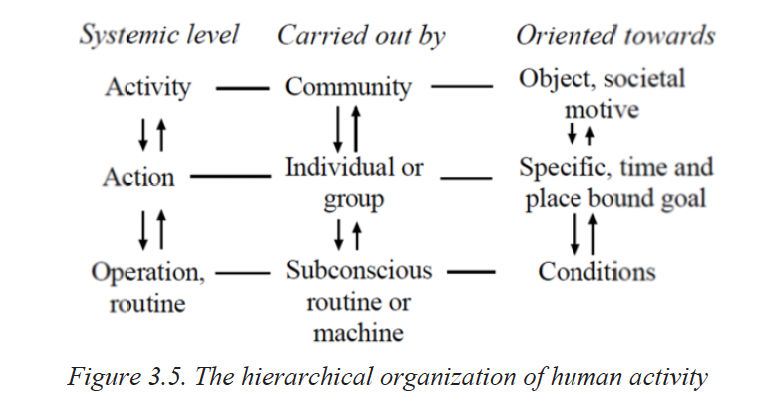
Leontiev didn’t give a diagram for this three-level structure of activity. The above diagram was designed by others. The problem with the diagram is the one-direction arrow which indicates the one-way relationship between the three levels. However, activity theorists don’t understand it in this way. Leontiev (1978), Kaptelinin and Nardi (2006), and others clearly pointed out it is a two-way relationship.
There is a more accurate diagram below I found in a 2013 book The Change Laboratory: A tool for Collaborative Development of Work and Education (Virkkunen, J. & Newnham, D. S., 2013)
According to Leontiev, “Human activity does not exist except in the form of action or a chain of actions. For example, work activity exists in work actions, school activity in school actions, social activity in actions (acts) of society, etc. If the actions that constitute activity are mentally subtracted from it, then absolutely nothing will be left of activity. This can be expressed in another way: When a concrete process is taking place before us, external or internal, then from the point of view of its relation to motive, it appears as human activity, but when it is subordinated to purpose, then it appears as an action or accumulation of a chain of actions…In addition, activity and action represent genuine and non-coinciding reality. One and the same action may accomplish various activities and may transfer from one activity to another, showing its relative independence in this way. The opposite is also obvious, specifically, that one or another motive may be given concrete expression in various purposes and correspondingly may elicit various actions.” (1978, p.100)
Kaptelinin and Nardi (2006) pointed out the transformation between actions and operations, “Levels of activity can transform into one another. Automatization is an example of transformations between actions and operations. Over the course of practice actions can become automatic operations. The opposite process is ‘deautomatization,’ the transformation of routine operations into conscious actions. Such a transformation can take place, for instance, when an automatized operation fails to produce the desired outcome and the individual reflects on the reasons for the failure and in how the operation can be ‘fixed.’ Typically a new, more appropriate procedure is devised which first is carried out as a conscious action and then becomes an operation.” (2006, pp.63–64)
Though Leontiev’s goal is to develop a new psychological theory, many researchers adopted this three-layer model as an analytical tool for empirical research projects.
1.2 Three levels of scope
In recent years, activity theorists went beyond Leontiev’s theoretical scope and expanded activity theory to “activity system” and “activity network”. Following this trend, researchers developed new versions of the hierarchical structure of activity for theoretical purpose and empirical purposes. One version is Clay Spinuzzi’s “Three Levels of Scope”.
In 2003, Spinuzzi published a book titled Tracing Genres Through Organizations. In chapter 2 of the book, he introduced “three levels of scope” with the following chart. Based on three levels of activity and HCI researchers’ methods, Spinuzzi suggested “Macroscopic”, “Mesoscopic”, and “Microscopic” for describing three levels of analysis for empirical research. He said, “These relationships are not typically examined — and are inherently difficult to examine — through single-scope approaches, which by definition privilege one level of scope over another and which take level of scope as foundational to the other levels. They lend little attention to how that level is constituted and made meaningful through what occurs at the other levels.” (p.29)
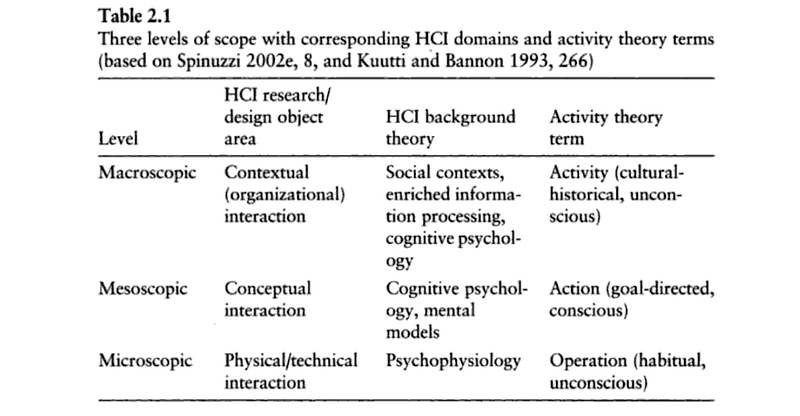
Spinuzzi also argued, “These perspectives are typically discussed as organizational (or contextual), conceptual, and technical layers (p.265). Furthermore, these layers are not typically integrated in human-computer research: each is studied separately, with its own theoretical assumptions, methodologies, and methods.” (p.29) Since Activity Theory provides a consistent conceptual framework for all three levels, Leontiev’s three-layers model is a great framework for guiding research and curating empirical data.
In 2013, Clay Spinuzzi published Topsight: A Guide to Studying, Diagnosing, and Fixing Information Flow in Organizations and introduced his research methodology and related tools. He still uses three levels of scope for Topsight, however, we have to notice that the “macro level of activity” refers to two models: Activity systems and Activity networks. The concept of “activity network” is not a part of Leontiev’s original theoretical framework, it was introduced by Yrjö Engeström’s in 1987.
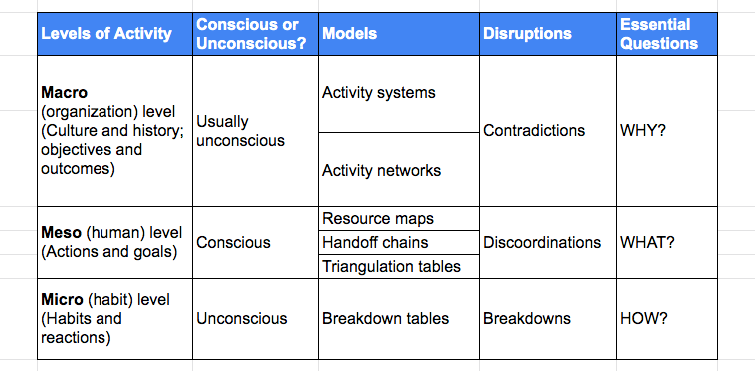
If we consider the activity network as a new layer, the hierarchical structure of activity should expand from three levels to four levels:
- Activity Network
- Activity System
- Actions
- Operation
In fact, some activity theorists have argued there is a need to expand Leontiev’s three-level hierarchical structure to a four-level hierarchical structure. However, there are many versions of this kind of argument.
1.3 Four levels of the hierarchical structure of activity
In 2006, Victor Gonzalez published his doctoral studies and dissertation titled The Nature of Managing Multiple Activities in the Workplace. The study was conducted at two different companies where he observed the practices of 36 information workers. Gonzalez proposed a notion of working sphere for representing the practical units in which individuals conceptualize their work. He defined it as “…a unit of work that, from the perspective of the individual, thematically connects a number of actions and their goals towards the achievement of a specific purpose, has a unique time frame, demands the use of particular resources and tools, and involves a particular collaborative structure.” He also identified five typical patterns of the working sphere (event, project, recurrent, request, and problems).
Traditionally, activity theorists adopted the hierarchical structure of activity with three layers (activity, action, and operation) from Leontiev’s theoretical construction. Based on his empirical study, Gonzalez found the notion of working sphere, as a personal conceptualization of work, faces problems when it is compared with Leontiev’s model. Thus, he suggested that there is a need for an intermediate unit of work between activities and actions (see the left part of the diagram below).
In a special issue of Interacting with Computers (2008), some authors commented on Gonzalez’s idea. The editors of the issue said, “Activity Theory, with its roots in Soviet Communist society, is introduced and the relevant, critical concept of a three level hierarchy of human activity is summarised, along with a key proposal that for Western HCI and CSCW applications the utility of this hierarchy would be improved by the introduction of a new, intermediate level, called either ‘working spheres’ or ‘engagements’…while the problems of migrating and adapting Activity Theory to Western HCI and CSCW applications are here made visible, very similar issues arise when attempts are made using linguistically and culturally closer theories, methods and practices.”
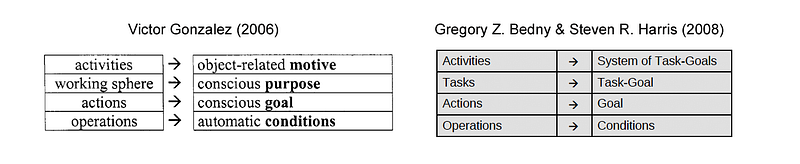
One of seven commentary papers “Engagement” and the Concept of Task in Activity Theory appreciates Gonzalez’s intention but the authors suggested using “Tasks” as the new intermediate level (see the right side of the above diagram). Bedney & Harris, the authors of the paper, said, “We very much appreciate the present authors’ intention in this regard, and — given the formidable complexity of the topics under discussion — admire the direct and simple manner in which they present their argument. They begin by clearly identifying an important and persistent problem in the field, namely that: “The need for an intermediate concept has been particularly clear in studies exploring the instantiation of activities within disciplines such as HCI and CSCW” (p.2). This is very much in accordance with the position taken in some of our recent work (Bedny, Chebykin, & Karwowski, 2005; Harris, 2005) and thus we find ourselves in broad agreement with the authors’ characterization of the difficulties involved in attempting to understand the complex and dynamic structure of activity using only the notions of activity and action, an argument which they support here with some useful examples from their empirical investigations.” (2008)
Bedney & Harris pointed out that the “intermediate concept” is already part of the theoretical tradition of activity theory, “As we have seen, the interpretation and adaptation of AT terminology present considerable challenges to Western scientists. However, we must point out that even a cursory review of the Russian-language literature not only demonstrates that the ‘intermediate concept’ the authors seek already exists, but shows that it has in fact long been an object of intense study within AT. This concept is the task. Both of the great founders and theoreticians of activity theory, A. N. Leont’ev, and S. L. Rubinshtein, used the notion of task to deal with the obvious presence of hierarchies of goal-orientation within activity. Over the decades a great many Soviet texts have presented the task, task-goal, and hierarchies and sequences of goals as fundamental concepts within activity theory.”(2008)
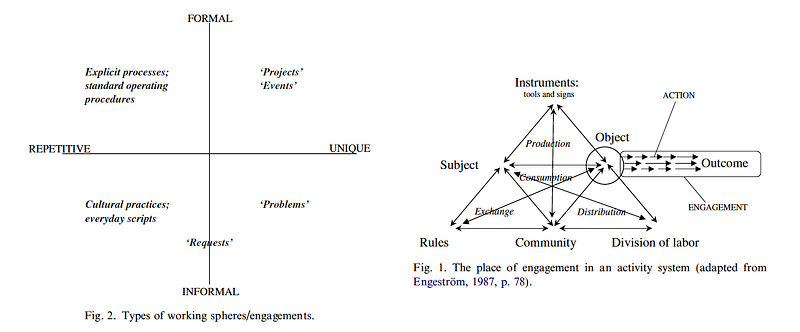
Yrjö Engeström also wrote a commentary paper titled Enriching activity theory without shortcuts and rejected the proposal of “engagement (working sphere)” as the new “intermediate concept”. He said, “Attempts to identify an intermediate unit between collective activity and individual action within activity theory are useful and necessary. While several possible conceptualizations have been put forward, engagement is a relevant candidate for naming such a unit. However, the elaboration of such a unit opens up difficult theoretical questions which should not be overlooked.” (2008)
A most important aspect of Gonzalez’s notion “working spheres/engagements” is its subjectivist position which is not appropriate to the philosophical stance of activity theory. Gonzalez gave his idea a definition: ‘‘A working sphere is a unit of work that, from the perspective of the individual, thematically connects a number of actions and their goals towards the achievement of a purpose, has a unique time frame, and involves a particular collaborative structure.’’ Engeström argued, “Activities are oriented to and driven by objects and motives. Actions are oriented to and driven by goals… They are historically built into the object, division of labor and rules of the work activity — they are not arbitrary. This is very different from the subjectivist position of Gonzalez…” (2008)
1. 4 Multiple levels of the hierarchical structure of activity
In fact, Bedney & Harris suggested an extremely complex framework of the hierarchical structure of activity in a branch of activity theory: Systemic — Structural Activity Theory (SSAT).
Gregory Z. Bedny (October 8, 1938 — July 22, 2018), a Ukrainian-American psychologist, was the founder of the SSAT framework. In a 2007 book, Bedny claimed, “ We have derived the main principles of SSAT from general activity theory, which was developed over the course of approximately 70 years in the former Soviet Union. While in this book we focus our attention on SSAT, we also explore the relationships between general activity theory and SSAT. We consider SSAT a grand theory, or framework, from which one can derive unified and standardized methods for the study of human performance. General AT is a powerful descriptive tool rather than a strong predictive theory. In contrast, SSAT, which has carefully developed units of analysis and principles of development of predictive models of human performance, can be regarded as a strong predictive theory for the study of human work systems.” (2007, p.ix)
Bedny and other SSAT theorists argued that Leontev’s activity theory is too general and inappropriate to design research. In order to clarify this issue, they presented a general scheme of the structural components of activity: Activity — Task — Action — Operation — Function Block.
They also distinguished “Objects of study” and “Units of analysis”, they said, “The first two components of this schema (activity, task) are considered primarily as the objects studied by activity theory, the remainder as the units of analysis employed for the study of these objects. Because activity is understood as a holistic, structured, systemic entity, when an activity becomes the object of study it must be approached from a variety of perspectives, using a variety of interrelated units of analysis. In this way, the primary object of study, some specific activity, can become the subject of a number of methodologically different, but closely interrelated descriptions.” (2005)
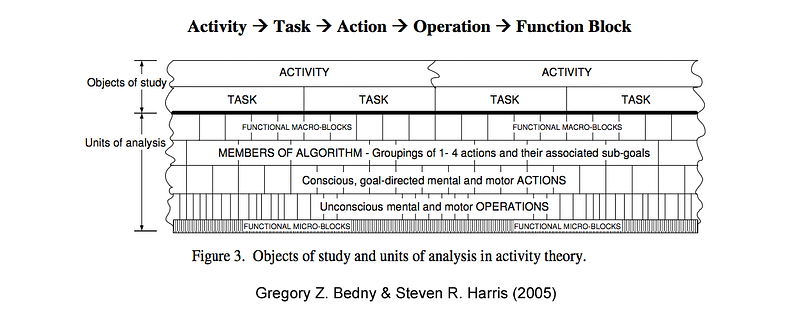
The above diagram represents the details of “objects of study” and “units of analysis” of SSAT. They claimed, “Units of analysis are unified components into which we divide the whole, for the purposes of studying those components and their integration into the dynamic whole. The main object of study is human work activity, which is principally analyzed as activity during the performance of some specific task. The principal unit of analysis for the morphological analysis of activity is the action, which may be further decomposed into operations. When undertaking functional descriptions of activity, function blocks may be used for either macro- or micro-analysis, according to the focus of the study. It should be noted that in activity theory, meanings and signs are treated as the psychological tools of mental actions, but not as units of analysis. Meanings are themselves products of action that, in turn, become tools for action.” (2005)
The SSAT framework is very complicated for ordinary readers because it is primarily developed for human factors and ergonomics which is a special domain of micro-level work processes.
PART 2: Applications of Leontiev’s framework
This part selects some applications of Leontiev’s framework.
2.1 Different aspects of user interface
One of the application domains of activity theory is HCI (Human-computer interaction) which refers to a field of research with a focus on the design and use of computer technology. Around the late 1980s — early 1990s, the focus of HCI research shifted from the “cognitivist perspective (human factors)” to the “post-cognitivist perspective (human actors)”. Researchers started to pay attention to the context of human-computer interaction such as social practices, work settings, communities, and everyday life environments.
Susanne Bødker is the pioneer of the Activity theoretical approach of HCI. She introduced Leontiev’s activity theory to the HCI domain with her dissertation Through the Interface — a Human Activity Approach to User Interface Design in 1987. This section focuses on her works related to the hierarchical structure of activity. If you want to know her other insights such as “design as an activity which is a process of negotiation between different groups, with conflicting interests, and with different resources and power to pursue their goals” and participatory design (PD), you can read the original dissertation.
In the 1987 dissertation, she pointed out the collective and individual character of human activity from the perspective of activity theory, “Human activity is part of the social activity of various groups and it has a purpose that contributes to the goal of the collective activity. The person is part of the practice of the group. Human activity is also a personal activity. To conduct a certain activity, the person has a repertoire of operations that are applied in conscious actions. During the conduction of the activity, certain shifts of levels of action occur due to conceptualization and operationalization. ”
Bødker also connected the above three types of aspects with the hierarchical structure of activity. First, she presented the following typology of aspects of the user interface, “I have chosen to characterize different aspects of the user interface based on the distinction between the different objects/subjects towards which the human being directs her operations, and on the specific role and characteristics of these subjects/objects in use.” (1987, p.42)
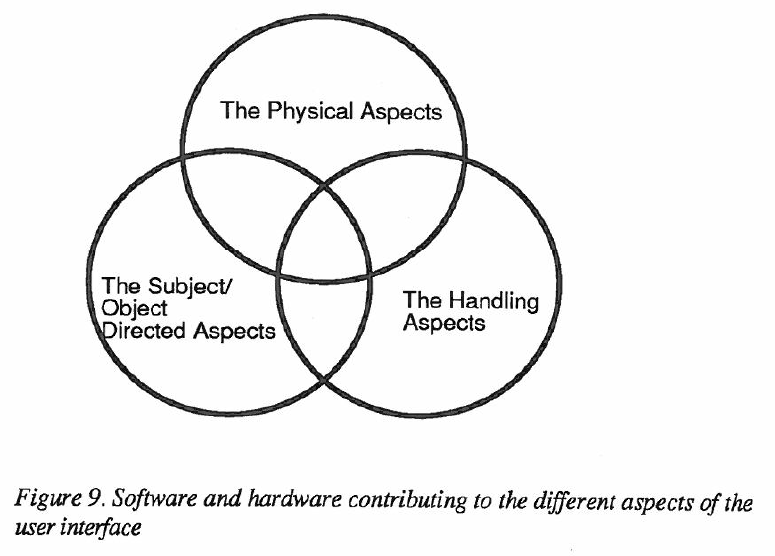
- The physical aspects, the support for our operations towards the computer application as a physical object. We will meet this object in the total breakdown or before we get to know the application. The physical aspects are the conditions for the physical handling of the artifact. The human adopts the forms and shapes of the artifact, and a mal-adaption might prevent the forming of certain operations.
- The handing aspects, the support for operations towards the computer application. A breakdown in these operations will make the artifact appear to us as an object. The handing aspects are the conditions for the transparency of the artifact. As the artifact is a thing, the operations which are supported are inherently instrumental, no matter whether the actions are communicative or instrumental. This type of operation can, for instance in breakdown situations, be conceptualized, whereby the user can be forced to conduct actions towards the artifact as an object.
- The subject/object directed aspects which constitute the conditions for operations directed towards objects or subjects that we deal with “in” the artifact or through the artifact. Different parts of the subject/object directed aspects relate to different subjects or objects, but it is also part of these aspects to support the shift between subjects/objects.
Second, she claimed, “Each action performed by a human being has not only intentional aspects but also operational aspects. Likewise, the artifacts employed in the actions support these aspects. When the person uses some computer based artifact in this activity, the most fundamental level of operation is an adaptation to the physical aspects of the user interface. In addition to this, the handling aspects serve to operate the artifact. And the subject/object directed aspects support the development and use of a repertoire of operations toward subjects or objects through the application.” (1987, p.50)
Third, she also pointed out the “Operationalized, Conceptualized, and Breakdown situations” of these aspects from the perspective of activity theory.
- Operationalized: Actions can be operationalized, i.e. turned into operations…The operations applied in a specific action are not conscious to the human being.
- Conceptualization: Operations can be conceptualized. Conceptualization means to articulate for one self what is otherwise self-evident….The make-up person can reflect upon what was formerly operations, and to try to perform former operations as actions, e.g. if the editor tells him that he is not pleased with the product of the work of the typographer.
- Breakdown: Conceptualization can take place in breakdown situations, situations in which some unarticulated conflict occurs between the assumed conditions for the operations on the one side, and the actual conditions on the other; between the human reflection of the material conditions, and the actual conditions.
This typology of aspects of user interface was further developed as a model for understanding artifact ecologies in 2011.
2.2 The HAM model and artifact ecologies
In 2013, Susanne Bødker and Clemens Nylandsted Klokmose published a paper titled The Human-Artifact Model– an Activity Theoretical Approach to Artifact Ecologies and presented a framework for addressing the analysis of individual interactive artifacts while embracing that they are part of a larger ecology of artifacts.
The Human-Artifact Model provides four interconnected levels of analysis and addresses the possibilities and problems at these four levels. The authors developed the framework through two steps of theoretical thinking.
First, the authors started by grouping Bødker’s original framework with Bærentsen & Trettvik’s (2002) Affordance levels. The result is the chart below:
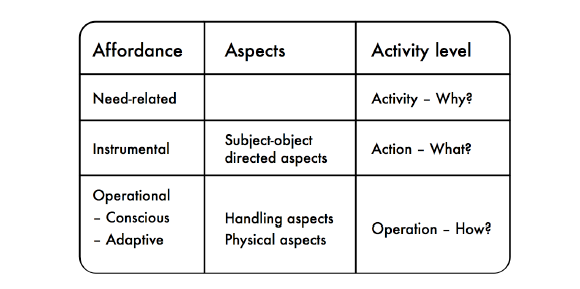
There is terminological work behind this chart. The authors said, “Instead of pursuing the complex discussions of Gibson’s affordances, we match Bødker’s (1991) aspects with the three types of affordances. This makes it possible to better understand how current mediators are integrated in the functional organs of the human users. We may address which possible and desirable types of uses that are afforded, and those, which are not. This mapping requires a re-interpretation of Bødker’s aspects. Bødker’s physical aspects encompass Bærentsen & Trettvik’s adaptive operational affordances, and we use this term since ‘physical’ can be slightly misleading. In Bødker’s three aspects, the need-related or activity-related level is missing, and since Bærentsen & Trettvik convincingly argue for its importance, we include this level. This aspect deserves a terminological comment: We have previously used the term motive as a synonym for need as the term is used here. In order to not confuse matters further, we continue talking about motive and the motive-related level. We use the term instrumental, as introduced by Bærentsen & Trettvik, instead of Bødker’s subject/object directed aspects. However, we use Bødker’s handling rather than conscious operational.” (2013)
Second, the authors moved to the orienting basis of the user and the qualities of action possibilities. The term orienting basis was conited by Gal’perin (1969) in order to understand the human capacities and experiences. The authors claimed, “Like the aspects of artifacts, the orientation can be broken down into levels of activity. At the top-level, activity is driven by a motivational orientation. The motivational orientation is partly subconscious, meaning that human beings are not in-situ aware of their motivation. Goal orientation encompasses the user’s repertoire of actions…The handling orientation refers to the users’ culturally developed operational means for realizing actions that have become partly sub-conscious. Such means include the way of holding the bow for classical bass, according to the German school and the French school. The adaptive operational orientation is the low-level response to physical conditions; e.g. tweaking one’s left-hand intonation for a set of new strings. This leveled analysis helps us provide a symmetrical model where the human side mirrors the artifact and vice versa.”
The final framework is the following chart. One column refers to the aspects of the artifact and another column refers to the orienting basis of the user. Both sides are expressed vertically with levels of activity.
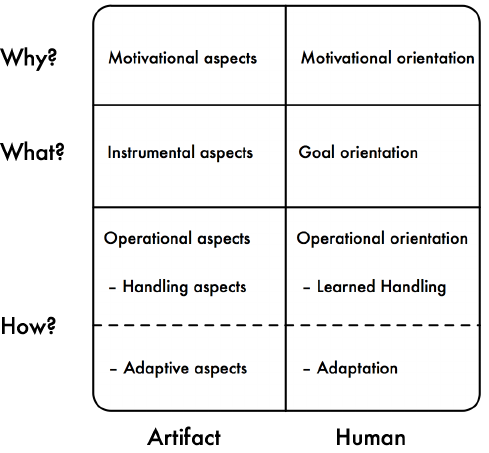
The above Human-Artifact Model can be applied to analyze the use of an artifact in a context with other artifacts and many users and many users. The following diagram shows one way of using this model: starting from the human side.
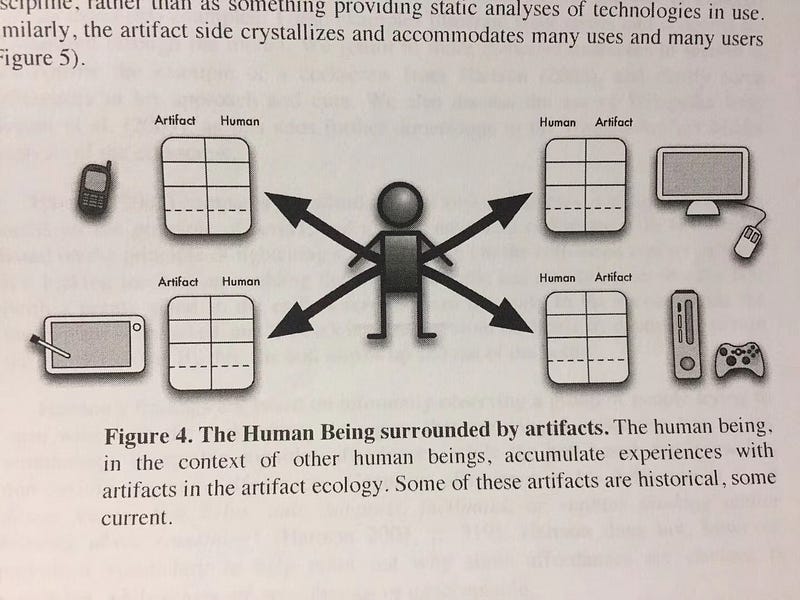
Another way of using this model is starting from the artifact side, see the diagram below.
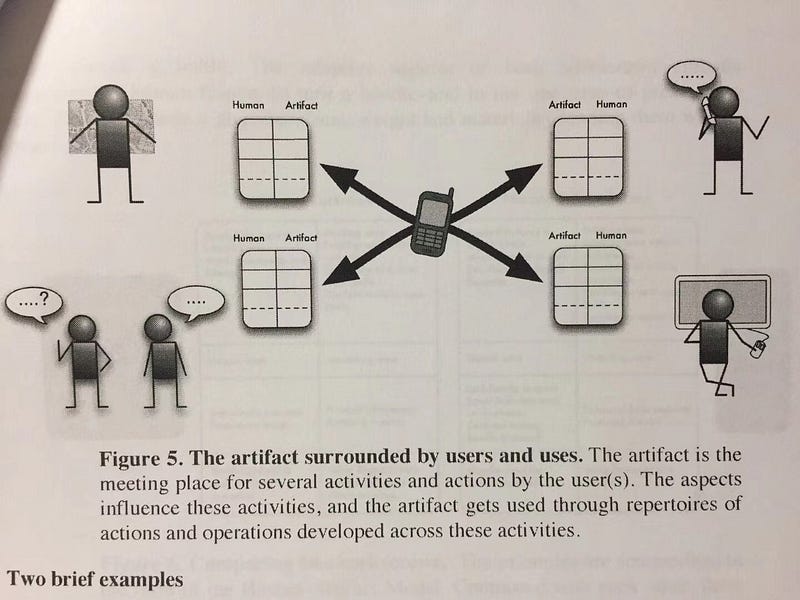
While Susanne Bødker focused on individual activity, her student Jakob E. Bardram moved to collaborative activity.
2.3 Levels of collaborative activity
Traditionally, activity theorists used the collective activity to refer to an activity with a common objective, Jakob E. Bardram chose a collaborative activity in order to underline that collaboration does not always need to have a common objective. In 1998, Bardram published his doctoral thesis titled Collaboration, Coordination, and Computer Support: An Activity Theoretical Approach to the Design of Computer Supported Cooperative Work.
Bardram identified a three-level hierarchical structure of a collaborative activity, “These are labeled the co-ordinated, co-operative, and co-constructive level of activity, and correspond to the level of operation, action, and activity respectively.” (1998, p.36)
- Co-ordinated activity: In coordinated work the various actors are following their scripted roles, each concentrating on the successful performance of the assigned actions according to the conditions of work.
- Co-operative activity: the actors focus on a common object and thus share the objective of the collective activity, instead of each focusing on performing their assigned actions and roles. In the cooperative activity, the object is stable and generally agreed upon. However, the means for realizing the activity might not be present or known.
- Co-constructive activity: At this level of collaborative activity the object of work is not stable — or is not even existing — and hence has to be collectively constructed, i.e. co-constructed. Transitions to the co-constructive level of collaboration are rare in the ongoing flow of daily work actions.
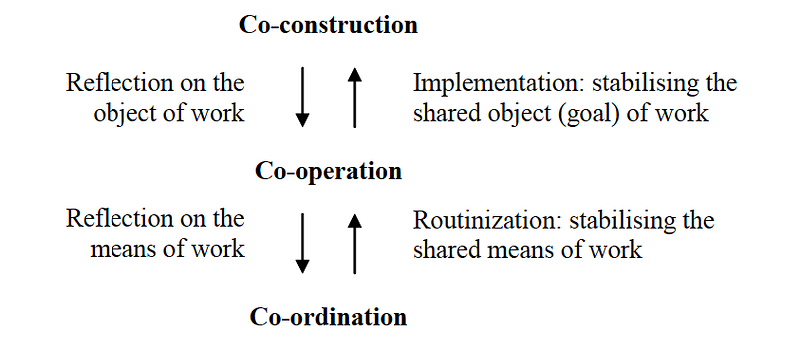
Bardram also pointed out the dynamic transformation between the levels of collaborative activities (see the above diagram). He said, “Central to the notion of hierarchical levels of an activity is the notion of dynamic transformation between the levels. The transformations are tied to the stability of the means of work and the object of work. Basically, the upward transformation is a reflection on the means for doing the work or a reflection on the object of work itself. Such reflections can be sparked either because of a breakdown or by deliberate shift of focus. The downward transformation is caused by resolving contradictions and problems, and re-embodying the resolution in the lower level.” (1998, p.40)
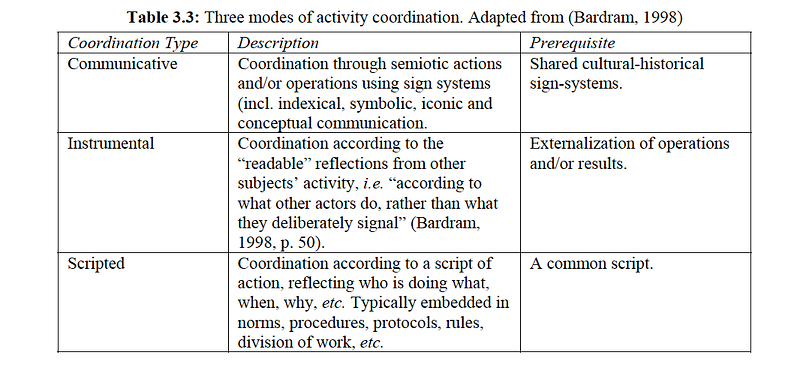
Based on empirical studies of healthcare work, Bardram suggested the above three basic types of coordination. He pointed out, “All three types of continuous coordination take place at all three levels of collaborative activity. Communicative coordination is clearly an essential part of co-ordinated, co-operative, as well as co-constructive activity. At the level of co-operation, where an actor acts according to a common objective, instrumental coordination can result in the correction of other actor’s faulty actions as illustrated by the kitchen example in last chapter. At the level of co-construction, instrumental coordination takes place when one is trying to figure out what is happening in other activity systems, and not just relying on what those people say they are doing. Scripted coordination at the level of co-construction is rare, but does occur for example when one relies on other people to stay within the law or follow some norms and rules within the community. These types of continuous coordination can be mediated by artifacts, and such artifacts are important exemplars of collaboration artifacts.” (pp.50–51)
Bardram also identified three general coordination aspects of a collaboration artifact: shared object, shared tool, and shared communication. This insight is close to the analysis of “activity network” which is based on Yrjö Engeström’s activity system model.
2.4 “Tuning” collaborative activity
A similar approach to Bardram was developed by Raeithel and Velichkovsky (1996). They coined the terms “discursive tuning” and “co-mimetic tuning” to describe the cognitive and motivational aspects of the process through which collaborating users produce what they termed a “shared task-model”. The diagram below represents the process, which relates different types of “tuning” or alignment to Leontev’s hierarchical model of activity.
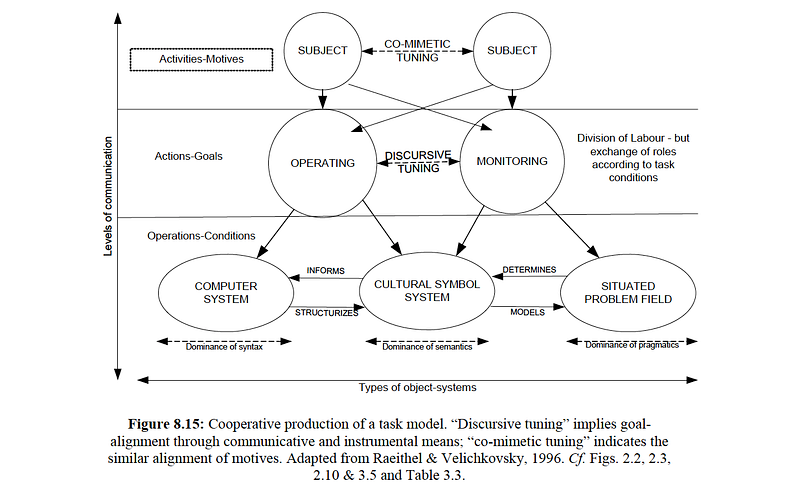
According to Steven Robert Harris, “…some alignment of individual participants’ cognitions (goal-images and situational understandings) is essential for successful collaborative work…an important aspect of this ‘discursive tuning’ is the role played in self- and mutual-regulation by discrepancies between collaborators’ goals and orientations.” (p.282)
PART 3: Other Perspectives
This part introduces some perspectives on the hierarchy of human activity and social practice from other theoretical traditions in order to form a comparative discussion.
3.1 The hierarchy of social practice
Since 2001, a group of philosophers, sociologists, and scientists have rediscovered the practice perspective and used it as a lens to explore and examine the role of practices in human activity. Researchers called it The Practice Turn in Contemporary Theory. As Schatzki pointed out, “there is no unified practice approach”(2001, p.2). Davide Nicolini introduced the following six different ways of theorizing practice in his 2012 book Practice Theory, Work, & Organization:
- Praxeology and the Work of Giddens and Bourdieu
- Communities of Practice (Lave & Wenger, 1991)
- Activity Theory / Cultural-historical activity theory (the Marxian/Vygotskian/Leont’evian tradition)
- Ethnomethodology (Harold Garfinkel, 1954)
- The Site of Social (contemporary developments of the Heideggerian/Wittgensteinian traditions, by Theodore R. Schatzki)
- Conversation Analysis / Critical Discourse Analysis (the Foucauldian tradition)
Nicolini considered Activity Theory as an approach to theorizing practice. This section will focus on another approach: The Site of Social (contemporary developments of the Heideggerian/Wittgensteinian traditions, by Theodore R. Schatzki).
Theodore R. Schatzki’s Social Practice Theory was mainly presented in his two books: Social Practices: A Wittgensteinian Approach to Human Activity and the Social (1996) and The Site of the Social (2002). The first book covers the most fundamental concepts of his work, such as intelligibility, normativity, and teleoaffective structure. The second book presents other ideas such as materiality, practice-arrangement bundles, and the notion of “site”.
In the 2002 book The Site of the Social, Schatzki provided a hierarchy of social practice: doings and sayings > tasks > projects.

Schatzki said, “A practice is a set of doings and sayings. Because these doings and sayings almost always constitute further actions in the contexts in which they are performed, the set of actions that compose a practice is broader than its doings and sayings alone.
I use the expressions ‘task’ and ‘project’ to impose some order on this wider set. Different doings and sayings often constitute the same action.
In the herb production practices, for instance, any of the following actions might have been constituted — on different occasions — by different sets of doings and sayings: getting the herbs up to the drying rooms, drying them, storing them, transporting them downstairs, and pressing them. I call such actions ‘tasks.’
The performance of tasks often consists of aggregated doings and sayings. On a particular occasion, for example, getting herbs into the drying rooms might have consisted of pulling on the hoist, bending over, lifting the basket of herbs, turning, and handing the basket to a co-worker. Tasks, in turn, constitute still higher-order actions; many tasks that particular or aggregated doings and sayings constitute themselves constitute, singly or in groups, further actions. For example, both getting the herbs into the drying rooms and drying them are consist of tasks ‘projects.’
A practice thus embraces a set of hierarchically organized doings/sayings, tasks, and projects; and at any given duree, a participant in the practice is likely, though not necessarily, to be carrying out actions of all three types. I add that a particular action term (e.g., ‘pressing’) can designate a task in some contexts and a project in others.”
Schatzki’s hierarchical structure of social practice is very similar to Leontiev’s hierarchical structure of human activity. However, the theoretical concepts behind these hierarchy frameworks are different. Schatzki claimed, “…the doings and sayings that compose a given practice are linked through (1) practical understandings, (2) rules, (3) a teleoaffective structure, and (4) general understandings.” Leontiev used “motive”, “goals”, and “conditions” to organize his hierarchy. The essential difference is the former is a social theory while the latter is a psychological theory.
3.2 The hierarchy of cultural theme
Anthropologist Morris Opler (1945) developed theoretical “themes” for studying culture. He claimed, “In every culture, are found a limited number of dynamic affurnatuins, called themes, which control behavior or stimulate activity. The activities, prohibitions of activities, or references which result from the acceptance of a theme are its expressions…The expressions of a theme, of course, aid us in discovering it. (pp.198–99)” (Cited in Ryan & Bernard, 2003)
According to Ryan & Bernard (2003), “Opler (1945) established three principles for thematic analysis. First, he observed that themes are only visible (and thus discoverable) through the manifestation of expressions in data. And conversely, expressions are meaningless without some reference to themes. Second, Opler (1945) noted that some expressions of a theme are obvious and culturally agreed on, while others are subtler, symbolic, and even Idiosyncratic. Third, Opler (1945) observed that cultural systems comprise sets of interrelated themes. The importance of any theme, he said, is related to (1) how often it appears, (2) how pervasive it is across different types of cultural ideas and practices, (3) how people react when the theme is violated, and (4) the degree to which the number, force, and variety of a theme’s expression is controlled by specific contexts.”
Opler (1946) applied his theory of themes to study the culture of the Lipan Apache. He found there are twenty themes in all for the Lipan Apache. For example:
- Theme 1: The elements of the universe are actually or potentially animate and personified.
- Theme 2: The universe is pervaded by diffuse supernatural power, which may become specific for those psychologically prepared to receive it.
- Theme 4: Security and harmony are attained largely through the conquest of fear and danger and through self-discipline.
- Theme 13: Childhood is a period of preparation for adulthood rather than an important phase of life in itself.
- Theme 17: Industry, generosity, and bravery are the cardinal moral-social virtues.
- Theme 19: Long life (old age) is an important goal for the individual to reach.
In a 1947 article, Thomas Gladwin shared some insights from Opler. Gladwin pointed out that the expressions given by Opler, for example, of Theme 4 above, include the following:
- in the mythology the cultural hero, Enemy Slayer, had to do battle with or outwit an array of monsters to make the world safe;
- awesome and frightening ceremonies are most effective for those who show no fear or doubt; children submit to pain ordeals in order to show their worth;
- fearless men are remembered in a large number of tales of their exploits;
- and, contrary to his own desires, a good man kills his faithless wife as well as her lover.
Gladwin also noticed that “Several instances are adduced for each of these types of expression except the last.”
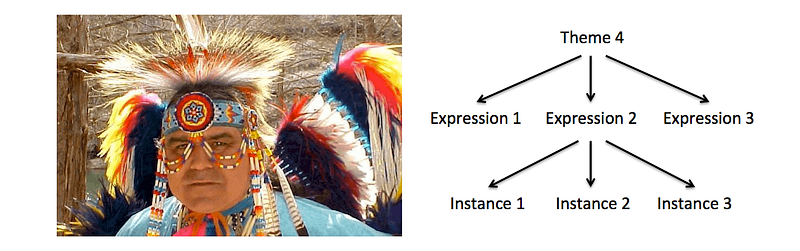
From the above descriptions, we can generate a hierarchy of Cultural themes. See the above diagram. It’s worth comparing the hierarchy of culture theme with Leontiev’s hierarchy of human activity and Schatzki’s hierarchy of social practice. It seems Opler’s “theme” is a more abstract concept than Leontiev’s “activity” and Schatzki’s “practice”. We can consider Leontiev’s “activity” and Schatzki’s “practice” to correspond to “expression” within Opler’s framework.
Career counseling therapists and psychologists also developed a theoretical concept called “life theme.” For example, Peter Mcllveen pointed out, “Over recent decades there has been a steady progression of career counselling frameworks informed by constructivism and social constructionism. The constructivist approach attends to how individuals make meaningful sense of their personally-experienced subjective careers, and how observers — researchers and practitioners — attempt to understand their socially-expressed objective careers. This chapter is centred upon the notion of life themes. Life themes may be understood subjectively and objectively as major dimensions of career, and they may be brought forward in career counselling as a significant source for generating meaning and understanding.”
If we put culture themes and life themes together, we see a “great debate” of social science: “individual — collective.” In 2009, I coined a new term Themes of Practice, and developed it as a new theoretical concept for my book Curativity: The Ecological Approach to Curatorial Practice. I recently used the WXMY diagram to represent the idea of Themes of Practice, the result is the diagram below.
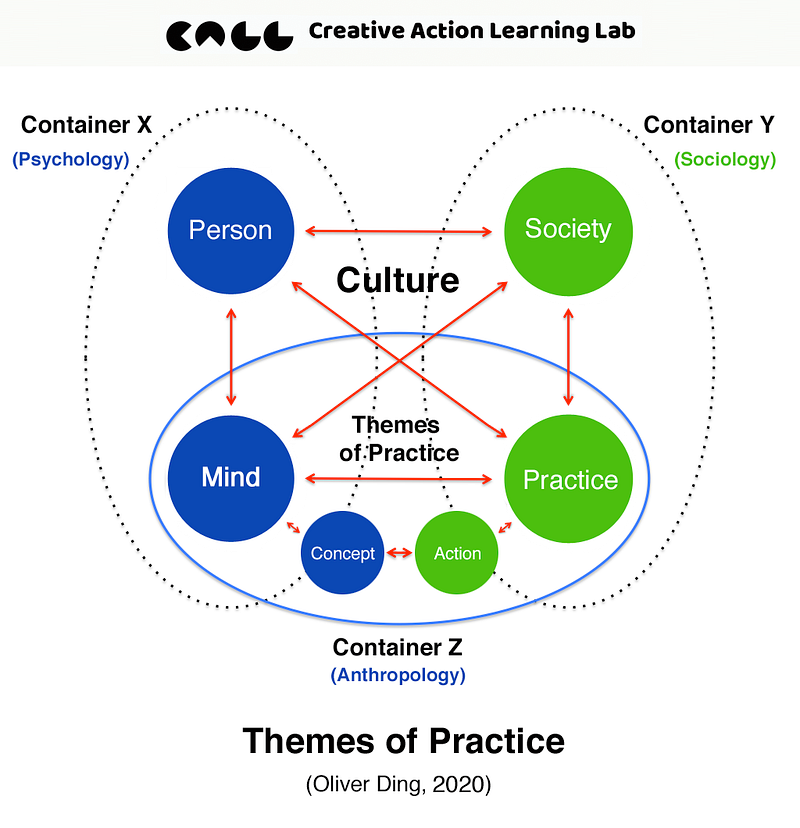
I consider the notion of Themes of Practice as a “process” type of concept, not a “substance” type of concept. Thus, it is not a new category of themes, but a transformational process between individual life themes and collective culture themes. It refers to both concept and action. It connects mind and practice. It indicates the transformation of both person and society.
3.3 The hierarchy of life goals
American academic and psychologist Angela Duckworth is best known for her research on Grit, a strength she defines as passion and perseverance for long-term goals. In her 2016 book Grit: The Power of Passion and Perseverance, she used the diagram below to represent the hierarchy of life goals.
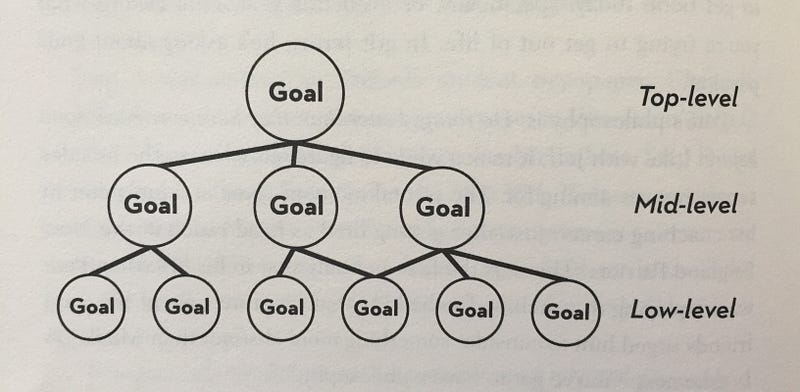
Duckworth said, “At the bottom of this hierarchy are our most concrete and specific goals — the tasks we have on our short-term to-do list…These low-level goals exist merely as means to ends. We want to accomplish them only because they get us something else we want. In contrast, the higher the goal in this hierarchy, the more abstract, general, and important it is. The higher the goal, the more it’s an end in itself, and the less it’s merely a means to an end.”(p.62)
She pointed out the diagram is just an oversimplification because there is more than one layer of mid-level goals between the lowest and the highest level. She also claimed “Grit is about holding the same top-level goal for a very long time… the idea that every waking moment in our lives should be guided by one top-level goal is an idealized extreme that may not be desirable even for the grittiest of us. Still, I would argue that it’s possible to pare down long lists of mid-level and low-level work goals according to how they serve a goal of supreme importance. And I think one top-level professional goal, rather than any other number, is ideal.” (p.64, p.66)
If we use my term “Life as Activity” (it means many activities, not single activity), let’s compare “object of activity” with Duckworth’s “top-level goal”. Duckworth argued that “…the more unified, aligned, and coordinated our goal hierarchies, the better.” (p.66) From the perspective of activity theory, activity theorists pay attention to other things. For example, Victor Kaptelinin and Bonnie A. Nardi (2006) suggested four criteria for “high-quality” objects of activities: “(a)balance: the effective motives should be properly represented — if a motive is systematically ignored, the activity may face a breakdown; (b)inspiration: the object of activity should not only be rationally feasible but also attractive and energizing; (c)stability: if the object changes too often, the activity can be disorganized; (d) flexibility: when factors such as motives and available means change, the object of activity should be redefined to avoid becoming obsolete and ineffective.” (p.151)
If a person’s life only has one top-level professional goal, then he only can use more levels to organize his various life activities, or more general words to describe his goal. I personally don’t believe this is suitable for most people. It’s hard for most people to manage multiple levels of hierarchy, it also doesn’t make sense to use too general words to describe the top-level goal. In contrast, I think the “high-quality” object of activities is better advice for us. Instead of keeping one top-level goal, you can manage high-quality objects of activities in your life. Furthermore, you can manage high-quality objects of “activity network” in your life.
PART 4: Discussion
This part will present a universal hierarchy of activity and practice which synthesizes the above multiple perspectives. I also use the HCI domain to test this new version hierarchy framework. The end of the article also discusses some related topics.
4.1 A universal hierarchy of activity and practice
Human activity and social practice are extremely complex, the hierarchy is a great thinking tool for understanding them. The above sections present various perspectives on the hierarchy of activity and practice, I summarized them in the following table. You can also view its original file on Google Spreadsheet.

Based on perspectives from activity theorists and other researchers, I found there are eight levels of the hierarchy of activity and practice. The six mid-levels are adopted from activity theorists. The top-level is adopted from anthropologist Morris Opler (1945). The low level is adopted from ecological psychologist James J. Gibson (1979).
I also classify these eight levels into three types: “logical level”, “actual level”, and “possible level”. We can call the logical level as ideal level too. I don’t have perfect terms to name these types. Bedny and other SSAT theorists distinguished “Objects of study” and “Units of analysis”. They think “activity” and “task” are considered the objects of study while the other levels as the units of analysis. “Logical level” is similar to their “objects of study”, I think both “theme”, “activity network”, and “activity (or activity system)” are only needed for the analysis requirement. “Actual level” is similar to their “units of analysis”.
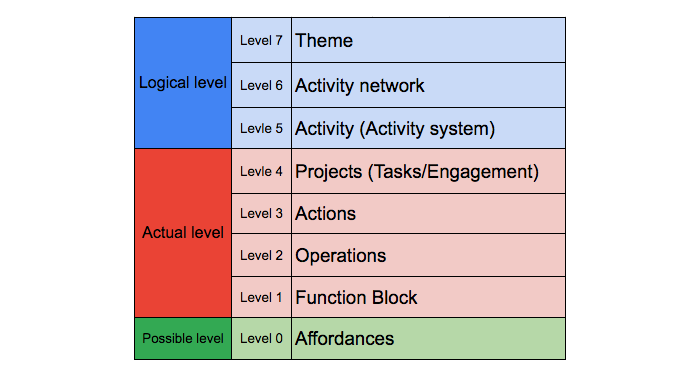
A new animal within the list is “affordance” which refers to the possible level.
What’s Affordance? Let’s have a look at the original definition made by Gibson: “The affordances of the environment are what it offers the animal, what it provides or furnishes, either for good or ill. The verb to afford is found in the dictionary, but the noun affordance is not. I have made it up. I mean by it something that refers to both the environment and the animal in a way that no existing term does. It implies the complementarity of the animal and the environment. (p.119)”
Why do I add the idea of affordance to the hierarchy of activity and practice? I think the value is it could expand the scope of hierarchy from “actual” to “possible” because affordance refers to “action possibilities.”
Activity theorists tend to adopt the idea of affordance at the operation level. Victor Kaptelinin and Bonnie A. Nardi pointed out, “Affordances are typically interpreted in terms of low-level manipulation with physical artifacts. Therefore, the concept is limited to the level of operations.” (2006, p.81) Bærentsen & Trettvik’s (2002) provided a framework of Affordance levels which suggested the concept of affordance can be extended to levels of actions and activities.
I personally suggested another way to adopt the concept of affordance to activity theory. Instead of matching the existing three levels of the hierarchy of activity, the concept of affordance can be considered as a new level for extending the scope of the hierarchy of activity. In other words, affordance can be a new unit of analysis of activity theory and other practice theories.
At the general philosophical level, both ecological psychology and activity theory share the same view of the inseparability of human beings and the world. Victor Kaptelinin and Bonnie A. Nardi claimed, “In Western thought, the fundamental insight of the inseparability of subjects and objects is expressed, for instance, in the philosophical views of Hegel and Marx, Goethe’s poetry, Brentano’s ‘act psychology’, and the ecological psychology of Gibson.” (2012, p.13)
However, there is an important theoretical difference between ecological psychology and activity theory. Activity theorists define the “activity” as “object-oriented”, according to Leontiev, “Any activity of an organism is directed at a certain object; an ‘objectless’ activity is impossible” (Leontiev, 1981). Ecological psychologists don’t use “activity” as a theoretical concept, they use “action” and “activity” interchangeably. Ecological psychologist Edward S. Reed (1996) pointed out there are two kinds of action, “We should thus differentiate between two kinds of activity, performatory and exploratory — because the selective contingencies are very different for the two cases. Exploratory activity, as I call the scanning for and use of information (following James Gibson; see Reed, 1988a) typically does not require the expenditure of a significant amount of force to alter the substances or surfaces of the environment. Instead, it involves the adjustment of the head and sensory organs to the ambient energy fields. These adjustments are typically embodied in cyclic, low-energy, and low-impact movements of the sense organs or the head. The selective advantage thus obtainable is that of having information useful for regulating one’s activity pattern. These latter performatory activities are precisely those cases in which the animal does use significant amounts of force to alter the substances and surfaces of its environment. It is one thing to see or to smell a piece of food, it is quite another thing to obtain it, masticate it, and eat it — and this applies whether one is a dragonfly or a mammalian carnivore.”(1996, pp. 80–81)
The operation level can’t cover the meaning of the concept of exploratory action. The exploratory action goes beyond the scope of activity theory. Thus, the “possible level — affordances — exploratory action” combination is a heterogeneous theoretical resource to activity theory.
It depends on the needs of theoretical development and empirical research. Thus, I call the new hierarchy “a universal hierarchy of activity and practice” in which I use “activity” as a regular word, not the concept of activity theory. We can see this new hierarchy as a basic reference, readers can adopt some levels from it and form their own version of the hierarchy to match their needs.
4.2 HCI as a cross-disciplinary
Let’s use the HCI domain as an example. The diagram below summarizes the structure of HCI and its main research themes. According to Steven Robert Harris, “HCI is a relatively young, rapidly developing scientific field that is inherently multi- and cross-disciplinary (Carroll, 2003, p. 1). From the computer side, HCI can be considered as a branch of computer science which was defined by Newell, Perlis, and Simon as ‘the study of computers and the major phenomena surrounding them’ (Newell et al., 1967, p.373), HCI can be considered as that branch of computer science concerned with the design of computer applications and their interfaces. However, HCI also forms a specialised area of concern within other disciplines (Dix et al., 2003, Hewett et al., 1996): in psychology, HCI studies focus on the application and testing of theories of cognition and the empirical analysis of user behaviour (e.g. Rauterberg, 1995a, Sedig et al., 2001); in sociology and anthropology, on the interactions between computer-based technologies, work processes, and organizations (e.g. Gärtner and Wagner, 1996, Törpel et al., 2003); and in industrial design, on the development and use of computer-based products (e.g. Kaikkonen and Roto, 2003).”
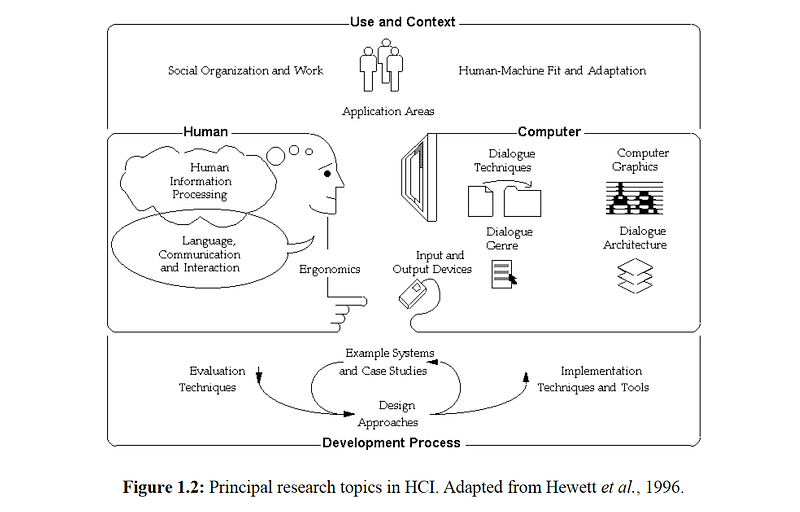
How do HCI researchers apply the hierarchy of activity to HCI study? I have mentioned two branches of activity theory: SSAT and CHAT. The following section shall review their frameworks with the universal hierarchy framework.
4.3 SSAT and Ergonomics
I have mentioned a branch of activity theory: Systemic — Structural Activity Theory (SSAT). Bedny and other SSAT theorists argued that Leontev’s activity theory is too general and inappropriate to design research. In order to clarify this issue, they presented a general scheme of the structural components of activity: Activity — Task — Action — Operation — Function Block. The SSAT framework is very complicated for ordinary readers because it is primarily developed for human factors and ergonomics which is a special domain about micro-level work processes.
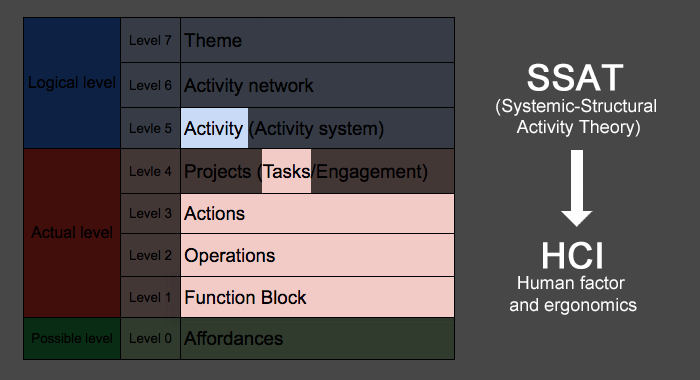
SSAT theorists don’t talk about “activity systems”, “activity networks” and other terms related to the level of “social organization and work.”
4.4 CHAT and social context
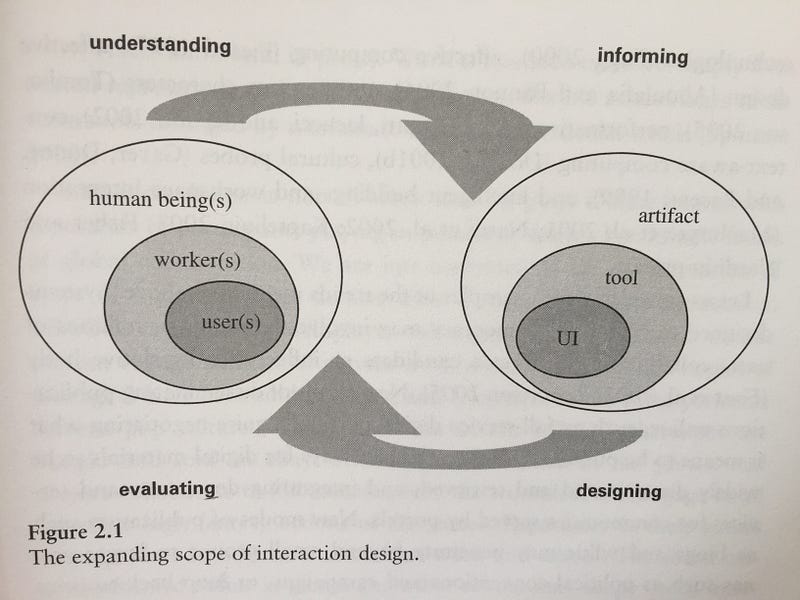
Victor Kaptelinin and Bonnie A. Nardi argued a post-cognitivist perspective for HCI in their 2006 book Acting with Technology, they said “…we believe we will get the most leverage from theory are those involving complex systems with multiple actors and objects. The focus in design is changing from a knowledge worker using a desktop computer to: (a) collaborative uses of technology by groups and the larger society, (b) varied virtual and physical contexts, (c) an expanded set of activities (including those conducted at home), and (d) human experience in general, not just cognition. Of particular interest are the ways individual and collective activities are linked, negotiated, and managed over time.”(p.25)
They used the diagram below to represent “the complexity of real practice, widening analysis to include a cycle of evaluation and design in which people and artifacts influence one another.”(p.25)
In the 2012 book Activity Theory in HCI, Victor Kaptelinin and Bonnie A. Nardi also reviewed the applications of activity theory in the HCI domain. They focus on two versions of activity theory: the approach developed by Leontiev and a closely related approach proposed by Yrjö Engeström. They said, “By ‘activity theory’ in general we mean an aggregated framework comprising a combination of these two approaches. There are other approaches, which have ‘activity theory’ in their names, as well. A systematic exploration of the question of what (if any) conceptual links are there between these approaches and the ones developed by Leontiev and Engeström is beyond the scope of our discussion here.” (p.11)
The combination of Leontiev’s approach and Engeström’s approach can be referred to as CHAT (cultural-historical activity theory).
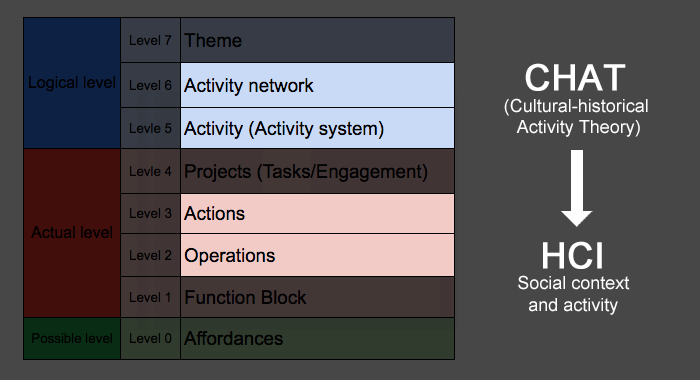
CHAT theorists don’t pay attention to the level of “Function Block”, the level of operations is the low level of analysis for CHAT theorists. They also talk about “activity system” and “activity network” since they pay attention to the social context of human-computer interaction.
4.5 Possible Practice and Creative Actions
I recently developed a new framework for discussing social practice. The above diagram represents the new framework in which the possible practice is placed in the center.
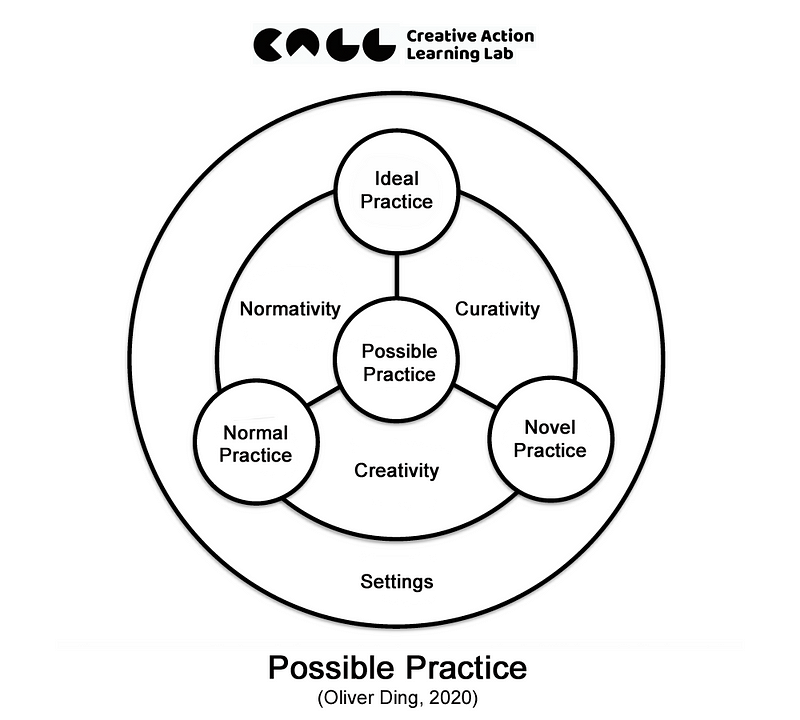
I suggest “Possible Practice” as a new term that expands the scope of contemporary practice theories from “actual actions and existing practice” to “possible actions and possible practice”. The Possible Practice framework is not an alternative to contemporary practice theories, but expands their scope and contains more theoretical concepts such as James J. Gibson’s Affordance.
The notion of Creative Actions is part of the Possible Practice framework. I consider Possible Practice at the macro collective level while Creative Actions at the micro individual level. However, the detail of the mid-level analysis is not clear. Now the universal hierarchy of activity and practice can help me solve the problem. I’d like to select “Themes”, “Projects”, “Actions”, “Acts (Operations)”, and “Affordances” to form a new hierarchy for the Possible Practice approach.
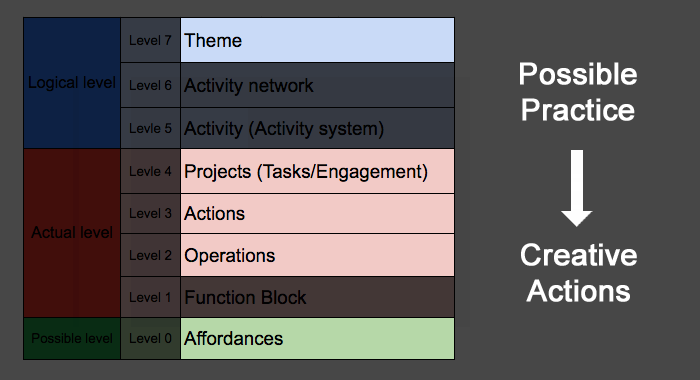
Obviously, this is not a new version of activity theory, but a new approach to social practice, especially creative behavior-related social phenomena.
4.6 Hierarchy and Fractal Heuristics
The hierarchy is a heuristic tool, we can use it with other heuristic tools together. For example, if we want to discuss the structure and dynamics of academic activity, we can adopt American sociologist Andrew Abbott’s fractal heuristics.
In a 2001 book Chaos of Disciplines, Andrew Abbott started an insight that claims many social structures look the same on large scale and in a small scale. He called this insight “Self-similar social structure.” and applied it to discuss academic social science in general and sociology in particular. He also found there is a classical example from Kant, “…Kant obviously does not think there is an infinite gradation from absolute pure reason through some proportionately mixed varieties of reason to absolute practice reason. He has done something else. He has created what I shall call a ‘fractal distinction.’ The name capture the fact that such a distinction repeats a pattern within itself, as geometric fractals do…There are, of course, dozens of general sources on fractals…I have tended to focus on fractals that are nested dichotomies. There is no necessary restriction to this case; it is simply the most familiar and hence makes for the easiest exposition.”(p.9)
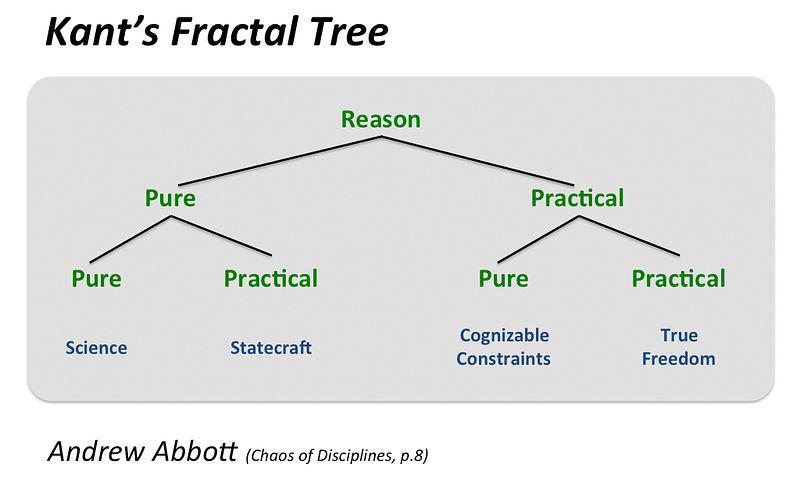
The above diagram is adopted from Andrew Abbott and it represents Kant’s fractal tree. After reviewing Kant’s writing, Abbott summarized that “Kan has first split pure and practical reason and then, under each of those headings, has split pure and practical reason once again.” (p.8)
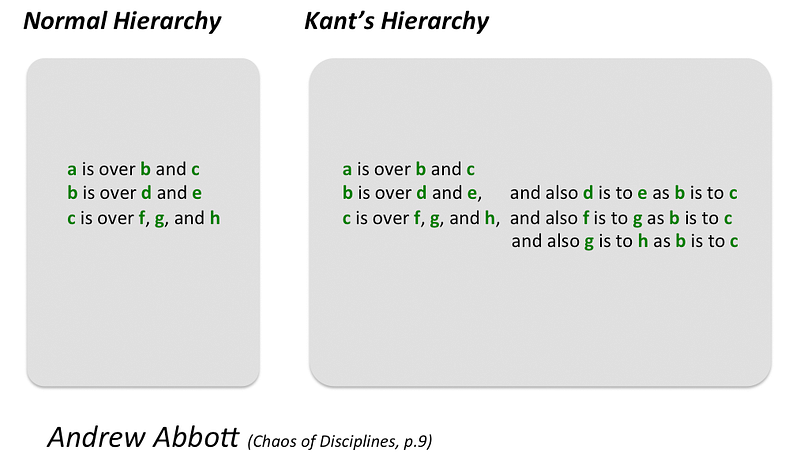
Abbott also pointed out Kant’s approach is not a normal hierarchy, “…Kant has made a relational judgement at one level and then repeated it at the next…the relation of the general terms is recapitulated in the specific ones…This is not a simple hierarchy.” (p.9) Further, Abbott claimed that the power of fractal distinction, “The concept of fractal distinctions not only proves useful in understanding the external location of the social sciences generally. It also provides an essential tool for understanding relations within them. Indeed, as I shall show, both the external and the internal structures are produced by the same mechanism.” (p.10)
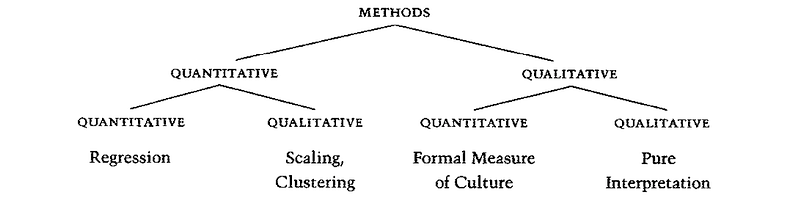
The above diagram shows an example of fractal distinction of the methodological approaches. Abbott said, “For about sixty years, sociology has been divided into two broad methodological strands, usually called quantitative and qualitative. Put starkly, the quantitative position recognizes only those social phenomena measurable on univocal scales. The qualitative side attributes multivocality to all social phenomena and therefore denies strong measurability. This sounds like a simple opposition. But within each one of these strands can be distinguished ‘quantitative’ and ‘qualitative’ positions. On the quantitative side, for example, the admired ‘causal’ methods like regression contrast with the denigrated ‘descriptive’ methods like scaling and clustering. On the qualitative side, there are relatively formalized measurement procedures that are used by some sociologists of culture and by most practitioners of conversational analysis, while strongly interpretive strategies characterize much of the new sociology of science.” (p.10)
What a simple but powerful heuristic tool! Abbott focused on academic activity, we can apply it to non-academic activities. We can check if we can find the same fractal distinction in our domain, or use it to guide our journey of making innovation and finding new niches. We even can think about if there are other heuristic tools that present special comment patterns of hierarchy.
4.7 Beyond the hierarchy
I consider the universal hierarchy of activity and practice as a meta-framework that can be used as a heuristic tool for building frameworks. Readers could use it in the following ways:
- Use it as a list for reference. You can select some levels from the list to build your own hierarchy.
- Use it as a reflecting tool for understanding theories. You can ask yourself: Why does this particular theory (for example, SSAT) accept some levels and refuse other levels?
- Use it as an innovative tool for exploring new theoretical spaces. You can ask yourself: Can I add a new level to the list?
- Use it with other heuristic tools. For example, fractal distinction.
Moreover, a hierarchy is part of a theoretical framework or approach. Though this article focuses on hierarchy, we should understand it with its theoretical background and inspect the deep theoretical assumptions and inherent consistencies.
CALL for Action
I have created a template of the Activity System model on Miro, you can access it at the following board:
This board is part of the Activity U project, it will be a fun place for collective learning and creating. If you want to join the project, you can DM me on Twitter.
You are most welcome to connect via the following social platforms:
Twitter: https://twitter.com/oliverding Doowit: https://doowit.co/profile/gm0k2ax9 Linkedin: https://www.linkedin.com/in/oliverding
License
This work is licensed under the Creative Commons Attribution-NonCommercial-ShareAlike 4.0 International (CC BY-NC-SA 4.0) License. Please click on the link for details.
References
Abbott, A, (2001). Chaos of disciplines. W.W. Norton & Company.
Bardram, J. E. (1998). Collaboration, coordination, and computer Support: An activity theoretical approach to the design of computer supported cooperative work. Doctoral thesis, Aarhus University, computer science department. (DAIMIPB-533).
Bedny, G. Z., & Harris, S. R. (2005). The Systemic-structural theory of activity: Applications to the study of human work. Mind, culture, and activity, 12:2, 128–147, DOI: 10.1207/s15327884mca1202_4
Bedny, G. Z., & Karwowski, W. (2007). A systemic-structural theory of activity: Applications to human performance and work design. CRC Press, Taylor & Francis Group.
Bedny, G. Z., & Harris, S. R. (2008). “Working sphere/engagement” and the concept of task in activity theory. Interacting with Computers, 20(2), 251–25.
Bødker, S. (1987). Through the interface — a human activity approach to user interface design. DAIMI Report Series, 16(224). https://doi.org/10.7146/dpb.v16i224.7586
B⊘dker, S., & Klokmose, C. N. (2013). The Human–Artifact Model: An Activity Theoretical Approach to Artifact Ecologies. Hum.-Comput. Interact. 26, 4 (October-December), 315–371.
Dan Diaper, Gitte Lindgaard, West meets East: Adapting Activity Theory for HCI & CSCW applications?, Interacting with Computers, Volume 20, Issue 2, March 2008, Pages 240–246, https://doi.org/10.1016/j.intcom.2007.11.006
Duckworth, A. (2016). Grit: The Power of Passion and Perseverance. Scribner.
Edward S. Reed (1996). Encountering the world: Toward an ecological psychology. Oxford University Press.
Engeström, Y. (2008). Enriching activity theory without shortcuts. Interacting with Computers, ISSN: 0953–5438, Vol: 20, Issue: 2, Page: 256–259
Gibson, J.J. (1979/2015). The ecological approach to visual perception: classic edition. New York: Psychology Press. (originally published in 1979).
Gladwin, T. (1947). Morris E. Opler’s Concept of “Themes”. American Anthropologist. N.S., 49, 1947.
Gonzalez, V., (2006). The Nature of Managing Multiple Activities in the Workplace. Doctoral dissertation in Information and Computer Science, University of California, Irvine.
Harris, S. R. Supporting Learning-in-use: Some Applications of Activity Theory to the Analysis and Design of ICT-Enabled Collaborative Work and Learning. A submission presented in partial fulfilment of the requirements of the University of Glamorgan/Prifysgol Morgannwg for the degree of Doctor of Philosophy.
Kaptelinin V., & Nardi B. (2006). Acting with technology: activity theory and interaction design. The MIT Press.
Kaptelinin V., & Nardi B. (2012). Activity theory in HCI: fundamentals and reflections. Morgan & Claypool Publishers.
Leontiev, A. N. (1978). Activity, Consciousness, and Personality. Englewood Cliffs, N.J.: Prentice-Hall. (Original work published in Russian in 1975.)
Nicolini, D. (2012). Practice Theory, Work, & Organization: An Introduction. Oxford University Press.
Ryan, G. W., & Bernard, H. R. (2003). Techniques to identity themes. Field Methods 2003; 15; 85. DOI: 10.1177/1525822X02239569
Schatzki, T. R. (2002). The site of social: A philosophical exploration of the constitution of social life and change. Pennsylvania State University Press.
Spinuzzi, C. (2003). Tracing genres through organizations: A sociocultural approach to information design. The MIT Press.
Spinuzzi, C. (2013). Topsight: A guide to studying, diagnosing, and fixing information flow in organizations. Amazon CreateSpace, 2013; Topsight 2.0, second edition, Urso Press, 2018
Virkkunen, J. & Newnham, D. S. (2013). The change laboratory: A tool for collaborative development of work and education. Sense Publishers.


