
Life Discovery: The “Discovery as Development” Principle
Life Discovery is not only for Life Transitions. Life Discovery is for both settled life stages and unsettled life stages.

The Life-as-Project Approach is inspired by Project-oriented Activity Theory, Anticipatory Systems Theory, Curativity Theory, and other theoretical resources, it was developed with the following six basic principles:
- Being by Doing
- Engagement as Projection
- End as Means
- Discovery as Development
- Performance as Experiment
- Curativity as Creativity
This article offers some related ideas for the “Discovery as Development” principle and the “Curated Mind” framework.
Exploration, Detection, and Recognition
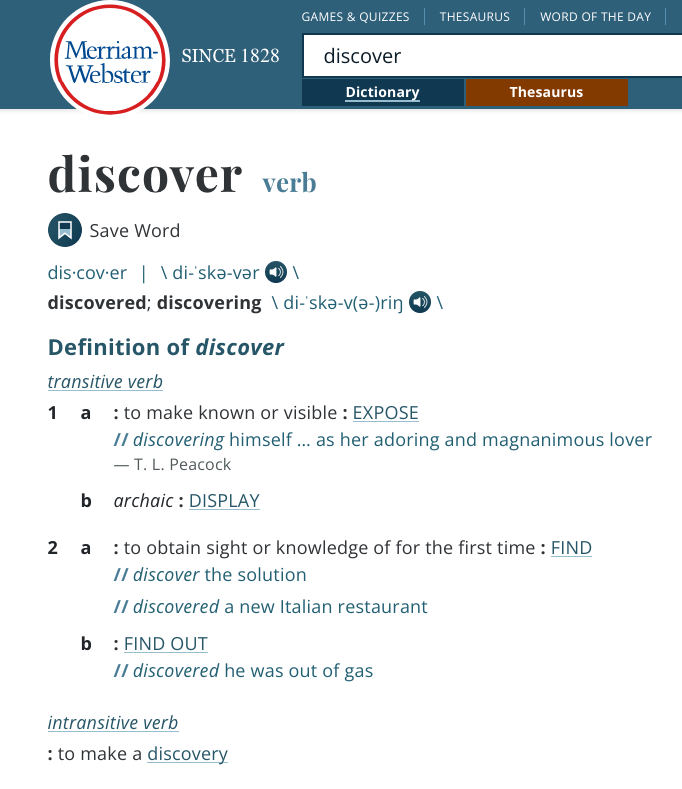
According to the Merriam-webster dictionary, the word Discover has two meanings: 1) to make known or visible; 2) to obtain sight or knowledge of for the first time.
For Life Discovery Activity, I roughly identify the following essential actions:
- Exploration: detach from the Produce status and attach to the Play status
- Detection: pay attention to cues from experiences and environments
- Recognition: identify significant insights
These notions are inspired by Activity Theory and Ecological Psychology.
At the general philosophical level, both Ecological Psychology and Activity Theory share the same view of the inseparability of human beings and the world. Victor Kaptelinin and Bonnie A. Nardi claimed, “In Western thought, the fundamental insight of the inseparability of subjects and objects is expressed, for instance, in the philosophical views of Hegel and Marx, Goethe’s poetry, Brentano’s ‘act psychology’, and the ecological psychology of Gibson.” (2012, p.13)
However, there is an important theoretical difference between Ecological Psychology and Activity Theory. Activity theorists define the “activity” as “object-oriented”, according to Leontiev, “Any activity of an organism is directed at a certain object; an ‘objectless’ activity is impossible” (Leontiev, 1981).
Ecological psychologists don’t use “activity” as a theoretical concept, they use “action” and “activity” interchangeably. Ecological psychologist Edward S. Reed (1996) pointed out there are two kinds of actions, “We should thus differentiate between two kinds of activity, performatory and exploratory — because the selective contingencies are very different for the two cases. Exploratory activity, as I call the scanning for and use of information (following James Gibson; see Reed, 1988a) typically does not require the expenditure of a significant amount of force to alter the substances or surfaces of the environment. Instead, it involves the adjustment of the head and sensory organs to the ambient energy fields. These adjustments are typically embodied in cyclic, low-energy and low-impact movements of the sense organs or the head. The selective advantage thus obtainable is that of having information useful for regulating one’s activity pattern. These latter performatory activities are precisely those cases in which the animal does use significant amounts of force to alter the substances and surfaces of its environment. It is one thing to see or to smell a piece of food, it is quite another thing to obtain it, masticate it, and eat it — and this applies whether one is a dragonfly or a mammalian carnivore.”(1996, pp. 80–81)
One of the important concepts of Ecological Psychology is the concept of Affordance. What’s Affordance? Let’s have a look at the original definition made by Gibson: “The affordances of the environment are what it offers the animal, what it provides or furnishes, either for good or ill. The verb to afford is found in the dictionary, but the noun affordance is not. I have made it up. I mean by it something that refers to both the environment and the animal in a way that no existing term does. It implies the complementarity of the animal and the environment. (p.119)”
Activity theorists tend to adopt the idea of affordance at the operation level. Victor Kaptelinin and Bonnie A. Nardi pointed out, “Affordances are typically interpreted in terms of low-level manipulation with physical artifacts. Therefore, the concept is limited to the level of operations.” (2006, p.81) Bærentsen & Trettvik’s (2002) provided a framework of Affordance levels which suggested the concept of affordance can be extended to levels of actions and activities.
Activity theorists use “activity — action — operation” as three levels of the hierarchy of activity theory. I personally suggested another way to adopt the concept of affordance to Activity Theory. Instead of matching the existing three levels of the hierarchy of activity, the concept of affordance can be considered as a new level for extending the scope of the hierarchy of activity. The operation level can’t cover the meaning of the concept of exploratory action. The exploratory action goes beyond the scope of activity theory. Thus, the “possible level — affordances — exploratory action” combination is a heterogeneous theoretical resource to activity theory.
Why do I add the idea of affordance to the hierarchy of activity and practice? I think the value is it could expand the scope of the hierarchy from “actual” to “possible” because affordance refers to “action possibilities.” Eventually, I develop “logical — actual — possible” as three levels of hierarchy for the Ecological Practice approach.
The Life-as-Project approach adopts the notion of “Actions — Activity” from Activity Theory and considers the following three types of actions for the Life Discovery Activity.
- Exploration: detach from the Produce status and attach to the Play status
- Detection: pay attention to cues from experiences and environments
- Recognition: identify significant insights
These three types of actions are inspired by Ecological Psychology, especially James J. Gibson’s ecological approach to visual perception.
Contradictions, Themes, and Opportunities
Inspired by Derek Layder’s Social Domains Theory (1997) and Andy Blunden’s “Project as a Unit of Activity” (2010, 2014), I adopted the concept of “Project” as a Container for understanding Life. The Life-as-Project approach uses the concept of “Project” to understand both individual life and collective life.
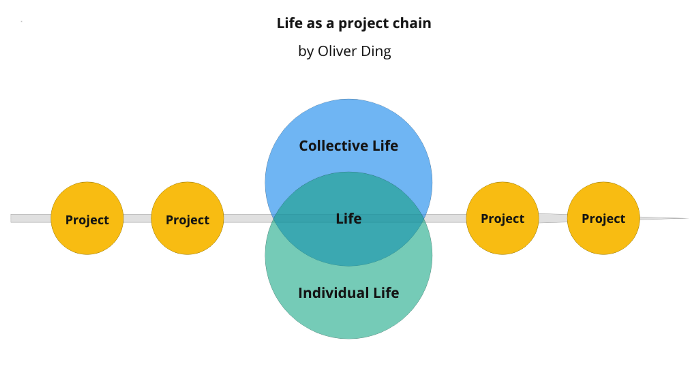
Andy Blunden mentions a project-oriented approach in both psychology and sociology, “A project is a focus for an individual’s motivation, the indispensable vehicle for the exercise of their will and thus the key determinant of their psychology and the process which produces and reproduces the social fabric. Projects, therefore, give direct expression to the identity of the sciences of the mind and the social sciences. Projects belong to both; a project is a concept of both psychology and sociology.” (2014, p.15)
The concept of Life can be understood as Collective Life and Individual Life. We can use the concept of Project to understand both of them. A person’s real life is a set of real actions. The concept of Project is a way of curating these actions. On the other hand, Collective Life can be curated with Projects too.
I have mentioned 16 blocks in the Life Discovery Canvas. See the diagram below.
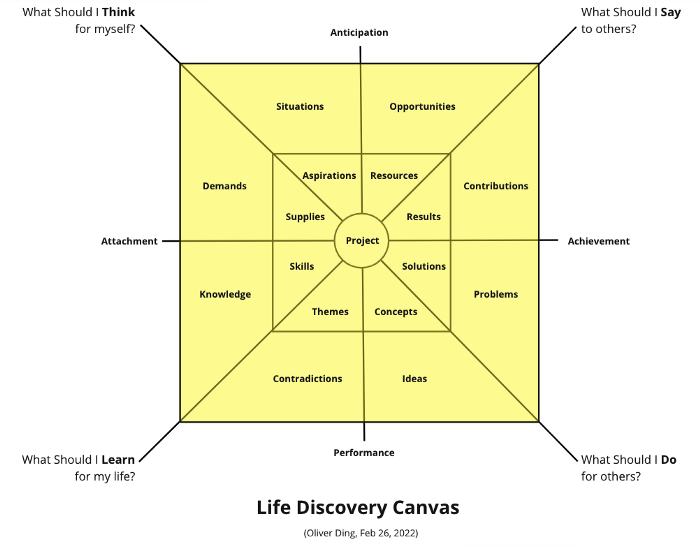
For readers who want a mini version of the canvas, I’d like to point out that the following three things are important for the Life-as-Project approach:
- Potential Contradictions
- Potential Themes
- Potential Opportunities
The notion of Potential Contradictions is inspired by Activity Theory. From the perspective of the Activity System model, the Life Discovery Activity can focus on Detecting Potential Contradictions within a person’s life activities. You can find more details about the four levels of contradictions in the Activity System model here.
From the perspective of Project-oriented Activity Theory and Curativity Theory, the Life Discovery Activity can focus on Exploring Potential Themes within a person’s life activities. You can find more details about Themes of Practice here.
I also introduced the ECHO Way as a heuristic tool for this action. You can find more details here.
In order to explain the value of the ecological practice approach, I adopt the concept of Opportunity as mediation and redefined it as the formula below:
Opportunity = From a perspective (X), You (U) could do things (Y) with an object (Z).
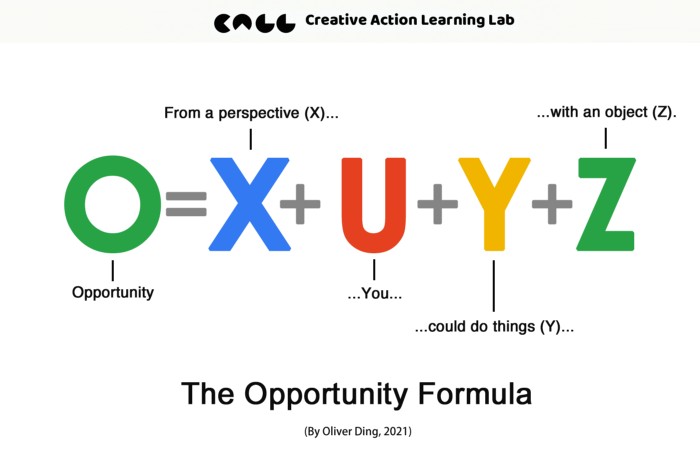
For the Opportunity Formula, each color refers to a particular meaning.
- Opportunity: Green. It refers to hope and growth.
- X: Blue. It refers to rational thinking.
- U: Red. It refers to passion and purpose.
- Y: Yellow. It refers to social practices.
- Z: Green. It refers to ecological context.
From the perspective of the Ecological Practice approach, the concept of Opportunity is both subjective and objective. The objective aspect refers to the ecological context which means an objective reality. The subjective aspect refers to a person’s attitude, knowledge, skills, and situation.
The Ecological View of Opportunities
While the concept of Affordance which is a core concept of Ecological Psychology refers to the physical environment and material objects, the Ecological Practice approach offers more concepts that could be applied to non-material objects such as a picture, a tweet, a theory, an experience, etc.
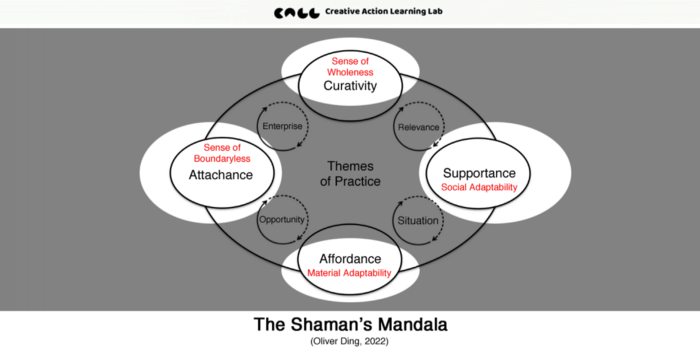
The above diagram highlights four concepts from the Ecological Practice approach and their value for the Life Discovery Activity.
- Affordance
- Attachance
- Supportance
- Curativity
For life strategy and related issues, these four theoretical concepts have some heuristic orientations for thinking.
- Affordance: Material Adaptability
- Supportance: Social Adaptability
- Attachance: Sense of Boundaryless
- Curativity: Sense of Wholeness
These heuristic orientations refer to the benefits of learning these concepts and mastering related skills.
Material Adaptability refers to a person’s competence in the actualization of affordance and material engagement while Social Adaptability refers to a person’s competence in the actualization of supportances and human engagement. There is a gap between potential possibilities, a person has to develop his skills and capabilities in order to take Affordances and Supportances.
Attachance leads to the Sense of Boundaryless because actions of Attaching and Detaching reduce the boundary’s impact on a person. Curativity leads to the Sense of Wholeness because actions of turning pieces into a meaningful whole increase the skill of making sense of wholeness.
The Development of Mind
Last month I developed the Curated Mind model with the following diagram:
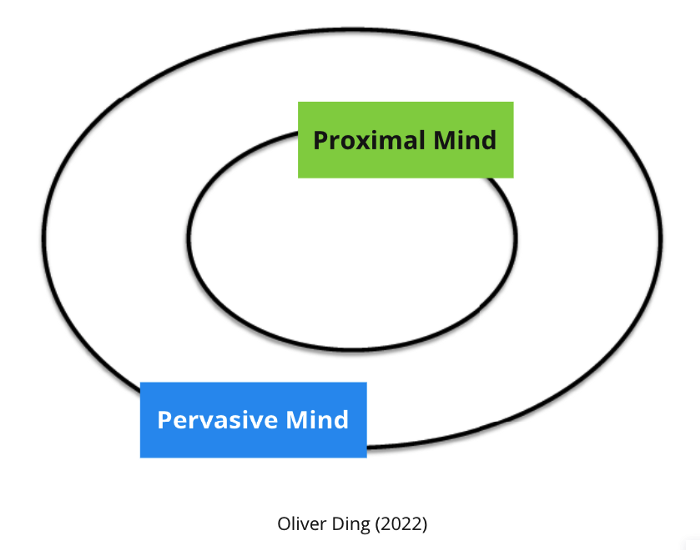
The above diagram is the basic model of the Curated Mind. This model is adopted the ecological approach to reflect on the Mind. While Proximal Mind corresponds to Proximal Contexts, Pervasive Mind corresponds to Pervasive Mind.
- Proximal Contexts (Proximal Mind)
- Pervasive Contexts (Pervasive Mind)
These two parts form a whole as a system which is called Curated Mind.
If we apply this diagram to reflect on my theoretical interests, then most of my writings are about the Proximal Contexts and Proximal Mind. I didn’t pay attention to Pervasive Contexts and Pervasive Minds before 2021. For example, I didn’t write some articles about cognitive representations and cultural significance. I didn’t pay attention to some fields about Future Studies, Social Discourse, Ecosystem Innovation, etc.
In March 2022, Maurizio Goetz, who is the Co-founder presso Italian Institute for the Future — Speculative Design Hub, encouraged me to explore Future Studies, Imagination Design, and Anticipative Communication /Storytelling.
Our discussion inspired me to expand the level of Pervasive Mind from the original two practical perspectives to four perspectives:
- Representation (old version)
- Significance (old version)
- Imagination (new version)
- Anticipation (new version)
Then I made the following framework for the Curated Mind model.
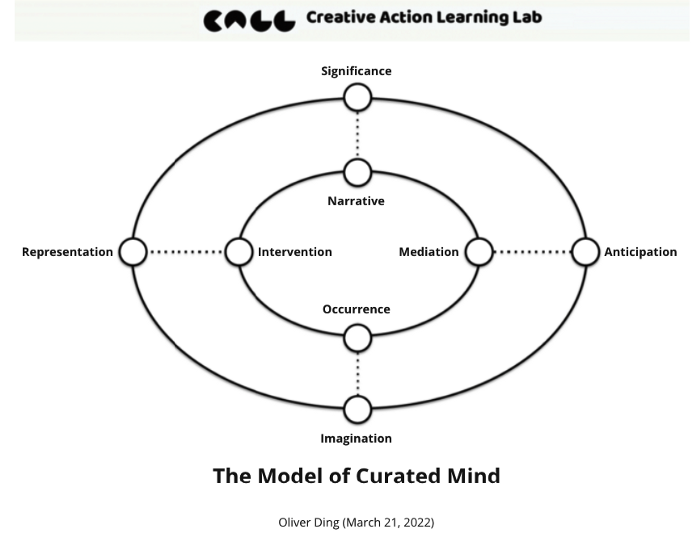
The model also emphasizes the following three types of Curativity:
- The Curativity of Proximal Mind: Turning pieces of experiences into a meaningful whole at the loop of Proximal Mind.
- The Curativity of Pervasive Mind: Turning pieces of experiences into a meaningful whole at the loop of Pervasive Mind.
- The Curativity of Mind: Turning “Proximal Mind” and “Pervasive Mind” into a meaningful whole.
You can find more details about the Curated Mind here.
If we adopt the Curated Mind for the Life Discovery Activity, then we can claim that the Life Discovery Activity is an activity of developing the Mind.
Settled Life and Unsettled Life
The lifestorian Bruce Feiler conducted a life narrative study project which collected hundreds of life stories in all fifty states from Americans who’d been through major life changes. In 2020, he published a book titled Life Is in the Transitions: Mastering change at any age.
Bruce Feiler uses Disruptors to describe major life change events, “A disruptor is an event or experience that interrupts the everyday flow of one’s life. I chose disruptors as opposed to stressors, crises, problems, or any other label they’ve been given over the years because the term is move value neutral. Many disruptors, like adopting a child, say, or starting a new job, would not traditionally be defined as negative, yet they’re still disruptive. Even the most customarily negative life events, like losing a spouse or being fired, sometimes become catalysts for reinvention. Disruptors are simply deviations from daily life.” (2020, p.52)
I agree with Bruce Feiler on selecting a value neutral term for life change and life discovery. In a general sense, any new change always leads to a challenge for a person and it can be considered a problem.
From 225 life stories, Bruce Feiler discovers a typology of life change events. The total number of disruptors was fifty-two. He also divided the list into five categories: Love, Identity, Beliefs, Work, and Body. See the following picture.
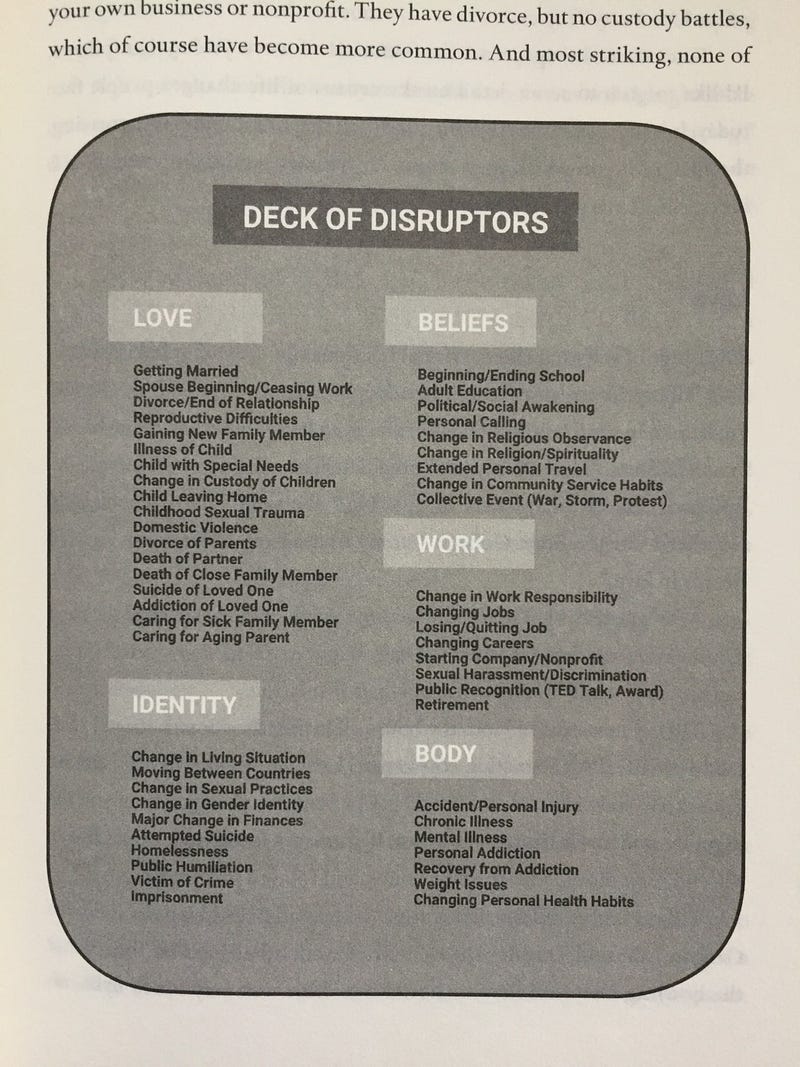
The above Deck of Disruptors gives us a list of major life change events in the 21st century. This is very useful for the Life Discovery Activity project.
However, I’d like to emphasize that the Life Discovery Activity is not only for Life Transitions. Life Discovery is for both settled life stages and unsettled life stages.
In CALL for LIFE: Oliver Ding @ 2021 and Second-order Activity, I used the notion of “The Hiddenness of Second-order Activity” to highlight the importance of Life Discovery in the settled life stages.
In unsettled life stages, it is easy to find Life Discovery Activities in our life. For example, we might visit a career coach and discusses the future of career development, we might read books about life transitions, etc.
However, some actions of Life Discovery Activity are not obviously perceived in the settled life stages.
I’d like to encourage you to run the Life Discovery Activity in the settled life stages because this is a great approach for personal innovation.
Related Articles
- The Project Engagement Toolkit (2022)
- Life Discovery: The Life-as-Project Approach
- The Life Discovery Toolkit (v1)
- The Life Discovery Canvas (v1.0) — Part 1: Theoretical Background
- The Life Discovery Canvas (v1.0) — Part 2: Spatial Structure
- The Life Discovery Canvas (v1.0) — Part 3A: Concepts (THINK and LEARN)
- The Life Discovery Canvas (v1.0) — Part 3B: Concepts (SAY and DO)
- The Life Discovery Canvas (v1.0) — Part 4: Inspirations
- Life Discovery: The “Being by Doing” Principle
- Life Discovery: The “Performance as Experiment” Principle
- Life Discovery: The “Engagement as Projection” Principle
- CALL for LIFE: Anticipatory Activity System for Life Transitions
- CALL for LIFE: Modeling A Developmental Project
- CALL for LIFE: Oliver Ding @ 2021 and Second-order Activity
I am also working on building a new website for the Platform Ecology project. You can save the following links:
- PlatformEcology.org
- Twitter: @PlatformEcology
- Linkedin: @PlatformEcology
You are most welcome to connect via the following social platforms:
Linkedin: https://www.linkedin.com/in/oliverding Twitter: https://twitter.com/oliverding Polywork: https://www.polywork.com/oliverding Boardle: https://www.boardle.io/users/oliver-ding


