
Social Moves: Weaving the Mind and Clarifying the Order
A Case Study of Strategic Change
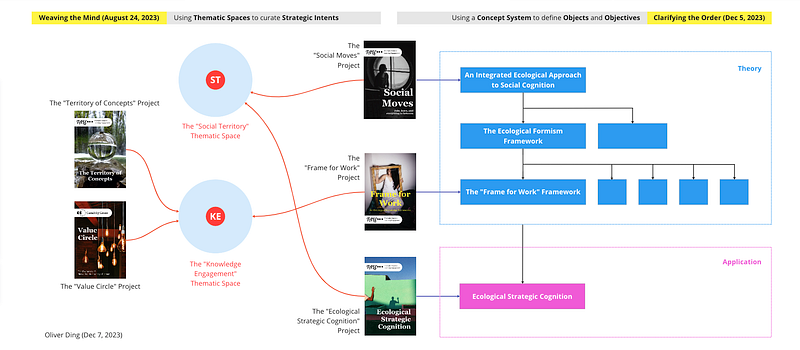
On Dec 5, 2023, I published an article titled Social Moves: An Integrated Ecological Approach to Social Cognition. This is a major milestone of the Social Moves project.
The article reviewed the concept of “Ecological Formism” and used it to develop a new knowledge framework. This decision caused a series of changes in my knowledge projects.
The above diagram represents these changes.
In this article, I will use it as an example to discuss the issue of Strategic Changes.
The above diagram has two parts:
- Left: Weaving the Mind (August 24, 2023)
- Right: Clarifying the Order (Dec 5, 2023)
This is a simple structure: Before | After
I will use this structure to organize this article.
Contents
Part 1: Before — Weaving the Mind
1.1 Thematic Exploration for Early Discovery 1.2 August 24, 2023: A Thematic Scraboard 1.3 The Journey from August to November 1.4 Revisiting Two Thematic Spaces
Part 2: After — Clarifying the Order
2.1 A New Knowledge Challenge 2.2 A New Knowledge Solution 2.3 An Integrated Ecological Approach 2.4 Clarifying the Order with a Hierarchy
Part 3: Discussion — Strategic Changes
3.1 Change Inhibits Further Change 3.2 Strategic Changes 3.3 Curate Stratgegic Intents 3.4 Define Objects and Objectives 3.5 The Evolving Concept System
Part 1: Before — Weaving the Mind
Part 1 discusses the Left side: Weaving the Mind (August 24, 2023).
1.1 Thematic Exploration for Early Discovery
I often curate my mind by diagramming with pictures, text, and signs. From Jan 2023 to August 2023, I developed a new visual diagramming style to connect Themes, Thematic Spaces, and Knowledge Models. I used “Thematic Scarpboard” to name the new type of diagram for thematic exploration and thematic card sorting.
A Thematic Scrapboard has three different types of elements:
- Thematic Cards (pictures)
- Thematic Spaces
- Mental Models
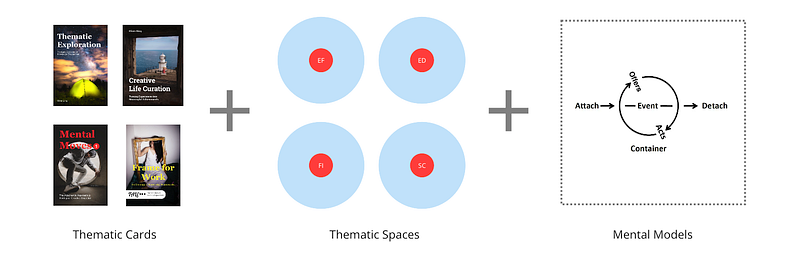
- I used the following rules for this special type of diagramming:
- Using Thematic Cards (Pictures) to represent Possible Themes
- Red dots refer to Thematic Spaces
- A Knowledge Model is used as a context for the diagramming
- Making Personal Tacit Knowledge Visible
- Loose connections between mental elements
I used this method during the phase of the early discovery of a knowledge journey. The diagram below is an example.
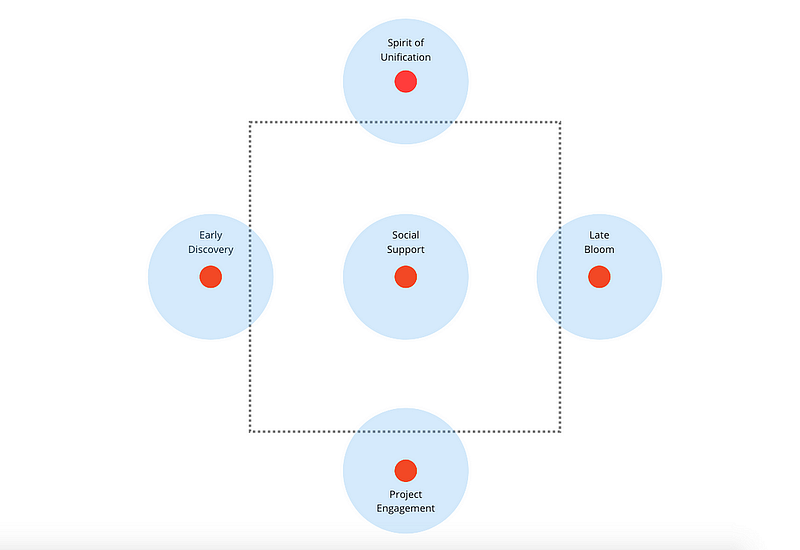
On Oct 5, 2023, I reviewed the Creative Life Theory (v2.0) framework and made the above diagram. I used the sign of Creative Life Theory (v2) as the primary mental model to build the thematic scrapboard and discovered five thematic spaces.
- Early Discovery
- Late Bloom
- Project Engagement
- Social Support
- Spirit of Unification
You can find more details in CALL: The Development of Creative Life Theory (2020–2023, Part 7).
You can also find more examples:
- TALE: A new network of possible themes — April 21, 2203
- TALE: Possible Themes v.s. Possible Books — July 14, 2023
- Creative Life Curation: Discover Thematic Spaces of Creative Life — Nov 2, 2023
I used it as a creative heuristic tool to discover potential thematic spaces for further exploration within a loosely structured context. Also, this tool is part of a toolkit for the Thematic Exploration Framework.

You can find more details in Thematic Exploration: The Early Discovery of Knowledge Engagement (book, v1).
1.2 August 24, 2023: A Thematic Scraboard
In July 2023, I finished the “Mental Moves” knowledge project and edited a possible book titled Mental Moves: The Attachance Approach to Ecological Creative Cognition.
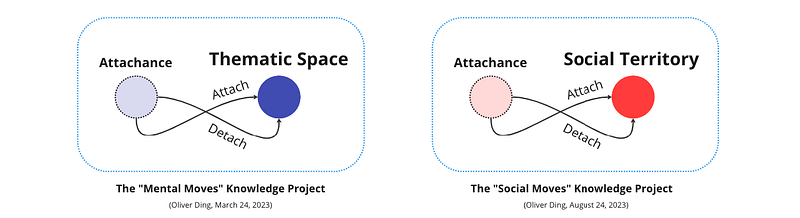
On August 24, 2023, I started the “Social Moves” knowledge project which uses “Social Territory” as the primary concept.
On August 24, 2023, I made the diagram below to weave my mind.
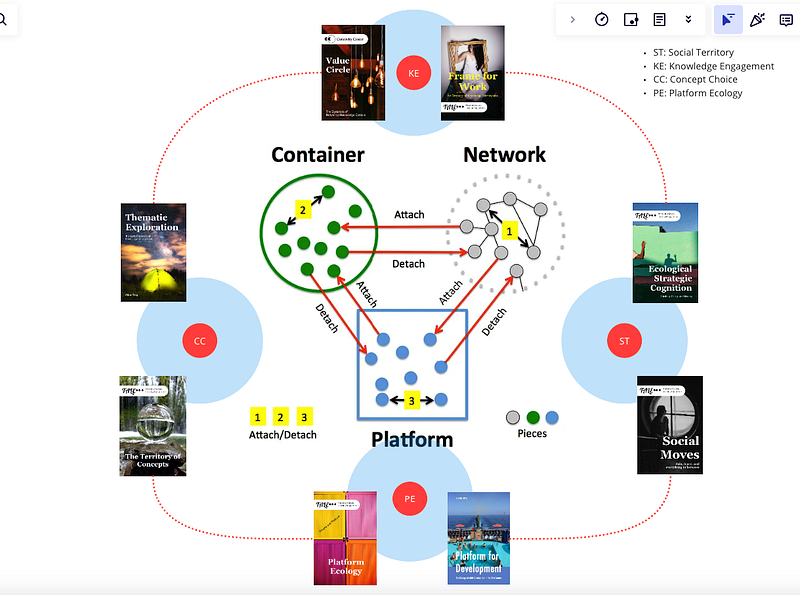
On August 24, 2023, I used the above diagram to highlight some possible themes for further exploration with some possible books and reviewed their status:
- Social Moves (theme) — To Do
- Ecological Strategic Cognition (theme) — To Do
- Frame for Work (theme) — To Do
- Value Circle (project) — Doing
- Thematic Exploration (book) — Done
- The Territory of Concept (theme) — To Do
- Platform Ecology (project) — Doing
- Platform for Development (book) — Done
These themes are curated around the following four Thematic Spaces:
- ST: Social Territory
- KE: Knowledge Engagement
- CC: Concept Choice
- PE: Platform Ecology
The theme “Ecological Strategic Cognition” is about an individual startup founder’s strategic mind while the theme “Social Moves” is about individuals’ creative social action. Thus, they belong to the “Social Territory” thematic space.
The theme “Frame for Work” and the “Value Circle” project are about knowledge models and knowledge centers. They belong to the “Knowledge Engagement” thematic space.
I set a new thematic space called “Concept Choice” to put the theme “Thematic Exploration” and the theme “The Territory of Concepts” together.
Finally, the “Platform Ecology” thematic space refers to the Platform Ecology framework (v3.1) and the book (draft) titled Platform for Development.
1.3 The Journey from August to November
Later, I published a post about the theme of “Social Moves” on Oct 17, 2023.
I used the “Theme > Project > Book” process to manage my journey of knowledge engagement.
I also used Thematic Spaces to connect different themes and explore new possible themes for my knowledge projects.
From July 2023 to Oct 2023, I wrote several articles for the Value Circle project:
- TALE: A Possible Theme called “Value Circle” — July 18, 2023
- Value Circle #1: From “Mental Moves” to “Value Circle” — August 7, 2023
- Value Circle #2: Engaging with Lui’s Theoretical Sociology — August 9, 2023
- Value Circle #3: TALE as A Thematic Transformation Hub — August 31, 2023
- Value Circle #4: From “ARCH” to “Activity Circle” — Oct 11, 2023
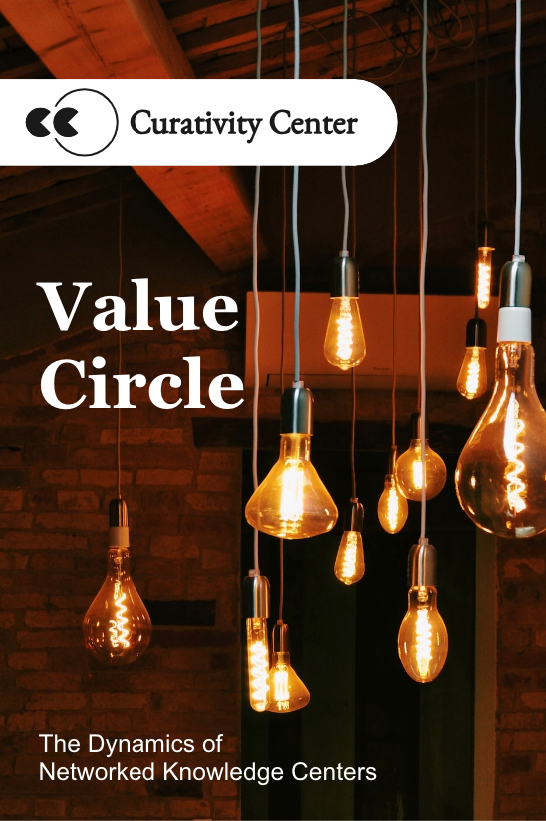
From Jan 2023 to Oct 2023, the concept of “Knowledge Center” was the primary object of my knowledge projects such as the Mental Moves project, the Value Circle project, and the Creative Life Theory project.
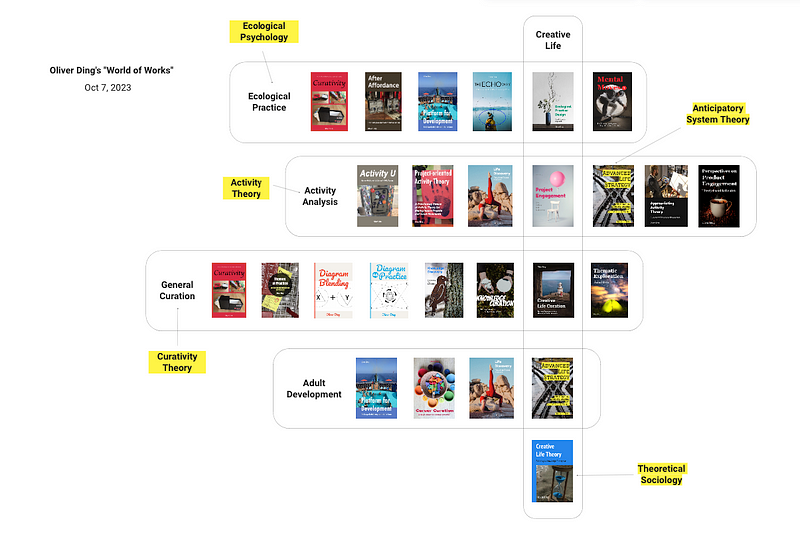
On Oct 6, 2023, I edited a book (draft) Creative Life Theory: Building A Knowledge Enterprise. On Oct 7, 2023, I used the diagram below to represent my “World of Works”.
On Nov 29, 2023, I closed the Territory of Concept project and edited a book (draft) titled Grasping the Concept: The Territory of Concepts and Concept Dynamics. There is no single theory or framework in the possible book. What you will see is a dynamic network of knowledge frameworks. In order words, this is an evolving concept system.
The book is divided into six parts corresponding to the six projects.
- Part 1: The “Territory of Concepts” Project
- Part 2: The “Concept Dynamics” Project
- Part 3: The “Theme (Concept)” Project
- Part 4: The “Social Cognition” Project (The “Thematic Space” Project, the “Social Moves” Project, etc)
- Part 5: The “Platform Genidentity” Project
- Part 6: The “Slow Cognition” Project

A major outcome of the book is the model of an Evolving Concept System.
1.4 Revisiting Two Thematic Spaces
On Dec 7, 2023, I made a diagram below to represent the status of “Theme — Project”.
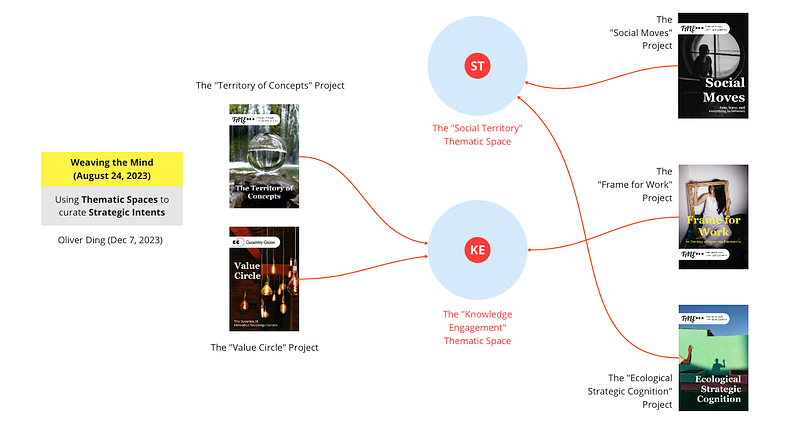
The above diagram only keeps two thematic spaces:
- The “Social Territory” thematic space
- The “Knowledge Engagement” thematic space
I didn’t mention the “Platform Ecology” thematic space. You can find more details about it in Platform Ecology (v3.1).
The “Concept Choices” thematic space led to the book Grasping the Concept: The Territory of Concepts and Concept Dynamics.
In the “Knowledge Engagement” thematic space, we see three projects:
- The Frame for Work project
- The Value Circle project
- The Territory of Concept project
In the “Social Territory” thematic space, we see two projects:
- The “Social Moves” project
- The “Ecological Strategic Cognition” project
What’s the difference between the “Knowledge Engagement” thematic space and the “Social Territory” thematic space?
I started the “Knowledge Engagement” thematic space on June 2, 2022. I also used the term “Knowledge Engagement” as the primary theme of my journey of engaging with Activity Theory.
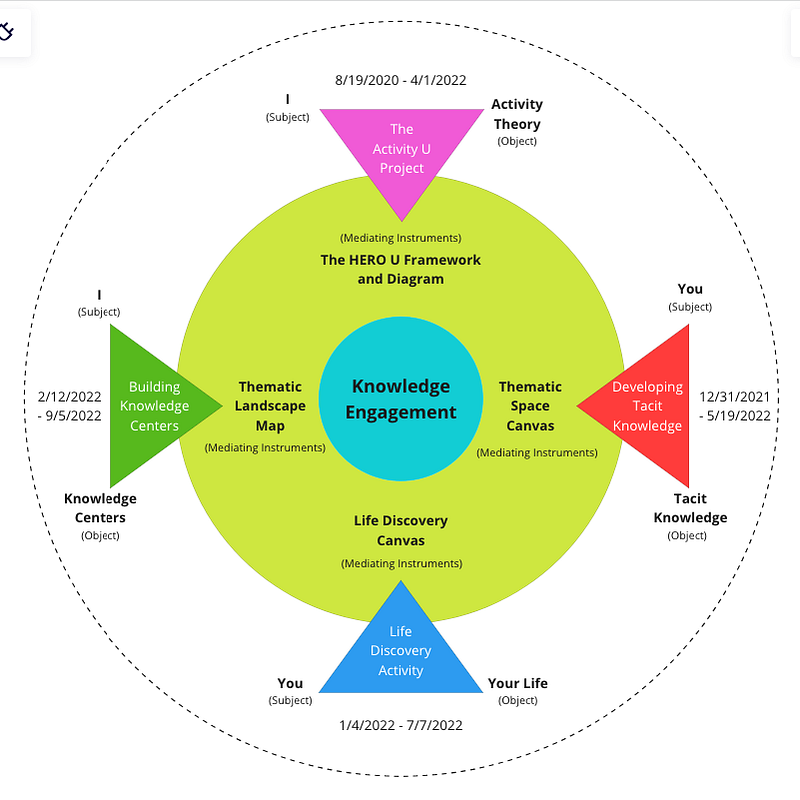
You can find more details in Slow Cognition: Mapping Thematic Journey (Engaging with Activity Theory, 2020–2022).
The “Knowledge Engagement” thematic space was well-developed in August 2023.
In contrast, the “Social Territory” thematic space just started its embryonic stage in August 2023. I made the logo for the Social Moves project on August 24, 2023. See the diagram below.
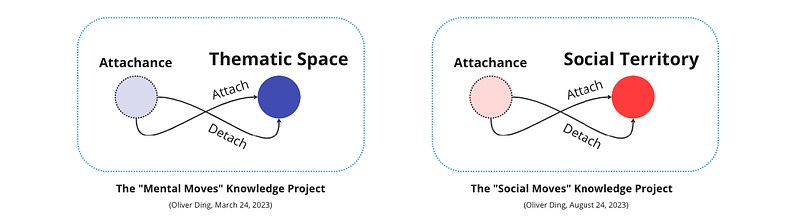
The term “Social Territory” was inspired by Ping-keung Lui’s term “Social Territory” and his Subjectivist Structuralism which is part of his theoretical sociology.
“Knowledge Center” is a type of Social Territory. You can find more details in Knowledge Engagement: The Creative Course Framework.
I use “Social Territory” in general in the “Social Moves” knowledge project.
If we put “Mental Moves” and “Social Moves” together, we see a new unit of analysis of Social Cognition. While “Social Moves” are about Social Actions, “Mental Moves” are about related Mental Activities.
Social Cognition = Social Moves (Mental Moves)
In the Knowledge Engagement thematic space, I have a mature knowledge framework and a primary object.
- Knowledge Framework: The Creative Course Framework
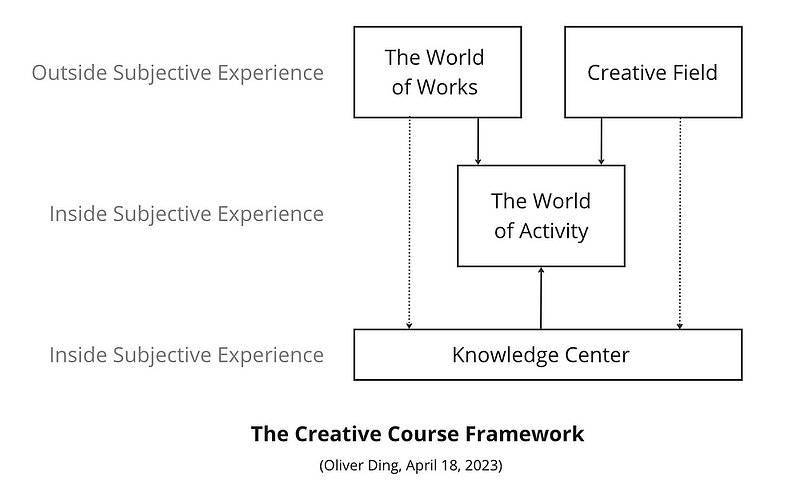
Both the Mental Moves project and the Value Circle project have the same primary object: the concept of “Knowledge Center”.
However, I didn’t have a clear knowledge framework and a primary object for the “Social Territory” thematic space and the “Social Moves” project on August 24, 2023.
Part 2: After — Clarifying the Order
From August 2023 to Dec 2023, I worked on several knowledge projects and developed several knowledge frameworks and some new ideas. For example:
- Themes of Practice: Concept, Activity, and Cognition — Sept 21, 2023
- Advanced Life Strategy: The Microdynamics of Creative Identity — Sept 24, 2023
- Situational Note-taking: The idea of “Meaning Matrix” — Oct 17, 2023
- Projectivity as Cultural Attachance — Oct 30, 2023
- [Creative Diagramming] Graphic Space Affordances, Thematic Space, and Possible Paths — Oct 31, 2023
- Creative Life Curation: Discover Thematic Spaces of Creative Life — Nov 2, 2023
- Psychological Knowledge Engagement and Robert Kegan’s Knowledge Enterprise — Nov 17, 2023
- The Art of Situational Note-taking — Nov 26, 2023
- Mental Platform: The Evolving Concept System — Nov 30, 2023
On Nov 30, 2023, I closed the Territory of Concepts project and edited a book (draft) Grasping the Concept: The Territory of Concepts and Concept Dynamics (Introduction, Table of Contents).
My mind was free again!
2.1 A New Knowledge Challenge
On Dec 1, 2023, I made two diagrams titled “Thematic Space Theory: An Ecological Approach to Social Cognition”.
These two diagrams were based on the “Variant > Quasi-invariant > Invariant > Invariant Set” schema which is related to the “Frame for Work” project.
On Dec 3, 2023, I moved back to the “Frame for Work” project and wrote a note: Creative Life, Thematic Space, and the Social Moves Project.
On Dec 4, 2023, I reviewed an old email about the historical development of the concept of “Thematic Space” and realized that there is a conflict between the “Variant > Quasi-invariant > Invariant > Invariant Set” schema and the “Possible — Actual — Representation” schema.
I didn’t figure out a solution.
2.2 A New Knowledge Solution
On the morning of Dec 5, 2023, while running, I had an idea. I could use them as two frameworks and put them into an integrated approach. This idea should be a good solution to curate the following ideas together:
- “Thematic Space Theory”
- “Social Cognition”
- “Frame for Work”
- “Meaning Matrix”
- “Ecological Formism”
After I got home, I wrote a short private note on my Code doc. In the short note, I gave a rough idea of a new possible book titled Frame for Work.
Then, I started writing a long article.
2.3 An Integrated Ecological Approach
Eventually, I made the Ecological Formism Framework and the Ecological Actualism Framework. After putting them together, I found an integrated ecological approach.
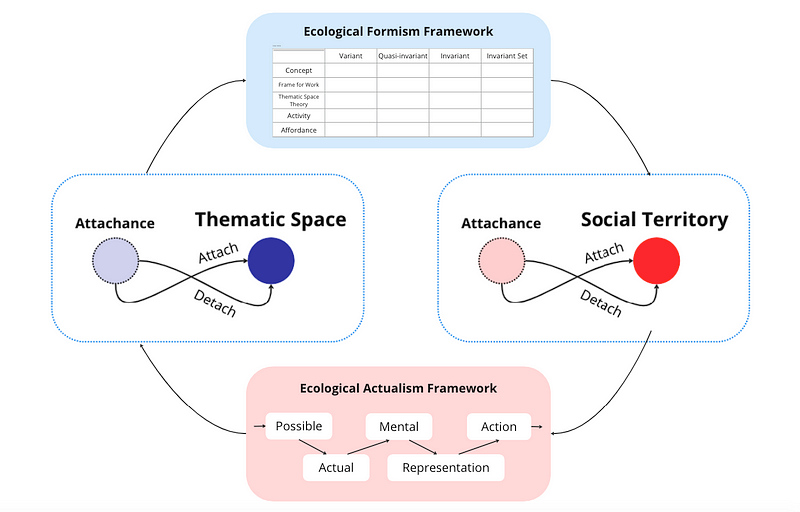
You can find more details in Social Moves: An Integrated Ecological Approach to Social Cognition.
Originally, the Social Moves project, the Frame for Work project, and the Ecological Strategic Cognition project are connected loosely. I considered them as three independent knowledge projects.
However, the integrated ecological approach to social cognition changed their status on Dec 5, 2023.
Now, the “Frame for Work” framework is a row of the Ecological Formism Framework.
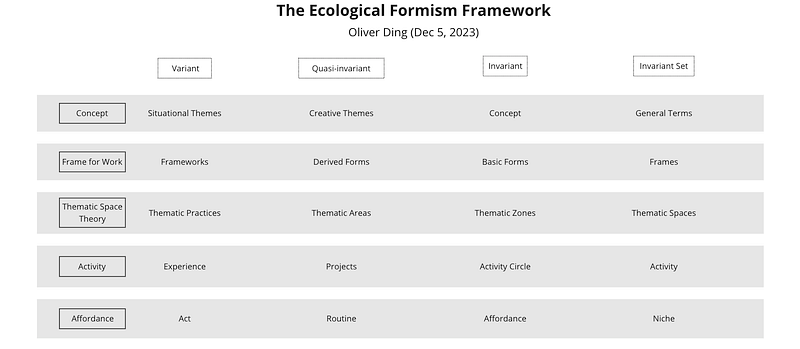
The Ecological Formism Framework is part of the integrated ecological approach to social cognition.
The new integrated framework becomes the primary object of the Social Moves project.
It also can be applied to the Ecological Strategic Cognition project.
2.4 Clarifying the Order with a Hierarchy
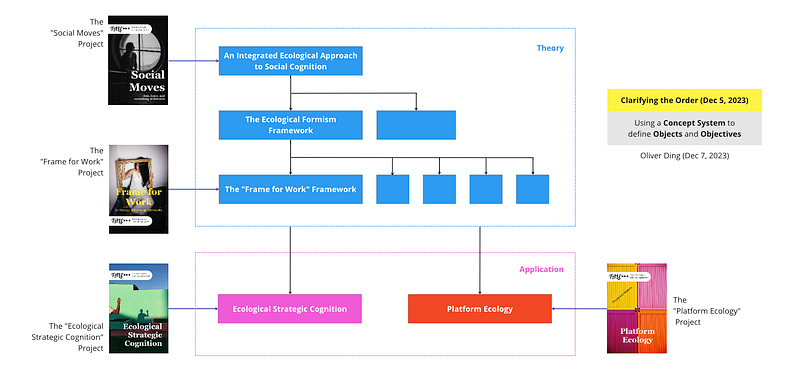
On Dec 5, 2023, I made a clear concept system (a knowledge framework) that defined a primary object and a clear objective for my network of projects. See the diagram below.
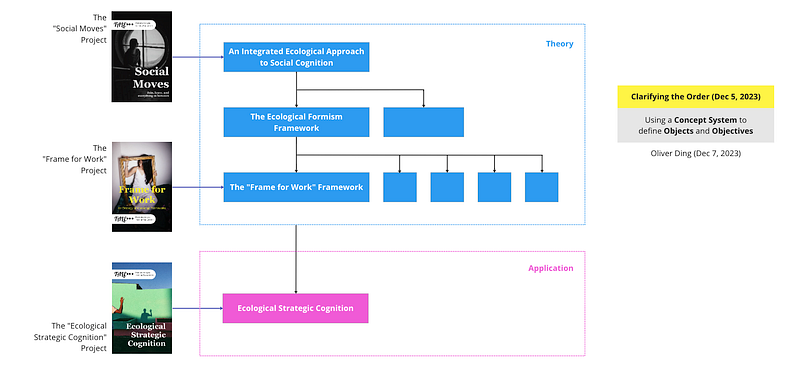
The loosely connected network transformed into a hierarchy.
Now the Social Moves project has a primary object: the integrated ecological approach to social cognition.
It also has two objectives: 1) developing the approach as a new theory, and 2) applying the new theory to the application level, especially in the field of Strategic Cognition.
In the article titled The Theme of “Conceptual Elaboration”, I used the concept of “Ecological Formism” as an example to discuss several issues of “Conceptual Elaboration”.
In the phase of Conceptual Elaboration, there are four critical challenges.
- Internal Integration: curate our pieces of ideas into a meaningful conceptual framework or concept system, understand the Part — Whole relationship
- External Alignment: compare our ideas with other ideas, understand the Collaboration — Competition relationship
- Cultural Projection: match our ideas with cultural needs, understand the Means-End relationship
- All three challenges are related to a deep issue: the Mindset — Meaning relationship.
A creative concept system is a meaningful conceptual framework. The integrated ecological approach uses a hierarchical structure to clarify the order of my network of knowledge projects.
Part 3: Discussion — Strategic Changes
The primary theme of the Mental Moves project is creative cognitive cognition. The primary theme of the Social Moves project is not only about cognitive cognition but also creative actions.
As mentioned above, I used a nested structure to define the basic unit of social cognition:
Social Cognition = Social Moves (Mental Moves)
Following this basic unit, we can get the unit of analysis for the theme of Strategic Changes:
Strategic Changes (Cognitive Change)
In this way, we can expand Howard Gruber’s ideas on Cognitive Changes for the present discussion.
3.1 Change Inhibits Further Change
In Darwin on Man: A Psychological Study of Scientific Creativity (1974), Howard Gruber used Darwin’s creative work to discuss cognitive changes. In Chapter 6 of the book, he discussed the theme of “Identity and the Rate of Cognitive Change”.
The stream of thought is incredibly swift, but the emergence and solidification of new ideas is a relatively slow process. Creative thinking is often treated as an isolated act, but if instead it is treated as a growth process it may be easier to understand why progress is slow.
To understand the rate of change of scientific thought we need to consider many things, among them the factors inhibiting change, the relation between method and rate, and the identity of that which is changing. This last point inevitably refers to groups of ideas which are not changing, or which are changing much more slowly than the change process under scrutiny. Most important of all, a full discussion of rate of change in a system must take into account the new problems the system confronts, by virtue both of its own inner development and of its interaction with the larger milieu in which it functions.(p.114)
Gruber used the evolving systems approach to study creative work. Inspired by his theory and method, I worked on the Slow Cognition project to explore the historical-cognitive approach and the long-term development of thoughts from Jan 2022 to Oct 1, 2022.
Gruber pointed out an important fact about creative cognitive change: change often inhibits further change.
Any special system of ideas undergoing change is at all times part of some larger system with which it is interacting, and in such a fashion that change often inhibits further change. Examples of this kind of relationship are the following:
Communication: As the individual departs from accepted patterns of thoughts, he becomes less capable of communicating with others who have not. But such communication is both the instrument and the goal of change, so that the increase in intellectual distance inhibits further change.
Definition of Problems: As the individual departs from accepted patterns of thought, he moves into areas where basic premises defining soluble problems are less and less clear. Ill-defined problems are hard to solve, and some of them, when clarified, turn out to be insoluble. The time devoted to such matters may be not only unproductive but discuptive as well. Normally, one works within a context that defines soluble problems, and provides methods for solving them and criteria for recognizing solutions. The further one moves from this complex norm, the less likely one is to arrive at an effective solution: change inhibits further change.
Interpretation of Observations: The two examples above illustrate ways in which the very process of change inhibits further change. The existing structure of ideas also protects itself more directly from new elements which might lead to change. Observations which might require change are either neglected or assimilated into existing structures. Thus, even in the face of objective novely, the existing structure inhibits its recognition, inhibits change…
Memory: Similarly, a novel achievement is often unstable simply because there exists as yet no structure into which it can be assimilated. It is therefore neglected or even forgotten — but since some change is eventually engendered, the meaning of the term forgotten must be considered carefully. (p.115)
The fact that “change inhibits further change” can be seen as good or bad. It depends on your perspective and situation.
For the present discussion, my case is about developing a concept system for the Social Moves project which is a knowledge creation project.
My goal is to transform rough ideas into a mature knowledge framework. In this context, I could use the notion of “change inhibits further change” in different ways at different moments.
3.2 Strategic Changes
Inspired by Gruber’s ideas, I developed two principles for the notion of “Strategic Changes” in the context of Knowledge Engagement.
- Emergence First
- Solidification First
At the beginning of the Knowledge Discovery Activity, we can apply the Emergence First principle.
At the end of the Knowledge Discovery Activity, we can apply the Solidification First principle.
Let’s connect these ideas with the Anticipatory Activity System (AAS) framework. See the diagram below.
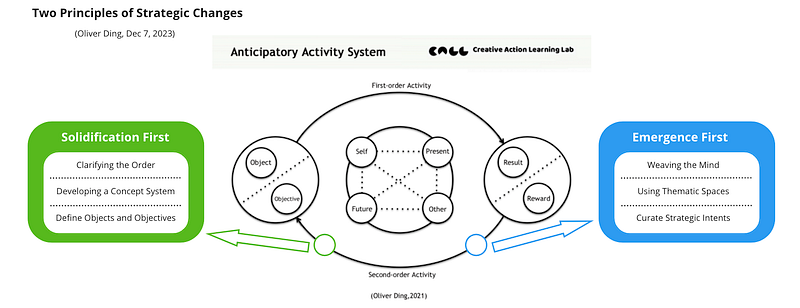
The Anticipatory Activity System (AAS) framework is inspired by Activity Theory, Anticipatory System theory, Relevance theory, and other theoretical resources. The framework is about modeling a specific structure: “Self, Other, Present, Future”.
An Anticipatory Activity System is formed by two parts: First-order Activity and Second-order Activity.
From the perspective of AAS, there are two types of activities in the World of Activity:
- First-order Activity: Knowledge Performance Activity
- Second-order Activity: Knowledge Discovery Activity
Knowledge Discovery Activity is about developing Tacit Knowledge, discovering possible themes, developing concept systems, etc. It is more about Subjectification.
Knowledge Performance Activity is about making solid things of knowledge such as writing an academic paper, publishing a book, making a speech, developing software, etc. It is more about Objectification.
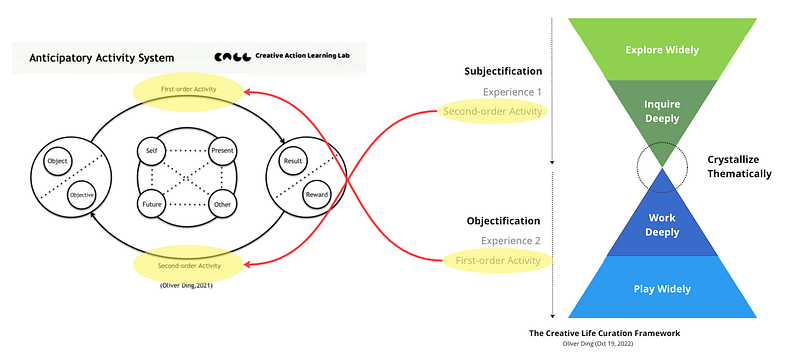
While First-order Activity refers to normal activities which are defined by traditional Activity Theory, Second-order Activity is a specific type of activity in which subjects aim to define objectives and goals for their further activities.
You can find more details in Anticipatory Activity System (AAS) and A Possible Book, Advanced Life Strategy: Anticipatory Activity System and Life Achievements, and The Creative Life Curation Framework.
3.3 Curate Stratgegic Intents
I used “Curate Strategic Intents” for the Emergence First principle. The term was used for the “Strategic Thematic Exploration” Framework.
I use “Strategic Thematic Exploration” to frame a creative space for exploring the strategic intent using thematic analysis methods, especially for knowledge engagement.
In the above working definition of “Strategic Thematic Exploration”, I used the term “Strategic Intent”.
What’s “Strategic Intent”?
I learned the term from Competing for the Future: Breakthrough strategies for seizing control of your industry and creating the markets of tomorrow (Gary Hamel and C.K. Prahalad, 1994).
According to the authors, they use the term to describe an animating dream that energizes a company (pp.129–130).
Strategic intent is strategic architecture’s capstone. A strategic architecture may point the way to the future, but it’s an ambitious and compelling strategic intent that provides the emotional and intellectual energy for the journey. Strategic architecture is the brain; strategic intent is the heart. Strategic intent implies a significant stretch for the organization.
Whereas the traditional view of strategy focuses on the “fit” between existing resources and emerging opportunities, strategic intent creates, by design, a substantial “misfit” between resources and aspirations.
As the distilled essence of a firm’s strategic architecture, strategic intent also implies a particular point of view about the long-term market or competitive position that a firm hopes to build over the coming decade or so. Hence, it conveys a sense of direction. A strategic intent is differentiated; it implies a competitively unique point of view about the future. It holds out to employees the promise of exploring new competitive territory. Hence, it conveys a sense of discovery. Strategic intent has an emotional edge to it; it is a goal that employees perceive as inherently worthwhile. Hence, it implies a sense of destiny.
Direction, discovery, and destiny. These are the attributes of strategic intent.
The authors claim that the three attributes of strategic intent are Direction, Discovery, and Destiny. We can apply these attributes to “Strategic Thematic Exploration” too.
I also pay attention to the difference between Strategic Intent and Strategic Architecture, “Strategic architecture is the brain; strategic intent is the heart”. We can apply the same metaphor to “Theme v.s. Concept”.
- Theme > Heart
- Concept > Brain
We don’t only consider the semantic relationship between themes, but also the genetic relationship between them. While the semantic relationship is associated with the part of “themes”, the genetic relationship is associated with the part of “practice” which means the real historical development of projects.
The term “Loose coupling” is inspired by Karl E. Weick who is an American organizational theorist. If you visit Wikipedia, you can pay attention to the following paragraph:
Loose coupling in Weick’s sense is a term intended to capture the necessary degree of flex between an organization’s internal abstraction of reality, its theory of the world, on the one hand, and the concrete material actuality within which it finally acts, on the other.
A loose coupling is what makes it possible for these ontologically incompatible entities to exist and act on each other, without shattering (akin to Castoriadis’s idea of ‘articulation’).
Orton and Weick argue in favour of uses of the term which consciously preserve the dialectic it captures between the subjective and the objective, and against uses of the term which ‘resolve’ the dialectic by folding it into one side or the other.
Thematic Engagement is both subjective and objective, the “Loose coupling” model is a typical configuration of a theme network. In this way, we can have the necessary degree of flex between the semantic relationship and the genetic relationship.
You can find more details in TALE: Possible Configurations of A Theme Network.
3.4 Define Objects and Objectives
The AAS is a self-referential system. The Second-order Activity produces Objects and Objectives that define the First-order Activity. Also, the First-order Activity produces Results and Rewards that support the Second-order Activity.
The end of the Knowledge Discovery Activity should define Objects and Objectives for further Knowledge Performance Activities such as editing a book.
This is a dynamic developmental process!
Concepts and Frameworks are Objects of the Activity of building a knowledge enterprise. Closing a project, and editing a book are my Objectives for each knowledge project.
The changes in Objects will cause the changes in Objectives.
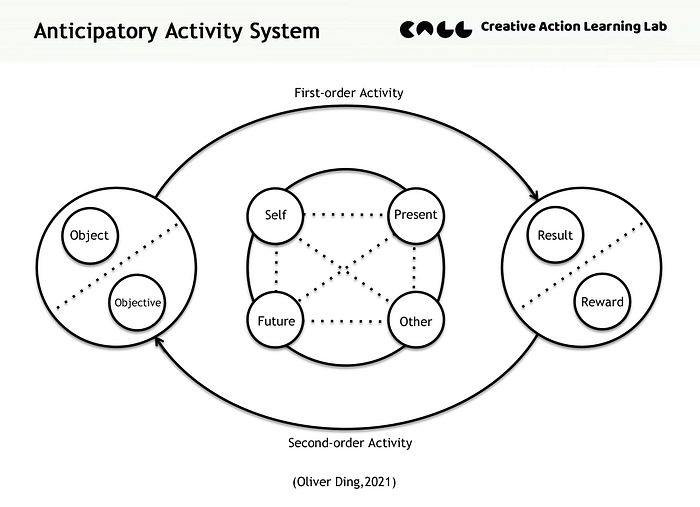
The above diagram is the standard model of the Anticipatory Activity System framework. It was formed by the following pairs of concepts:
- Present — Future
- Self — Other
- Object — Objective
- Result — Reward
- First-order Activity — Second-order Activity
You can find more details from D as Diagramming: Strategy as Anticipatory Activity System.
For the Anticipatory Activity System framework, we have to use two terms because Objective (what is motive about) is about the Future while Object (what is acted on) is about the Present.
Moreover, Objective is related to Anticipation while Object is related to Performance. They refer to two types of complexities. See the diagram below.
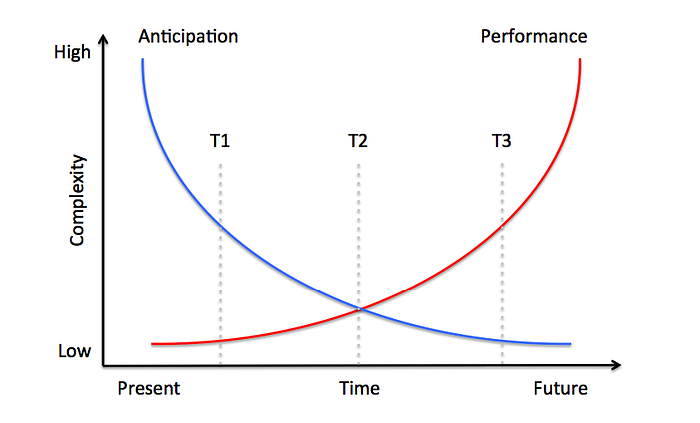
In the beginning, an Objective projects our anticipation about the future, and the complexity of anticipation is high because we don’t know if we can achieve the objective. At the end of an activity, the complexity of anticipation becomes low because the outcome is there.
However, the complexity of Performance on Object is a different trajectory. In the beginning, we do less work on an Object. Then, the complexity of interaction with Objects is getting higher and higher.
The Object — Objective Gap is not a bug, but a wonderful key for unlocking the deep secret of the Anticipatory Activity System. You can find more details in Life Discovery: The “Object — Objective” Gap and Attachment and Life Discovery: The “Means — End” Spectrum and Becoming.
3.5 The Evolving Concept System
In Part 2, I have mentioned a new concept system called the Integrated Ecological Approach to Social Cognition.
Now let’s see another new concept system that is associated with the Social Moves project.
On August 24, 2023, I made the diagram below.
The center of the diagram is called “the Network — Container — Platform Move” perspective.
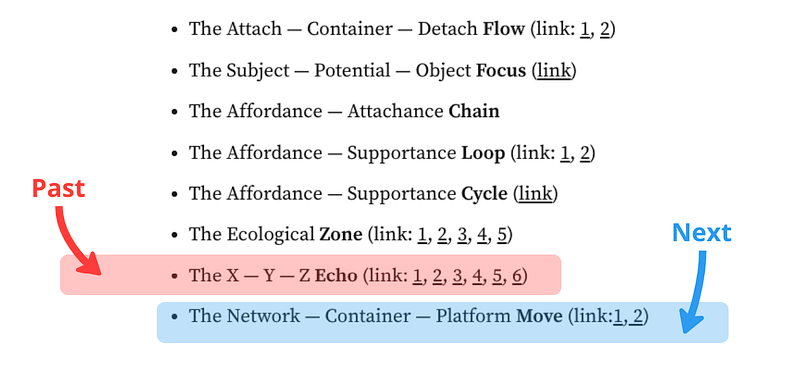
On August 17, 2023, I wrote the article titled The Ecological Practice Design Toolkit (V2, 2023) and recognized that the X-Y-Z Echo (see the above screenshot) is the most popular model!
In contrast, I didn’t frequently use the Network — Container — Platform Move.
On August 23, 2023, I realized that I should use it as the knowledge model for curating the set of possible themes. This notion led to the thematic scrapboard on August 24, 2023.
Later, I used it to make a new framework for Developing A Concept System on Nov 4, 2023.
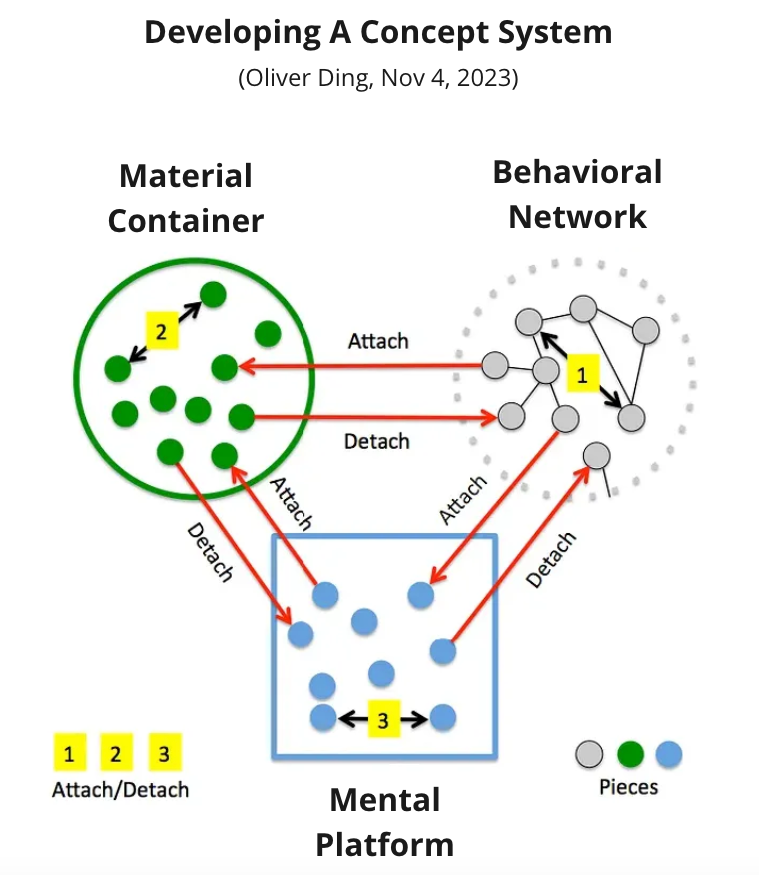
The above basic model was expanded into a large knowledge framework on Nov 25, 2023. See the diagram below.
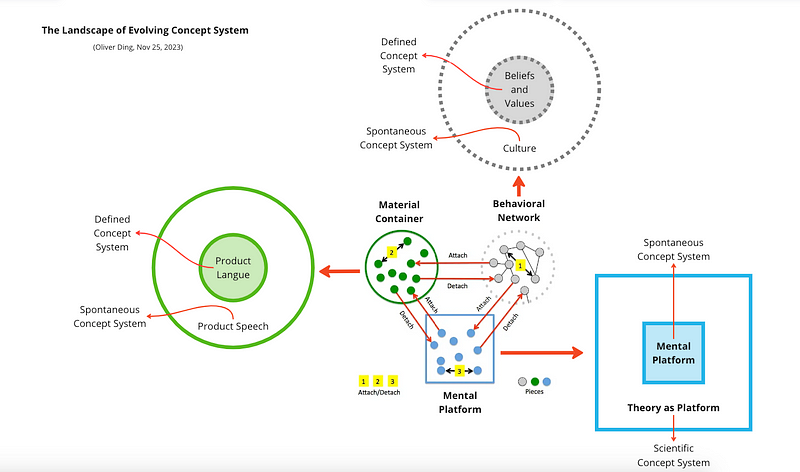
You can find more details in Mental Platform: The Evolving Concept System.
I had the new idea in mind on Dec 5, 2023.
So, the Meaning of the Center of the thematic scrapboard (August 24) was changed on Dec 5, 2023.
What’s the relationship between the Evolving Concept System and the Social Moves project?
See the diagram below.
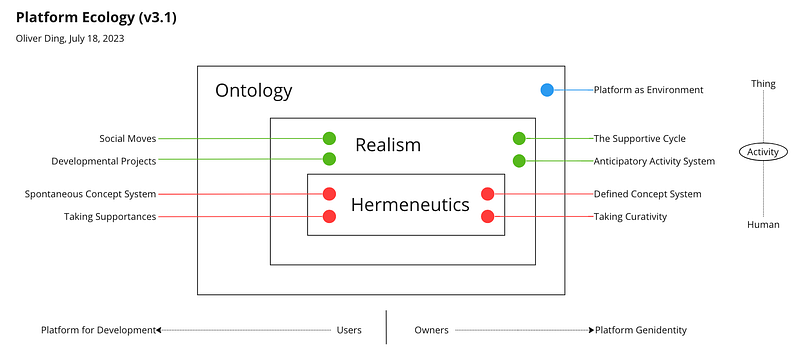
On July 18, 2023, I made the above diagram for the Platform Ecology project.
Why did I put the theme “Social Moves” on the above diagram?
A Platform is a social environment in which people move between different social spaces.
I did not put “The Evolving Concept System” on the above diagram. However, you can see the following terms:
- Spontaneous Concept System
- Defined Concept System
From April 2023 to August 2023, I worked on a strategic design research project about a Web 3.0 platform. A by-product of the project is the idea of “Spontaneous Concept System”.
The Evolving Concept System is a bridge between Mental Moves and Social Moves.
- Mental Moves is about developing concept systems which refers to Mental Platform
- Social Moves is about Behavioral Network and Material Container
In this way, we consider the Platform Ecology project as a sub-project of the Social Moves project.
This is a fantastic strategic change!
Related books (drafts)
- Creative Life Theory: Building A Knowledge Enterprise
- Mental Moves: The Attachance Approach to Ecological Creative Cognition
- Knowledge Discovery: Developing Tacit Knowledge with Thematic Space Canvas
- Knowledge Curation: Turning Pieces into A Meaningful Whole
- Life Discovery: Biography, Journey, Program
- Perspectives on Product Engagement
- Diagramming as Practice
- Diagram Blending: Building Diagram Networks
- Creative Life Curation: Discover Thematic Spaces of Creative Life


