
The ECHO Way: Waterfall, Bridge, and Creative Life
A metaphor for the ECHO Way

In June 2020, I published an article titled HERO U — A New Framework for Knowledge Heroes. This is the beginning of my creative journey of developing Creative Life Theory.
From August 2020 to March 2021, I used the HERO U framework to guide the Activity U project which is about curating theoretical resources of Activity Theory into a meaningful whole. The project produced three books (drafts): Activity U, Project-oriented Activity Theory, and Platform for Development.
In April 2021, I joined an online program and shared my reflection about the HERO U framework and the Activity U project. Eventually, I wrote a new book called THE ECHO WAY in Chinese in April. It is a 312-page draft.
The book is about The ECHO Way (v1.0).
Later, I applied the HERO U framework to other domains such as Platform Innovation, Personal innovation, and Youth Development. In fact, I just reused the source of the HERO U framework: WXMY (When X Meets Y), a diagram for visualizing boundary innovation.
On June 30, 2021, I introduced the Echo Way (v2.0) and expanded it from Knowledge Curation to Boundary Innovation.
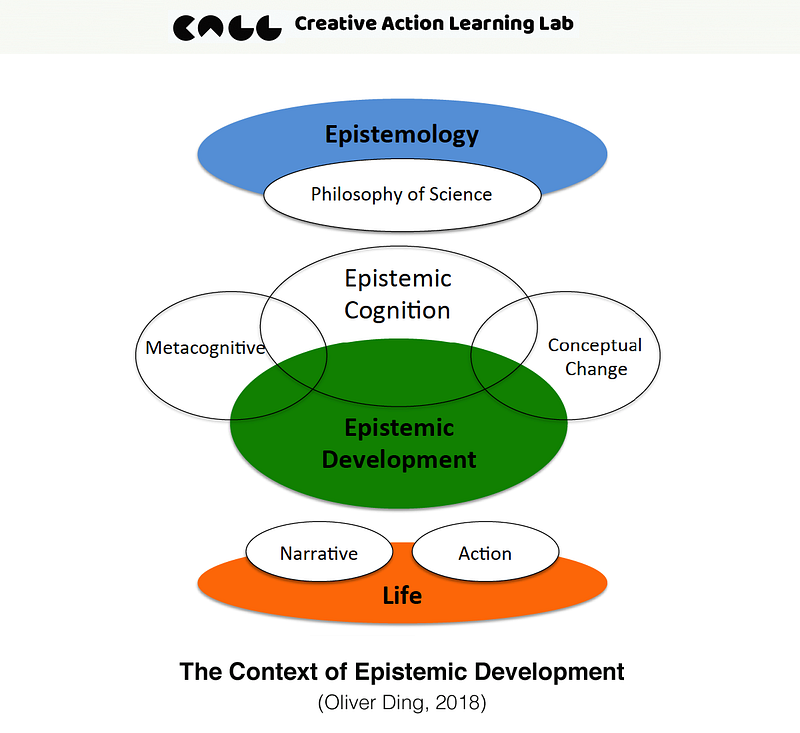
On Oct 7, 2022, I claimed that the ECHO Way (v2.0) is a solution to Epistemic Development in D as Diagramming: From Sandwich to Containers.
In Feb 2022, I applied the ECHO Way (v2.0) to Life Discovery Activity.
Life Discovery is a “cross-the-gap” activity that aims to explore a new place in a certain direction. There is a spatial distance between the existing place and the expected place where we want to be.
We can consider Life Discovery as Boundary Innovation because it is about a dialogue between the Present (the existing place) and the Future (the expected place).
Let’s apply the ECHO Way (v2.0) to the “Present — Future” fit for the Life Discovery Activity. We can roughly use three phases for this process:
- Life U: Think with the Theme U diagram.
- Project I: Act with the Developmental Project model.
- Echo Z: Reach the end of the journey: an expected place.
You can find more details in Life Discovery: The “Present — Future” Fit and The ECHO Way.
In 2023, I applied the ECHO Way to reflect on a 10-day road trip and conducted a case study of “Creative Life Curation”. You can find more details in The ECHO Trip: A 10-day Road Trip and Creative Life Curation.
From 2022 to 2023, I worked on developing the Creative Life Curation project and the Knowledge Engagement project. The outcome is a new theoretical approach to knowledge creators’ life course: Creative Life Theory.
In the book (draft) titled Creative Life Curation, I developed Creative Life Theory (v1.0) which considers the following five units of analysis.

1. Creative Actions 2. Creative Projects 3. Creative Journey 4. Creative Landscape 5. Creative Lifescope
The framework also highlights the following three types of “Curativity”:
- Curativity 1: Turning pieces of Projects into a Journey as a meaningful whole
- Curativity 2: Turning pieces of Projects into a Landscape as a meaningful whole
- Curativity 3: Turning pieces of Actions and Projects into a Lifescope as a meaningful whole
It’s an open framework!
If we can discover a new significant aspect of Creative Life and develop a corresponding method, we can add Curativity 4 and related keywords to the diagram.
Or, we can add Curativity 1.5 or Curativity 2.5 to the diagram.
In the past several weeks, I realized that “Creative Dialogue” is a significant aspect of Creative Life. For example, I developed the Mapping Thematic Dialogue method in Sept 2022. From 2020 to 2022, I worked on Activity Theory and Ecological Psychology. I faced the challenge of maintaining a boundary between these two theoretical approaches. However, I found the zone of boundary is a great creative space for developing new ideas. Eventually, I used the WXMY model to develop a thematic dialogue between two theories.
So I decided to add “Creative Dialogue” as a new unit of analysis to Creative Life Theory.
The ECHO Way is a concrete framework that is used in the “Creative Dialogue” unit of analysis. We can also find other relevant frameworks.
So, I am going to collect a series of articles about relevant frameworks about the “Creative Dialogue” unit of analysis and edit a new possible book titled Mapping Creative Dialogue.
This article aims to introduce a metaphor for the ECHO Way.
An Ecological Metaphor
I have used several pictures for the ECHO Way and Creative Dialogue.
On Oct 1, 2022, I wrote a short note about Creative Journey and designed the following picture.
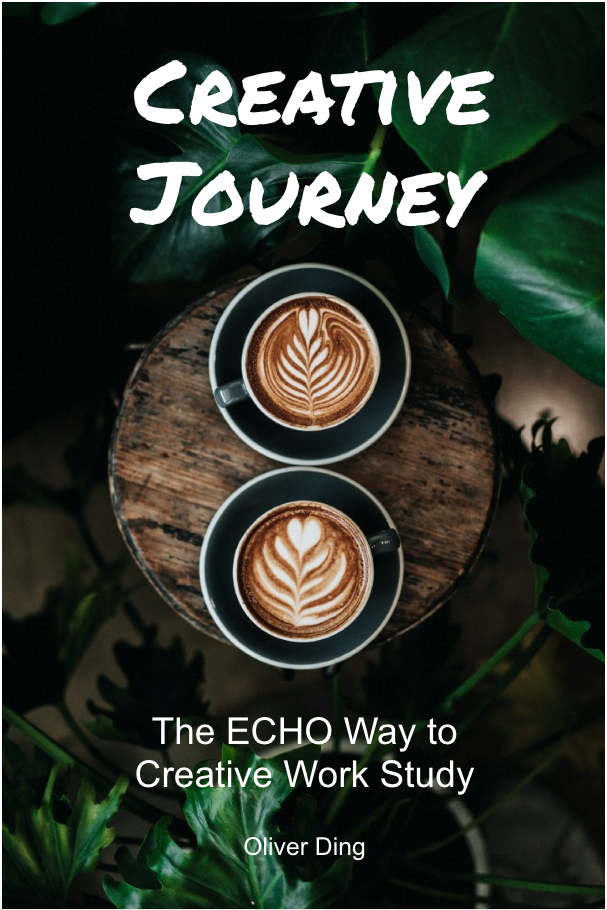
I used two cups of coffee as a metaphor to represent the meaning of the ECHO Way (v3.0) model for Creative Cognition.
I also used the picture below in Life Discovery: The “Present — Future” Fit and The ECHO Way.
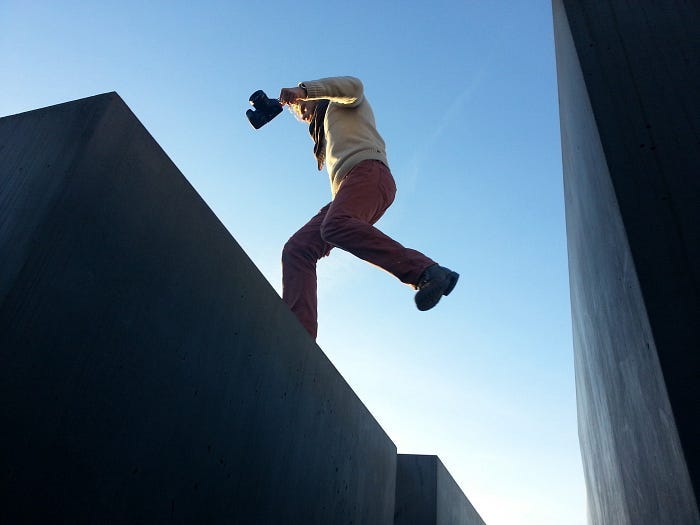
The above picture uses two builds to represent a gap and a “cross-the-gap” activity.
There is a spatial distance between the existing place and the expected place where we want to be.
We can consider Life Discovery as Boundary Innovation because it is about a dialogue between the Present (the existing place) and the Future (the expected place).
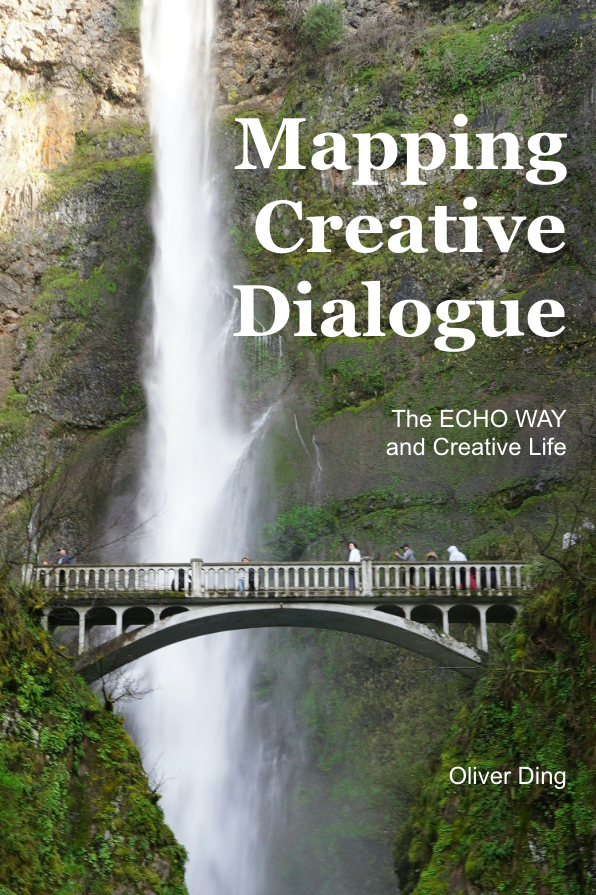
Finally, I found an ideal metaphor for the ECHO Way. See the picture below.
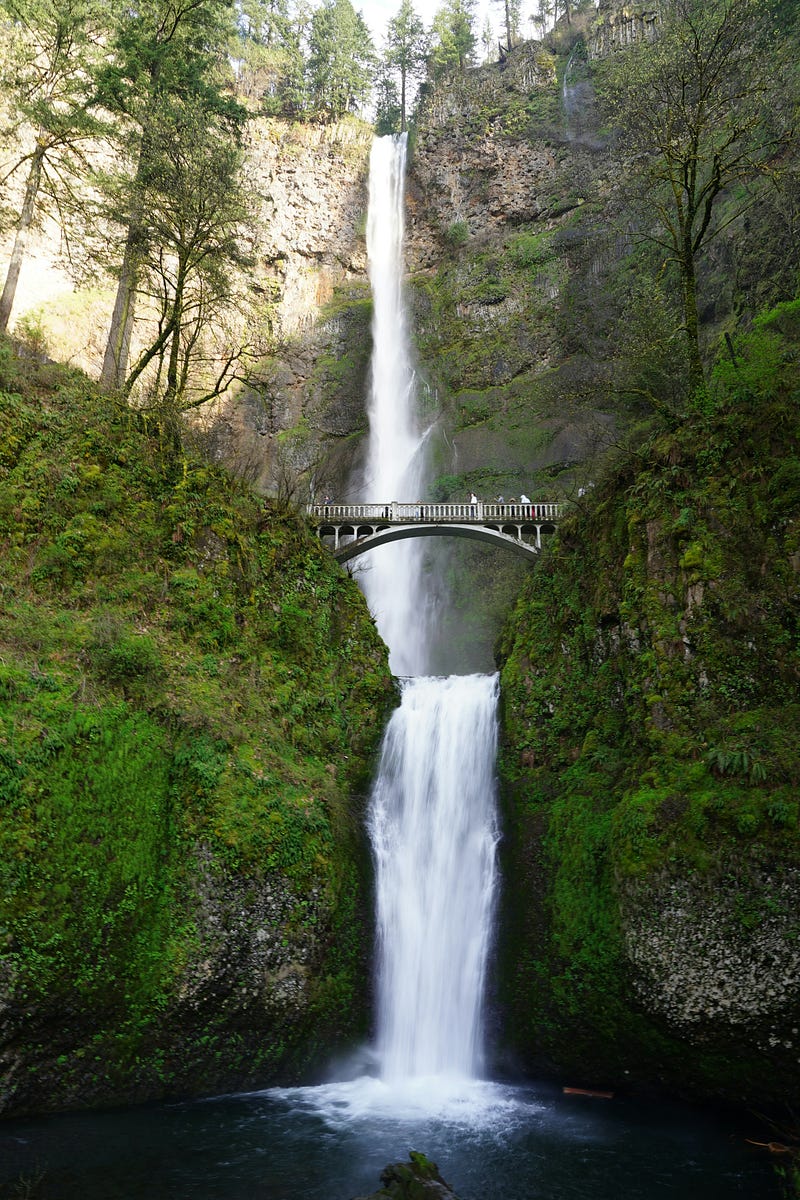
Bridge + Waterfall = The ECHO Way!!!
This is a great ecological metaphor!
I use the term “ecological metaphor” to refer to a metaphor including two types of meanings: 1) subjective experiences, and 2) objective conditions.
- Bridge: it refers to a gap which is an objective condition
- Waterfall: it refers to an activity which is a subjective experience
Bridge can be seen as a metaphor for Theme U while Waterfall can be seen as a metaphor for Project I.
Bridge, Gap, and Opposite Themes
The metaphor of Bridge refers to two objects or entities and a gap or distance between them.
X____Y
From the perspective of the Ecological Formism Framework, this is a Basic Form of Framework.
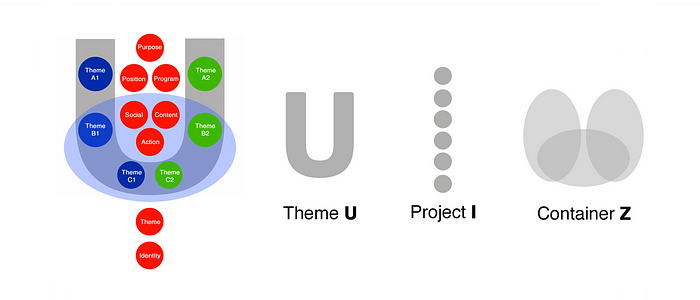
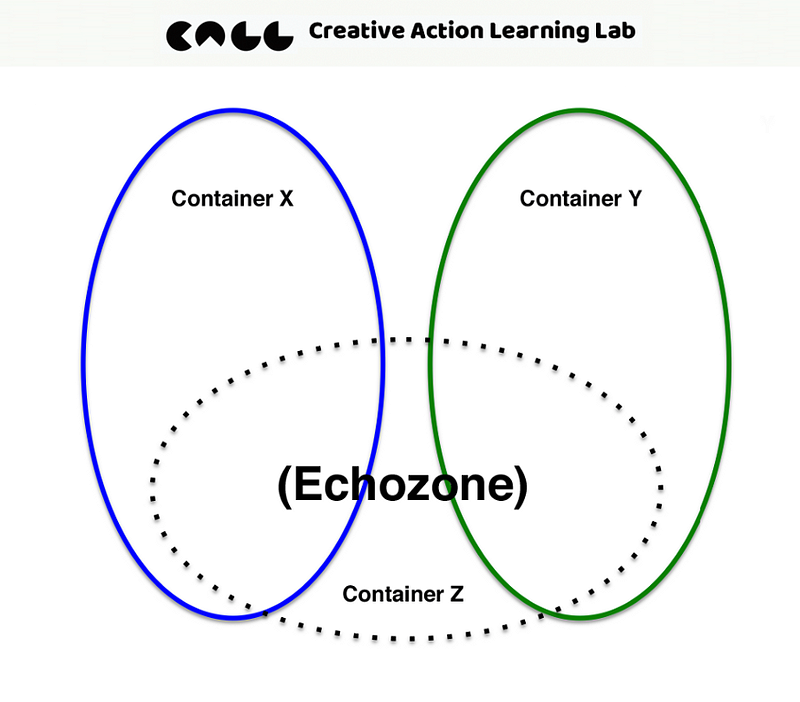
The X____Y Basic form could be represented by different diagrams such as Theme U and WXMY. The Theme U diagram is used to display six themes in a U shape. The WXMY diagram is used to frame a creative space by using three containers.
It could lead to Derived Forms such as the Echozone model, the ARCH model, and the Activity Circle model. In the present discussion, we only focus on the Echozone model.
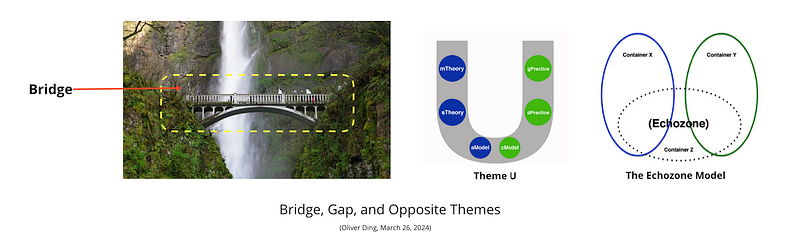
The Theme U diagram is a meta-diagram representing a unique spatial structure without touching domain-specific content.
The unique spatial structure of Theme U is perfect for displaying opposite themes. For example, Three levels can be used to define three Dimensions. The diagram below shows an example of using Theme U to display Pairs of Opposite Themes. For each dimension, you can select two themes that form a pair. For example, Theme A1 and Theme A2 are a pair of opposite themes that share Dimension A.
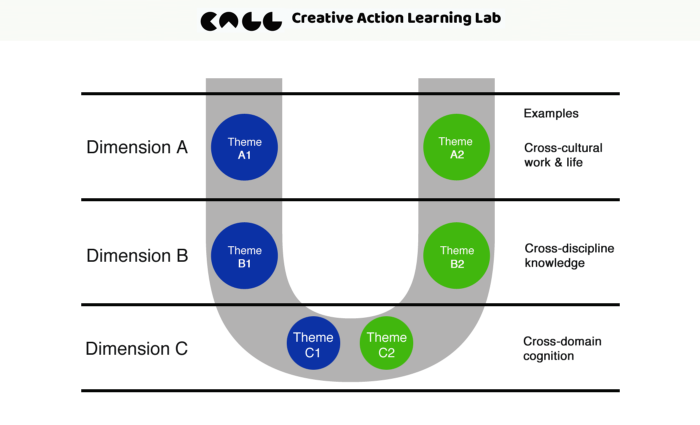
I use the above diagram to discuss my personal innovation. I defined the following dimensions for curating three pairs of opposite themes of my career experience.
- Dimension A: Cross-cultural work & life
- Dimension B: Cross-discipline knowledge
- Dimension C: Cross-domain cognition
You don’t have to use these examples of dimensions since you have your unique career experience.
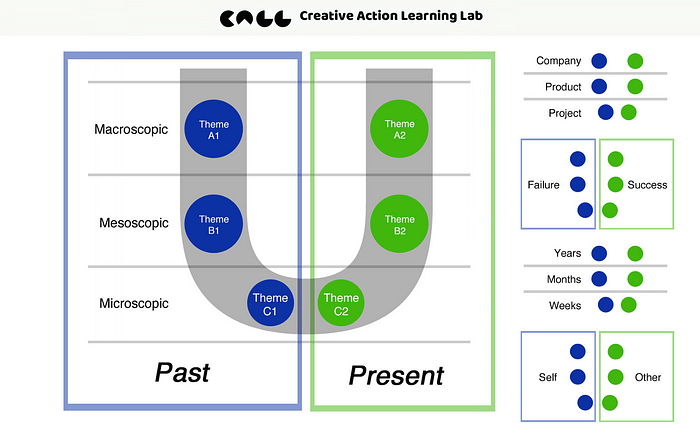
In addition to three dimensions, the Theme U diagram uses Left Field and Right Field to group themes.
By combining Dimensions and Fields, you can make a configuration of your themes with the Theme U diagram. The above diagram shows some examples of dimensions and fields. You can define your dimensions and fields too.
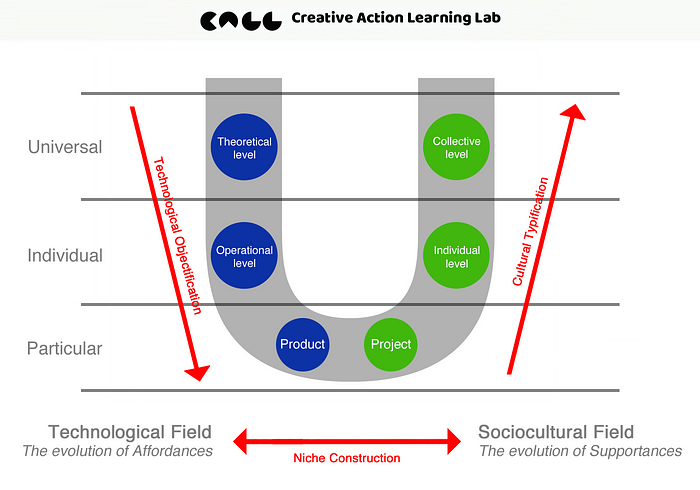
You also connect themes to define Paths. The above diagram shows an example of using Paths for conceptual development. See more details about this case in Platform Innovation as Concept-fit.
The WXMY diagram is an advanced way to use the Theme U diagram. It uses one container to connect two containers.
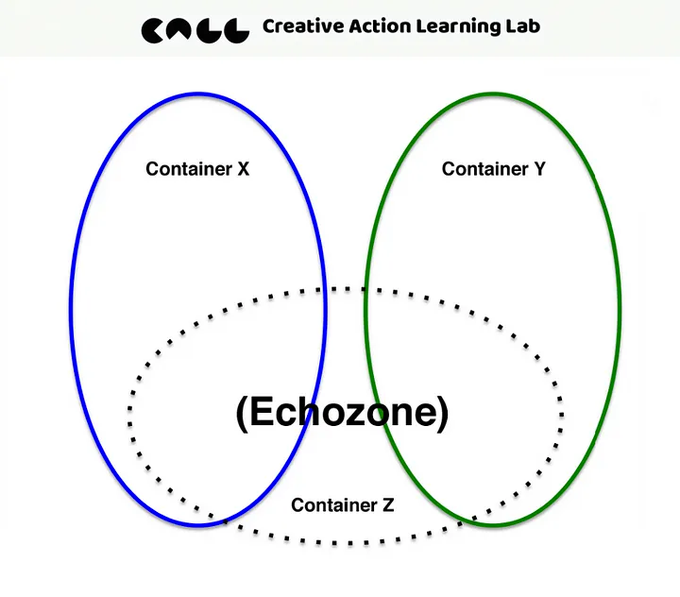
We can also place six themes in three containers. See the original WXMY framework below.
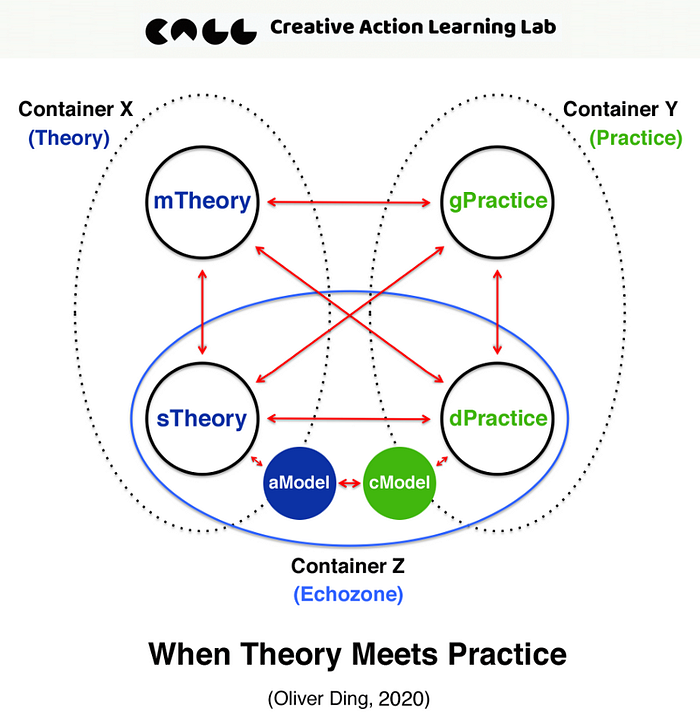
I often used a simple version of WXMY. See the example below.
Moreover, we can expand the third container by adding more themes. See the example below.
In most cases, I only pay attention to the third container ECHOZONE which is considered the “Figure” and the space outside the ECHOZONE as “Ground”.
However, it is also possible to connect the opposite themes at the “Ground”. See the example below.
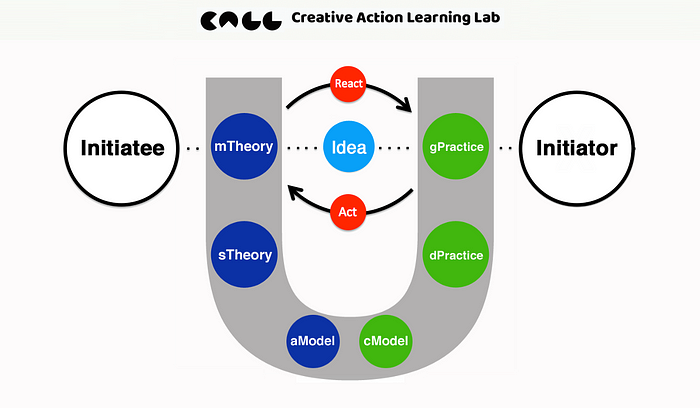
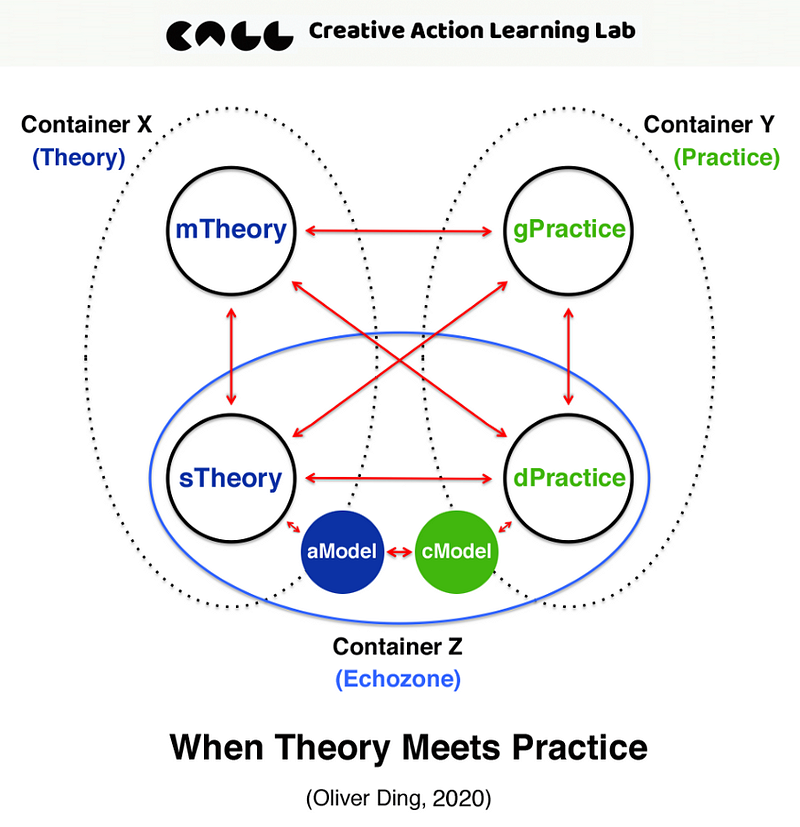
You can also discover Creative Connections between Theme A1 and Theme A2. For example, the above diagram is an application of the HERO U diagram (see below). Theme A1 refers to mTheory (Meta-theory) and Theme A2 refers to gPractice (General Practice).
How can we connect Meta-theory and General Practice since these two are located at two different levels of abstraction? You can find my solution in D as Diagramming: Meta-theory and General Practice.
Theme U and WXMY are used to present Pairs of Opposite Themes that could lead to Structural Tensions such as boundary, distance, difference, heterogeneity, contradiction, and complementation. If we can turn one or more structural tensions into creative opportunities, then we could find a way of innovation.
However, this is half of the whole story.
Flow, Project, and Model
As mentioned above, the ECHO Way is a practical framework that blends several diagrams.
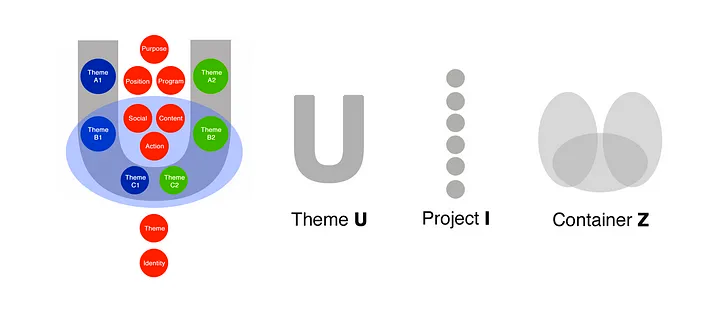
While Theme U is used to represent Objective Conditions by using opposite themes, Project I is used to represent Subjective Experiences by running developmental projects.
The metaphor of Waterfall represents the Flow of Life Experiences.
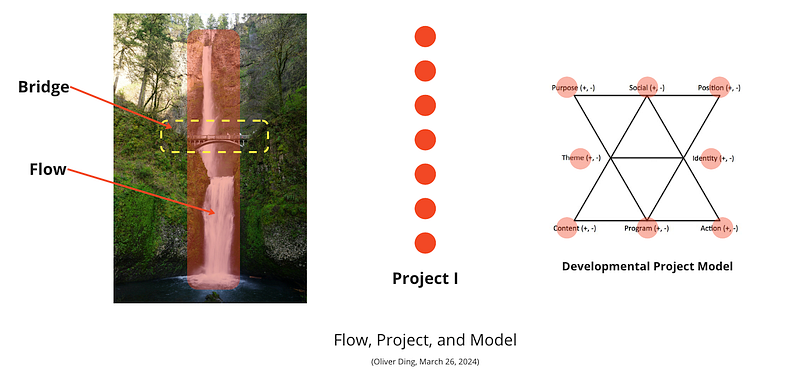
I use “continuous flow” as a metaphor to describe Life and Experience. This metaphor is inspired by William James’ metaphor “Stream of Thought”.
In fact, James used a group of metaphors around the notion of “Stream of Thought”. According to Jeffrey V. Osowski, the following other metaphors or images were part of the stream family (1989, p.132): train, chain, path, current (both water and electric), channel, line (with segments), procession, kaleidoscope, and fabric. “By using these metaphors, James was able to capture the concepts of continuity, constant change, direction, connectedness, pace, rhythm, and flow, all of which were important characteristics of thought or consciousness.”
James used the stream metaphor to reject the British empiricists’ view of consciousness which refers to the chain or train metaphor. According to James:
“Consciousness, then, does not appear to itself chopped up in bits. Such words as “chain” or “train” do not describe it fitly as it presents itself in the first instance. It is nothing jointed; it flows. A “river” or a “stream” are the metaphors by which it is most naturally described. In talking of it hereafter let us call it the stream of thought, of consciousness or of subjective life. (vol. 1, p.239)
What James emphasized is the Subjective Life. I follow this metaphor and directly use Life as a continuous flow to describe a person’s subjective experience of his own life. You can’t use a knife to cut a stream, you only can use a container to contain it.
The water doesn’t have a form which also means structure, but the container has a form. The form of our experience is perceived as an interaction between our immediate actions and ecological situations such as physical environments and social environments.
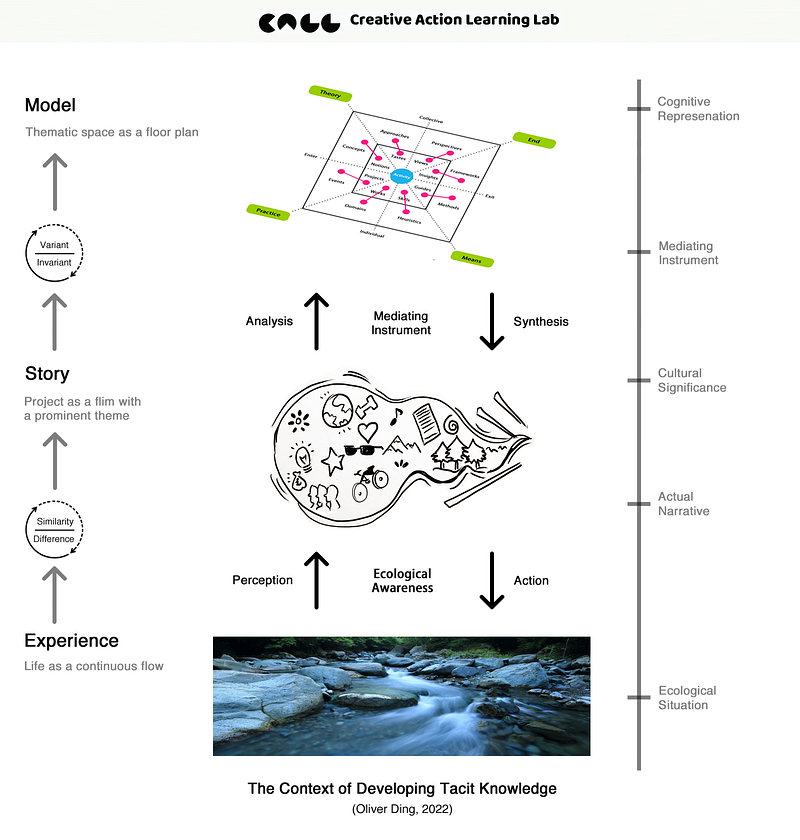
A Project is a container of the continuous flow of life experiences. We could share a Project by telling a Story. We could also use a Model to understand the pattern behind the Project and the Story.
I often use the Developmental Project Model to design and explain a Project. See the diagram below.
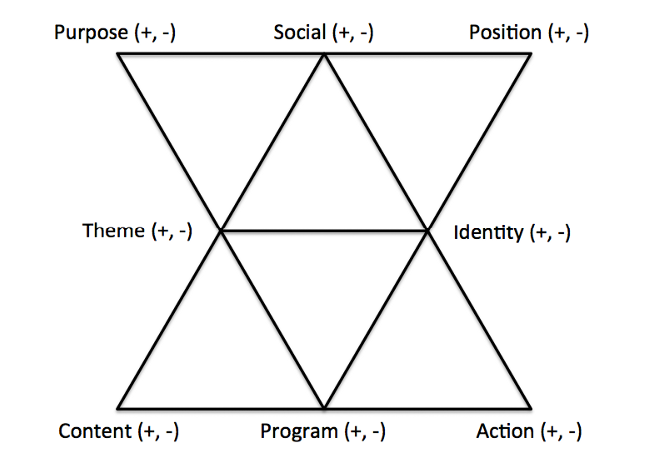
The above picture is the standard diagram of the Developmental Project Model. It uses eight elements to describe a developmental project:
- Purpose: Why do you want to initiate or join the project?
- Position: What’s the social structure of the project?
- Program: Does the project have formal organizational processes?
- Social: How do you connect with others due to joining the project?
- Content: How do you acquire new information and knowledge due to joining the project?
- Action: What do you do due to joining the project?
- Theme: Do you find some new and interesting themes for your career development?
- Identity: How do you perceive your identity before and after joining the project?
If we turn these elements into Project I and combine them with Theme U, then we get the Career-fit diagram.
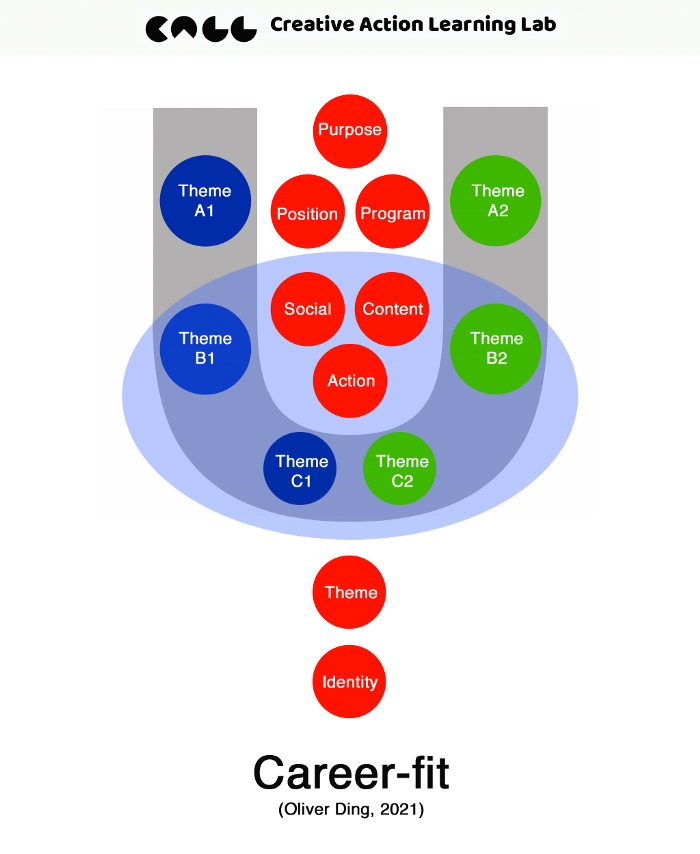

The diagram looks like U+I=Ψ. The Ψ is a Greek capital letter psi. It is often used as a symbol of psychology.
The final diagram can be considered as “an ecological approach” to career development because it refers to the structure of “organism (personal themes of career) — action (fitting) — environment (impact projects)”.
The eight elements of Project I form three groups as a process of transformation.
- The first group is defined as Situational Context which highlights three important aspects of Developmental Projects: Purpose, Position, and Program.
- The second group is defined as Developmental Resources which highlights three types of potential opportunities for Developmental Projects: Social, Content, and Action.
- The third group is defined as Impact by Projects which considers personal development caused by joining Developmental Projects from two dimensions: Theme and Identity.
Your identity is about how others view “what you do” and “who you are”. It’s also part of your self-knowledge. From the perspective of the Project Engagement approach, Identity is an element of a Developmental Project Model and it’s related to other elements.
Every time, you join a Project or leave a Project, your identity always changes. This is what I call the Microdynamics of Identity.
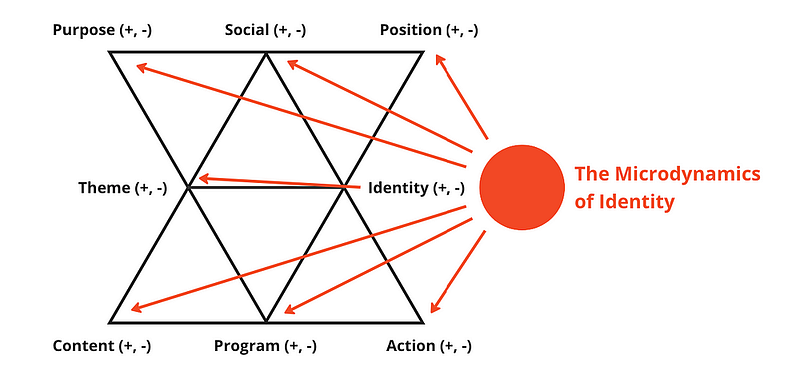
Life is a chain of projects, it is also a projection of social life.
By adopting the Developmental Project model, we have a way to reflect on the development of personal life and social life in one unit of analysis. We can connect psychology, sociology, and others.
When The Bridge Meets the Waterfall
The third part of the ECHO Way is the ECHOZONE part. Let’s see an example.
I started the Activity U project in August 2020. Activity Theory or the “Cultural-historical activity theory (CHAT)” is an interdisciplinary philosophical framework for studying both individual and social aspects of human behavior.
I selected some creations of Activity Theorists and made the Activity U diagram.
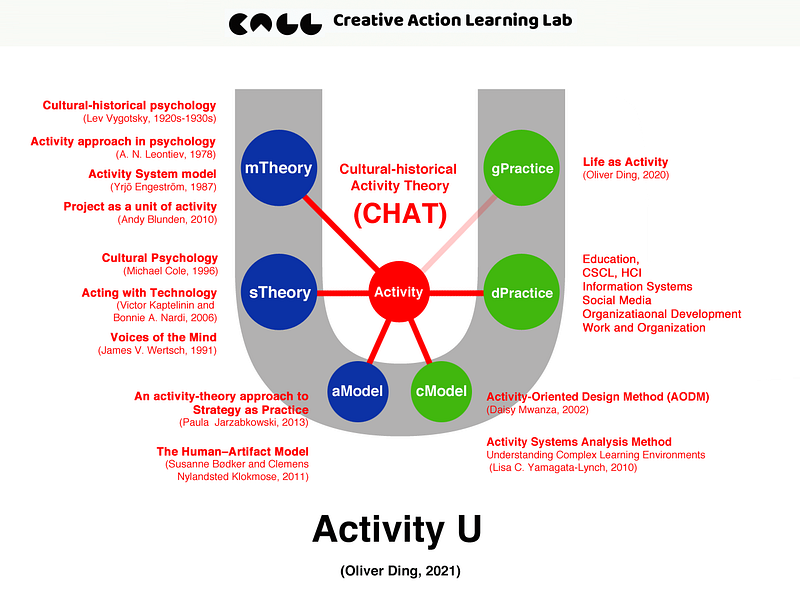
Initially, I just made the above diagram to test the “HERO U” framework. I wrote a post to explain the diagram “Activity U”. The original title of the post is Activity U: The Landscape of Activity Theory. Later, I added “(Part I)” to the end of the title. The project expanded from one post to a series of articles.
My primary actions were reading and writing. I originally published long articles on Medium. Later, I curated them into three books. A simple test became a Developmental Project!
The diagram below uses the Developmental Project Model to reflect on my experience of the project.
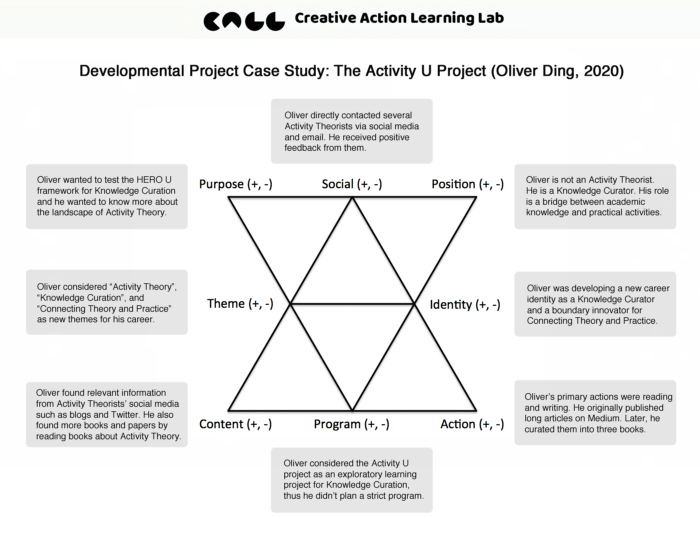
The most amazing part of the Activity U project is the ECHOZONE part. See the diagram below.
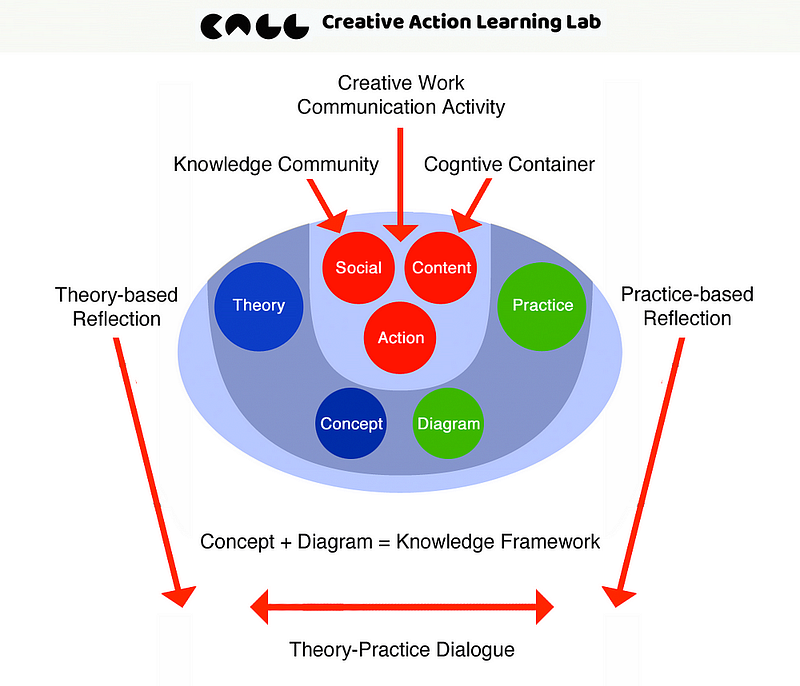
The above diagram presents fits of two pairs of opposite themes. The “Theory v.s. Practice” fit is described with three movements:
- Practice-based Reflection: building rough models with intuition.
- Theory-based Reflection: improving models with theoretical resources.
- Theory-Practice Dialogue: turn models into frameworks and test them with case studies.
The article Platform Innovation as Concept-fit offers a real example of these three steps.
The “Concept v.s. Diagram” fit is described with one formula:
- Concept + Diagram = Knowledge Framework
This formula was defined by the HERO U framework. I used the formula to guide my creative works on developing theoretical frameworks.
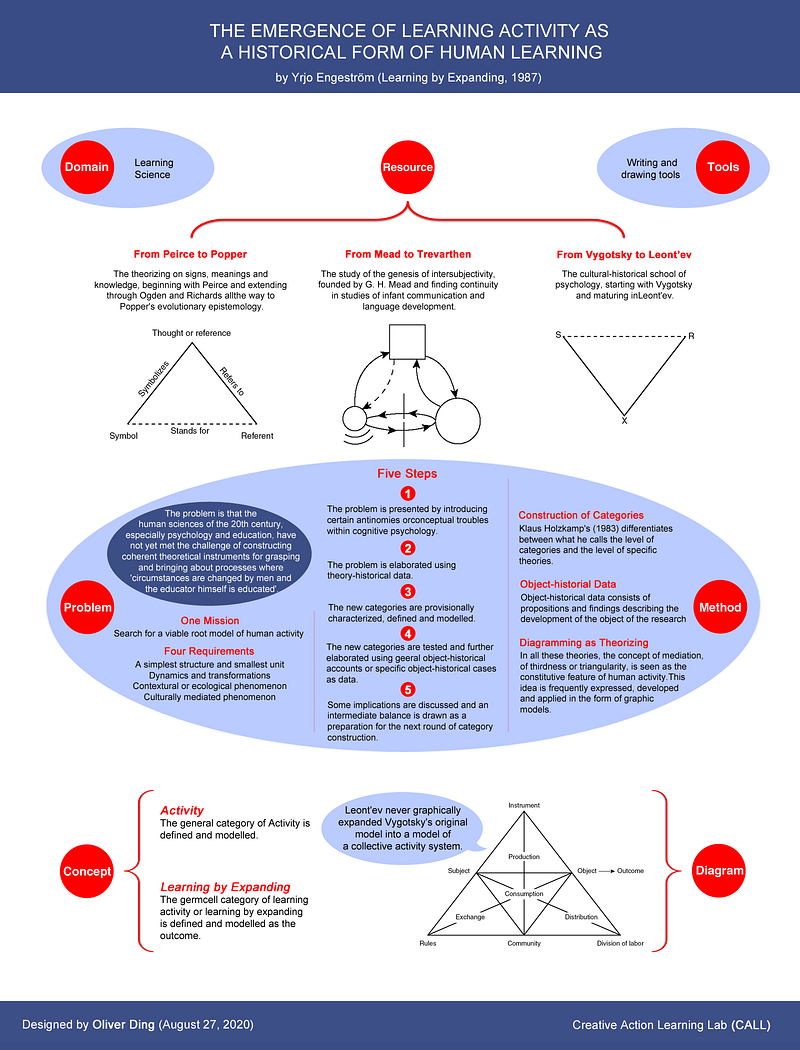
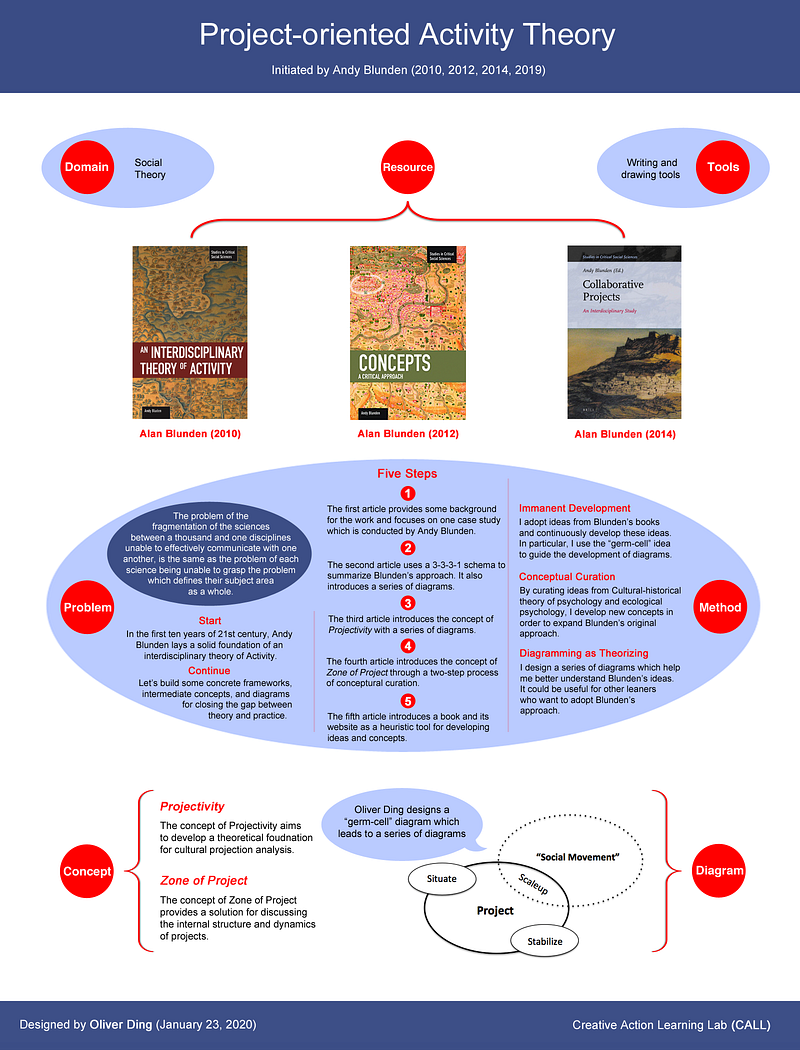
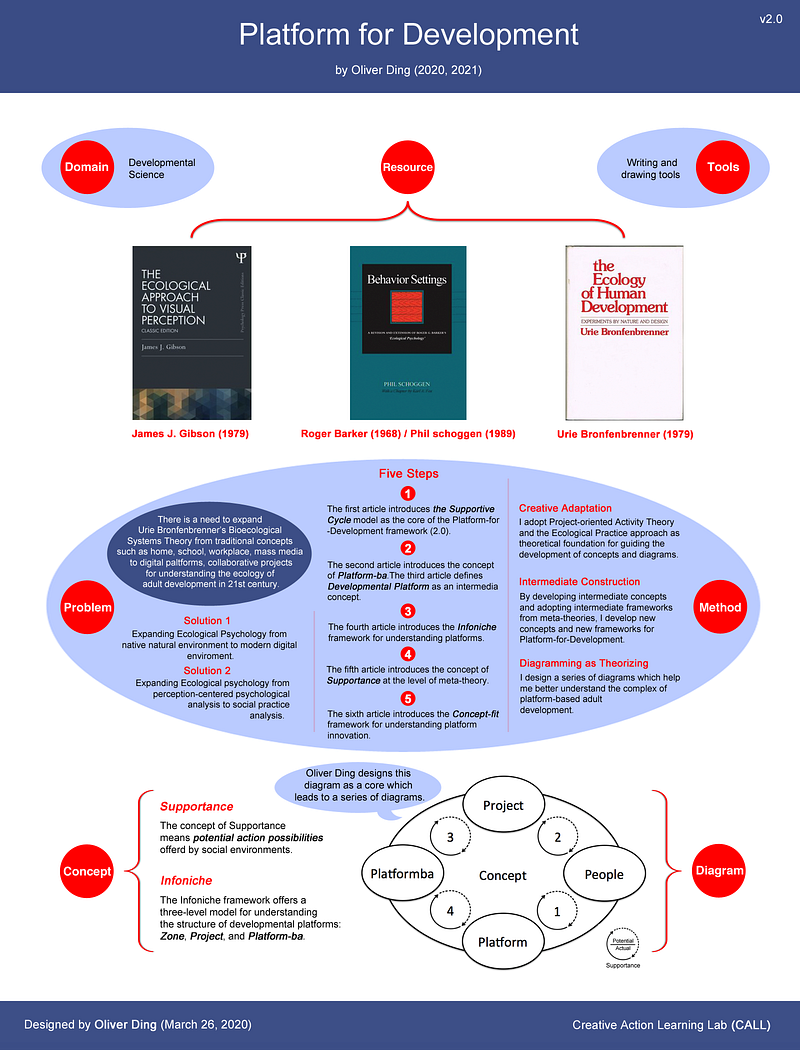
You can find more details from the following links:
- Activity U (IV): The Engeström’s Triangle and the Power of Diagram
- Project-oriented Activity Theory (Book)
- Platform for Development (2.0)
The above diagram of Echozone also presents three inspirations triggered by the Activity U project.
- Social > Knowledge Community
- Action > Creative Work Communication Activity
- Content > Cognitive Container
The red ball “Social” means connecting to someone by joining or initiating development projects. In order to run the Activity U project, I directly contacted several Activity Theorists via social media and email. I received positive feedback from them. Since Activity Theory is an established theoretical tradition, there is a knowledge community around the theory. By connecting to one or several members of the community, I could build a connection between the Activity U project and the community.
The red ball “Action” means my real actions and possible actions. During the past months, my primary actions were reading and writing. I originally published long articles on Medium. Later, I curated them into three books. However, I found Activity Theory also offers me a new perspective on understanding “Action” and related topics. I started looking for and defining a new form of Activity for my work and research. Also, I adopted the concept of “Mediation” from Activity Theory and used it to rethink the Knowledge Activity, especially the activity of using concepts, diagrams, and knowledge frameworks in practical workplaces. Eventually, I coined a new term called “Creative Work Communication Activity” for my further research.
The red ball “Content” means information offered by Developmental Projects. For the Activity U project, I found relevant information from Activity Theorists’ social media such as blogs and Twitter. I also found more books and papers by reading books about the theory. I also searched for videos about Activity Theory on YouTube and diagrams about the theory on Google Images. These experiences offer me an opportunity to test my idea of “Cognitive Container” which is part of my theoretical framework: Curativity Theory. For knowledge curation, the Cognitive Containers are Genre, Framework, Model, Concept, Papers, Conference, Workshop, Genre, Media, etc.
These three ideas are emergent career themes. I used them to guide exploratory learning activities in April 2021.
We can also use a simple version of ECHOZONE, see the diagram below.
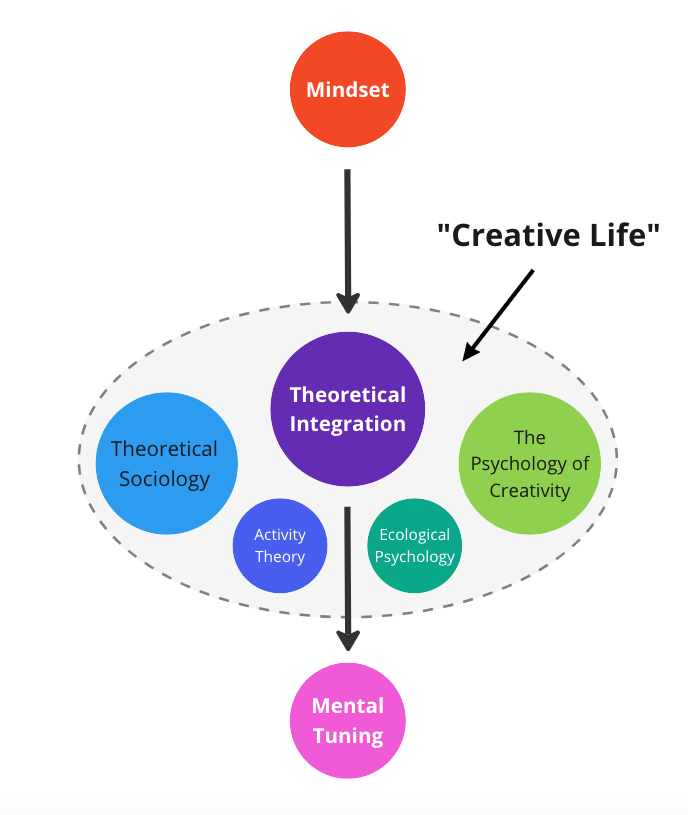
On Sept 9, 2023, I applied some techniques I learned from Theoretical Sociologists to run a theoretical integration project about the concept of Mindset. You can find more details in Knowledge Engagement: The Concept of Mindset and Theoretical Integration.
The outcome is fantastic!
I made a Configurational Theory of Mindset and a new meta-framework called the Mental Tuning Framework.
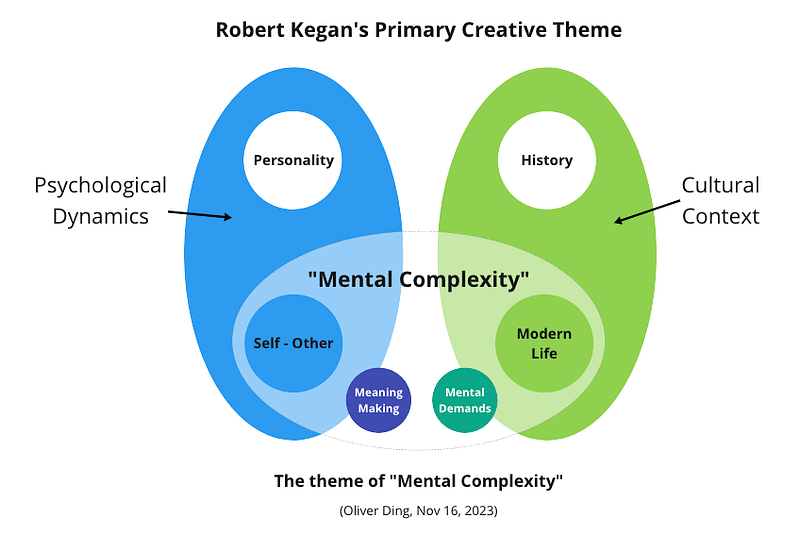
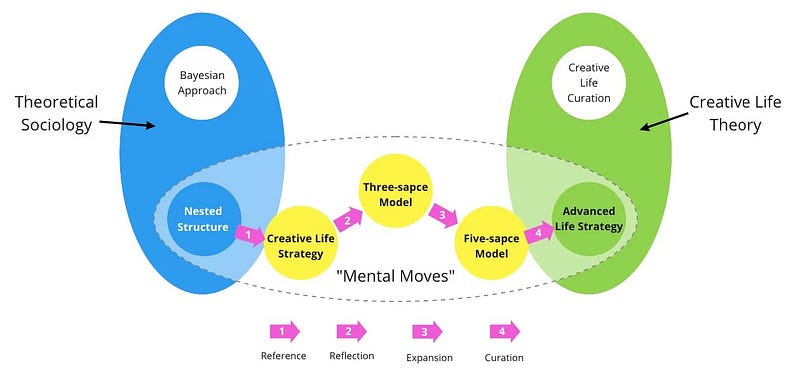
The above diagram represents the ECHOZONE of the Mindset project. You can find more details in Advanced Life Strategy: The Microdynamics of Creative Identity.
The Basic Form of Creative Dialogue
As mentioned above, the metaphor of Bridge refers to two objects or entities and a gap or distance between them.
X____Y
From the perspective of the Ecological Formism Framework, this is a Basic Form of Framework.
The X____Y Basic form could be represented by different diagrams such as Theme U and WXMY. The Theme U diagram is used to display six themes in a U shape. The WXMY diagram is used to frame a creative space by using three containers.
The Ecological Formism Framework is an epistemological framework that frames six units of analysis from four types of knowing.
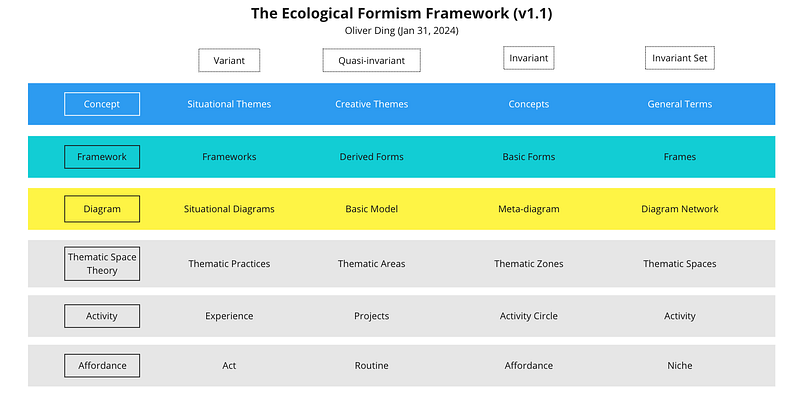
The “Concept” level is about the transformation between themes and concepts.
The “Framework” level is about the emergence of knowledge frameworks.
The “Diagram” level is about the External Visual Representations of knowledge frameworks.
The TST level (the “Thematic Space” level) is a middle level that connects “Activity” and “Framework”.
The “Activity” level is about different patterns of actions.
The “Affordance” level is related to the Operation level of Activity.
The Ecological Formism Framework uses “Variant > Quasi-invariant > Invariant > Invariant Set” as the foundation to define four types of entities for knowing:
- Invariant: Basic Forms
- Invariant Set: Frames
- Quasi-invariant: Derived Forms
- Variant: Frameworks
For example, the idea of “Container(Containee)” was claimed as a basic form of “Container Thinking”.
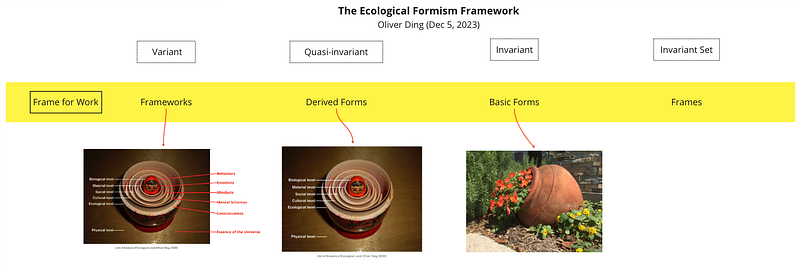
The above diagram uses “Container Thinking” as an example to showcase the differences between “Basic Forms”, “Derived Forms”, and “Frameworks”.
The Basic Form of “Container(Containee)” is the foundation of my theoretical account: the Ecological Practice approach.
In the past several years, I used the Basic Form of “Container(Containee)” to generate many knowledge frameworks for different projects. See the diagram below.
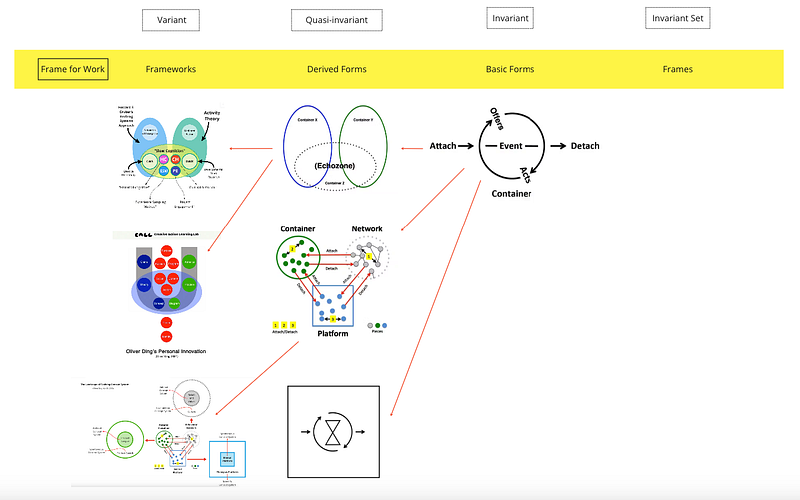
You can find more details in Frame for Work: The Hermeneutics of Knowledge Frameworks and Ecological Formism.
We should notice that the Echozone model is a Derived Form of the “Container (Containee)” Basic Form.
In this article, I claim that the Echozone model is a Derived Form of the “Creative Dialogue” Basic Form because it refers to a dialogue between two containers.
Let’s see the whole landscape of “Creative Dialogue”.
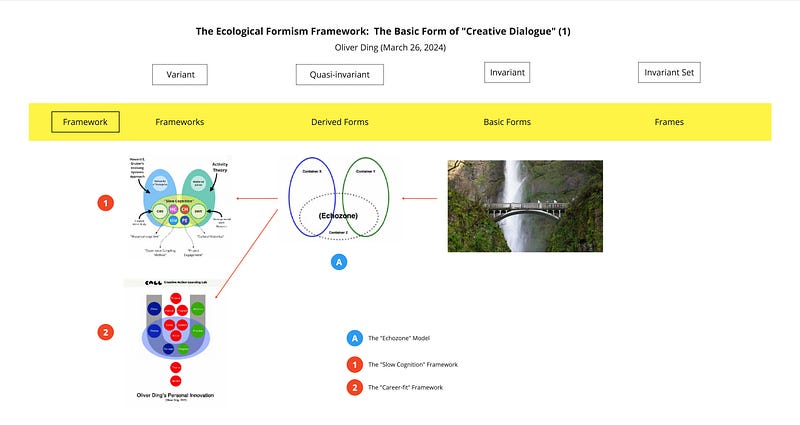
Basic form:
X____Y
(the metaphor of bridge)
Derived form:
The Echozone Model
Frameworks:
The “Slow Cognition” Framework
The Career-fit Framework
The above discussion has mentioned the ECHO Way which is the name of the family of Career-fit, Concept-fit, etc.
I often use the WXMY diagram to develop some frameworks for some projects. The Slow Cognition framework is an example, see the diagram below.
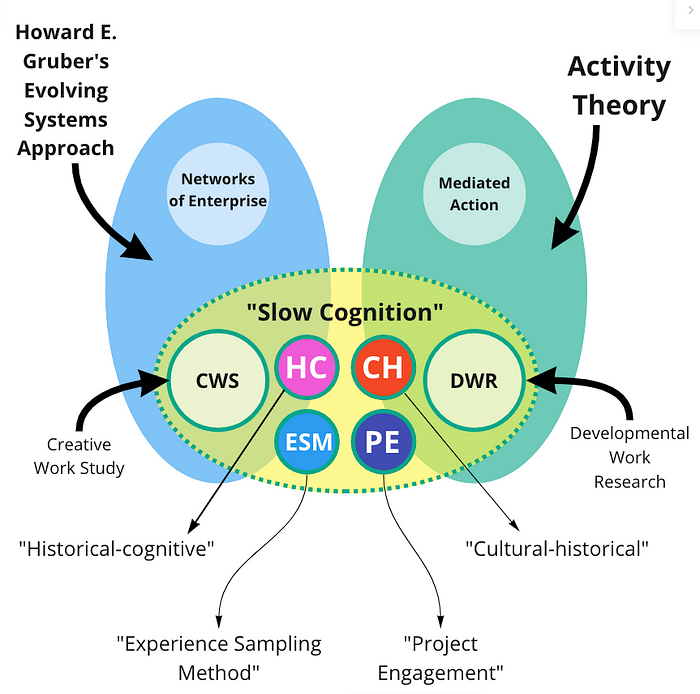
The above diagram was designed to represent the method of the Slow Cognition project. You can find more details in The Slow Cognition Project and related methods.
I also used the WXMY diagram to develop a unique model for understanding independent research projects.
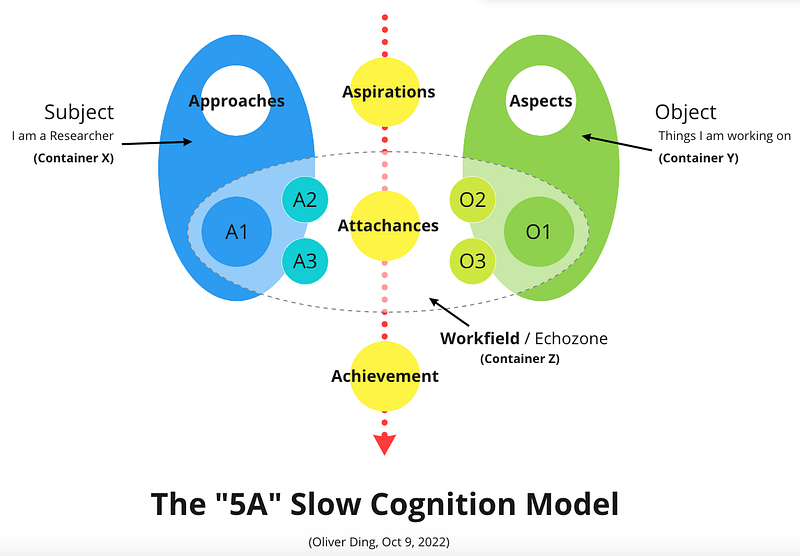
The above diagram defines a special structure: the “Subject — Workfield — Object” model. You can find more details in The “5A” Slow Cognition Model.
Related Articles
WXMY
- March 31, 2020 — When X Meets Y (WXMY)
- July 18, 2021 — The DEEP Framework
- August 7, 2021 — Themes of Practice (2019–2021)
- Oct 7, 2021 — From Sandwich to Containers
- Dec 16, 2021 — The Diagramming as Practice Framework and A Model of Knowledge Curation
- Feb 10, 2022 — The Connected Hub and “Service Thinking”
- March 15, 2022 — The Curated Mind
- June 8, 2022 — #TalkThree 05: How to Connect X and Y?
- June 24, 2022 — The Knowledge Curation Toolkit #2: WXMY for Interdisciplinary Curation
- August 19, 2022 — The Slow Cognition Project and related methods
- Sept 21, 2022 — The “Host-Guest” Mode of “WXMY”
- Sept 22, 2022 — The “Activity — Opportunity” Thematic Dialogue
- Sept 26, 2022 — The Echoes of A Thematic Dialogue
- April 28, 2023 — A Possible Theme called “Possible Discipline”
- Jan 19, 2023 — The Challenge of Thematic Conversation
- Jan 30, 2023 — A Strategic Designer’s Creative Journey
- April 27, 2023 — A Possible Theme called “Possible Practice”
- Nov 17, 2023 — Robert Kegan’s Primary Creative Theme: Mental Complexity
Theme U
- August 20, 2020 — Domain U: Bonnie Nardi’s Choices and Boundary Knowledge Work
- July 21, 2020 — Frame Analysis in Context and Ecological Interaction
- Feb 14, 2021 — Platform U: Platform, Platform-ba, and Platform Ecology
- August 12, 2021 — Meta-theory and General Practice
- Oct 12, 2021 — The Dialectic Room and Value Engagement
- Oct 14, 2021 — The Interactive Zone and Value Engagement
- Oct 19, 2021 — The Value-fit Framework and Canvas
- June 19, 2022 — The Knowledge Curation Toolkit #1: Theme U for Single-theory Curation
- August 26, 2022 — Theme U: The AAS Framework and its Applications
- August 28, 2022 — The Development of AAS (August 21, 2021 — August 26, 2022)
The ECHO Way
- June 26, 2020 — HERO U — A New Framework for Knowledge Heroes
- August 10, 2020 — Activity U: The Landscape of Activity Theory (Part I)
- March 24, 2021 — Platform Innovation as Concept-fit
- May 25, 2021 — Personal Innovation as Career-fit
- June 30, 2021 — The ECHO Way (v2.0)
- June 9, 2021 — Developmental Project Canvas
- Jan 8, 2022 — Youth Development as Drama-fit
- Feb 20, 2022 — Life Discovery: The “Present — Future” Fit and The ECHO Way
- July 27, 2023 — The ECHO Trip: A 10-day Road Trip and Creative Life Curation
- Sept 24, 2023 — The Microdynamics of Creative Identity
- Oct 3, 2023 — The Development of Creative Life Theory (2020–2023, Part 5): Creative Dialogues and Mental Moves
Others
- April 2, 2022 — Knowledge Discovery: The “Double Theme” Strategy
- Oct 12, 2022 — The “5A” Slow Cognition Model
- Nov 17, 2022 — A Five-space Model for Strategic Curation
Flow, Story, and Project
- Jan 11, 2022 — Thematic Space: Flow, Film, and Floor Plan
- Jan 19, 2024 — The Meaning Discovery Model (v1, 2024)


