
Supercharged King: How T.rex Grew Faster Than Any Other Giant Theropod
Tyrannosaurus grew at a speed similar to modern-day mammals and birds.…
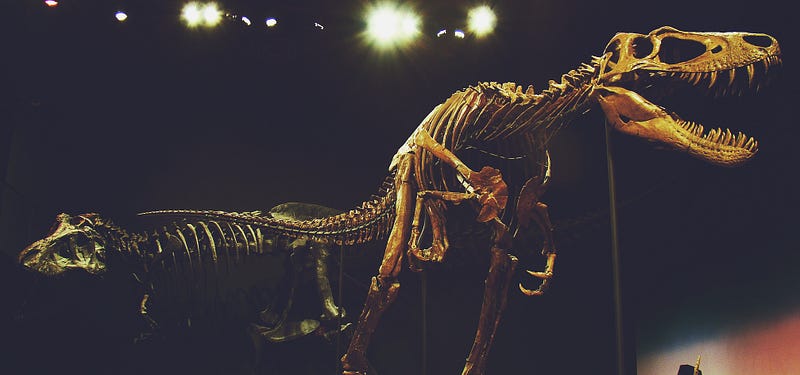
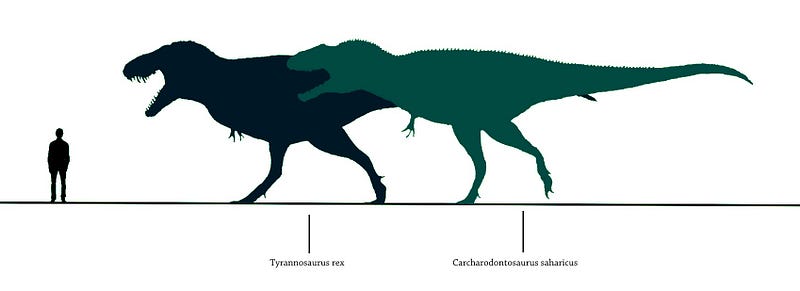
Theropod dinosaurs were the largest bipeds to have ever walked the Earth. Some of these creatures could grow up to 13 meters (42 ft) long and weigh as much as 9 tons. Tyrannosaurus is an obvious example, but paleontologists know there were several theropods that could reach similar proportions.
You may discover them below:
What paleontologists did not know, however, was whether these giants shared similar growth patterns except their size. Researchers from the Chicago’s Field Museum were determined to find this out.
The study
In their study, they inspected several skeletons of theropod dinosaurs from museums in the United States, Canada, China, and Argentina.
To perform the examination, the team got permission to cut into bones of various genera of theropods, including one of the world’s most famous T. rex fossils, known as Sue. Other examples included the late Jurassic predator Allosaurus and the carcharodontosaurid Acrocanthosaurus from North America. A recently discovered species of carcharodontosaurid from Argentina that rivaled T. rex in size was also examined.
The results of the study were surprising.
Supercharged T.rex
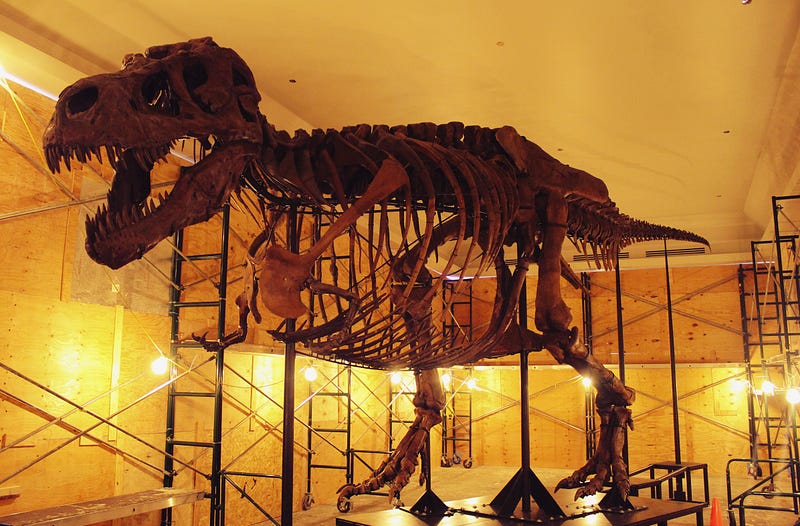
Previous research has shown that Tyrannosaurus grew at a speed similar to modern-day mammals and birds. Scientists noticed that T.rex and its closest relatives went through a huge teenage growth spurt. These creatures grew so much and so quickly during their adolescence that their appearance, their speed- even their preferred prey- radically changed.
Between ages 14 and 18, the ‘tyrant lizard king’ was transformed from a slender, quick-footed predator that could out-sprint its prey to a massive hunter that simply walked up to a meal and bit down hard. Scientists estimate that at the peak of its growth spurt, an average T. rex gained 4.6 pounds (2.1 kilograms) every day!
Getting big quickly is a competitive advantage — it makes it easier for a predator to hunt other animals, and harder for other predators to hunt it. On the flip side, a growth spurt requires a lot of energy and resources.
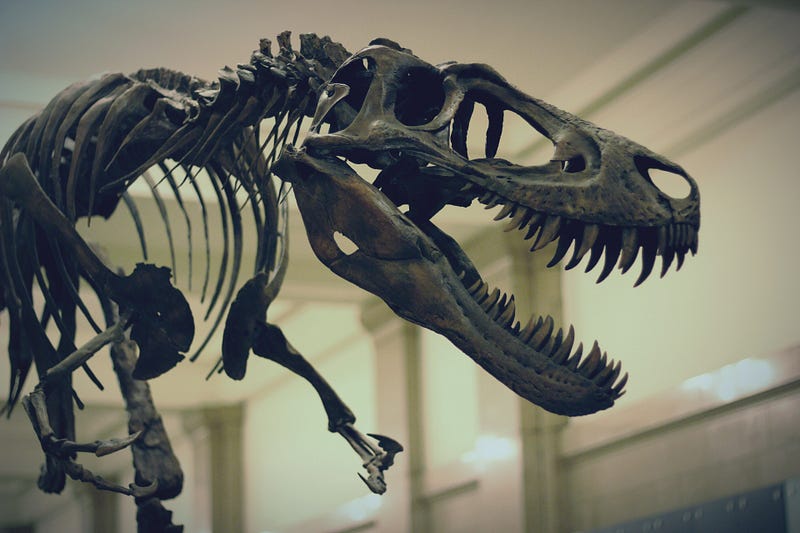
Thanks to its extreme growth spurt, Tyrannosaurus could have reached full adult size quite fast, in a time span of around two decades. Scientists did not know, however, if the rest of the big biped theropods also shared the growth patterns observed in tyrannosaurs.
Tom Cullen, a scientific affiliate of Chicago’s Field Museum explains, “We particularly wanted to understand how some of them got so big — is the way T. rex grew the only way to do it?”
A different approach
It turns out, it’s not. The study found that the other groups of large predatory theropods tended to have more steady rates of growth over a longer period of time. The particular growth strategy was detected in dinosaur families that arose earlier in the Mesozoic era. Among them were the allosaurs, a superfamily of theropods that were the apex predators of their ecosystems long before tyrannosaurs rose to prominence.
To find more about these terrifying predators, read the article below:
The results of the study open up questions about how these predatory dinosaurs interacted with their prey.
The plant-eating dinosaurs that shared their environment with T. rex were ceratopsians like Triceratops and duck-billed hadrosaurs. These animals grew extremely quickly in adolescence, too. The slow-growing allosauroid carnivores lived alongside the giant long-necked sauropods that, while they grew quickly, it appears they have taken a long time to reach full size.
“We can’t say for sure, but there could be some kind of selection pressure for the coelurosaurs to grow quickly to keep up with their prey, or pressure for the allosauroids to keep growing in size since their prey were also increasing in size, But it’s pretty speculative. It could be that even if the sauropods kept growing their whole lives, they had so many offspring that there was always something small to eat,” said Tom Cullen.
Epilogue
Theropod dinosaurs were the largest bipeds that have ever existed. While several predatory theropods managed to achieve great sizes, they did so in two different ways. Tyrannosaurus and its closest relatives got suddenly huge during adolescence, while their more distant cousins were growing at a steadier pace each year.
These distinct growth strategies lead scientists to conclude that there was not any strong mechanistic or physiological constraint that played a part in the size evolution of these amazing predators.
To get a more complete idea regarding the paleobiology of Tyrannosaurus, read the article below:
Relevant reads:
References
Field Museum. “T. rex had huge growth spurts, but other dinos grew slow and steady: By cutting into fossils and examining growth rings, scientists learned how predatory dinosaurs got so big.” ScienceDaily. ScienceDaily, 24 November 2020. Link:https://www.sciencedaily.com/releases/2020/11/201124190527.htm
Thomas M. Cullen, Juan I. Canale, Sebastián Apesteguía, Nathan D. Smith, Dongyu Hu, Peter J. Makovicky. Osteohistological analyses reveal diverse strategies of theropod dinosaur body-size evolution. Proceedings of the Royal Society B: Biological Sciences, 2020; 287 (1939): 20202258 DOI/ Link: 10.1098/rspb.2020.2258
Holly N. Woodward, Katie Tremaine, Scott A. Williams, Lindsay E. Zanno, John R. Horner and Nathan Myhrvold, (Jan 2020), Growing up Tyrannosaurus rex: Osteohistology refutes the pygmy “Nanotyrannus” and supports ontogenetic niche partitioning in juvenile Tyrannosaurus, Science Advances, Link: https://advances.sciencemag.org/content/6/1/eaax6250
Aylin Woodward, (Jan 2020), Paleontologists are unraveling the mysteries of young T. rexes. Creatures they thought were 2 species turned out to be kids and adults., Business Insider, Link: https://www.businessinsider.com/tyrannosaurus-rex-teenage-growth-spurt-2019-12


