avatarPanos Grigorakakis

Free AI web copilot to create summaries, insights and extended knowledge, download it at here

3621

Abstract

-images-1.readmedium.com/v2/resize:fit:800/1*YwrxmudpvbS1goMjxsym-A.jpeg"><figcaption>A comparison of skulls, a T. rex, top, and the Nanotyrannus lancensis specimen found in the Hell Creek Formation of Montana / Credit: Larry Witmer; American Museum of Natural History</figcaption></figure><p id="0099">Dr. Longrich’s team also said the specimens had features consistent with mature animals, not juveniles. They pointed out that the growth rings inside the bone from three specimens suggested slowing growth rates.</p><p id="2a26">“We have three individuals, which basically rules out an individual variation or aberrant growth pattern,” Dr. Longrich said. “What we’re seeing is that the growth patterns are inconsistent with these animals being juveniles.”</p><p id="ce9e">These dinosaurs were on track to weigh over a ton, much less than an adult Tyrannosaurus <i>rex</i> which is estimated to have grown up to 7–8 tons.</p><figure id="16f3"><img src="https://cdn-images-1.readmedium.com/v2/resize:fit:800/1*qK2jrVxgdOOBs83N8q5oFg.jpeg"><figcaption>Estimated sizes of Tyrannosaurus rex and “Nanotyrannus lancensis” compared to a human / Chart by author (2024)</figcaption></figure><p id="1422">Where, then, are the actual juvenile T. rex? Dr. Longrich believes he’s found a fragment of one — a piece of skull from the University of California, Berkeley. “In every single feature it was T.rex,” he said.</p><figure id="a452"><img src="https://cdn-images-1.readmedium.com/v2/resize:fit:800/1*5_Cm838ek26_rEP1-Fh-Ow.png"><figcaption>Young juvenile <i>T. rex</i> frontal skull bone from the Hell Creek of Montana / Credit: Nicholas Longrich</figcaption></figure><h1 id="f4f7">Opposing views</h1><p id="5e78">Yet the resurrection of Nanotyrannus by Dr. Longrich and his team faced some strong objections from other paleontologists who are not yet convinced about the species' validity.</p><p id="9c56">Thomas Carr, a paleontologist at Carthage College said that the specimens in question do show features in common with adult Tyrannosaurus — including the forehead, snout, and braincase.</p><p id="d4cd">Moreover, he disagrees with the claim that they don’t fit the growth pattern in other tyrannosaur skulls. “With T. rex and tyrannosaurs in general, differences between juveniles and adults are quite extreme and people are easily thrown,” Dr. Carr said.</p><p id="024f">Holly Woodward, a paleontologist at Oklahoma State University who produced some of the growth data used by Dr. Longrich’s team, also disputed their conclusions. The spacing of the innermost growth rings in the bone tissue of nearly full-grown adult T. rex suggests “lower growth rates at younger ages before the big growth spurt,” she said.</p><p id="85e3">Dr. Woodward added that the team’s choice of mathematical models risks producing a distorted picture that shows younger animals that are done growing, even if that isn’t the case.</p><p id="4981">“I’m just not convinced that the growth curve arguments support that hypothesis,” she said.</p><figure id="d9e0"><img src="https://cdn-images-1.readmedium.com/v2/resize:fit:800/1*XpMwSMvKuAb9VjBcw7R_kw.jpeg"><figcaption>Graph comparing growth curves of T. rex vs Nanotyrannus / Credit: Dr. Nick Longrich</figcaption></figure><h1 id="555d">Epilogue</h1><p id="6b71">So, is Nanotyrannus a valid genus after all?</p><p id="3aa0">The short answer is we don't know...yet.</p><p id="5823">“The discovery of either an older adult Nanotyrannus or a young T. rex distinct from the Nanotyrannus form would help clarify things”, said Thomas Holtz, a paleontologist at the University of Maryland who was not in

Options

volved with the paper.</p><p id="7c08">But until then, the debate will continue.</p><p id="e02f">One thing is certain though: for an animal that may not have existed, Nanotyrannus is proving increasingly difficult to kill.</p><h1 id="7942">Relevant reads:</h1><div id="f820" class="link-block"> <a href="https://readmedium.com/closest-t-rex-relative-may-have-been-an-even-bigger-predator-34541a345068"> <div> <div> <h2>Closest T. Rex Relative May Have Been an Even Bigger Predator</h2> <div><h3>Tyrannosaurus mcraeensis is a newly identified species of the eponymous T.rex.</h3></div> <div><p>medium.com</p></div> </div> <div> <div style="background-image: url(https://miro.readmedium.com/v2/resize:fit:320/1*C1Dbrw_650XlzWHCQSAbfA.jpeg)"></div> </div> </div> </a> </div><div id="1cec" class="link-block"> <a href="https://readmedium.com/supercharged-king-how-t-rex-grew-faster-than-any-other-giant-theropod-1b8d69c5aaa1"> <div> <div> <h2>Supercharged King: How T.rex Grew Faster Than Any Other Giant Theropod</h2> <div><h3>Tyrannosaurus grew at a speed similar to modern-day mammals and birds.…</h3></div> <div><p>medium.com</p></div> </div> <div> <div style="background-image: url(https://miro.readmedium.com/v2/resize:fit:320/1*nctFZNrb3kAbriXxzxM8Ug.jpeg)"></div> </div> </div> </a> </div><div id="b29c" class="link-block"> <a href="https://readmedium.com/spectacular-fossil-of-dueling-dinosaurs-can-finally-reveal-its-secrets-c3d1cc15e31a"> <div> <div> <h2>Spectacular Fossil of ‘Dueling Dinosaurs’ Can Finally Reveal Its Secrets</h2> <div><h3>The astonishing find features a juvenile T.rex and a full-grown Triceratops practically intertwined…</h3></div> <div><p>medium.com</p></div> </div> <div> <div style="background-image: url(https://miro.readmedium.com/v2/resize:fit:320/1*xj-CbY47RPDhxCxX2MoeAQ.jpeg)"></div> </div> </div> </a> </div><div id="2278" class="link-block"> <a href="https://readmedium.com/t-rex-beyond-the-pop-culture-monster-f7fedc063e24"> <div> <div> <h2>T.rex: Beyond the Pop Culture Monster</h2> <div><h3>The conflicting image between a movie monster and a 66 million-year-old dinosaur…</h3></div> <div><p>medium.com</p></div> </div> <div> <div style="background-image: url(https://miro.readmedium.com/v2/resize:fit:320/1*1HlBN8Vmz9eW7CFl70yizw.jpeg)"></div> </div> </div> </a> </div><h1 id="8a97">References</h1><p id="fa2d">Longrich, Nicholas R.; Saitta, Evan T. (March 1, 2024). <a href="https://www.mdpi.com/2813-6284/2/1/1">“Taxonomic Status of <i>Nanotyrannus lancensis</i> (Dinosauria: Tyrannosauroidea) — A Distinct Taxon of Small-Bodied Tyrannosaur”</a>. <i>Fossil Studies</i>. <b>2</b> (1): 1–65. <a href="https://en.wikipedia.org/wiki/Doi_(identifier)">doi</a>:<a href="https://doi.org/10.3390%2Ffossils2010001">10.3390/fossils2010001</a>. <a href="https://en.wikipedia.org/wiki/EISSN_(identifier)">eISSN</a> <a href="https://www.worldcat.org/issn/2813-6284">2813–6284</a>.</p></article></body>

New Study Brings “Dwarf” Tyrannosaur Back From Oblivion

The decades-long Nanotyrannus saga takes another turn…
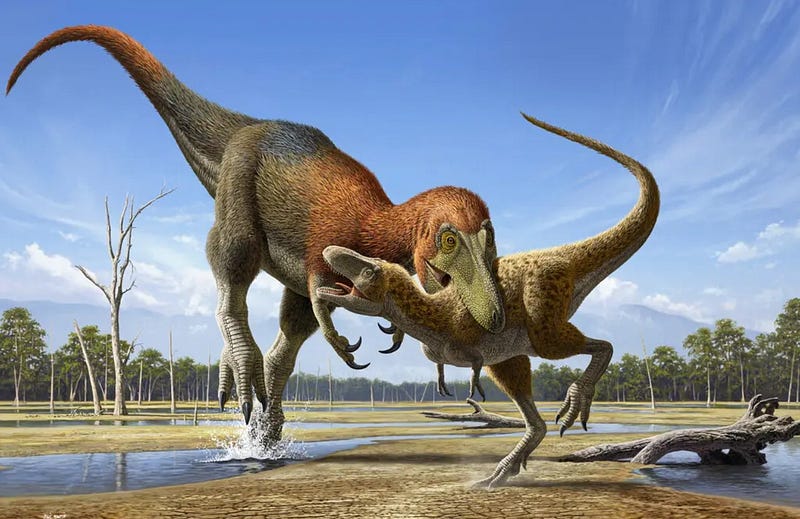
An artist’s reconstruction of an adult Nanotyrannus lancensis attacking a young Tyrannosaurus rex / Art by Raul Martin

A new study suggests fossils usually attributed to juvenile specimens of Tyrannosaurus rex actually belong to a separate genus of a tyrannosaur less than half the size of its famous cousin, reviving a decade-long debate among paleontologists.

The “Dwarf Tyrant”

It all began in 1942 with the discovery of a 23-inch-long tyrannosaur skull in Montana. This skull was originally classified as a juvenile species of Gorgosaurus (a relative of T.rex) by Charles W. Gilmore in 1946.

But in 1988 the specimen was re-described by Robert T. Bakker, Phil Currie, and Michael Williams who argued that the skull bones were fused and that it therefore represented an adult specimen of a new species. They named the new genus Nanotyrannus lancensis (meaning “dwarf tyrant”).

The scientific community has since gone back and forth in the debate of whether this skull and similar specimens represent a distinct genus of a dwarf tyrannosaur that lived in the shadow of T. rex or a juvenile form of the “tyrant-lizard king” before it underwent an extraordinary growth spurt that preceded adulthood.

During recent years the hypothesis that the 23-inch-long skull and similar fossils represented a juvenile form of Tyrannosaurus rex gained traction.

“Most people bought into it, including me,” said Nick Longrich, a paleontologist with the University of Bath in England.

But now Dr. Longrich has changed his mind.

The Study

In his recent study published in the journal Fossil Studies, he and colleagues argue that enough evidence exists to resurrect Nanotyrannus as a separate genus among the broader tyrannosaur family. They also claim that, based on anatomical features, Nanonytannus is not even that closely related to T. rex.

To back their claims, Dr. Longrich’s team studied specimens commonly argued to represent forms of adolescent Tyrannosaurus rex, including recent finds like Jane and Petey, the tyrannosaur specimen of the “Dueling Dinosaurs” as well as the original 23-inch skull originally assigned to Nanotyrannus.

The team said it found around 150 differences in their anatomy, including skull details; an extended, bladelike snout; and longer arms and claws than adult T. rex.

“Unlike T. rex, this dinosaur had a light build, long limbs and large arms that would have been pretty formidable weapons,” Longrich said. “It’s really just a completely different animal,” he added.
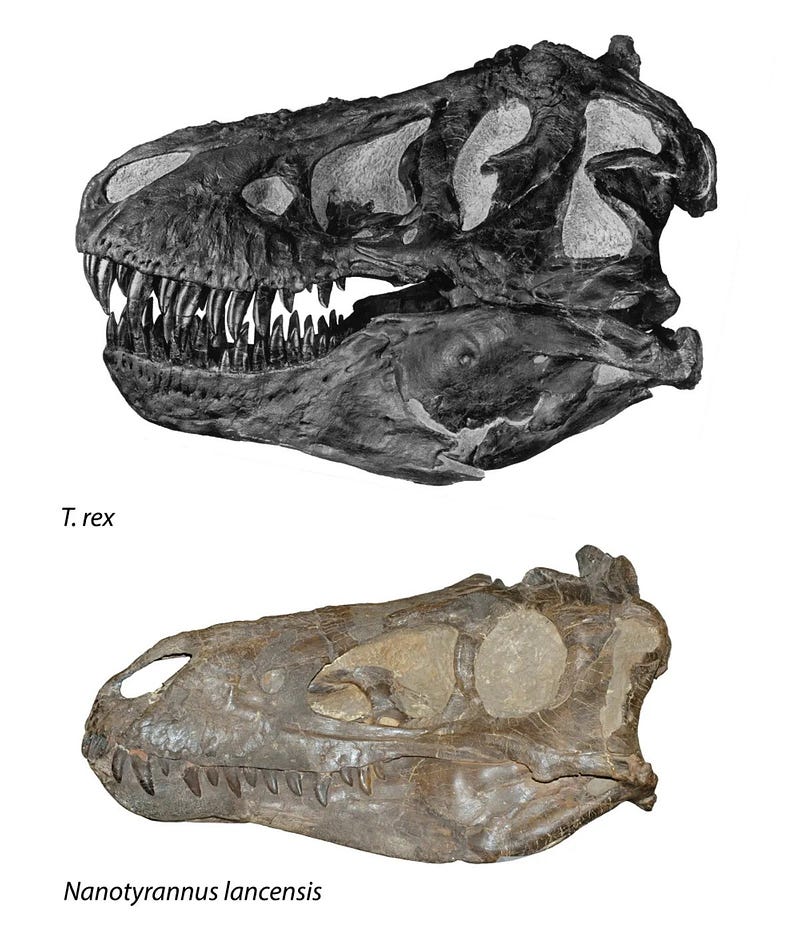
A comparison of skulls, a T. rex, top, and the Nanotyrannus lancensis specimen found in the Hell Creek Formation of Montana / Credit: Larry Witmer; American Museum of Natural History

Dr. Longrich’s team also said the specimens had features consistent with mature animals, not juveniles. They pointed out that the growth rings inside the bone from three specimens suggested slowing growth rates.

“We have three individuals, which basically rules out an individual variation or aberrant growth pattern,” Dr. Longrich said. “What we’re seeing is that the growth patterns are inconsistent with these animals being juveniles.”

These dinosaurs were on track to weigh over a ton, much less than an adult Tyrannosaurus rex which is estimated to have grown up to 7–8 tons.
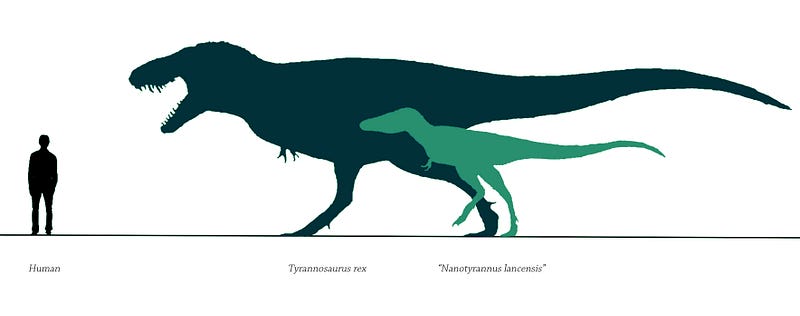
Estimated sizes of Tyrannosaurus rex and “Nanotyrannus lancensis” compared to a human / Chart by author (2024)

Where, then, are the actual juvenile T. rex? Dr. Longrich believes he’s found a fragment of one — a piece of skull from the University of California, Berkeley. “In every single feature it was T.rex,” he said.
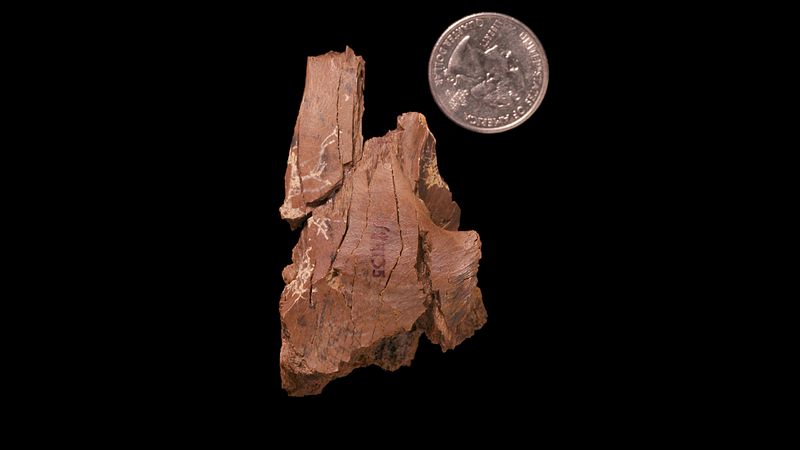
Young juvenile T. rex frontal skull bone from the Hell Creek of Montana / Credit: Nicholas Longrich

Opposing views

Yet the resurrection of Nanotyrannus by Dr. Longrich and his team faced some strong objections from other paleontologists who are not yet convinced about the species' validity.

Thomas Carr, a paleontologist at Carthage College said that the specimens in question do show features in common with adult Tyrannosaurus — including the forehead, snout, and braincase.

Moreover, he disagrees with the claim that they don’t fit the growth pattern in other tyrannosaur skulls. “With T. rex and tyrannosaurs in general, differences between juveniles and adults are quite extreme and people are easily thrown,” Dr. Carr said.

Holly Woodward, a paleontologist at Oklahoma State University who produced some of the growth data used by Dr. Longrich’s team, also disputed their conclusions. The spacing of the innermost growth rings in the bone tissue of nearly full-grown adult T. rex suggests “lower growth rates at younger ages before the big growth spurt,” she said.

Dr. Woodward added that the team’s choice of mathematical models risks producing a distorted picture that shows younger animals that are done growing, even if that isn’t the case.

“I’m just not convinced that the growth curve arguments support that hypothesis,” she said.
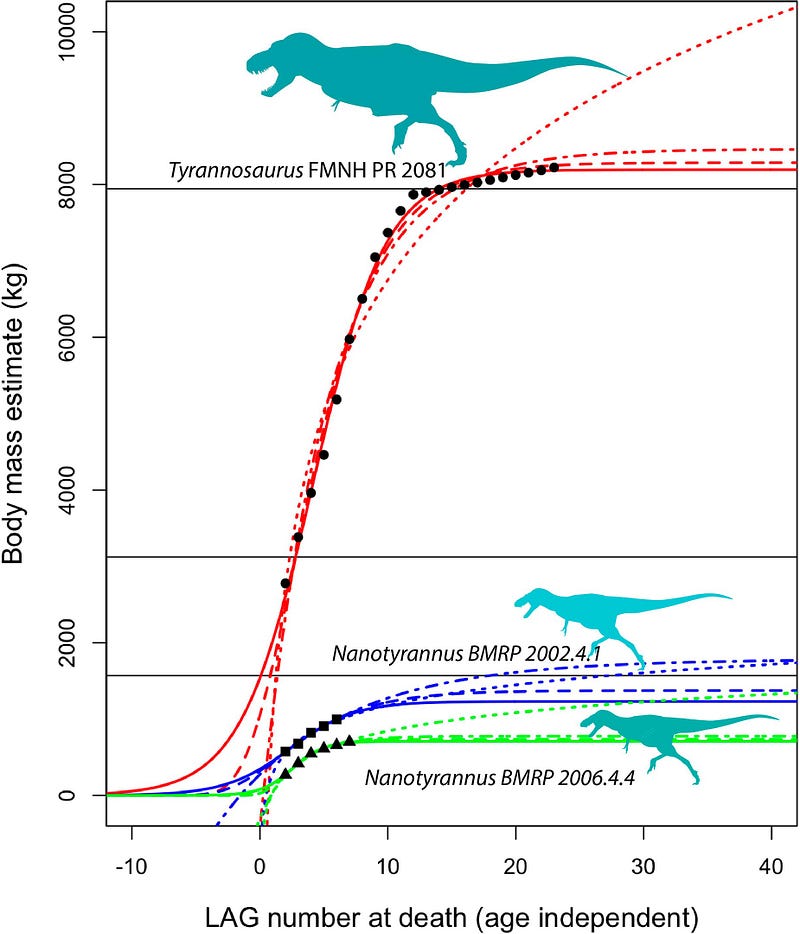
Graph comparing growth curves of T. rex vs Nanotyrannus / Credit: Dr. Nick Longrich

Epilogue

So, is Nanotyrannus a valid genus after all?

The short answer is we don't know...yet.

“The discovery of either an older adult Nanotyrannus or a young T. rex distinct from the Nanotyrannus form would help clarify things”, said Thomas Holtz, a paleontologist at the University of Maryland who was not involved with the paper.

But until then, the debate will continue.

One thing is certain though: for an animal that may not have existed, Nanotyrannus is proving increasingly difficult to kill.

Relevant reads:

References

Longrich, Nicholas R.; Saitta, Evan T. (March 1, 2024). “Taxonomic Status of Nanotyrannus lancensis (Dinosauria: Tyrannosauroidea) — A Distinct Taxon of Small-Bodied Tyrannosaur”. Fossil Studies. 2 (1): 1–65. doi:10.3390/fossils2010001. eISSN 2813–6284.

Science
Dinosaurs
Tyrannosaurus
Paleontology
Discovery
Recommended from ReadMedium