
Mesozoic Quick Fact Series
Tyrannosaurs: The ‘Kings’ of the Cretaceous
Meet the famous T.rex and its kin…
Mesozoic Quick Fact Series aims to provide interesting facts about various groups of extinct animals in a fun and readable way. We will focus on the highlights, so you don’t need to read extensive, time-consuming texts!
In this article, we will take a quick overview of the tyrannosaurs, the family of carnivorous theropods with massive skulls and terrifying teeth that includes the all-time-favorite Tyrannosaurus rex.
Let’s jump right through!
Starting with the basics…
The family of the ‘tyrant lizards’ was erected and named after the discovery of the eponymous Tyrannosaurus in 1905. Early in their existence, tyrannosaurs were small predators with long, three-fingered forelimbs. Most of the advanced genera though, became much larger, including some of the largest land-based predators ever to exist. These giants had proportionately small forelimbs with only two digits.
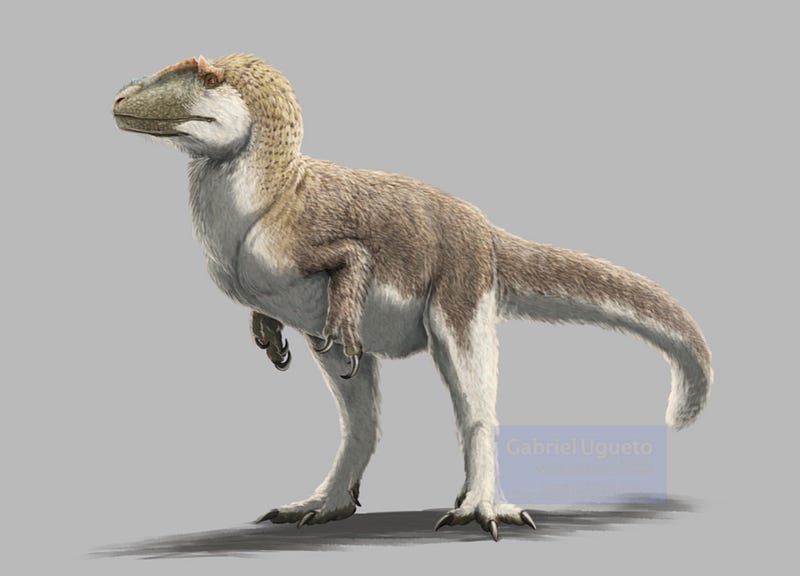
Scientists have identified primitive feathers in fossils of at least two tyrannosaur species and may have been present in other members of the group as well. Prominent bony crests in a variety of shapes and sizes on the skulls of many tyrannosaurs may have served display functions.
When did they live?
The earliest members of the tyrannosaur family, like Proceratosaurus and Kileskus, appeared roughly 166 million years ago, during the Middle Jurassic Period. Tyrannosaurus rex was the last surviving member of the group and among the last non-avian dinosaurs to exist on the planet. This giant carnivore lived during the latest part of the Cretaceous Period some 100 million years after its earliest cousins.
…and where?
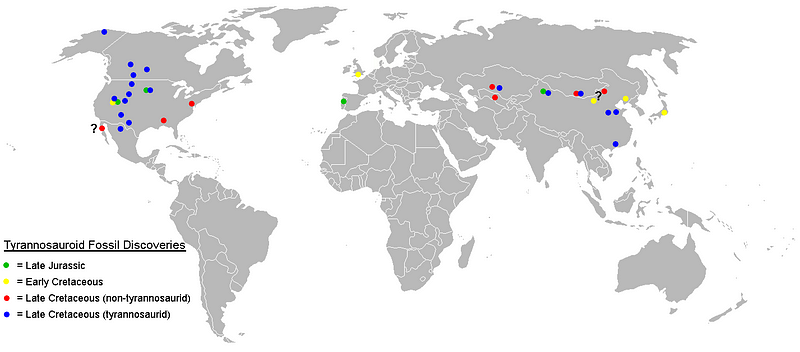
So far, paleontologists have discovered concrete evidence of tyrannosaur remains only in the Northern Hemisphere. Tyrannosaurs were pretty widespread in the Laurasian supercontinent, which included modern-day Asia, Europe, and North America. Some scientists attribute the obscure genera Santanaraptor from South America and Timimus from Australia to the group. Yet, since these dinosaurs are only known from fragmentary remains, their classification is uncertain.
How large were they?
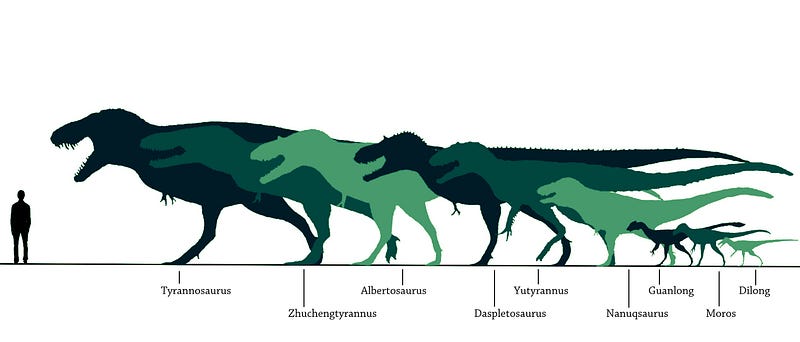
Tyrannosaurs varied widely in size, although there was a general trend towards gigantism over time. As mentioned earlier, basal tyrannosaurs were small animals. Dilong and Guanlong — two early tyrannosaurs from China — measured just 1.6 meters (5.3 ft) and 3 meters (10 ft) in length, respectively.
The Late Cretaceous tyrannosaurs ranged from the 9-meter (30 ft) Albertosaurus and Daspletosaurus to Tyrannosaurus, which exceeded 12 meters (39 ft) in length and may have weighed over 6400 kilograms.
A 2010 review of the literature concluded that tyrannosaurs were small- to mid-sized for their first 80 million years but were some of the largest terrestrial carnivores to ever live in their last 20 million years.
Any cool names?
It’s hard to find a tyrannosaur name that isn’t cool — most of them are truly memorable and compelling.
Let’s start off with the most memorable of all: Tyrannosaurus rex! The generic name is derived from the Greek tyrannos, meaning “tyrant” and sauros, meaning “lizard”. The specific name rex is the Latin word for “king”. The full binomial name translates to “tyrant lizard the king” or “King Tyrant Lizard”, emphasizing the animal’s size and perceived dominance over other species of the time.
A close second is Lythronax argestes. The generic name is derived from the Greek words lythron, meaning “gore”, and anax, meaning “king”. The specific name argestes is a Greek name used by the poet Homer for the wind from the southwest, in reference to where the specimen was found within North America. In full, the scientific name can be translated as “gore king (or “king of gore”) from the southwest”.
Equally awesome names are Thanatotheristes and Teratophoneus. The former literally translates to the “death harvester” from the Greek thánatos (“death”) and theristḗs (“harvester”). The latter means “monstrous murderer”; from the Greek words teras (“monster”), and phoneus (“murderer”).
In popular culture:
Tyrannosaurus rex is by far the most well-known tyrannosaur, and possibly even the most famous dinosaur of all time. Therefore, the animal had appeared countless times in popular media that the full appreciation of its cultural significance needs an article of its own.
This dinosaur has starred in several television series, including children’s programs, and documentaries. In literature, a dominant representation of Tyrannosaurus since 1990 has been that of Michael Crichton’s, as seen in the novel Jurassic Park and its sequel The Lost World. Its skeleton was also used to illustrate the covers of these books.
Tyrannosaurus’s first appearance on the silver screen was in 1925, where it was featured in the film adaption of Arthur Conan Doyle’s novel The Lost World. In 1933, T.rex appeared in the original monster movie King Kong, which featured a climactic battle between the giant ape and the dinosaur.
One of the most iconic modern depictions of Tyrannosaurus was in the 1993 film Jurassic Park and its successive sequels. Tyrannosaurus has made major appearances in many other films, including Dinosaurus! (1960), The Last Dinosaur (1977), The Land Before Time, and its direct-to-video sequels (1988–present), We’re Back! A Dinosaur’s Story (1993), Toy Story (1995), Night at the Museum (2006), Meet the Robinsons (2007), Ice Age 3: Dawn of the Dinosaurs (2009), and The Good Dinosaur (2015). The IMAX 3D film T-Rex: Back to the Cretaceous (1998).
Did you know…?
The three specimens of the basal tyrannosauroid Yutyrannus huali from the Liaoning Province of China preserve impressions of feathers covering most of their body. At 9 meters (29.5 ft) in length and with an estimated weight of about 1,414 kilograms (3,117 lb), Yutyrannus is currently the largest-known dinosaur with direct evidence of feathers.
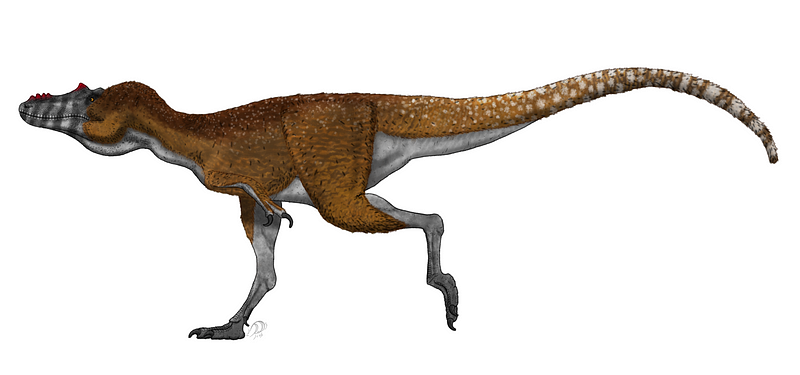
Qianzhousaurus sinensis is a recently found tyrannosaur from China. It had a thin, long snout studded with tiny horns which is a far cry from the short, muscular skull of its famous cousin Tyrannosaurus rex. For this unique trait, paleontologists nicknamed Qianzhousaurus the “Pinocchio rex”.
Relevant Reads:
References
Holtz, Thomas R. (2004). “Tyrannosauroidea”. In Weishampel, David B.; Dodson, Peter; Osmólska, Halszka (eds.). The Dinosauria (Second ed.). Berkeley: University of California Press. pp. 111–136. ISBN 978–0–520–24209-
Xu Xing, X; Clark, James M.; Forster, Catherine A.; Norell, Mark A.; Erickson, Gregory M.; Eberth, David A.; Jia Chengkai; & Zhao Qi.; Forster, Catherine A.; Norell, Mark A.; Erickson, Gregory M.; Eberth, David A.; Jia, Chengkai; Zhao, Qi (2006). “A basal tyrannosauroid dinosaur from the Late Jurassic of China”. Nature. 439 (7077): 715–718.
Olshevsky G.; Ford T.L. (1995). “The origin and evolution of the Tyrannosauridae, part 2 [in Japanese]”. Dino Frontline. 6: 75–99.
Erickson, Gregory M., GM; Makovicky, Peter J.; Currie, Philip J.; Norell, Mark A.; Yerby, Scott A.; Brochu, Christopher A. (2004). “Gigantism and comparative life-history parameters of tyrannosaurid dinosaurs”. Nature. 430 (7001): 772–775. Bibcode:2004Natur.430..772E. doi:10.1038/nature02699. PMID 15306807. S2CID 4404887. Sampled longevities for T. rex ranged from 2 to 28 years and corresponding body mass estimates ranged from 29.9 to 5654 kg
Parrish J.M., Molnar R.E., Currie P.J., Koppelhus E.B.,(2013), Tyrannosaurid Paleobiology, Indiana University Press
Hone D.,(2016) The Tyrannosaur Chronicles, Bloomsbury Publishing Plc
Paul G.S.,(2010), Dinosaurs A Field Guide, A&C Black Publishers Ltd
Hone D.,(2011), Teeth like steak knives or bananas or well, tyrannosaur teeth, Link: https://archosaurmusings.wordpress.com/2011/12/04/teeth-like-steak-knives-or-bananas-or-well-tyrannosaur-teeth/


