
Meet the Humble Ancestors of the Most Famous Dinosaur Genera
You won’t believe the creatures that gave rise to your favorite dinosaurs…
Dinosaurs such as Tyrannosaurus rex and Brontosaurus are trademark icons of prehistory. Yet, these animals evolved from descendants far less impressive than themselves. Most of these humble ancestors were pretty unremarkable animals and showed little sign of the bright evolutionary future their successors would have.
This text will introduce you to the ancestral animals that led to the evolution of some of the world’s most recognizable dinosaur genera: Tyrannosaurus, Triceratops, Stegosaurus, Parasaurolophus, and Brontosaurus.
Let’s go!
My future is big
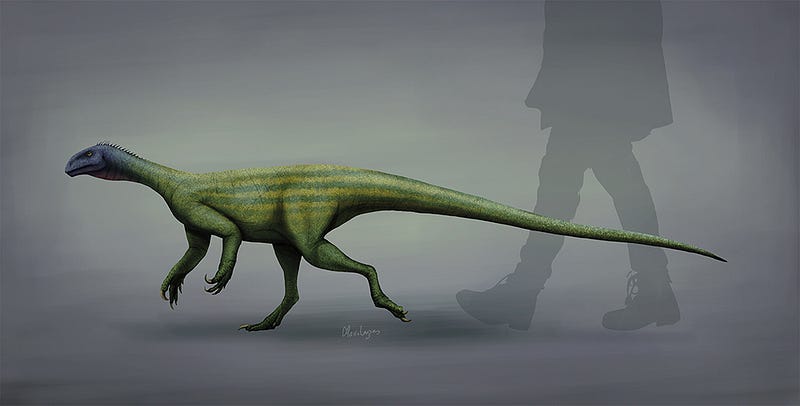
Roughly 200 million years ago, a small herbivorous dinosaur, no larger than 2m (6.5 ft) long, thrived in what is today South England.
It bore five digits on its limbs, and it had long and narrow hands, each equipped with an extended claw. The dinosaur’s front limbs were much shorter than its legs, and its tail was longer than the head, neck, and body put together.
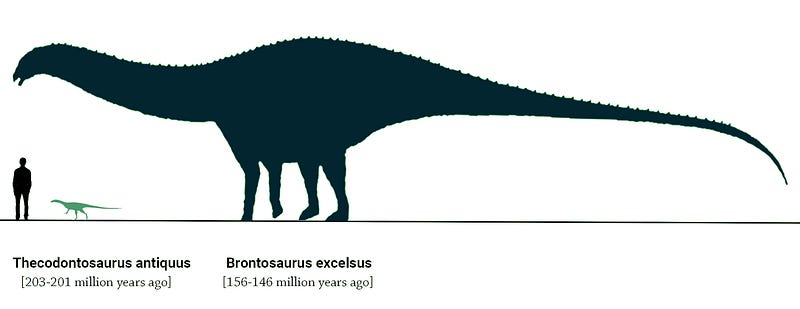
Scientists named this animal Thecodontosaurus antiquus. Thecodontosaurus was a basal sauropodomorph, the group of dinosaurs that eventually would give rise to the long-necked sauropods, including the iconic Brontosaurus.
Through the course of millions of years that followed, sauropods would develop their characteristic long necks and tails, adopt a quadrupedal stance to support their enormous weight, and become the largest animals to ever walk the Earth [1].
Some 50 million years after Thecodontosaurus time, the Earth shook under the steps of Brontosaurus and its relatives, creatures that weighed tens of tones and stretched over 20 meters (65 feet) long.
Primitive armor
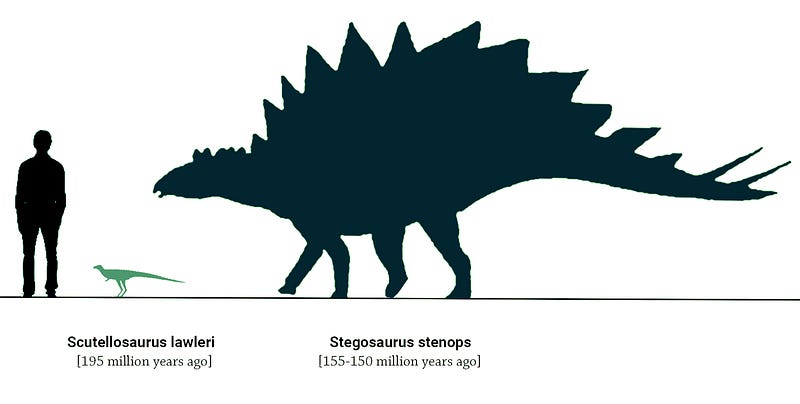
Scutellosaurus was a small, lightly built, ground-dwelling herbivore that lived 196 million years ago in what is now Arizona, USA.
The most characteristic feature of this animal was its several hundred osteoderms running along its body, which formed parallel rows. This feature gave the dinosaur its name: Scutellosaurus translates to “little-shielded lizard” deriving from the Latin word “scutellum” which means “little shield”.
Scutellosaurus could grow up to an estimated 1.2m (3.9 ft) long and had an unusually long tail, possibly to provide a counterbalance against the weight of its armored body.
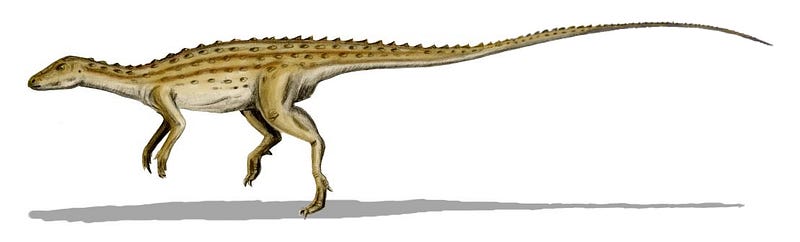
Scutellosaurus was a primitive thyreophoran, the clade that includes the so-called armored dinosaurs. Thyreophorans are divided into two main families, the stegosaurs and the ankylosaurs.
Stegosaurus itself, the iconic heavily built quadruped with the distinctive combination of broad, upright plates and a tail tipped with spikes, evolved from creatures similar to Scutellosaurus.
Cretaceous cow
Having a low, aerodynamic posture, powerful hind limbs, and a long, stiff tail, Gideonmantellia was made for running.
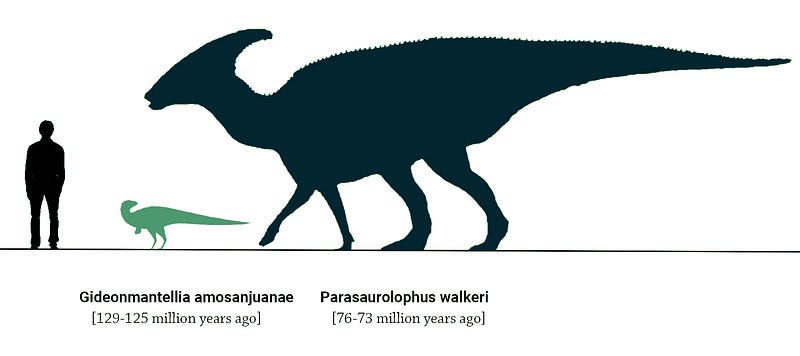
This lightweight animal lived between 129 and 125 million years ago and grew to about 2m (6ft) in length. It was herbivorous, and its pointed snout ended in a sharp beak for biting off plant material. Gideonmantellia is one of the most primitive ornithopod dinosaurs known so far.
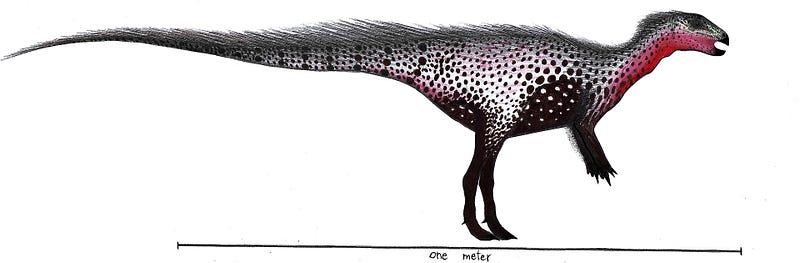
Ornithopods started out as small, bipedal running grazers, but gradually grew in size and numbers until they became one of the most successful groups of herbivores in the Cretaceous world. Their major evolutionary advantage was the progressive development of a chewing apparatus that became the most sophisticated ever developed by non-avian dinosaurs, rivaling that of modern mammals such as the domestic cow.
Famous derived ornithopods like Parasaurolophus originate from dinosaurs that looked not much different from Gideonmantellia.
Ancestral tyrant
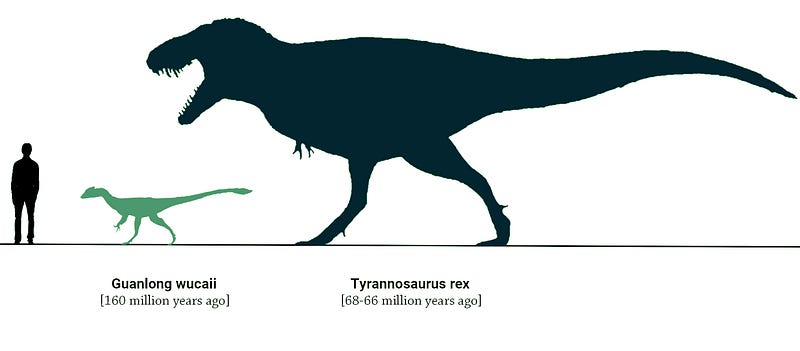
Sporting an elaborate crest, a pair of long, three-clawed forelimbs, and being covered in feathers, Guanlong seems at first an unlikely ancestor of the mighty Tyrannosaurus rex.
Yet, the shape of its teeth and specific features in its skull and pelvis are definitely of tyrannosaur origin, making Guanlong one of the earliest forms of the group.
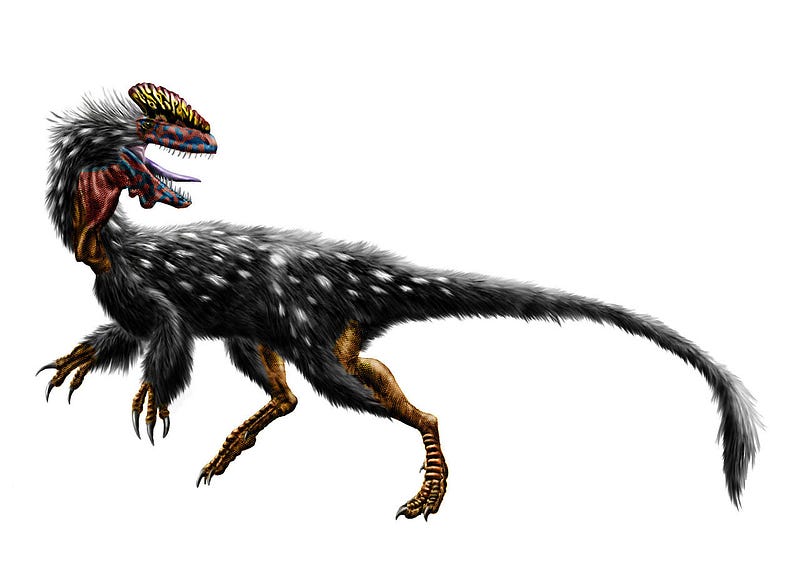
The most characteristic feature of this primitive tyrannosaur is undoubtedly its crest. Made from fused nasal bones, it was filled with air sacs and was reminiscent of the ornamental features found on some living birds, like cassowaries and hornbills [2].
Guanlong lived in China during the Late Jurassic Period, a full 92 million years before the appearance of its well-known descendant. It could grow to about 3m (9.8 ft) in length, only a fraction of the size of its famous cousin.
A horned-faced without horns
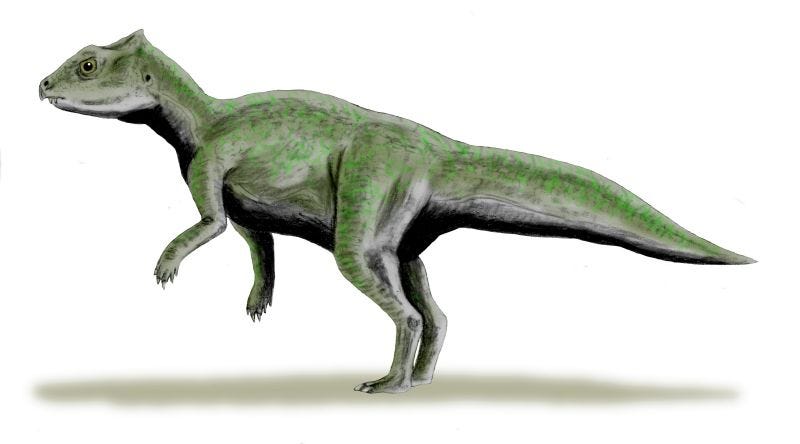
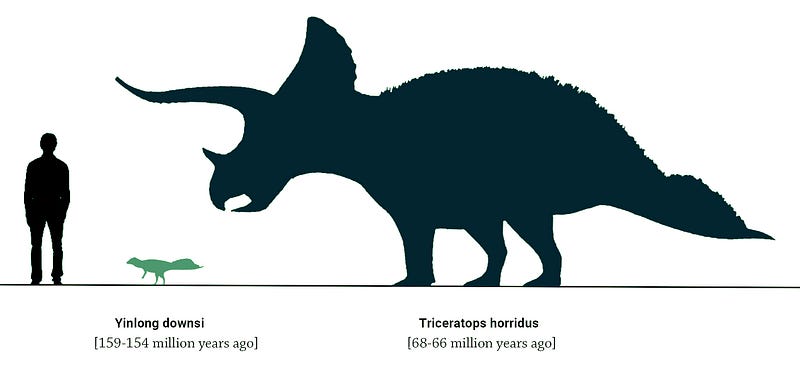
Small, herbivorous, with a virtually frill-less and totally hornless skull. This is the description of Yinlong, the oldest and most primitive relative of the famous Triceratops.
About 1.2 meters (3.9 ft) from nose to tail, and with a weight of about 15 kilograms (33 lb), Yinlong was dwarfed by its iconic three-horned-faced descendant. Like many small ornithischians, Yinlong had long, robust hind limbs and shorter slender forelimbs which suggested a bipedal lifestyle.
This creature is known from a single nearly complete skeleton taken from the Junggar Basin of western China. Its remains were found in rock deposits dating from 159 million to 154 million years ago, during the Late Jurassic Period.
Yinlong coexisted with the primitive tyrannosaur Guanlong (see above) and the two may have developed a predator-prey relationship long before their iconic successors.
One can say that the Tyrannosaurus versus Triceratops rivalry, the greatest of its kind in the animal kingdom, has a surprisingly long history after all!
Epilogue
Animals like Thecodontosaurus, Scutellosaurus, Gideonmantellia, Guanlong, and Yinlong gave rise to some of the most recognizable creatures of prehistory.
These dinosaurs were not special in their own regard, but through the course of millions of years of evolution, their lineages eventually produced the prehistoric icons we are all familiar with today.
Notes
[1] Titanosaurs, a group of sauropods not closely related to Brontosaurus, were the largest animals that have ever walked the planet: species like Argentinosaurus and Patagotitan were more than 30m (98ft) long and weighed over 50 tons.
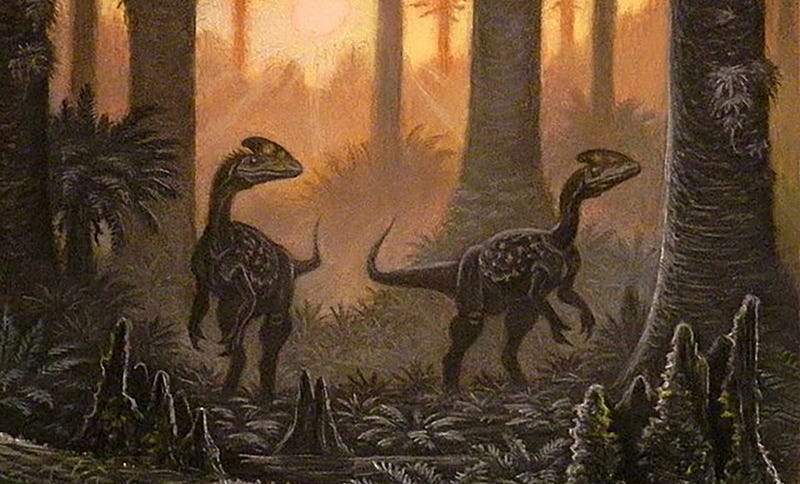
[2] Similar crests developed other theropod dinosaurs as well, including the primitive predator Dilophosaurus wetherilli.
To learn more about this dinosaur, read the article below:
Relevant reads:
References
M.J. Benton, L. Juul, G.W. Storrs and P.M. Galton, 2000, “Anatomy and systematics of the prosauropod dinosaur Thecodontosaurus antiquus from the upper Triassic of southwest England”, Journal of Vertebrate Paleontology 20(1): 77–108
E. H. Colbert. 1981. A primitive ornithischian dinosaur from the Kayenta Formation of Arizona. Museum of Northern Arizona Bulletin 53:1–61
Xu X.; Clark, J.M.; Forster, C. A.; Norell, M.A.; Erickson, G.M.; Eberth, D.A.; Jia, C. & Zhao, Q. (2006). “A basal tyrannosauroid dinosaur from the Late Jurassic of China” (PDF). Nature. 439 (7077): 715–718. doi:10.1038/nature04511. PMID 16467836.
Xu, X., Forster, C.A., Clark, J.M., and Mo, J. (2006). “A basal ceratopsian with transitional features from the Late Jurassic of northwestern China.” Proceedings of the Royal Society B: Biological Sciences, 273(1598): 2135–2140. doi:10.1098/rspb.2006.3566


