
The Dinosaur That Went Extinct Twice
The confusing story of the mighty Brontosaurus…
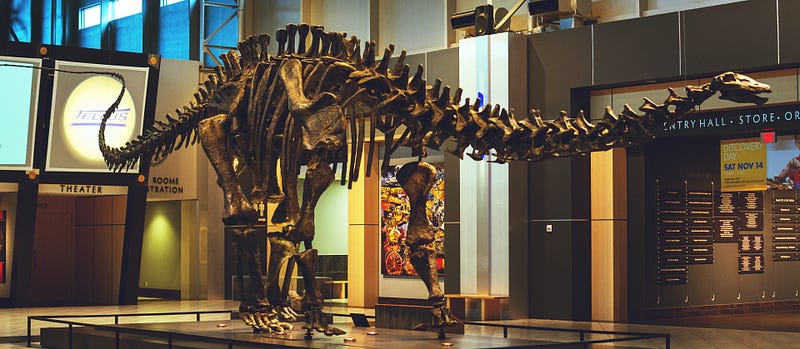
Few prehistoric creatures are as iconic as Brontosaurus, the mighty “thunder lizard”. Thanks to its evocative name and gargantuan size, Brontosaurus quickly invaded popular culture, becoming one of the most famous dinosaurs of all time.
Despite its popularity, though, scientists had been denying its existence for more than a century. Paleontologists had previously noted that Brontosaurus looked too similar to Apatosaurus, a sauropod with an equally long neck and tail. The consensus was that the two species were in fact the same dinosaur. The rules of scientific naming imply that Brontosaurus should be discarded in favor of Apatosaurus, since the latter genus was named first. Although the name Brontosaurus refused to die in popular culture, the “thunder lizard” was considered extinct in the scientific world.
Yet, in 2015 a meticulous study by a team of scientists from Portugal and the United Kingdom shed new light on the subject. Their detailed research concluded that Brontosaurus was a separate genus from Apatosaurus after all. The “thunder lizard” that during the previous decades had gone both literally and scientifically extinct was finally resurrected -at least in the paleontology nomenclature.
Background
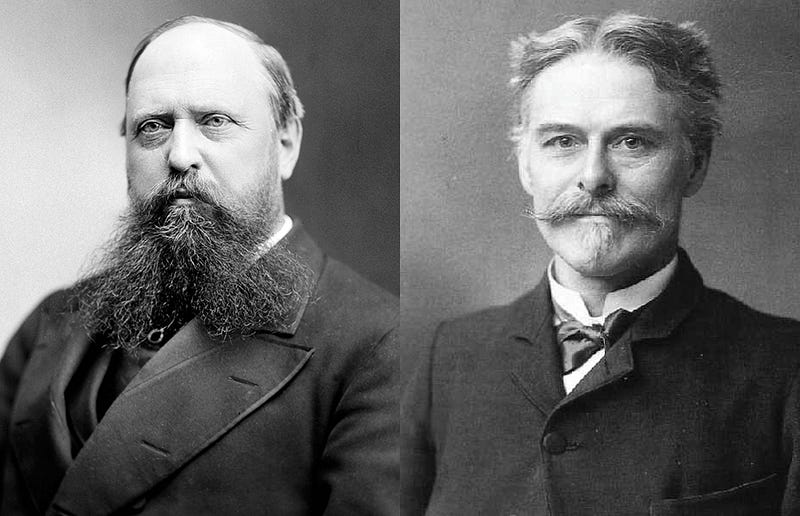
The late 19th-century paleontology in North America was marked by a heated rivalry between two of the most prominent scientists of the continent. This rivalry was expressed by a ruthless and competitive fossil hunting commonly known as the ‘Bone Wars’.
Othniel Charles Marsh from the Peabody Museum of Natural History at Yale, and Edward Drinker Cope from the Academy of Natural Sciences of Philadelphia engaged in a merciless race to discover new fossils. So great their antagonism was, that the prospect of discovering and naming a new dinosaur often trumped scientific scruples. As a result, many descriptions of new taxa were hastily published without proper and careful study.
Discovery
In this climate of intense competition, Marsh discovered in Colorado a nearly complete skeleton of a sauropod dinosaur. In 1877, he coined the name Apatosaurus ajax for the extinct creature he found. Two years later, he announced the discovery of a larger and more complete specimen at Como Bluff, Wyoming. Marsh identified it as belonging to an entirely new genus, which he named Brontosaurus excelsus.
The legend of the “thunder lizard” had just been born.
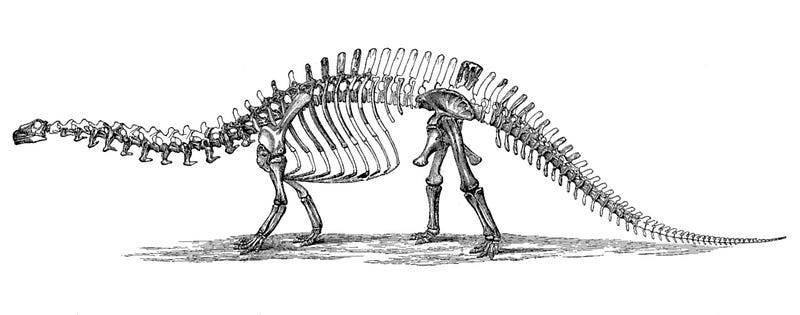
Brontosaurus as well as Apatosaurus are known from the Morrison Formation, the most fertile source of dinosaur fossils in North America. Find out more about this lost world below:
Extinct in science — Alive in popular culture
Paleontologist Elmer Riggs examined both specimens and concluded that Brontosaurus was not different enough from Apatosaurus to warrant its own genus. He renamed the original Brontosaurus specimen Apatosaurus excelsus and he published his findings in the 1903 edition of Geological Series of the Field Columbian Museum. It was the second extinction of Brontosaurus, this time a scientific one.
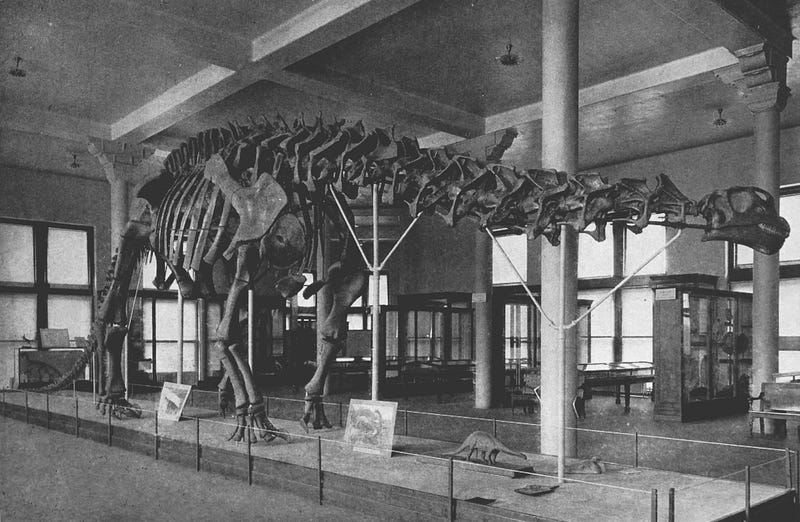
In 1905 the American Museum of Natural History (AMNH) unveiled the first-ever mounted skeleton of a sauropod dinosaur. The skeleton was mainly based on bones recovered from the Apatosaurus ajax specimen. Yet, Henry Fairfield Osborn, American paleontologist and future president of the museum, insisted the mounted exhibit to be labeled as Brontosaurus. Thanks to his decision and the museum’s popularity, the name Brontosaurus was commonly used outside of scientific literature and was quickly engraved in people’s minds.
Riggs’ reclassification of the animal took a long time to attract the public’s attention. When it did, Brontosaurus was already an established name in popular culture and it was hard to be discarded in favor of a less glamourous one like Apatosaurus.
Yet, Riggs’ assessment was widely accepted in the scientific community, and paleontologists treated Brontosaurus as the most famous dinosaur that never existed. Or so it seemed until 2015.
Resurrection
One hundred and twelve years after Rigg’s original assessment, a team of scientists from Portugal and the United Kingdom came to overthrow long-held assumptions and brought new light to the Brontosaurus story.
After five years of extensive research, during which they analyzed 477 different physical features of 81 sauropod specimens, they came to the conclusion that Brontosaurus was distinct from Apatosaurus after all. The all-time favorite “thunder lizard” was officially back!
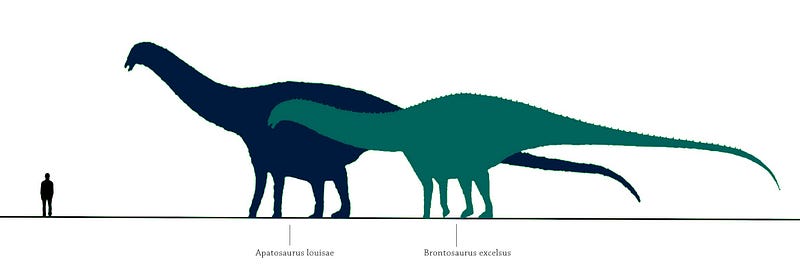
Emanuel Tschopp, lead study author and vertebrate paleontologist at the New University of Lisbon, explained that the reevaluation of Brontosaurus as a separate genus was in accordance with the findings of many species similar to Apatosaurus that have been discovered in the recent years. During its extensive research, the team could compare many more specimens and spot with more clarity their differences.
“Generally, Brontosaurus can be distinguished from Apatosaurus most easily by its neck, which is higher and less wide. So although both are very massive and robust animals, Apatosaurus is even more extreme than Brontosaurus,” said Tschopp.
“The differences we found between Brontosaurus and Apatosaurus were at least as numerous as the ones between other closely related genera, and much more than what you normally find between species,” stated Roger Benson, a co-author from the University of Oxford.
Epilogue
Portrayed as the archetypal sauropod, Brontosaurus had always captured the world’s imagination. Its impressive name quickly resonated in people’s minds and its appeal did not wane even when the scientific community declared it invalid.
After more than a century of denial, the mighty “thunder lizard” came back-this time for good. Thanks to evidence surfaced by new and innovative research techniques, Brontosaurus can proudly step in the pantheon of prehistoric icons where it had always belonged.
Relevant Read:
References
C. Choi, (2015), “The Brontosaurus Is Back”, Scientific American, Link: https://www.scientificamerican.com/article/the-brontosaurus-is-back1/
Brontosaurus”. Oxford Dictionaries UK Dictionary. Oxford University Press. Retrieved 2016–01–21.
Barrett, P. M.; Storrs, G. W.; Young, M. T.; Witmer, L. M. (2011). “A new skull of Apatosaurus and its taxonomic and palaeobiological implications” (PDF). Symposium of Vertebrate Palaeontology & Comparative Anatomy Abstracts of Presentations: 5.
Gorman, James (7 April 2015). “A Prehistoric Giant Is Revived, if Only in Name”. The New York Times. Retrieved 7 April 2015.
Paul G.S.,(2010), Dinosaurs A Field Guide, A&C Black Publishers Ltd.
Brusatte S., (2018), “The Rise and Fall of the Dinosaurs: A New History of a Lost World”, William Morrow.


