
Was This Iconic Jurassic Dinosaur a Scavenger After All?
The new perspective of Allosaurus may overturn 150 years of established thought…
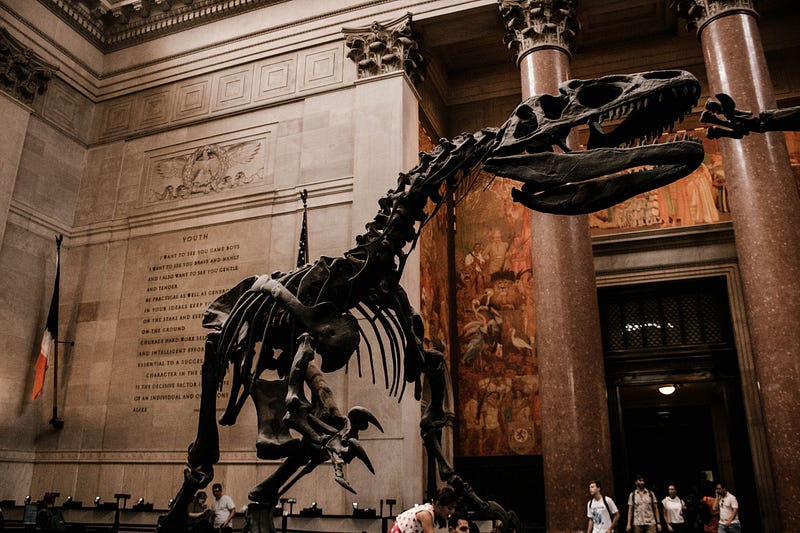
Allosaurus is probably the most famous carnivorous dinosaur of the Jurassic Period. For more than 100 years, paleontologists have considered Allosaurus and its relatives as apex predators, but according to a recent study conducted by researchers at Portland State University, these dinosaurs may have evolved to fill a different niche altogether.
“Different lizard”
Allosaurus lived between 155.7 and 150.8 million years ago during the Late Jurassic Period. Its name means ‘different lizard’ in Greek because its hollow vertebrae were considered distinct from other dinosaur species known at the time of first discovery in 1877. Remains of the Allosaurus have been found in the Morrison Formation — a series of sedimentary rocks spanning the Western United States, which is a fossil-hunting haven for researchers.
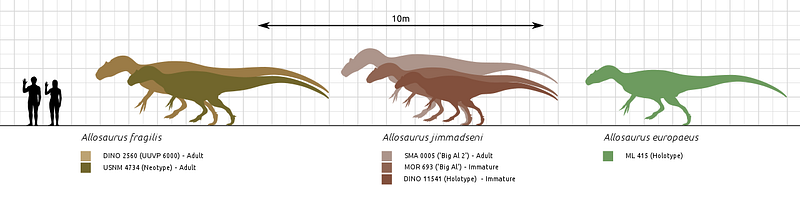
The genus has a complicated taxonomy and includes three valid species, the best known of which is Allosaurus fragilis. The dinosaur averaged 8.5 meters (28 ft) in length, though fragmentary remains suggest it could have reached over 12 m (39 ft), rivaling Tyrannosaurus in stature.
Allosaurus indeed bore some superficial resemblance to Tyrannosaurus rex: it walked bipedally and its jaws were filled with long, sharp, serrated teeth that were easily shed and continuously replaced. Distinguishing features included a disproportionately large head, small horns above the eyes, and facial ridges. Together, these characteristics and the superficial similarities to T. rex led to Allosaurus being thought of as the top predator of the Morrison Formation.

A revolutionary perspective
Researchers Cameron Pahl and Luis Ruedas suggest a new, revolutionary perspective of this iconic carnivore. According to the results of their study, rather than being an active predator, Allosaurus had an ecological role of a scavenger, similar to today’s vultures.
The scientists from the Portland State University supported this hypothesis with a robust agent-based model, which simulated the relationship between carrion resources (carcasses) present in the Morrison Formation generated from the deaths of herbivorous dinosaurs, and the food energy requirements of Allosaurus.
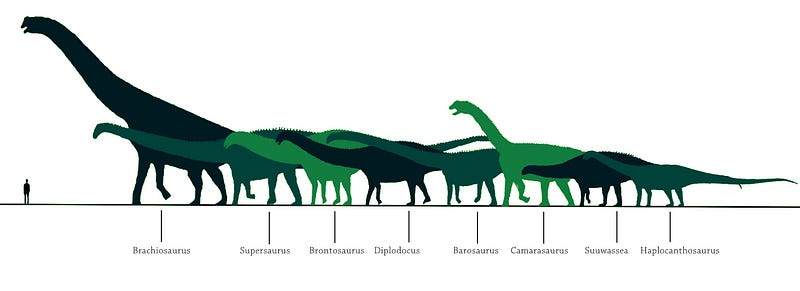
Allosaurus was contemporary in time and space with some of the largest herbivorous dinosaurs ever lived. The Late Jurassic Period is often called the heyday of the sauropods, the iconic dinosaurs with very long necks, long tails, small heads, and four thick, pillar-like legs. These would have included famous species such as Brontosaurus, Apatosaurus, Diplodocus, Camarasaurus, Supersaurus, and Brachiosaurus. Brachiosaurus in particular once was considered the largest land animal to have ever lived and could have been up to 25 meters (82 ft) long and 64 tons in weight. Supersaurus was over 33 meters (110 ft) in length and weighed up to 40 tons.
If these giant dinosaurs died primarily of natural causes, such as disease, starvation, and exhaustion, as is typical of many modern herbivore populations, their carcasses would have been plentiful enough to sustain viable populations of Allosaurus even without these undertaking any predatory behaviors, the researchers claim.
Adding to their hypothesis, Pahl and Ruedas further examined morphological attributes of allosaur skulls, including the extent of binocular vision in predators versus scavengers, as well as ecological data from fossils, such as relative population numbers in predators, herbivores, and scavengers. It was long known that Allosaurus had a relatively fragile skull and dentition. Besides this shortcoming, Allosaurus did not have the binocular vision required to be a successful predator: it was only 30% that of Tyrannosaurus rex, and 15% that of a modern lion’s.
“Our results may explain why carnosaurs like Allosaurus did not evolve powerful bite forces, binocular vision, or advanced cursorial adaptations,” the scientists said. “Carrion [dead flesh] generated by their whale-sized sauropod neighbors may have been abundant enough to support them as obligate scavengers.”
The experts suggest that carnivorous dinosaurs with limited access to dead flesh lying on the ground evolved to be vicious active predators. Contrary to allosaurs, these animals had to aggressively hunt down scarpering prey in the bid to stay alive.
‘The absence of sauropods in certain environments led to more obvious predatory adaptations in theropods such as tyrannosaurs, which evolved without access to significant sauropod carrion,’ the researchers explained. ‘This may have forced them to meet their energy budgets by hunting and pressured them to evolve differently.’
Additional evidence
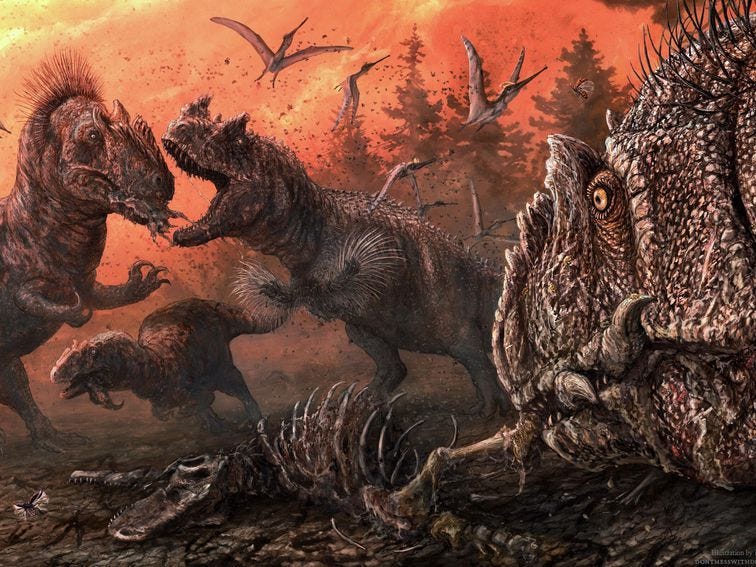
In May 2020, another study had provided evidence for Allosaurus not only being a scavenger but also a potential cannibal. The evidence came from a cache of dinosaur bones found in the Mygatt-Moore quarry, in western Colorado.
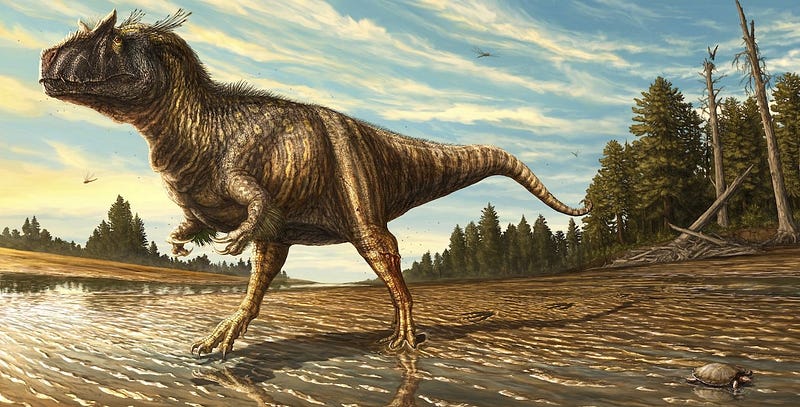
While many of the bitten bones discovered in the quarry had belonged to long-necked sauropods, and some had come from Mymoorapelta maysi, a type of armored dinosaur, the team found several bite marks on Allosaurus fossils. Ceratosaurus, the three-horned, 6-meter-long (20 ft) carnivorous dinosaur could have made the marks, but Ceratosaurus is rare at Mygatt-Moore. The only other carnivore that could have made them is Allosaurus itself, which is much more abundant at the site and would mean Allosaurus were eating some of their own.
“We’re not sure if the Mygatt-Moore preserves an unusually stressed ecosystem, where theropods like Allosaurus were eating any available food — including each other — or if this was actually normal behavior for them, and our previous fossil collection strategies have led us astray. With either result though, we know that these animals were more willing and able to bite into bones than we previously thought,” said Dr. Stephanie Drumheller-Horton, from the University of Tennessee.
While some of the marks could have been due to predation, at least some were down to just scavenging, Drumheller-Horton said. “Predators usually target the meatiest bits first and work their way down through less and less nutritious parts. A big theropod trying to eat another big theropod’s toes was probably very late to the party when the more choice sections were already eaten.”
So, why would Allosaurus eat other Allosaurus? Evidence of dinosaur cannibalism is rare in the fossil record. To date, only two other predatory dinosaurs — Tyrannosaurus and Majungasaurus — have been shown to feed on the carcasses of their own species. Drumheller-Horton notes that cannibalism isn’t all that rare among modern carnivores, though. “Almost no predator will turn down a free meal, so the line between predators and scavengers is fuzzy at best,” she notes.
A fuzzy line
Despite the latest paper, there is also evidence and alternative theories supporting the idea of Allosaurus being a predator.
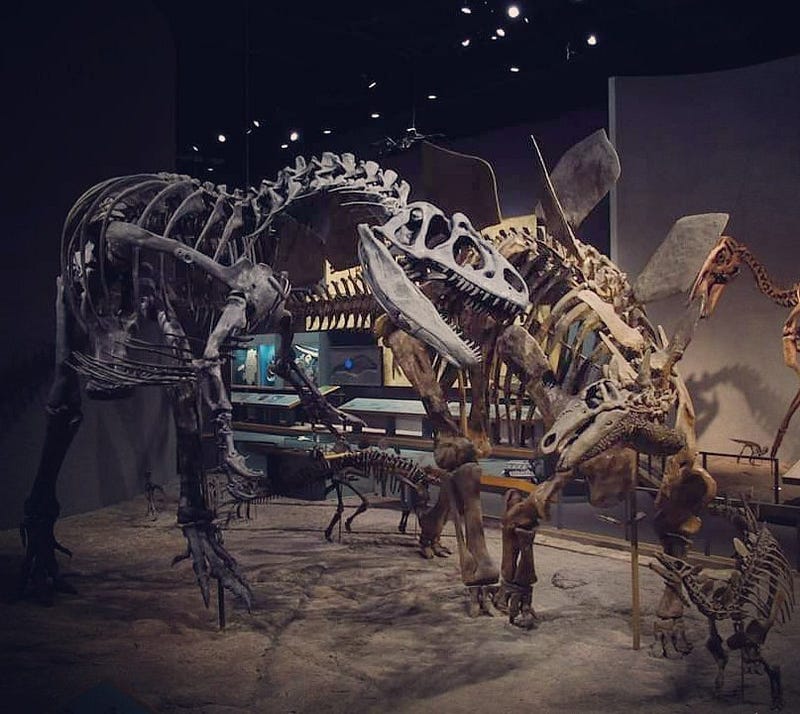
For example, there is dramatic evidence for allosaur attacks on Stegosaurus, the famous dinosaur with the distinctive double row of kite-shaped plates and the two pairs of long spikes at the end of its tail. Paleontologists have discovered an Allosaurus tail vertebra with a partially healed puncture wound that fits a Stegosaurus tail spike and a Stegosaurus neck plate with a U-shaped wound that correlates well with an Allosaurus snout.
As far as sauropods go, an alternative possibility for handling large prey is that Allosaurus was a “flesh grazer”. According to this theory, allosaurs could take bites of flesh out of living sauropods that were sufficient to sustain the predators so they would not have needed to expend the effort to kill the prey outright. This strategy would also potentially have allowed the prey to recover and be fed upon in a similar way later. Alive juvenile or sick sauropods could have been targeted too.
An additional suggestion notes that small, fast-moving ornithopods, like Dryosaurus, were the most common available dinosaurian prey and that allosaurs may have subdued them by using an attack similar to that of modern big cats: grasping the prey with their forelimbs and then making multiple bites on the throat to crush the trachea. This is compatible with other evidence that the forelimbs of Allosaurus were strong and capable of restraining prey.
Epilogue
All the facts coming from the latest study of the Portland State University point to Allosaurus having an ecological role of a scavenger rather than being an active predator. While the paper adds some revolutionary insights into the study of this iconic dinosaur, a firm conclusion is yet to be established. As it’s often with science, more evidence is necessary to overturn 150 years of established thought.
The study was published in the journal Ecological Modelling in August 2021. Find out other exciting discoveries happening during the past month below:
Relevant Reads:
References
“Carnosaurs as Apex Scavengers: Agent-based simulations reveal possible vulture analogues in late Jurassic Dinosaurs” by Cameron C. Pahl and Luis A. Ruedas, 21 August 2021, Ecological Modelling. DOI: 10.1016/j.ecolmodel.2021.109706
“High frequencies of theropod bite marks provide evidence for feeding, scavenging, and possible cannibalism in a stressed Late Jurassic ecosystem” by Stephanie K. Drumheller, Julia B. McHugh, Miriam Kane, Anja Riedel, Domenic C. D’Amore, 27 May 2020, Plos One, https://journals.plos.org/plosone/article/metrics?id=10.1371/journal.pone.0233115#citedHeader
Carpenter, Kenneth; Sanders, Frank; McWhinney, Lorrie A.; Wood, Lowell (2005). “Evidence for predator-prey relationships: Examples for Allosaurus and Stegosaurus”. In Carpenter, Kenneth (ed.). The Carnivorous Dinosaurs. Bloomington and Indianapolis: Indiana University Press. pp. 325–350. ISBN 978–0–253–34539–4.
Rayfield, Emily J.; Norman, DB; Horner, CC; Horner, JR; Smith, PM; Thomason, JJ; Upchurch, P (2001). “Cranial design and function in a large theropod dinosaur”. Nature. 409 (6823): 1033–1037. Bibcode:2001Natur.409.1033R. doi:10.1038/35059070. PMID 11234010. S2CID 4396729.
Foster, John (2007). “Allosaurus fragilis”. Jurassic West: The Dinosaurs of the Morrison Formation and Their World. Bloomington, Indiana: Indiana University Press. pp. 170–176. ISBN 978–0–253–34870–8. OCLC 77830875.
Carpenter, Kenneth (2002). “Forelimb biomechanics of nonavian theropod dinosaurs in predation”. Senckenbergiana Lethaea. 82 (1): 59–76. doi:10.1007/BF03043773. S2CID 84702973.