
When Tyrannosaurs Were Prey
The rise and fall of the giant allosaurs that ruled the Mesozoic world…
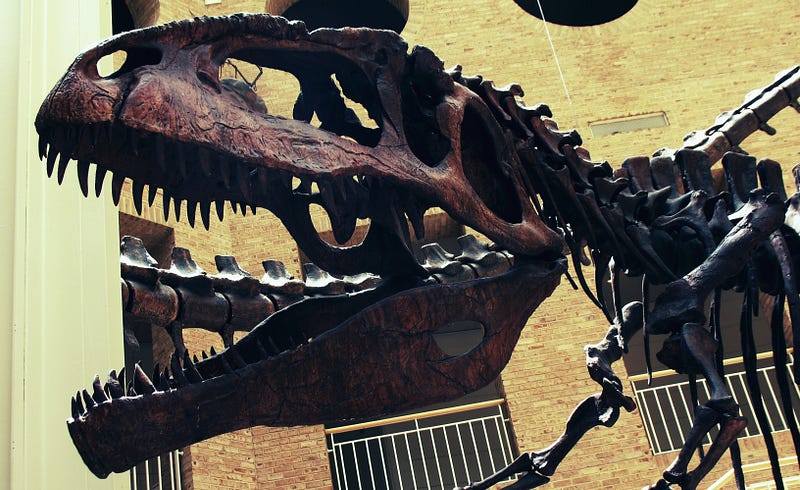
Tyrannosaurus rex is commonly depicted as the king of prehistoric life, its kin ruling the saurian world. Yet, tyrannosaurs rose late in the dinosaur age to become the apex predators of their ecosystems. For most of their existence, T.rex’s ancestors lived in the shadows while a mighty class of theropods dominated the world around them. These theropod dinosaurs are known as allosaurs [1].
Allosaurs were the undisputed rulers of their terrestrial ecosystems for far longer than tyrannosaurs, had a much wider distribution in the world, and some of them matched or even exceeded the eponymous Tyrannosaurus rex in size. It is kind of ironic that these theropods are always overshadowed by tyrannosaurs in popular culture. Evidence tells us that in the past it was the other way around.
What is an Allosaur?
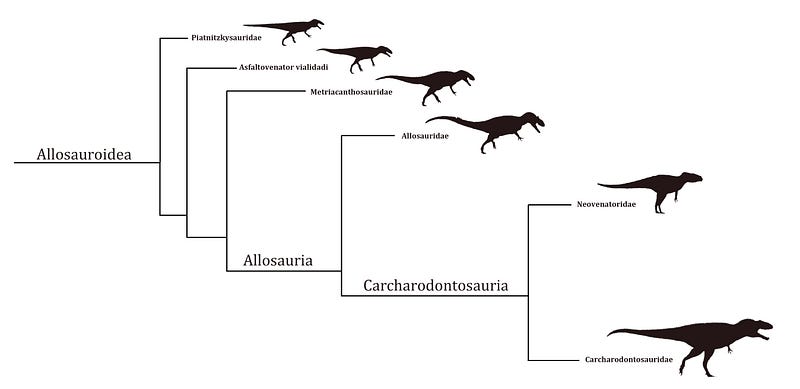
The Allosauroidea is a superfamily of theropod dinosaurs, which is divided into four main groups — the Metriacanthosauridae, the Allosauridae, the Carcharodontosauridae, and the Neovenatoridae. All these groups share certain distinctive features, such a long, narrow skulls usually accompanied by “horns” or ornamental crests on their heads [2].
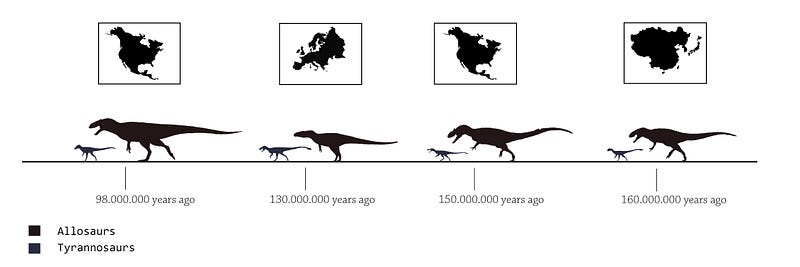
Allosaurs first evolved during the Middle Jurassic Period (≈175 million years ago) and their reign lasted for more than 80 million years. Tyrannosaurs, on the other hand, were at the top of the food chain for less than a quarter of that period. Allosaurs flourished in almost every continent, inhabiting North and South America, Africa, Europe, and Asia. For comparison, confirmed tyrannosaur remains are only known from the Northern Hemisphere.
The last definite members of the allosaurs, the Carcharodontosauridae, went extinct around 90 million years ago, during the Late Cretaceous Period [3]. It was only after the decline of allosaurs that tyrannosaurs managed to evolve larger size and came to be the dominant land predators of their environment.
A Question of Size
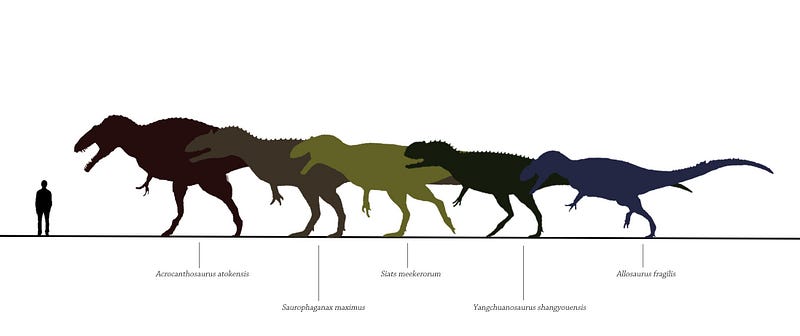
Despite the evolution of a few small to medium-sized forms, allosaurs were usually large predators finding themselves at the top of the food chain in the environments they lived. Species such as Acrocanthosaurus, Saurophaganax, Siats, Yangchuanosaurus, and Allosaurus are typical examples of big allosaurs that grew close to or past the 10m (33 ft) mark.
T.rex-sized
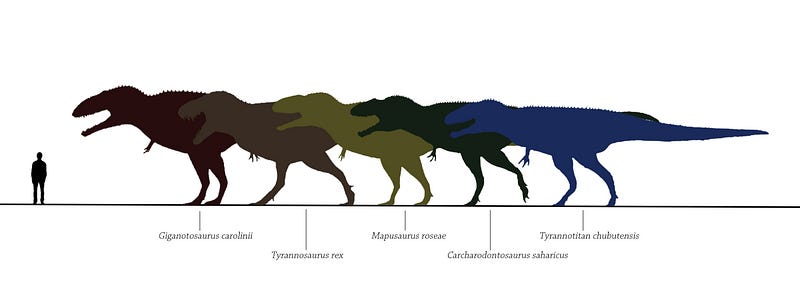
Nevertheless, it was through a subfamily of gigantic derived carcharodontosaurids that allosaurs reach their peak in terms of size. These giants lived in the Southern Hemisphere between 118 and 93 million years ago and they were the following: Carcharodontosaurus from Africa, and Giganotosaurus, Mapusaurus, and Tyrannotitan from South America. All of them rivaled and even topped the eponymous Tyrannosaurus rex in size, being undoubtedly the kings of the allosaur lineage.
These allosaurs may at first glance look a lot like T.rex: they were similar-sized bipedal predators with small forelimbs and giant skulls full of menacing teeth. Under closer inspection though, it becomes apparent that carcharodontosaurids and tyrannosaurs were very distinct.
Carcharodontosaurs vs Tyrannosaurs: The Differences
Carcharodontosaurs had serrated teeth, similar to those of a shark (hence their name which translates to shark-toothed lizards). Those teeth were thinner from side-to-side and, coming to a sharper point, they were ideal for cutting flesh. Their skulls had fewer air-pockets inside making them strong and powerful.
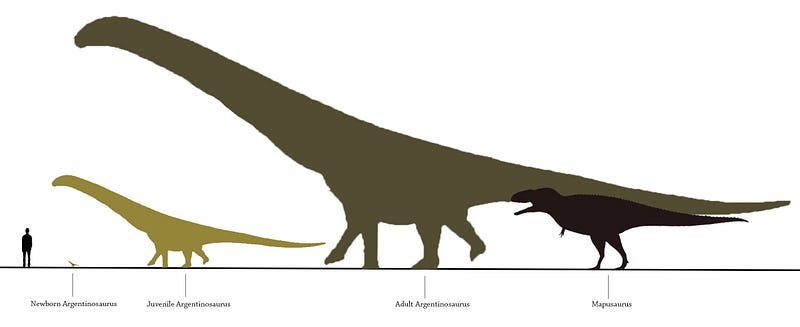
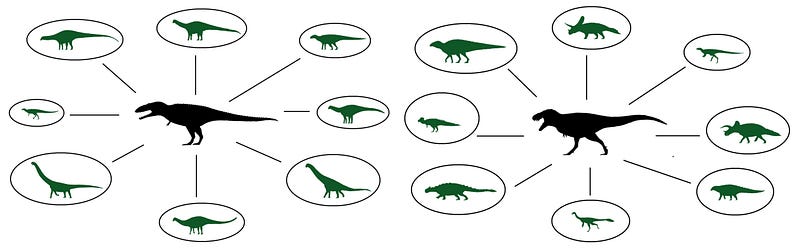
Fossils of Carcharodontosaurus, Giganotosaurus, Mapusaurus, and Tyrannotitan have all been found in formations associated with giant sauropods, known as titanosaurs [4].
It is still unknown if these predators were specialized sauropod-killers, especially since some of the sauropods they coexisted with reached (as their name suggests) titanic sizes. While it is doubtful whether carcharodontosaurids could hunt down and kill a healthy adult titanosaur, juvenile or sick animals may have been vulnerable.
The teeth of T. rex, on the other hand, are relatively thick, abnormally blunt, and only slightly serrated. Tyrannosaurus rex is estimated to have exerted the largest bite force among all terrestrial animals and used its teeth to crush bones and to penetrate thick bony armor plating.
Its paleo-environment was dominated not by titanic sauropods, but ferocious herbivores bearing huge horns, body armor, and tail clubs. Dinosaurs such as Triceratops and Ankylosaurus could very well fight back and, having the ability to kill with a single, powerful bite could mean the difference between life and death for a predator.
Extinction
Around 100 million years ago, allosaurs reigned supreme and tyrannosaurs were small to medium-sized carnivores living in parts of Asia, Europe, and North America. Fifteen million years later, the last surviving allosaur lineage — the carcharodontosaurs — were gone and large tyrannosaurs ruled the Northern Hemisphere.
It seems that something changed on the planet between 110 and 84 million years ago. Unfortunately, the fossil record of that 25-million-year period is poor and doesn’t provide us with concrete answers.
It is suggested that between the Cenomanian and Turonian stages of the Late Cretaceous Period a medium-scale mass extinction was in effect, driven by environmental change [5].
On the eve of this turmoil, the largest terrestrial predators were the carcharodontosaurian allosaurs and the spinosaurs — theropods with elongated vertebral spines and crocodile-like jaws that fed primarily on fish. Tyrannosaurs were small but, under the shadows of these giants, were gradually evolving larger brains and more sophisticated senses.
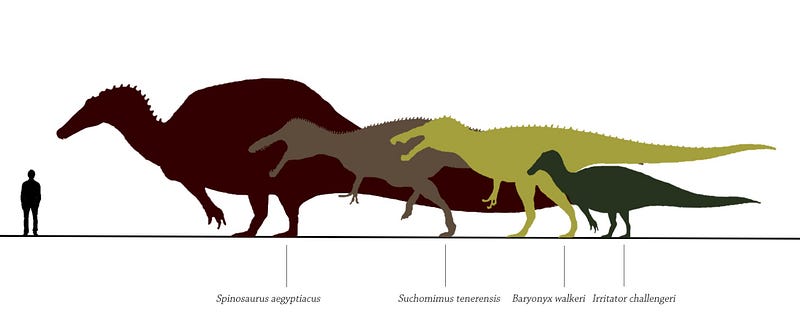
So did tyrannosaurs rose to prominence by chance, taking advantage of the environmental changes that drove to extinction the larger allosaurs and spinosaurs? Or did they gradually outsmart them with their keener senses and bigger brain? No one knows for sure, but one thing is certain: 84 million years ago tyrannosaurs were the largest terrestrial carnivores in the world and allosaurs were nowhere to be found.
Epilogue
Unfortunately, allosaurs are often portrayed as mere extras in a stage ruled by the all-time favorite T.rex. One has to remember that, had allosaurs not gone extinct, the trademark prehistoric monster of our popular culture could not have been evolved at all.
Allosaurs were one of the longest-surviving clades of theropod dinosaurs, being the apex predators for most of the Mesozoic Era. Their clade included some of the biggest terrestrial carnivores ever to exist and they conquered almost all continents. They were predators of unrivaled skill and endurance, possibly adapted to hunt down and kill the largest animals to ever walk the Earth. If a theropod lineage truly deserves to be portrayed as the rulers of the Mesozoic world, it would be them.
Notes
[1] Theropods are a group of saurischian dinosaurs characterized by hollow bones and three-toed limbs. All meat-eating dinosaurs were theropods. Note, though, that all theropods were not necessarily carnivorous as many species were insectivores, piscivores, omnivores or even herbivores.
[2] More distinctive features of allosaurs include: 1) a triangular-shaped pubic boot, 2) three fingers per hand -with the second and third digit being approximately equal in length-, 3) the femur being larger than the tibia, 4) the chevron bases on their tails have anterior and posterior bone growth, 5) and large orbits.
[3] Excluding Megaraptora, a clade of carnivorous dinosaurs with controversial relations to other theropods. Megaraptora have historically been classified as derived Carcharodontosauria, basal Coelurosauria, and basal Tyrannosauroidea. Members of this group survived until the mass extinction event that killed off all non-avian dinosaurs 66 million years ago.
[4] Titanosaurs were a diverse group of sauropod dinosaurs, including genera from Africa, Asia, South America, North America, Europe, Australia, and Antarctica. The group’s name alludes to the mythological Titans of ancient Greek mythology and includes the largest land animals known to have ever existed.
[5] According to a leading theory, intense volcanic activity was taking place at the time, resulting in the release of a massive amount of carbon dioxide and other greenhouse gases in the atmosphere. Global temperatures rose, sea levels fluctuated constantly, and the oceans were deprived of oxygen causing the extinction of many ocean-living invertebrates and other species. It’s not clear how these changes affected the allosaurs, but this period marks the beginning of their worldwide decline.
References
Brusatte S., (2018), “The Rise and Fall of the Dinosaurs: A New History of a Lost World”, William Morrow.
Black R., (2020), “How Shark-Toothed Dinosaurs Came to Rule the World”, Discover Magazine, Link: https://www.discovermagazine.com/planet-earth/how-shark-toothed-dinosaurs-came-to-rule-the-world
Benson, Roger B. J.; Carrano, Matthew T.; Brusatte, Stephen L. (2010). “A new clade of archaic large-bodied predatory dinosaurs (Theropoda: Allosauroidea) that survived to the latest Mesozoic”. Naturwissenschaften, Link: https://link.springer.com/article/10.1007/s00114-009-0614-x
Carrano, Matthew T.; Benson, Roger B. J.; Sampson, Scott D. (2012). “The phylogeny of Tetanurae (Dinosauria: Theropoda)”. Journal of Systematic Palaeontology, Link: https://www.tandfonline.com/doi/abs/10.1080/14772019.2011.630927?journalCode=tjsp20
Novas, Fernando E. (2013). “Evolution of the carnivorous dinosaurs during the Cretaceous: The evidence from Patagonia”. Cretaceous Research, Link: https://www.sciencedirect.com/science/article/pii/S0195667113000608?via%3Dihub
Delcourt, R.; Grillo, O.N. (2017). “Carcharodontosaurids remained extinct in the Campanian-Maastrichtian: Reassessment of a fragmentary maxilla from Presidente Prudente Formation, Brazil”. Cretaceous Research. Link: https://www.sciencedirect.com/science/article/pii/S0195667117301854?via%3Dihub
Woodward A., (2019), “The T. Rex had the strongest bite of any land animal ever — and new research shows the dinosaur really could crush a car”, Business Insider, Link: https://www.businessinsider.com/t-rex-stiff-jaws-bite-force-crush-car-2019-9
Hone, David William Elliott; Holtz, Thomas Richard (2017). “A Century of Spinosaurs — A Review and Revision of the Spinosauridae with Comments on Their Ecology”. Acta Geologica Sinica — English Edition, Link: https://onlinelibrary.wiley.com/doi/abs/10.1111/1755-6724.13328
White, Matt A.; Bell, Phil R.; Poropat, Stephen F.; Pentland, Adele H.; Rigby, Samantha L.; Cook, Alex G.; Sloan, Trish; Elliott, David A. (2020). “New theropod remains and implications for megaraptorid diversity in the Winton Formation (lower Upper Cretaceous), Queensland, Australia”, Link: https://www.ncbi.nlm.nih.gov/pmc/articles/PMC7029900/
Curry-Rogers, K. (2005). “Titanosauria: a phylogenetic overview”. In Curry-Rogers, K.; Wilson, J. (eds.). The Sauropods: Evolution and Paleobiology. Indiana University Press.
Paul G.S.,(2010), Dinosaurs A Field Guide, A&C Black Publishers Ltd.
Panos Grigorakakis is a journalist particularly interest in history, evolutionary biology, anthropology and…ocean liners! Connect with him on Linkedin or say hi on Twitter.


