
T.rex: Beyond the Pop Culture Monster
The conflicting image between a movie monster and a 66 million-year-old dinosaur…
“A name like Tyrannosaurus rex is just irresistible to the tongue.” — Robert Bakker
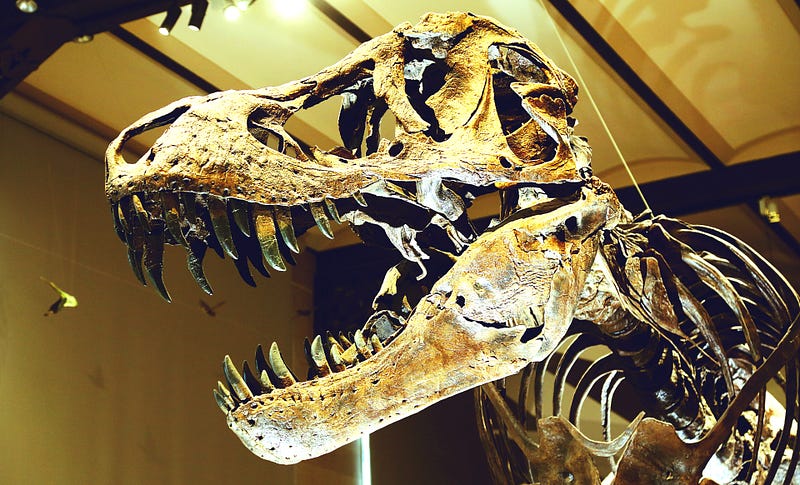
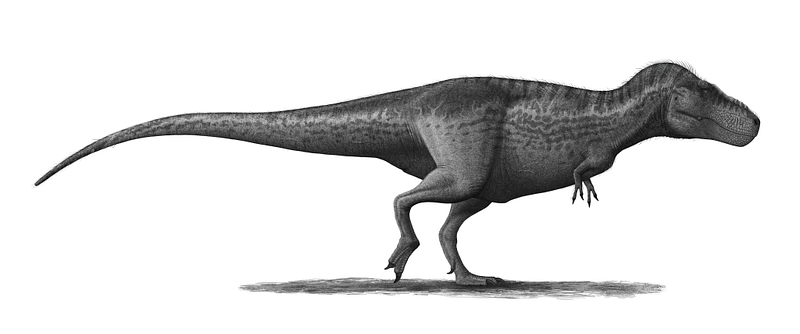
Tyrannosaurus rex is one of the most famous and easily recognizable monsters of popular culture starring in numerous films, movies, and documentaries. Unfortunately, our perception of this remarkable animal is often way different than the actual predator that lived in western North America 66 million years ago.
To get a more accurate picture of the ‘tyrant lizard king’ we need to steer away from Hollywood movies and to focus instead on the available scientific data. Fortunately, T.rex is the most well-studied dinosaur in science, so there is a plethora of information about it.
Our tribute to Tyrannosaurus will be broken into two parts in order to be more digestible:
. Part 1 will focus on debunking common misconceptions about Tyrannosaurus as well as providing information regarding its general description.
. Part 2 will cover a few more aspects of T.rex’s paleobiology as well as its evolutionary history and its paleoenvironment.
(Beginning of Part 1)
Myths & Misconceptions
Hollywood blockbusters such as the Jurassic Park films are responsible for common misconceptions about T.rex and need to be blamed for establishing a somewhat inaccurate picture of this animal.
For example, Tyrannosaurus could not outrun a jeep, its vision was not based on movement and it did not roar triumphantly after taking down an animal. Most probably it did not roar at all. It could not do so. As much as I love the iconic, menacing roar given to T.rex in Jurassic Park, I have to accept its scientific improbability.
Tyrannosaurus's closest living relatives, mainly birds (and less so crocodilians), do not roar. Instead of a roar, T.rex probably was able to produce an ominous, low rumble. The rumble may have reached such a deep frequency that it may have been ‘felt’ rather than heard.
Such scientific observations remind us that Tyrannosaurus, although monstrous in size and looks, it was not a monster in a literal sense, but an animal evolved like million others to occupy an available environmental niche.
The commonly depicted image of T.rex as a mindless meat-eating machine that kills every creature that crosses its path is simply not accurate.
To check out more scientific inaccuracies from the famous blockbuster read the article below:
Size
Tyrannosaurus is frequently regarded as the largest carnivorous dinosaur that had ever existed. One of the largest and most complete T.rex specimens is located at the Field Museum of Natural History. Nicknamed Sue, this animal measured 12.3–12.8 meters (40–42 ft) long and estimated to have weighed between 8.4 metric tons (9.3 short tons) to 14 metric tons (15.4 short tons).
While it’s true that Tyrannosaurus was gigantic, its size was matched by few other theropods as well. For example, the specialized semi-aquatic Spinosaurus aegyptiacus is generally considered to have been longer albeit more lightly built. This creature has an estimated length of over 14 meters (49 ft) and a body mass of 4 metric tons (4.4 short tons).
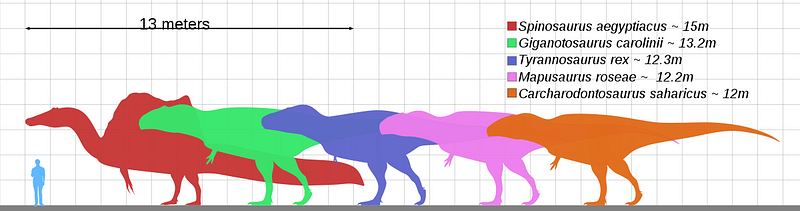
A subfamily of gigantic derived carcharodontosaurids that lived in the Southern Hemisphere between 118 and 93 million years ago also rivaled and even topped the ‘tyrant lizard king’ in size.
These species were the Carcharodontosaurus from Africa, and Giganotosaurus, Mapusaurus, and Tyrannotitan from South America.
To learn more about these giant allosauroids check the article below:
Lethal Bite
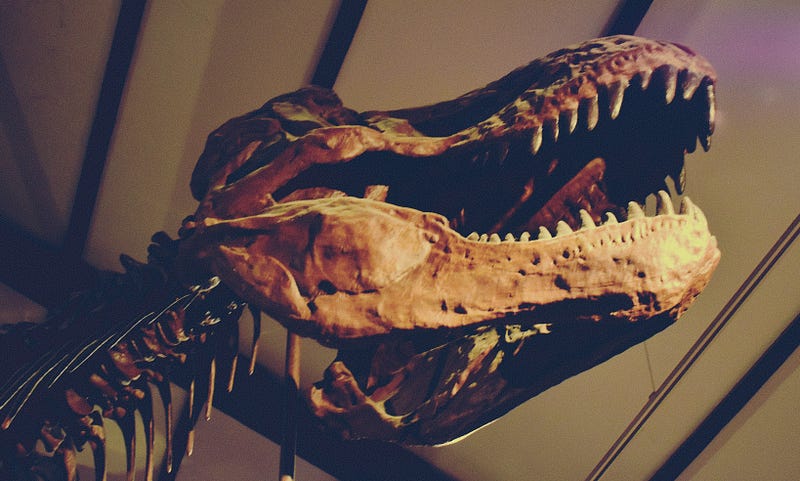
One of the most striking features of T.rex is undoubtedly its menacing jaws. These jaws are filled with relatively thick, abnormally blunt, banana-sized teeth. The largest found so far is estimated to have been 30.5 centimeters (12 in) long including the root when the animal was alive, making it the largest tooth of any carnivorous dinosaur yet found.
Tyrannosaurus rex is estimated to have exerted the largest bite force among all terrestrial animals and used its teeth to crush bones and to penetrate thick bony armor plating. The maximum bite force of T.rex was calculated to be between 35,000-57,000 newtons. That’s ten times as forceful as the bite of a modern alligator!
Tiny Arms
Contrary to its terrifying jaws, T.rex’s forelimbs were far less impressive. Measuring only 1 meter (3.3 ft ) long, they were very small relative to the creature’s overall body size. Despite that, they were considerably strong — the biceps muscle of Tyrannosaurus is estimated to have been 3.5 times as powerful as the human equivalent.
The heavy build of the arm bones, the strength of the muscles, and the limited range of their motion led some scientists to suggest that they could have been used to hold fast a struggling prey. This theory is not universally accepted among the scientific community though, and the true function of the forelimbs remains to this day largely obscure.
Surprisingly enough the tyrannosaurs did not have the smallest forelimbs in the theropod family tree. For example, Abelisaurids, a group of ceratosaurian theropods that characterized by the extensive ornamentation of their skulls, had almost vestigial arms that bore no wrist bones. To learn more about these remarkable predators check the article below:
Powerful Legs
Contrary to popular perception modern humans could outrun a fully-grown T.rex. Tyrannosaurus is estimated to have weighed anywhere between 5 and 9(!) tons, making it a really heavy animal. Its legs, even though huge, were not designed for active running. Tyrannosaur legs were found instead to be greatly adapted for low-energy, efficient walking.
Tyrannosaurus could have made some long strides reaching speeds of about 12 mph/20kph — not much, but probably fast enough to prey on the large ceratopsians and hadrosaurs of its paleoenvironment. Younger and juvenile animals were more lightly built, so they probably have been much faster.
Tyrannosaurus was a predator that based its success on its sheer power, its extremely developed senses, and intelligence-not speed.
Senses & Intelligence
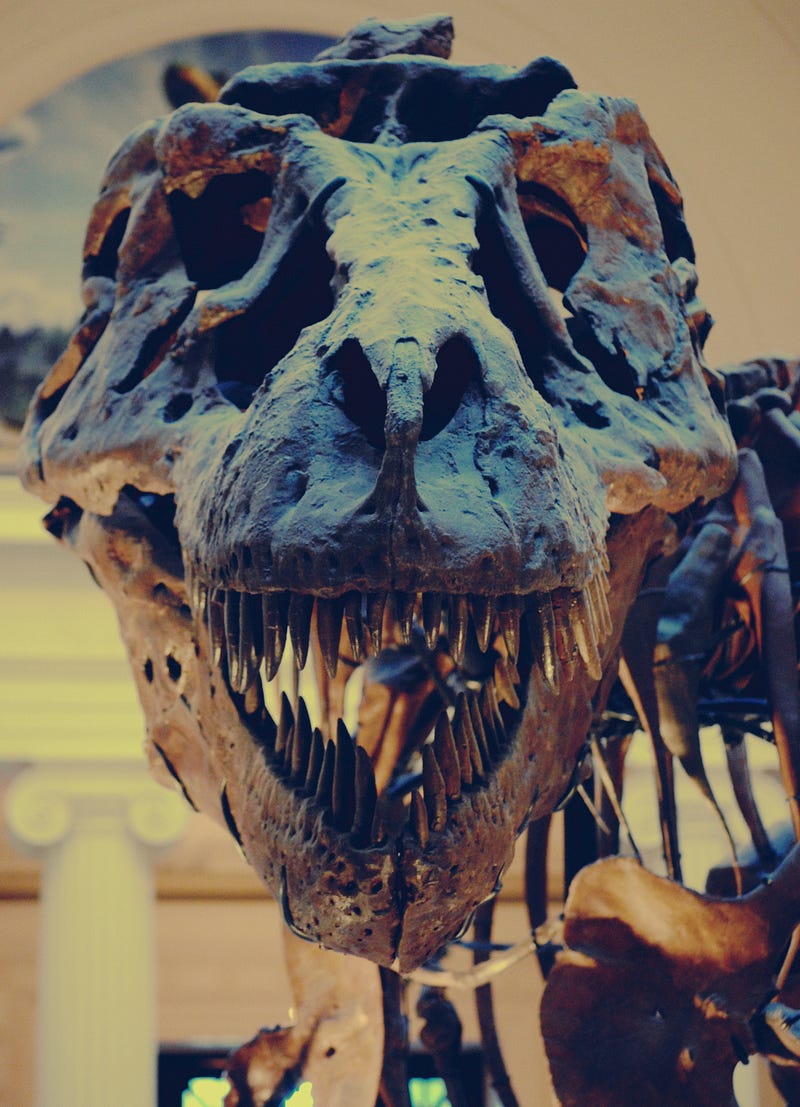
In the Jurassic Park movies, actors stay still to avoid detection from T.rex. In reality, though, Tyrannosaurus would have certainly seen something even if it didn’t move. This carnivore had an eagle-like binocular vision, able to perceive depth. Its eyesight abilities were thirteen times(!) better than ours.
T.rex had also large olfactory bulbs and olfactory nerves, giving it a great sense of smell. So much so, that they may have been comparable to modern vultures that use scent to track carcasses over great distances.
Furthermore, T.rex had an unusually long cochlea which enabled it to catch a variety of low-frequency sounds.
And as if all these were not enough, Tyrannosaurus had the relatively largest brain of all adult non-avian dinosaurs except certain small maniraptoriformes [1].
Epilogue
Tyrannosaurus rex was a truly remarkable creature. It had lethal jaws, acute senses, and a relatively big brain. The skeleton of this ferocious animal is enough to inspire awe and wonder to museum visitors all over the world, but the bones alone are inadequate to picture the real portrait of this great predator when alive — a portrait so different from the one we are used to in popular culture…
(End of Part 1)
Check Part 2 below:
Notes
[1] Maniraptoriformes is a clade of dinosaurs with pennaceous feathers and wings that contains ornithomimosaurs and maniraptors.
References
Parrish J.M., Molnar R.E., Currie P.J., Koppelhus E.B.,(2013), Tyrannosaurid Paleobiology, Indiana University Press
Hone D.,(2016) The Tyrannosaur Chronicles, Bloomsbury Publishing Plc
Paul G.S.,(2010), Dinosaurs A Field Guide, A&C Black Publishers Ltd
Hone D.,(2011), Teeth like steak knives or bananas or well, tyrannosaur teeth, Link: https://archosaurmusings.wordpress.com/2011/12/04/teeth-like-steak-knives-or-bananas-or-well-tyrannosaur-teeth/
Witton M.,(2017), Revenge of the scaly Tyrannosaurus, Link: http://markwitton-com.blogspot.gr/2017/06/revenge-of-scaly-tyrannosaurus.html
Montanari S.,(2017), Actually, You Could Have Outrun a T. rex, Link: https://news.nationalgeographic.com/2017/07/tyrannosaur-trex-running-speed
Brusatte S.,(2017), New research proves the T rex in “Jurassic Park” would never have caught Jeff Goldblum, Link: https://qz.com/1042454/how-fast-could-tyrannosaurus-rex-run-not-very/
Charles Q. Choi, (2012), T. Rex Bite Strongest Ever on Land — Ten Times Greater Than Gator’s, National Geographic, Link: https://www.nationalgeographic.com/news/2012/2/120228-t-rex-bite-bates-science-biology-letters-dinosaurs/


