
Top Things Jurassic Park Got Wrong About Dinosaurs
No way T. rex could have chased down that jeep if it was going at highway speeds…
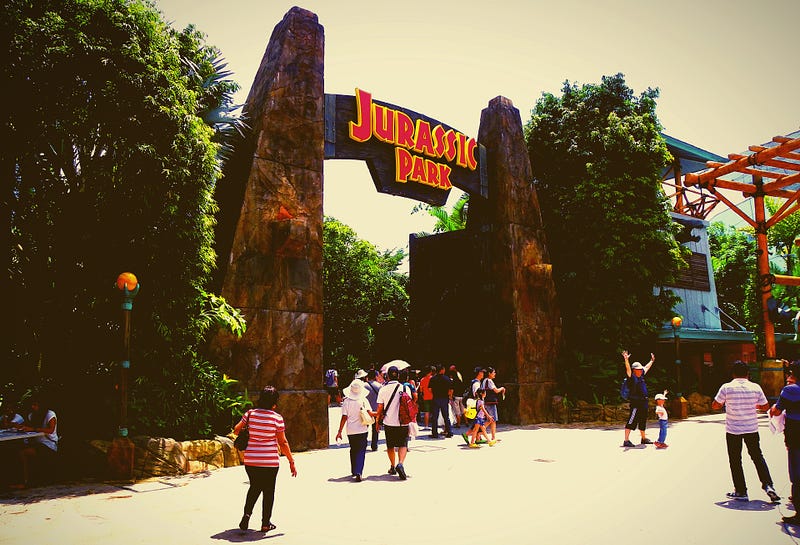
Jurassic Park is the trademark Hollywood movie featuring dinosaurs, praised for establishing a more accurate image of these creatures in popular culture. The film did indeed put an effort to deviate from the classic depiction of dinosaurs as sluggish and dumb animals, portraying them as energetic, social, and intelligent instead.
While this view is closer to what the paleontologists currently think of these creatures, elements that contradict modern-day science are also present.
In this text, we will try to address a few notable scientific inaccuracies featured in the famous blockbuster.
. The film’s Brachiosaurus turned out to be a different species
When the guests arrive at the park, they are stunted by the presence of an enormous long-necked dinosaur that gracefully stumbles across them. In a beautifully-crafted scene, the visitors remain speechless at the sight of this awe-inspiring animal. In the movie, this creature is referred to as a Brachiosaurus. Except that is not.
Back in 1993, two species of this sauropod were believed to exist, B. altithorax and B. brancai. The film based its Brachiosaurus on the more complete brancai specimen which later proved to belong to a different genus altogether. The ‘Brachiosaurus’ from Jurassic Park is in fact a Giraffatitan brancai!
. The jeep-chasing T.rex
The park’s star attraction, Tyrannosaurus rex, having previously escaped from its enclosure, attacks once again the film’s protagonists by chasing down their jeep. After a thrilling chase lasting a few moments, the giant predator gives up allowing the humans to flee and escape the attack.
This terrifying scene however iconic is fairly inaccurate. Tyrannosaurus was in truth a much slower-moving animal. So slow that modern humans could outrun a fully grown individual. This creature is estimated to have weighed anywhere between 5 and 9(!) tons, making it really heavy. Its legs, even though huge, were not designed for active running. Tyrannosaurus could make some long strides reaching speeds of about 12 mph/20kph, but most of the time this giant theropod just walked around averaging even lower velocities.
As paleontologist Stephen Brussate explains: “No way T. rex could have chased down that jeep in Jurassic Park if it was going at highway speeds. Maybe if it was in first gear, but even that’s a big if.”
. T.rex vision
“Don’t move! It can’t see us if we don’t move” screams Alan Grant to Lex Murphy when the mighty Tyrannosaurus approach them during the main road attack. In the movie, T.rexe’s vision is based on movement.
In reality, though, Tyrannosaurus would have certainly seen something even if it didn’t move. This carnivore had an eagle-like binocular vision, able to perceive depth. To put this into perspective, the eyesight abilities of this mighty predator were thirteen times(!) better than ours! Unfortunately, Dr. Grant and Lex wouldn’t have stood a chance being so close to the animal’s jaws.
To learn more interesting facts about the mighty ‘tyrant lizard king’ read the article below:
. The oversized featherless Raptors
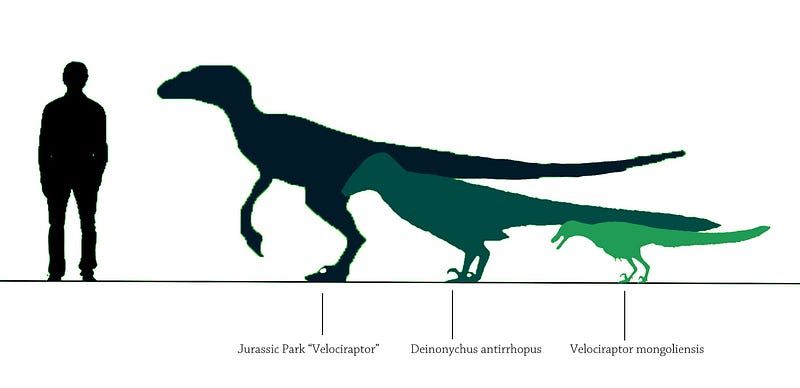
The Jurassic Park Velociraptors are the deadliest animals in the movie. They are intelligent, vicious, and…quite oversized. They also lack feathers.
Jurassic “raptors” are in fact based on Deinonychus antirrhopus, not Velociraptor mongoliensis. Deinonychus was a 3.4 meters (11 ft) long carnivore, almost double the size of Velociraptor. Still, the Jurassic Park variant is even larger.
In addition, there’s enough paleontological evidence to suggest that Dromaeosauridae, the clade that includes both Deinonychus and Velociraptor, were covered in feathers. As paleontologist Thomas Holtz explains: “Velociraptor would have been as feathered as a bald eagle”. In the movie though, they are covered in scales similar to those found in lizards.
. The venom-spitting Dilophosaurus
Being responsible for the death of Dennis Nedry, the man who took down the security systems of the park, Dilophosaurus made a memorable appearance in the movie. Unfortunately, it was also a really inaccurate one.
The film’s Dilophosaurus posses a large neck frill and spits venom in its victim’s eyes. Although this attribute took the audience by a welcome surprise, it’s entirely fictitious. There’s no evidence supporting the actual animal bearing any frill, let alone being venomous.
Also, Jurassic Park’s Dilophosaurus is quite small compared to its real counterpart. The actual dinosaur was about 7m (23 ft) in length; in fact, Dilophosaurus was among the largest terrestrial predators to roam the planet 193 million years ago. In contrast, Jurassic Park’s variant is only 2.7 m (9 feet) long. In the movie’s defense, it is not clear whether the animal that killed Dennis Nedry was an adult or a juvenile.
To learn more about this fascinating Jurassic predator, read the article below:
Epilogue
Do the inaccuracies mentioned above make the movie less enjoyable? The answer is probably no. We have to remember that Jurassic Park was a science fiction movie, not a natural history documentary. The fact that some of the inaccuracies were intentional in order to enhance the cinematic experience is quite understandable.
We also need to take into account that our knowledge of these animals has advanced a lot since 1993, and the amount of information we have today was not available 27 years ago. As a result, things that contradict our current understanding of dinosaurs were bound to be found.
Relevant Reads:
References
Taylor, M.P. (2009). “A Re-evaluation of Brachiosaurus altithorax Riggs 1903 (Dinosauria, Sauropod) and its generic separation from Giraffatitan brancai (Janensch 1914)” (PDF). Journal of Vertebrate Paleontology, Link: http://www.miketaylor.org.uk/dino/pubs/taylor2009/Taylor2009-brachiosaurus-and-giraffatitan.pdf
Montanari S.,(2017), Actually, You Could Have Outrun a T. rex, Link: https://news.nationalgeographic.com/2017/07/tyrannosaur-trex-running-speed
Blitz M., (2014), Jurassic Park Lied to You: T-Rex Had Great Eyesight Really, Gizmodo, Link: https://gizmodo.com/jurassic-park-lied-to-you-t-rex-had-great-eyesight-rea-1577352103
Pickrel J., (2020), ‘Jurassic Park’ got almost everything wrong about this iconic dinosaur, National Geographic, Link: https://www.nationalgeographic.com/science/2020/07/jurassic-park-got-almost-everything-wrong-about-iconic-dinosaur-dilophosaurus/
Black R., (2008), You say “Velociraptor,” I say “Deinonychus”, Smithsonian Magazine, Link:https://www.smithsonianmag.com/science-nature/you-say-velociraptor-i-say-deinonychus-33789870/
Dell’Amore C.,(2013), Revisiting My Teenage Crush on Jurassic Park (and Getting the Scoop on the Movie’s Dinos), National Geographic Society Newsroom, Link: https://blog.nationalgeographic.org/2013/04/05/revisiting-my-teenage-crush-on-jurassic-park-and-getting-the-scoop-on-the-movies-dinos/#:~:text=The%20feathered%20T.%20rex%20relative%20Yutyrannus,%20pictured%20in%20an%20illustration


