
You Are Using the Word “Dinosaur” in the Wrong Way
The association of dinosaurs with failure and obsolescence could not have been more inaccurate.…
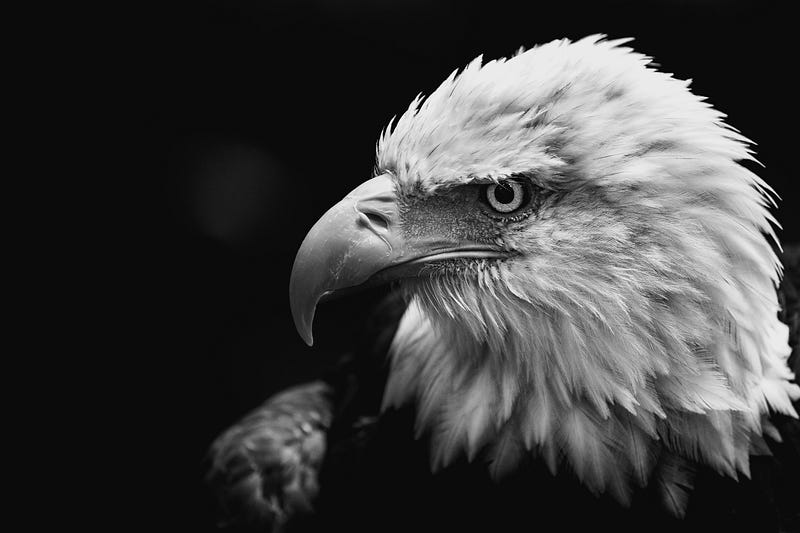
Dinosaur (n): someone or something that has not adapted to changing circumstances — Oxford English Dictionary
Dinosaurs are frequently used as a pejorative to describe obsolescence and are commonly portrayed as an example of evolutionary failure. Crack open any major English dictionary and you will find that a dinosaur is “someone or something that is impractically large, out of date, and obsolete”. Do a quick search in the Medium platform and you will stumble across results echoing the aforementioned definition.
But, do dinosaurs really deserve this fame? Are they rightfully a metaphor of incompetence and an epithet to invoke an evolutionary failure?
Let’s try to answer these questions by looking at the facts.
A long-lasting reign
Our species appeared on the planet a mere 250.000 years ago and we could claim to be the dominant life form in our ecosystem for a handful of centuries. Yet, non-avian dinosaurs were the undisputed rulers on land for more than 150 million years. This immense time scale is 600 times greater than the total duration of our existence on earth!
To get a more accurate sense of this tremendous time span, let’s take for reference the evolutionary history of mammals. The first mammalian ancestors date back to around 210 million years ago. Surely a 200 million-year-old time span is impressive, but it falls short compared to dinosaurs. Dinosaurs evolved around 21 million years earlier than the first mammals, and if we include the avian forms (aka birds), their run spans the last 231 million years!
That means that if all birds were to go extinct today, mammals would not surpass the temporal success of the dinosaurs until the year 21,002,020!
Extreme resilience & adaptability
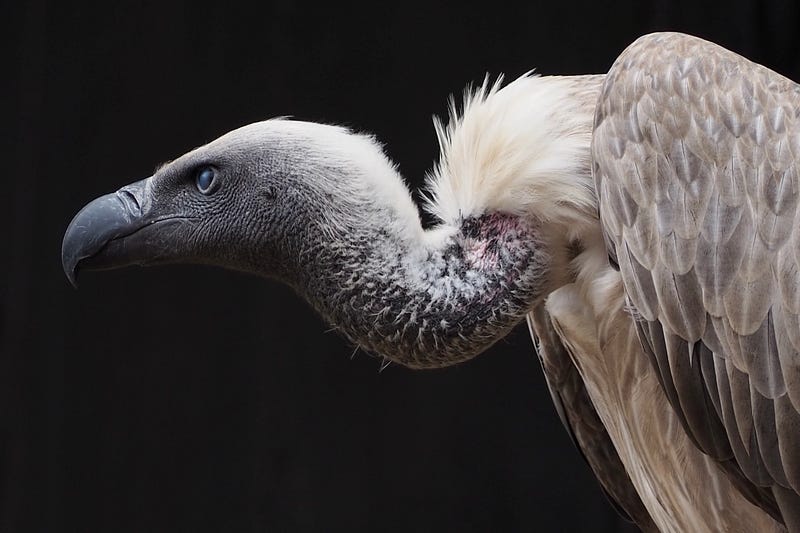
Dinosaur remains are known from every continent, a fact that demonstrates their global domination. Paleontologists have found their fossils in every conceivable terrain and environment including deserts, mountain peaks, coastal areas, iced tundras, and temperate zones. Everywhere. Discoveries around the world prove that dinosaurs were an extremely resilient group of animals, constantly evolving to adapt to ever-changing environments.
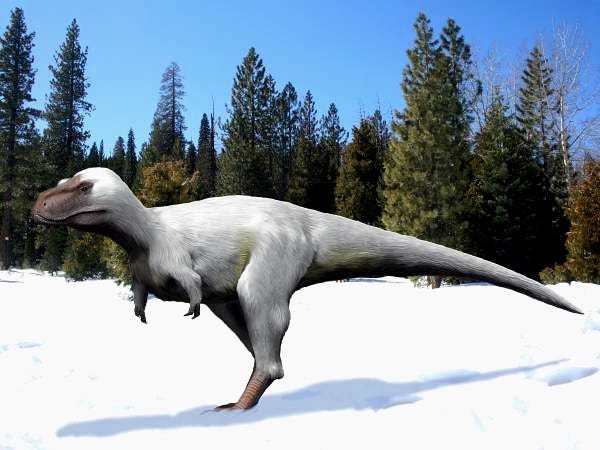
Scientists, for example, have confirmed the existence of dinosaurs in both the Arctic and the South Pole. There’s enough paleontological evidence to suggest that animals living in such latitudes had to endure long, cold winters with minimum food resources. Yet, dinosaurs managed to thrive even in these cruel environments.
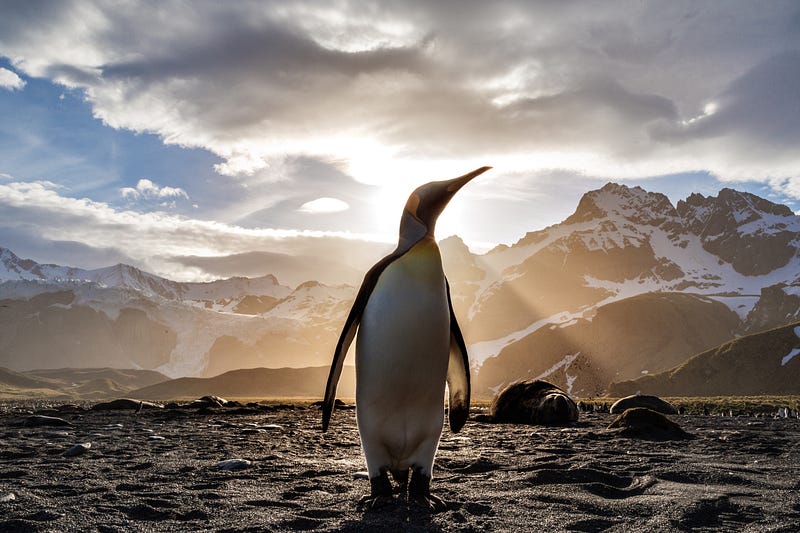
The avian dinosaurs are members of a select group of organisms that survived the Cretaceous-Paleogene Mass Extinction Event, the worst catastrophe faced by our planet during the last quarter of billion years. While the non-avian forms went extinct, about 18,000 species of birds co-exist with us today. The fact that avian dinosaurs are currently the only large vertebrates to have breeding populations on every continent is a great indication of their evolutionary success. Dinosaurs truly were-and still are- champions of resilience.
A great diversity
We will never find the exact number of dinosaur genera that once ruled our planet, yet we are confident that there should have been a lot. Paleontologists have named so far more than 1,000 species, but accounting for the rarity of the fossilization process and the immense time span of their existence on Earth, that number would only be a fraction of the actual one. To get an idea, birds alone outnumber mammalian species by more than three to one.
Dinosaurs displayed an immense variety of forms, shapes, and sizes. Their clade includes the largest and some of the smallest terrestrial vertebrates to ever have existed on our planet[1]. Their diversity in shapes, body plans, and features cannot be matched by any other group of large vertebrates- living or extinct.
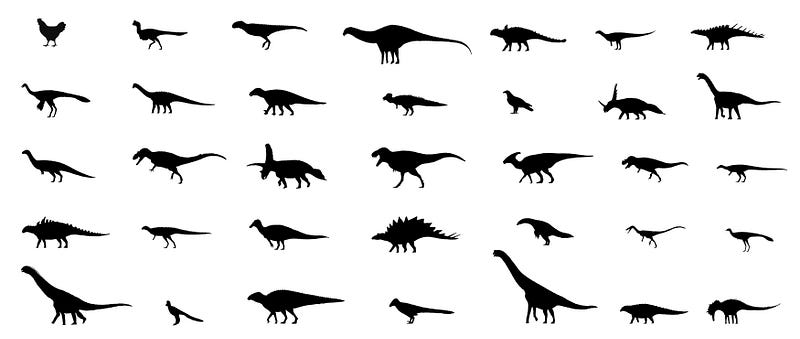
Dinosaurs were masters of niche partitioning. This can be demonstrated by the fact that they did not confine themselves to terrestrial environments: birds took to the skies, and some genera may even have conquered the underwater realm!
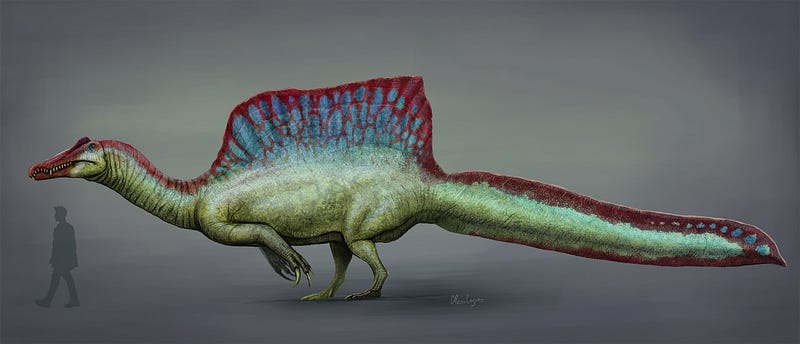
Recent fossil evidence has revealed that at least one species, Spinosaurus aegyptiacus, had possibly a semi-aquatic lifestyle. The large tail fin of this giant theropod and its distinct center of gravity were adaptations that enabled it to swim and hunt underwater. Discoveries like these confirm the notion that dinosaurs were even more diverse and specialized than we ever dared to imagine.
Epilogue
The association of dinosaurs with failure and obsolescence could not have been more inaccurate. Contrary to popular perception, their evolutionary history was one of triumph and success. Dinosaurs dominated our planet longer than any other group of terrestrial vertebrates. They displayed amazing resilience and adaptability, conquering every corner of the Earth, and their great diversity in forms and sizes reflects their evolutionary vigor.
To be a dinosaur means to belong to a staggeringly successful group of animals whose reign across time may never be matched by humans or any other mammal. Instead of besmirching their fame by using them as an example of obsolescence, we could learn from their evolutionary success and acknowledge their mighty legacy.
Notes
[1] Argentinosaurus huinculensis, a giant titanosaur, measured anywhere between 30 to 39.7 meters (98 to 130 ft) in length and 50 to 100 tonnes (55 to 110 short tons) in weight. In contrast, Mellisuga helenae, the common bee hummingbird, is 6.1 cm (2.4 in) long and weighs just 2.6 g (0.092 oz).
References
Lacovara, K., (2017), Why Dinosaurs Matter, Ted 2
Yeung J., (2019), Fluffy dinosaurs used to live at the South Pole, scientists say, CNN, Link: https://edition.cnn.com/2019/11/14/australia/feathered-dinosaur-australia-intl-hnk-scli-scn/index.html
Mitch L., (2007), The Strange Lives of Polar Dinosaurs How did they endure months of perpetual cold and dark?, Smithsonian Magazine, Link: https://www.smithsonianmag.com/history/the-strange-lives-of-polar-dinosaurs-180347471/
Treat J. and Schumacher M., (2020), RECONSTRUCTING A GIGANTIC AQUATIC PREDATOR, National Geographic, Link:https://www.nationalgeographic.com/science/2020/04/spinosaurus-graphic-reconstructing-gigantic-aquatic-predator/
Simon C., (2020), New paper argues the Spinosaurus was aquatic, and powered by predatory tail, The Harvard Gazzette, Link: https://news.harvard.edu/gazette/story/2020/04/new-paper-suggests-spinosaurus-may-have-been-aquatic/
Barrowclough, George F., Joel Cracraft, John Klicka, and Robert M. Zink, How many kinds of birds are there and why does it matter? PLOS ONE 11, no 11 (2016)


