
The Ever-changing Image of the World’s Largest Predatory Dinosaur
The depiction of Spinosaurus has changed a lot through the years…
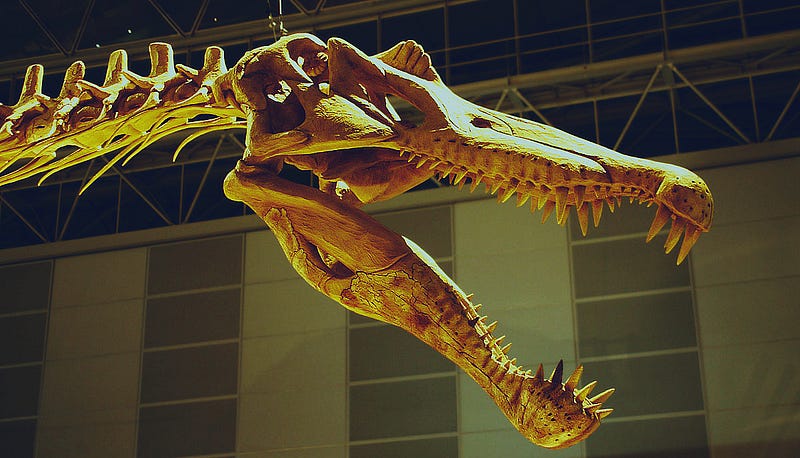

Spinosaurus is often regarded as the largest predatory dinosaur that ever existed. It is also one of the most bizarre-looking.
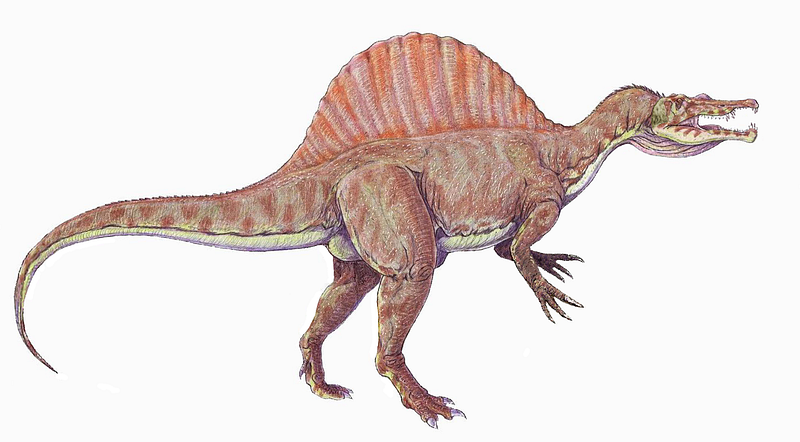
This aberrant creature looked nothing like Tyrannosaurus rex and the rest of the giant theropods. For one, it had a skull similar to that of a modern crocodilian and bore straight conical teeth with no serrations. It also had a pair of robust forelimbs bearing three-fingered hands, with an enlarged claw on the first digit. Its most prominent feature, though, was its tall neural spines, some of which grew to at least 1.65 meters (5.4 ft) long and formed a unique sail-like structure on its back.
Despite holding the prestigious title of the largest predatory theropod, Spinosaurus is only known from a handful of specimens discovered in North Africa. The loss of the original bones and the gradual discovery of more fossil material resulted in a constant revision of the appearance of this remarkable 99-million-year-old predator.
1915–1980s
The original Spinosaurus remains were found and described in the early 20th century. In 1912, Richard Markgraf discovered a partial skeleton in the Bahariya Formation of western Egypt, and in 1915, German paleontologist Ernst Stromer assigned the specimen to a new genus and species. Stromer named his discovery Spinosaurus aegyptiacus or the “spine lizard” from Egypt referring to the dinosaur’s very long spines growing on its back.
Sadly, however, Spinosaurus original material was destroyed during Allied bombing raids on Munich in April 1944. Despite Stromer’s repeated requests to the head of the Bavarian State Collection of Paleontology to move the fossils to a safer place, this never happened. With the fossil destroyed, paleontologists had to rely on Stromer’s drawings and descriptions when comparing Spinosaurus with other dinosaurs.
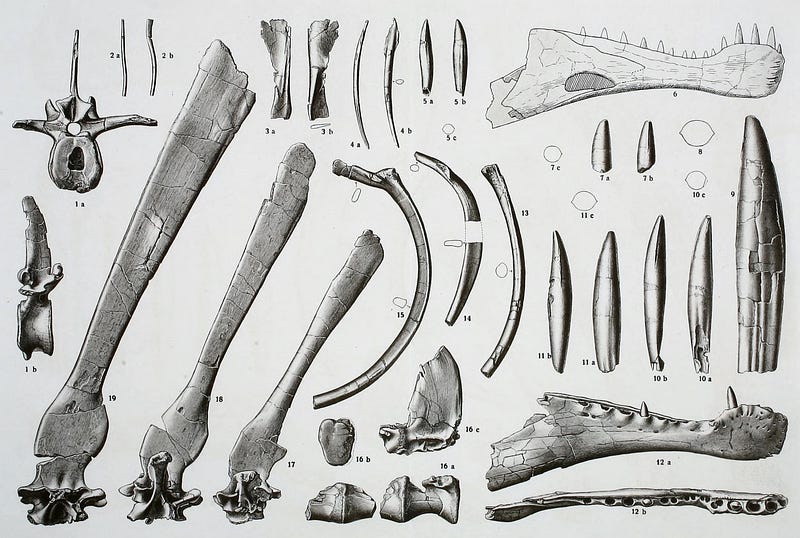

Stromer had realized that the lower jaw of Spinosaurus was peculiar and different from that of other theropods, yet he imagined it to be associated with a fairly normal, deep-snouted skull like that of Megalosaurus or Allosaurus.
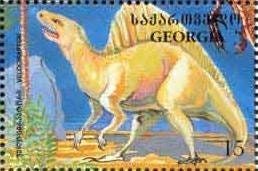

Thus early illustrations depicted Spinosaurus as an unremarkable generic theropod with tall vertebral spines. In the absence of further information, this reconstruction persisted for decades. Other artists like Giovanni Caselli even imagined Spinosaurus as a quadrupedal creature similar to the non-mammalian synapsid Dimetrodon.
It was during the last decades of the 20th century that scientists got a better idea of what Spinosaurus really looked like.
1986–2013
In 1986, Alan Charig and Angela Milner described a strange, crocodile-snouted dinosaur from England. This creature grew between 7.5 and 10 meters (25 and 33 feet) in length and had a large, heavy claw at the end of its forelimbs. Scientists named this new dinosaur Baryonyx.
Paleontologists noticed the many similarities Baryonyx shared with Spinosaurus, notably the conical teeth, the large forelimbs, and the crocodile-like snout. Known from an almost complete skeleton, Baryonyx would form the basis for the great Spinosaurus makeover that was to follow.
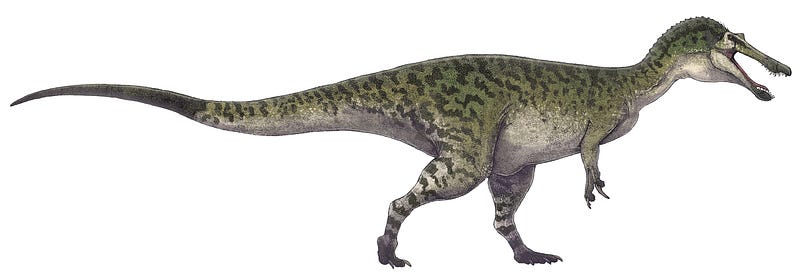

Scientists soon began to imagine Spinosaurus as an upscaled version of Baryonyx with an added sail on its back. Extrapolating from more complete spinosaurid specimens Cristiano Dal Sasso of the Civil Natural History Museum in Milan calculated that Spinosaurus could grow up to 17 meters long and weigh between 7 and 9 tons.
Dal Sasso’s calculations meant Spinosaurus was the largest predatory dinosaur ever discovered, surpassing the famous Tyrannosaurus, the biggest specimens of which were roughly 13 meters (40–42 ft) long.
The “new” Spinosaurus was soon to attract media attention in 2001 when the giant theropod from northern Africa made its first Hollywood appearance.

Spinosaurus was featured in the third installment of the famous Hollywood franchise Jurassic Park, replacing Tyrannosaurus as the main dinosaur antagonist.
In the film, Spinosaurus was portrayed as a mega-monster that is capable to hunt both in terrestrial and aquatic environments. The film’s consulting paleontologist Jack Horner was quoted as saying: “If we base the ferocious factor on the length of the animal, there was nothing that ever lived on this planet that could match Spinosaurus.”
Movie producers depicted Spinosaurus as a more powerful animal than the franchise’s beloved star Tyrannosaurus: in a scene featuring a battle between the two resurrected predators, Spinosaurus emerges victorious by snapping the Tyrannosaurus’ neck. The outcome of the fight divided the audiences and created a backlash for the Jurassic franchise.
You may watch the scene featuring the controversial fight between Spinosaurus and Tyrannosaurus below:
From then on and despite the negative reaction, Spinosaurus was portrayed in various documentaries and films as the ultimate predatory theropod, the new king of the carnivorous dinosaurs.
This view was seriously challenged in 2014.
2014–2020
A 2014 paper described more fossil material of Spinosaurus. Based on the newest fossils, paleontologist Nizar Ibrahim and colleagues argued that the hind limbs of Spinosaurus were in fact much shorter than previously believed and that the animal’s center of mass was located in the midpoint of the trunk region.
The observations above practically meant that Spinosaurus was poorly adapted for bipedal terrestrial locomotion, and must have been an obligate quadruped on land reviving in part the outdated depictions from the 1950s and 1970s. While Ibrahim’s new reconstruction was received with skepticism among fellow paleontologists, it was clear that Spinosaurus lacked the long, powerful hind limbs observed in other giant predatory theropods.
Additional discoveries were made in 2020. Based on the analysis of recently unearthed fossils, it was determined that Spinosaurus had a flat paddle-like tail, similar to that of a crocodile. This feature, combined with its long tooth-filled snout and relatively short stumpy legs, led researchers to believe that Spinosaurus was the first dinosaur to be perfectly adapted for an aquatic lifestyle.
“The case for a more aquatic Spinosaurus rests on a few genuinely bizarre features,” Dr. Ibrahim said. “Unlike most predatory dinosaurs — including some relatives such as the slender-snouted Baryonyx — Spinosaurus had densely mineralized bones, unusually short hind limbs, and a tail configuration that allowed for sinuous, sculling motions. Really, every part of the body we looked at has ‘water-loving’ written all over it,” Dr. Ibrahim said.
The hypothesis of a fully aquatic Spinosaurus was disputed in 2021.

2021-present
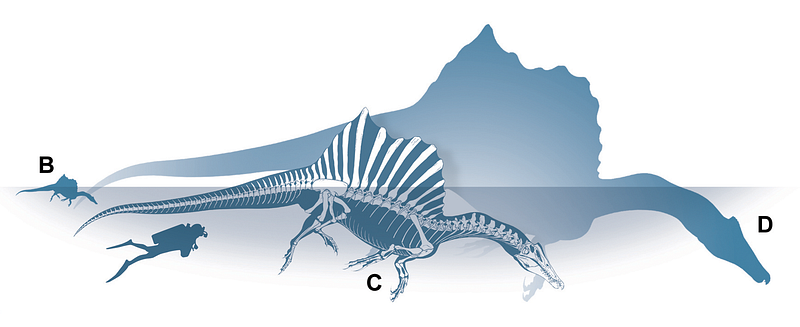
According to David Hone, a paleontologist at the Queen Mary University of London, and Thomas Holtz Jr., a paleontologist at the University of Maryland, Spinosaurus was not capable of swift subaquatic chases — a necessary adaptation for a fully aquatic lifestyle.
Both scientists pointed at the relatively small number of Spinosaurus tail muscles, the tall sail, and its bulky limbs. All these features would have produced tremendous drag in anything but the deepest water, making true underwater pursuit unlikely.
“Real aquatic pursuit predation is a very challenging lifestyle,” said Dr. Holtz. “Aquatic predators like otters, sea lions or sharks have compact, smooth bodies that reduce underwater drag.”
Instead of being a fully aquatic predator, the team proposed Spinosaurus had a lifestyle that is more similar to a stork — snatching at fish from the shoreline while also taking any other small available prey on land or in water. There are several pieces of evidence that point in this direction.
Spinosaurus had nostrils back on its long snout, rather than atop its face, like a crocodile. It had broad feet, as well as a head and neck adapted for a strong downward strike. Isotopic evidence from Spinosaurus teeth also suggests that at least some individuals were eating fully terrestrial prey, perhaps including other dinosaurs.
“The idea that Spinosaurus hung out by the water isn’t controversial,” Dr. Holtz said. “We’re not saying it didn’t swim, or even swim relatively well. But the idea that this is an otter-like animal is probably going way too far.”

Epilogue
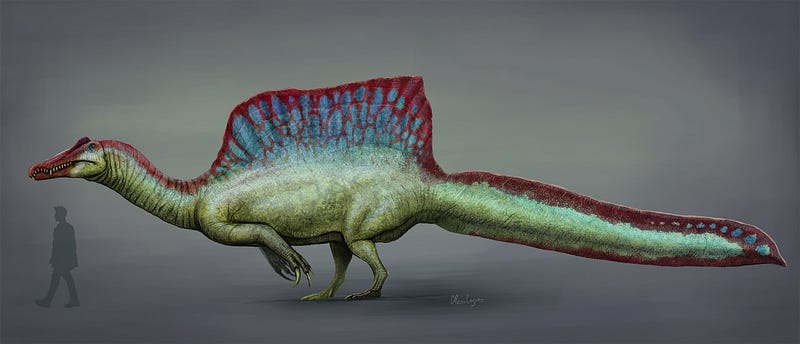
Spinosaurus was neither the mega-movie monster featured in Jurassic Park III nor the quadrupedal theropod that had trouble walking on land proposed by Ibrahim. The most recent view of Spinosaurus is that of a highly specialized predator that could exploit both aquatic and terrestrial environments.
At 14 meters (49 ft) in length and 4 metric tons (4.4 short tons) in weight, this remarkable animal is the longest carnivorous theropod described so far and the largest member of its clade. Whilst the latest study by Hone and Holtz provides a clearer picture of the ecology and behavior of Spinosaurus, there are still many outstanding questions and details to examine for future study.
One thing is certain: this will not be the last word on the biology of this amazing creature.
The most recent study on Spinosaurus was published on January 7, 2021 in the journal Paleontologia Electronica. To find out more paleontological discoveries from that month, read the article below:
Relevant reads:
References
Stromer, E. (1915). “Ergebnisse der Forschungsreisen Prof. E. Stromers in den Wüsten Ägyptens. II. Wirbeltier-Reste der Baharije-Stufe (unterstes Cenoman). 3. Das Original des Theropoden Spinosaurus aegyptiacus nov. gen., nov. spec”. Abhandlungen der Königlich Bayerischen Akademie der Wissenschaften, Mathematisch-physikalische Klasse (in German). 28 (3): 1–32
Hone, David W.E. and Holtz, Thomas R., Jr. 2021. Evaluating the ecology of Spinosaurus: Shoreline generalist or aquatic pursuit specialist? Palaeontologia Electronica, 24(1):a03. https://doi.org/10.26879/1110 palaeo-electronica.org/content/2021/3219-the-ecology-of-spinosaurus
Greshko, Michael (September 23, 2020). “Case for ‘river monster’ Spinosaurus strengthened by new fossil teeth — Newfound troves from the Moroccan desert suggest that the immense predator spent much of its time in the water”. National Geographic. Retrieved September 24,2020.
Ibrahim, Nizar; Sereno, Paul C.; Dal Sasso, Cristiano; Maganuco, Simone; Fabri, Matteo; Martill, David M.; Zouhri, Samir; Myhrvold, Nathan; Lurino, Dawid A. (2014). “Semiaquatic adaptations in a giant predatory dinosaur”. Science. 345 (6204): 1613–6. Bibcode:2014Sci…345.1613I. doi:10.1126/science.1258750. PMID 25213375. S2CID 34421257. Supplementary Information
Henderson, D.M. (2018). “A buoyancy, balance and stability challenge to the hypothesis of a semi-aquatic Spinosaurus Stromer, 1915 (Dinosauria: Theropoda)”. PeerJ. 6: e5409. doi:10.7717/peerj.5409. PMC 6098948. PMID 30128195.