
Famous Prehistoric Animals That Weren’t Actually Dinosaurs
So better stop calling them that way…
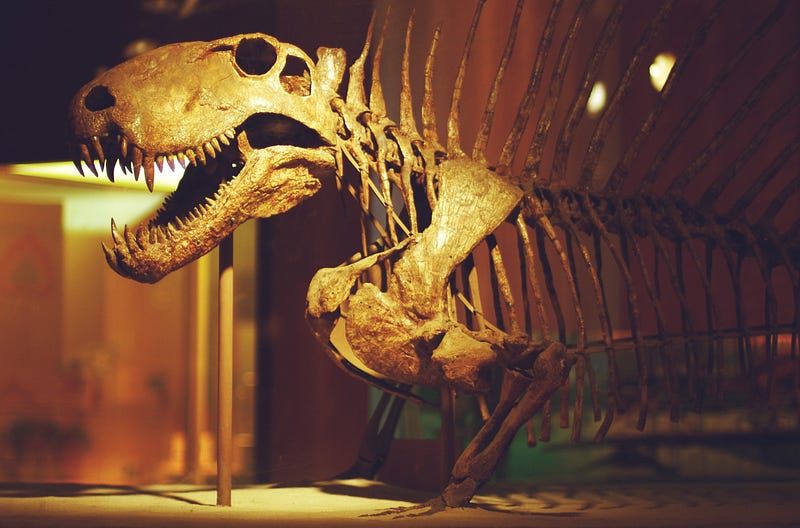
Most people often use the word ‘dinosaur’ as a catch-all term to describe any sort of extinct, large, or bizarre, reptilian-like animal. That’s unfortunate since Dinosauria is a scientific term with a strict meaning and well-defined membership. Thanks to common misconceptions generated by popular culture, many prehistoric animals we often call ‘dinosaurs’ actually weren’t.
Let’s try to address the most popular non-dinosaurian creatures that are frequently taken as dinosaurs.
Mosasaurus hoffmannii
Mosasaurus was prominently featured in the latest Jurassic World saga and left a memorable impression on popular culture [1]. Despite their terrifying appearance, mosasaurs were not dinosaurs, but a clade of marine reptiles closely related to varanoid lizards.
These creatures breathed air and were powerful swimmers. They had reduced limb bones and their paddles were formed by webbing between their long finger and toe bones. Their tails were broad and supplied their locomotive power. Some scientists proposed mosasaurs were so well adapted to their environment that they most likely gave birth to live young, rather than returning to the shore to lay eggs.
Mosasaurs were the apex predators of the Late Cretaceous seas and became extinct along with non-avian dinosaurs 66 million years ago.
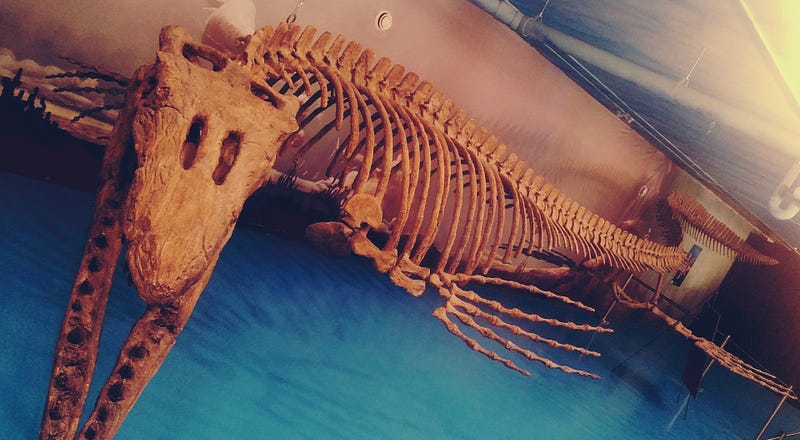
Pteranodon longiceps
Pteranodon is frequently featured in dinosaur media and is strongly associated with dinosaurs by the public. This creature is in fact a pterosaur, a group of highly successful flying reptiles, related and contemporary to dinosaurs [2]. Pterosaurs were the first vertebrates to fly, and some of them reached truly gigantic sizes.
Pteranodon itself was a large pterosaur, with an estimated wingspan of over 7 meters (23 feet). Scientists have discovered about 1,200 specimens of this animal, making it the most well-known pterosaur in science and popular culture.
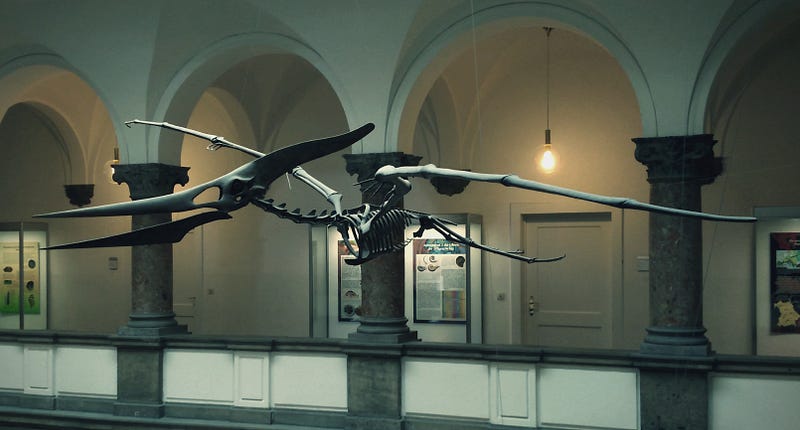
Plesiosaurus dolichodeirus
Plesiosaurus is usually referred to as an aquatic dinosaur. In fact, plesiosaurids were large marine reptiles that lived during the Jurassic and Cretaceous Periods (200–66 million years ago).
They had small heads, long necks, broad turtle-like bodies, short tails, and two pairs of large, elongated paddles. Their origins are traced within the Sauropterygia, a group of perhaps archosauromorph reptiles that returned to the sea. Plesiosaurus is also frequently associated with the legend of the Loch Ness monster.
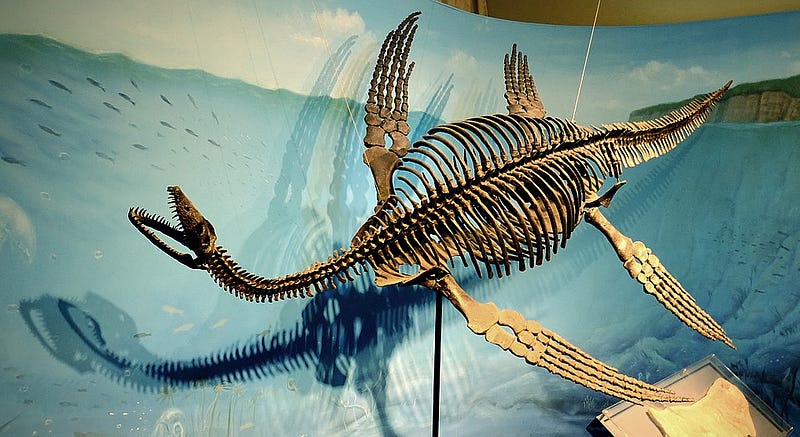
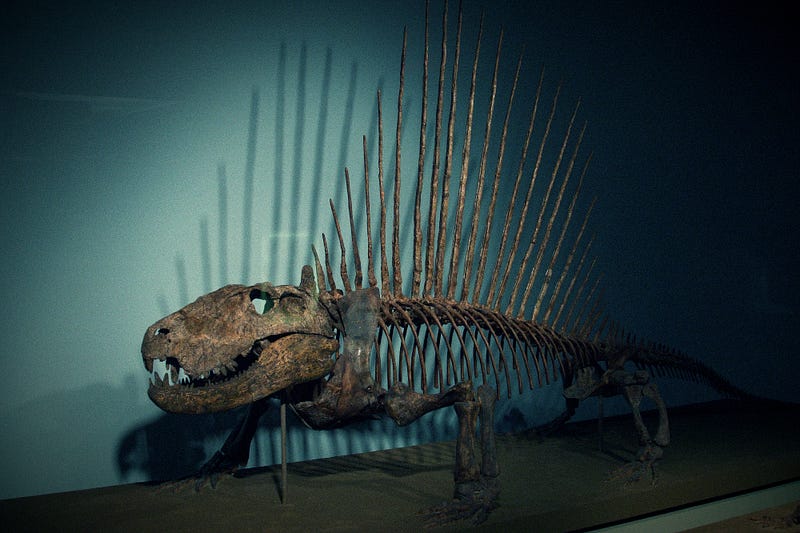
Dimetrodon grandis
Thanks to its reptile-like appearance and physiology, Dimetrodon is often mistaken for a dinosaur in popular culture. This creature had a large neural spine sail on its back, walked on four legs, and had a curved skull filled with large teeth of different sizes set along the jaws.
Dimetrodon was a non-mammalian synapsid, a group of animals more closely related to mammals (and us!) than to modern reptiles. It lived during the Permian period and became extinct some 40 million years before the appearance of the first dinosaurs.
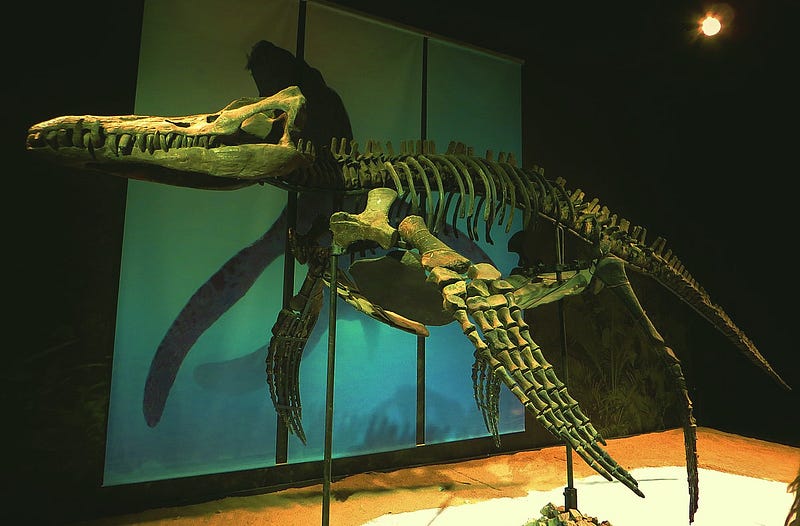
Pliosaurus brachydeirus
Being one of the top predators of the Late Jurassic seas, Pliosaurus was a fearsome creature. It had a short neck, an elongated head, and powerful jaws carrying numerous sharp, conical teeth.
Pliosaurs were Mesozoic sauropterygian marine reptiles that lived at the same time as dinosaurs, but they were not closely related to them. They had larger hind flippers compared to the fore ones and ranged from 4 to 16 meters (13- 52 ft) in length. Their prey may have included fish, sharks, ichthyosaurs, dinosaurs, and other plesiosaurs.
Epilogue
Dinosaurs and non-dinosaurs are often indiscriminately intermingled in popular culture with little thought to the fact that the particular term doesn’t apply to just anything reptilian and extinct.
Bellow follow some suggestions that may help you distinguish dinosaurs from other prehistoric creatures:
- The term ‘dinosaur’ is usually used to describe the dominant terrestrial archosaurian fauna of the Mesozoic Era (233–66 million years ago).
- Unlike other reptiles, dinosaurs had hind limbs that were held erect beneath their body.
- Even though there could have been some semi-aquatic forms, dinosaurs never evolved flippers and paddles and did not live fully underwater.
- The avian dinosaurs (aka birds) took to the skies, but their wings were completely different in structure compared to the pterosaurs, their archosaurian cousins [3].
Notes
[1] Even though Mosasaurus was one of the largest mosasaurs, it was greatly oversized in its Hollywood depiction: rather than being 33.5–36.6 meters (110–120 ft) long, the actual animal was must have reached sizes of around 13 meters (42.6 ft).
[2] Pterosaurs are also colloquially referred to as pterodactyls, particularly in fiction and by journalists. However, technically, pterodactyl only refers to members of the genus Pterodactylus {a relatively small pterosaur, with an estimated adult wingspan of about 1.04 meters (3 ft 5 in)}, and more broadly to members of the suborder Pterodactyloidea of the pterosaurs.
[3] Pterosaur wings were formed by a membrane of skin, muscle, and other tissues stretching from the ankles to a dramatically lengthened fourth finger.
References
T. L. Harrell Jr.; J. E. Martin (2014). “A mosasaur from the Maastrichtian Fox Hills Formation of the northern Western Interior Seaway of the United States and the synonymy of Mosasaurus maximus with Mosasaurus hoffmanni (Reptilia: Mosasauridae)”. Netherlands Journal of Geosciences. 94 (1): 23–37. doi:10.1017/njg.2014.27.
Bennett, S.C. (1994). “Taxonomy and systematics of the Late Cretaceous pterosaur Pteranodon (Pterosauria, Pterodactyloida)”. Occasional Papers of the Natural History Museum, University of Kansas. 169: 1–70.
Storrs, G. W. 1997. “Morphological and taxonomic clarification of the genus Plesiosaurus”. 145–190. In Callaway, J. M and Nicholls, E. L. (eds.). Ancient Marine Reptiles. Academic press. London.
Angielczyk, K. D. (2009). “Dimetrodon is Not a Dinosaur: Using Tree Thinking to Understand the Ancient Relatives of Mammals and their Evolution”. Evolution: Education and Outreach. 2 (2): 257–271. doi:10.1007/s12052–009–0117–4.
Taylor, M. A. and Cruickshank, A. R. I. 1993. Cranial anatomy and functional morphology of Pliosaurus brachyspondylus (Reptilia: Plesiosauria) from the Upper Jurassuc of Westbury, Wiltshire. Philosophical Transactions of the Royal Society of London, Series B, 341, 399–418.


.jpg)


