
MESOZOIC QUICK FACT SERIES:
Azhdarchids: The Largest Creatures to Fly
Meet the rulers of the Cretaceous skies…
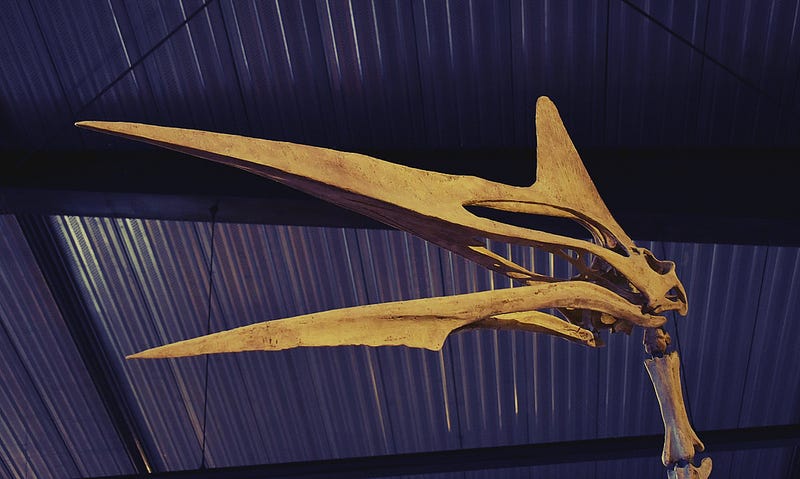
Mesozoic Quick Fact Series (MQFS) aims to provide interesting facts about various groups of extinct animals in a fun and readable way. We will focus on the highlights, so you don’t need to read extensive, time-consuming texts!
In this article, we will take a quick overview of the azhdarchids, a group of derived pterosaurs that includes the largest flying creatures that have ever lived.
Let’s jump right through!
Starting with the basics…
The family Azhdarchidae was erected after the discovery of the type species Azhdarcho lancicollis (1984), a pterosaur that lived in modern-day Kazakstan and Uzbekistan roughly 92 million years ago.
Its name derives from the word azhdar, a famous dragon-like creature from the Persian mythology. The specific epithet lancicollis refers to the Latin words lancea (meaning “lance” or “spear”) and collum (“neck”).
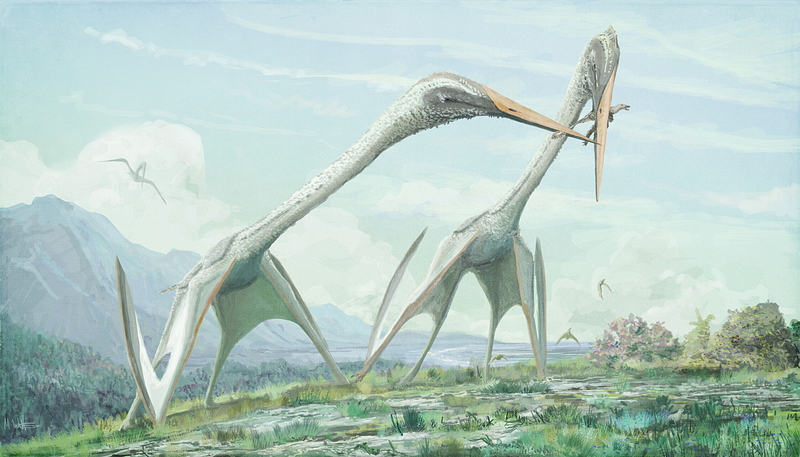
There were two main types of azhdarchid morphology: the “blunt-beaked” forms with shorter and deeper bills, and the “slender-beaked” ones with longer and thinner jaws.
When did they live?
Azhdarchids lived during the Cretaceous, and most of their fossils date from the uppermost stage of this period (100–66 million years ago).
However, there is an isolated vertebra of an earlier age that some scientists attribute to a yet unidentified species of azhdarchid pterosaur. This bone was found in Romania and is dated from about 140 million years ago.
Given that azhdarchids are definitely present at the final stage of the Cretaceous, the discovery from Romania could potentially give the group a stratigraphic record that spans 80 million years.
This is longer than any other pterosaur family!
…and where?
The particular group of pterosaurs was globally widespread. Paleontologists have so far discovered azhdarchid remains in North and South America, Europe, Africa, and Asia.
The global distribution of azhdarchids undoubtedly demonstrates their evolutionary success.
How large were they?
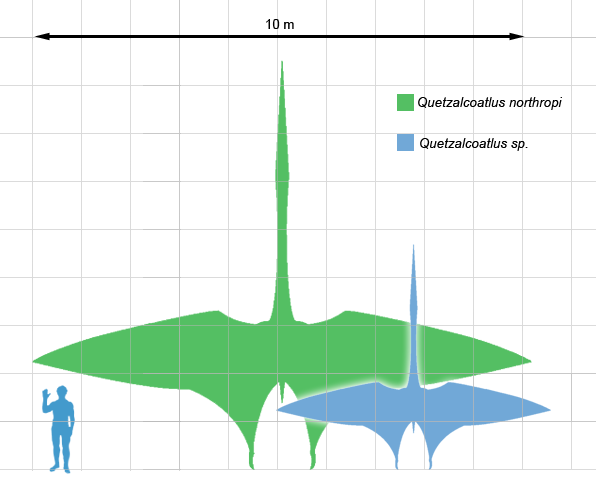
Some azhdarchid species, like Arambourgiania, Hatzegopteryx, and Quetzalcoatlus, achieved wingspans between 10 and 12 meters (33–39 ft), making them the largest flying creatures to have ever existed.
A recently discovered azhdarchid from Transylvania may have been even larger. Paleontologists nicknamed this yet unnamed specimen “Dracula”, and they estimate it may have had a wingspan of 12–20m (39–66 ft)!
Not every azhdarchid was a giant, though. Genera like Eurazhdarcho and Bogolubovia were smaller, achieving modest wingspans of about three and four meters (9.8–13 feet).
Any cool names?
The name of the giant azhdarchid Quetzalcoatlus northropi comes from Quetzalcoatl, the famous feathered serpent deity of the Aztec culture. The specific name is after John “Jack” Northrop, a developer of tailless flying wing aircraft that resembled the shape of this pterosaur.
Another cool name is that of Cryodrakon boreas, a large azhdarchid found in Canada. Its generic name derives from the Greek kryos, meaning “icy cold”, and drakon, meaning “dragon”. The specific name means “belonging to Boreas, the north wind”, or simply “northern”.

In popular culture:
Quetzalcoatlus is the azhdarchid most commonly featured in popular culture. The specific pterosaur is portrayed in various dinosaur-related documentaries and films, including Walking with Dinosaurs (1999), When Dinosaurs Roamed America (2001), Clash of the Dinosaurs (2009), and the Walking with Dinosaurs: the film (2013).
In 2010, several life-sized models of Quetzalcoatlus were on display on London’s South Bank as the centerpiece exhibit for the Royal Society’s 350th-anniversary exhibition. The models were displayed in an effort to help build public interest in science.

Did you know…?
. The skulls of the largest azhdarchids had an estimated length of 3 meters (9.8 ft), making them some of the largest skulls among non-marine animals.
. A 2021 study found the vertebrae in azhdarchid necks were arranged like spokes of a bicycle wheel. This adaptation enabled them to carry large prey while flying without breaking their elongated necks.
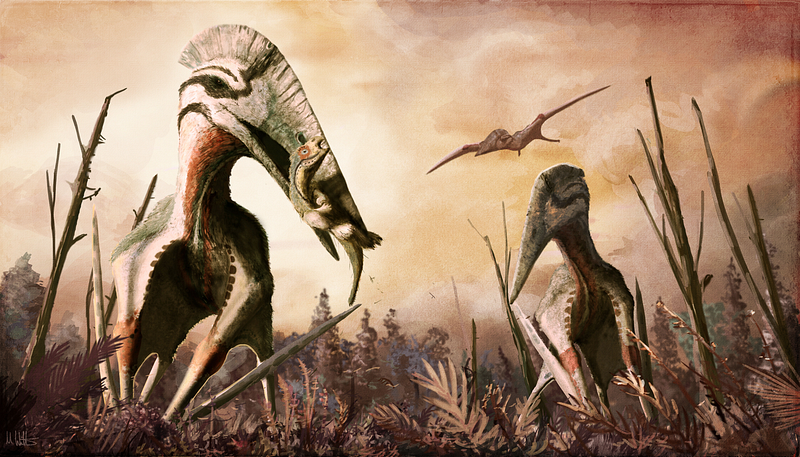
. The gigantic Hatzegopteryx from Romania was probably the apex predator in the Hațeg Island ecosystem, a large offshore island that existed during the Late Cretaceous period in the European archipelago. The giant azhdarchid was significantly larger than any other terrestrial carnivore of the region, and thanks to its robust anatomy it could have been adapted to feed on the dwarf dinosaur species that inhabited the island during this time.
Relevant Reads:
References
Witton, Mark P.; Naish, Darren (May 28, 2008). “A Reappraisal of azhdarchid pterosaur functional morphology and paleoecology”. PLOS ONE. 3 (5): e2271. Bibcode:2008PLoSO…3.2271W. doi:10.1371/journal.pone.0002271. PMC 2386974. PMID 18509539.
Lawson, Douglas A. (March 14, 1975). “Pterosaur from the Latest Cretaceous of West Texas: Discovery of the largest flying creature”. Reports. Science. 187 (4180): 947–948. Bibcode:1975Sci…187..947L. doi:10.1126/science.187.4180.947. PMID 17745279. S2CID 46396417.
Averianov, A. O. (2013). Reconstruction of the neck of Azhdarcho lancicollis and lifestyle of azhdarchids (Pterosauria, Azhdarchidae). Paleontological Journal, 47(2), 203–209.
Buffetaut, E.; Grigorescu, D.; Csiki, Z. (April 1, 2002). “A new giant pterosaur with a robust skull from the latest Cretaceous of Romania”. Naturwissenschaften. 89 (4): 180–184. Bibcode:2002NW…..89..180B. doi:10.1007/s00114–002–0307–1. PMID 12061403. S2CID 15423666
Harrell, T. Lynn Jr.; Gibson, Michael A.; Langston, Wann Jr. (2016). “A cervical vertebra of Arambourgiania philadelphiae (Pterosauria, Azhdarchidae) from the Late Campanian micaceous facies of the Coon Creek Formation in McNairy County, Tennessee, USA” Bull. Alabama Mus. Nat. Hist. 33:94–103
Witton, M. P., & Naish, D. (2008). A reappraisal of azhdarchid pterosaur functional morphology and paleoecology. PLoS One, 3(5), e2271.
Williams et al. Helically arranged cross struts in azhdarchid pterosaur cervical vertebrae and their biomechanical implications. iScience, 2021 DOI: 10.1016/j.isci.2021.102338


