
Exciting Paleontological Discoveries You Probably Missed in April
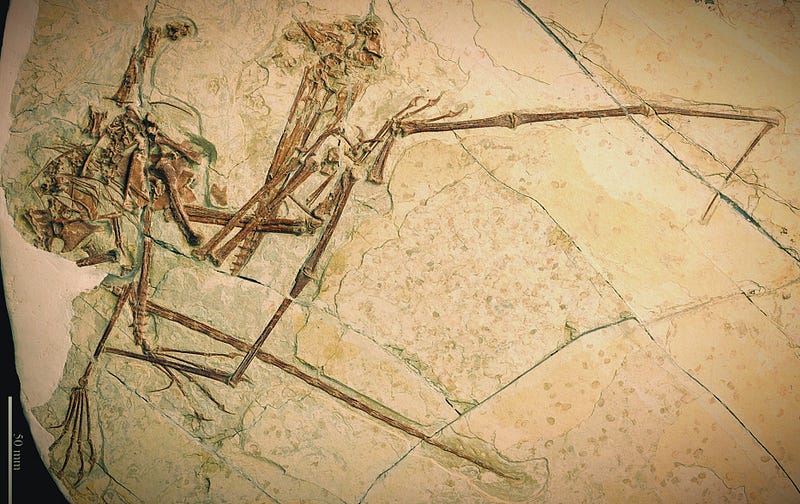
Scientists found a pterosaur with opposable thumbs…
Several fascinating paleontological discoveries are taking place each month. Scientists working in the field publish numerous studies, describe new prehistoric species, and propose exciting theories about the biology and behavior of many extinct animals.
This article will do a quick recap of the most important paleontological discoveries and updates from April 2021.
Before that, be sure to check the most memorable ones from March below:
Ready? Let’s go!
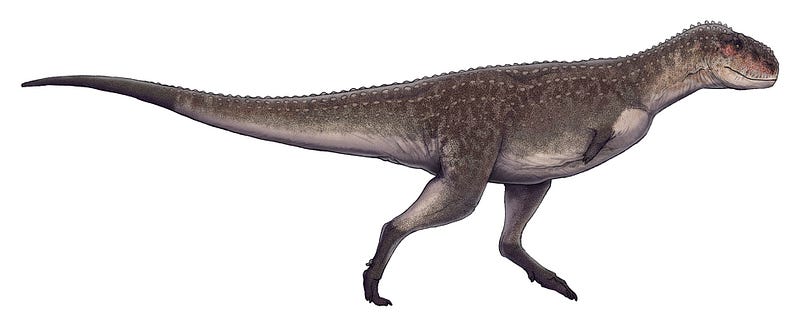
The ‘one who causes fear’: terrifying new dinosaur discovered in Argentina
A new genus of terrifying carnivorous dinosaur that existed around 80 million years ago has been discovered in Patagonia, Argentina.
Paleontologists named the new dinosaur Llukalkan aliocranius which translates to “the one who causes fear” in Mapuche, the language spoken by the indigenous people who live near the discovery site.
The new dinosaur belonged to the abelisaurid family, a group of carnivorous apex predators with tiny arms and extensive skull ornamentation. These carnivores rose to prominence during the Late Cretaceous Period, mostly on the southern continents.
To learn more about abelisaurids, read the article below:
Llukalkan could grow up to about 5 meters (16.4 feet) in length and had an extremely powerful bite, very sharp teeth, huge claws, and a keen sense of smell. Its remains were found close to another, somewhat larger abelisaurid known as Viavenator exxoni.
The discovery of Llukalkan demonstrates that abelisaurids were still flourishing right before dinosaurs went extinct.
‘Godzilla’ shark finally gets a formal name
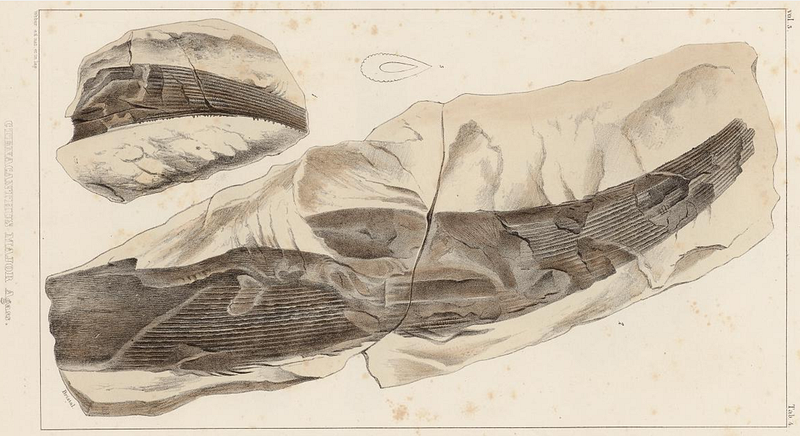
Also this month, a 300 million-year-old shark relative, nicknamed the ‘Godzilla shark’, has received a proper scientific name.
Paleontologists had found the unusually complete and well-preserved 2-meter-long (6.7 ft) fossilized skeleton at a private site in the Manzano Mountains of New Mexico back in 2013. After many years of delay, they finally named the fish Dracopristis hoffmanorum or Hoffman’s dragon shark.
Standout features of Dracopristis include 12 rows of piercing teeth supported in powerful jaws and a pair of 80-cm-long (2.5 ft) fin spines on its back. The nickname ‘Godzilla shark’ stands for the species’ size — the skeleton is the largest fossil of its kind ever discovered in the area — and the reptilian nature of the spines on its back.
Dracopristis belongs to a group of obscure ancient sharks known as Ctenacanths, which diverged from modern sharks around 390 million years ago. Ctenacanths had larger and less flexible jaws than their modern-day relatives and were probably occupying a more specialized ecological niche in their ecosystems. The exquisitely preserved skeleton of Dracopristis will help scientists to learn more about this poorly understood group.
The asteroid that killed the dinosaurs gave rise to the Amazon rain forest?
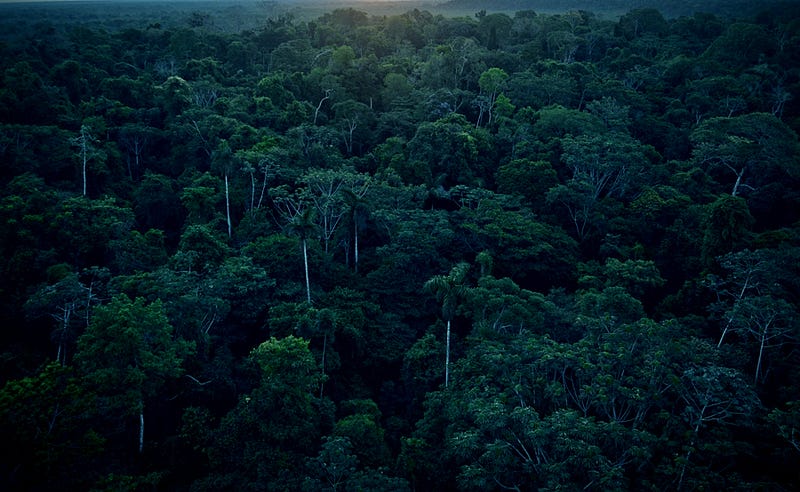
According to a new study, the asteroid that hit the Earth 66 million years ago and drove to extinction the non-avian dinosaurs was the driving force behind the birth of the modern Amazon rainforest.
Carlos Jaramillo at the Smithsonian Tropical Research Institute in Panama, and his colleagues analyzed tens of thousands of samples of fossilized pollen and leaves from northern South America that dated just before and right after the impact.
Before the asteroid hit the Yucatán peninsula in what is now Mexico, South America’s rainforests were mostly made up of ferns and conifers. In the aftermath of the catastrophe, most of the cone-bearing plants and ferns disappeared, and the rainforests became dominated by angiosperms (flowering plants). The researchers estimate the plant diversity declined by 45% after the impact and took almost six million years to recover.
There are several reasons why the asteroid may have caused this major change: the impact killed the large herbivorous dinosaurs that once trampled down and ate the lower levels of the forests. Also, the ash that settled out of the sky after the impact may have served as fertilizer, creating a nutrient-rich soil that favored the fast-growing angiosperms over other plants.
A new anurognathid from China
Also in April, scientists described a new genus of anurognathid pterosaur from the Tiaojishan Formation in China.
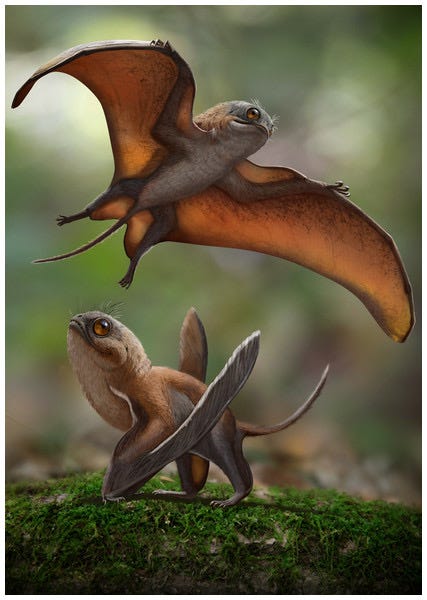
Anurognathids were small, bat-like pterosaurs with short or absent tails, whose remains are known from Europe, Asia, and possibly North America.
The newly discovered species, named Sinomacrops bondei, lived between 164 and 158 million years ago during the Jurassic Period. Its fossil is truly well-preserved: the skeleton is fairly complete, and it even includes patches of soft tissue.
The latest member of the anurognathid family further adds to the known diversity of these bizarre creatures and helps paleontologists better understand their evolutionary relationships.
Billions of T. rexes once roamed North America, a new study shows
A recent paper that attempts to estimate how many Tyrannosauruses actually lived on earth during their two-million-year existence on the planet was published this month.
To get the results, scientists used the relationship between body mass and population density among living animals. After running millions of computer simulations, each with a slightly different mix of possible values, the study found that the total count could be as low as 140 million and as high as 42 billion, with the average hovering around 2.5 billion individuals.
Likewise, anywhere from 1,300 to 328,000 individuals could have been alive at any one time, with 20,000 being the average. This average number translates to about 127,000 generations!
To find more about the paleobiology of the “tyrant lizard king”, click below:
One of the most important implications of this study is to estimate how rare dinosaur fossils really are. If these rates hold for genera other than T. rex, researchers may even be able to estimate how many dinosaur species simply didn’t fossilize at all — and are now irrevocably lost to time.
Mosasaurs regularly migrated from marine to freshwater environments
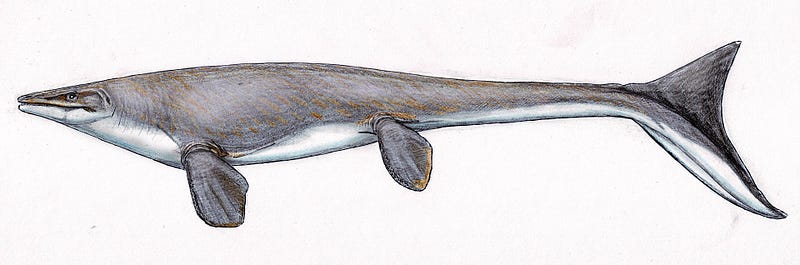
Scientists published an intriguing study investigating the migration habits of mosasaurs, the famous marine reptiles closely related to varanoid lizards that were the apex predators of the Late Cretaceous seas.
By looking at the level of oxygen isotopes in the tooth enamel of Platecarpus tympaniticus and Clidastes propython, two mosasaur genera that lived at the same time but come from different deposits in North America, paleontologists found these animals had records of semi-regular depletions in the oxygen isotope values of their enamel.
These depletions indicate traveling from marine environments to freshwater coastal ones every one to two weeks. The researchers also suggest that this regular consumption of fresh water shows the mosasaurs actually had osmoregulatory functions similar to their living relatives, the sea snakes.
A new hadrosaur from New Mexico
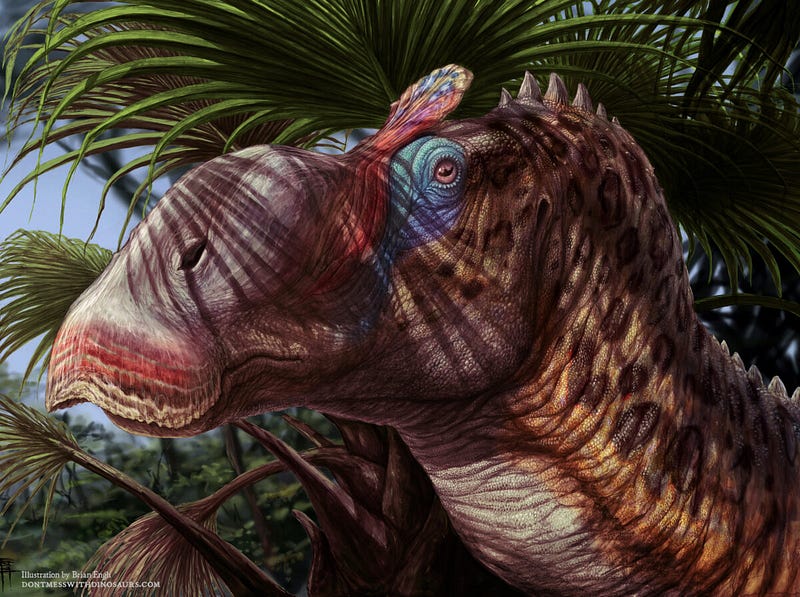
April saw the description of a new duck-billed dinosaur from the Menefee Formation of New Mexico. The dinosaur was originally discovered back in 2018, but during this month, the animal received a proper type of species name.
Paleontologists named the new genus Ornatops or “ornate face” alluding to an elaborate suture on the creature's skull that indicates a nasal crest of unknown shape. Ornatops was a herbivore and it could grow between 7 and 9 meters (23–30 ft) in length. It lived 78 million years ago, during the Late Cretaceous Period.
Ornatops was a member of the brachylophosaurines, a group of duck-billed hadrosaurs that previously were known from Montana and Alberta. The newly discovered genus is the first of its group to be found so far south, which illustrates how diverse and distributed brachylophosaurines were during this time in North America.
Pterosaur with opposable thumbs found in China
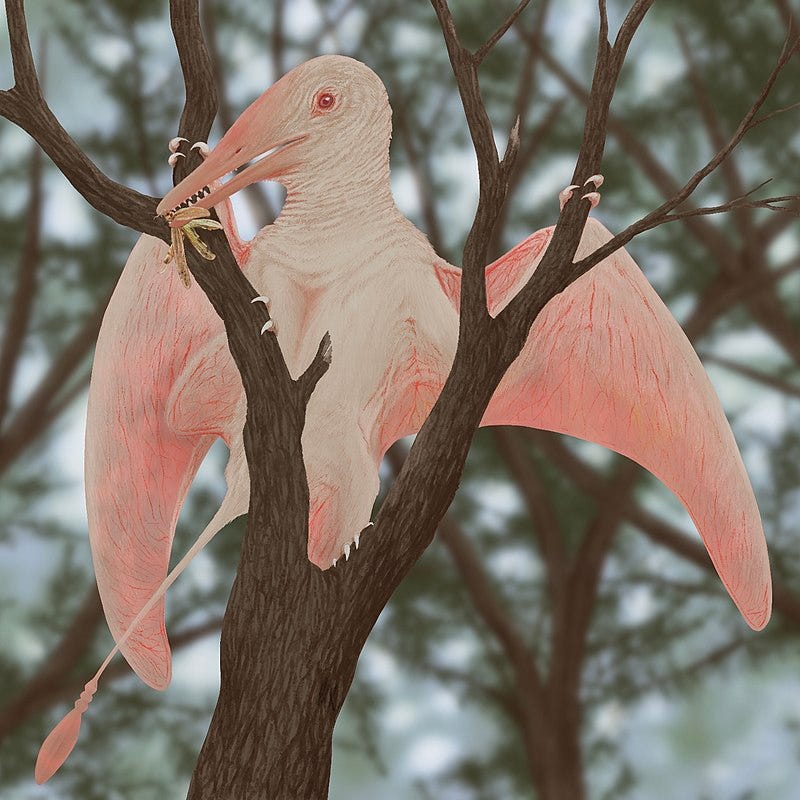
An international team of researchers from China, Brazil, the UK, Denmark, and Japan described a species of a small pterosaur with…opposable thumbs!
Dubbed ‘monkeydactyl’, the latest discovery represents the earliest known animal with the ability to touch the inside of its thumbs to the inside of its index fingers. Paleontologists retrieved the precious specimen from the Tiaojishan Formation of Liaoning, China, and named the new species Kunpengopterus antipollicatus.
The generic name combines the Kun, a large fish or whale from Chinese folklore that could transform itself into the Peng, a gigantic colorful bird, with a Latinised Greek for “wing”. The specific name antipollicatus translates to “opposite thumbs” in ancient Greek.
According to the scientists, the 160-million-year-old pterosaur likely used its dexterity to climb trees and hunt for insects and other prey.
Opposable thumbs are usually found in mammals like humans and apes — and some tree frogs — but Kunpengopterus is the first pterosaur with this feature and constitutes a truly remarkable discovery!
New evidence shows tyrannosaurs were pack-hunters
Tyrannosaurs were probably social predators and hunted in packs, scientists announced this month after analyzing fossils unearthed in Utah’s Grand Staircase-Escalante National Monument.
The quarry contains the remains of a group of Teratophoneus, a tyrannosaur that lived 77 to 76 million years ago and grew between 6.4 meters (21.0 ft) and 8 meters (26 ft) in length. Scientists discovered in the boned bed four or five individuals that ranged from 4 to 22 years of age.
According to the experts, the bones at the heart of the latest discovery suggest a tyrannosaur family that was hunting together when they all died during a seasonal flooding event.
“A lot of researchers feel like these animals simply didn’t have the brainpower to engage in such complex behavior. But this discovery, along with other recent findings, signals otherwise. This must be reflecting some sort of behavior and not just a freak event happening over and over again.” said paleontologist Alan Titus, who discovered the quarry site in 2014.
This quarry is the first tyrannosaur mass death site found in the southern United States.
Stomach stones may reveal a long dinosaur migration
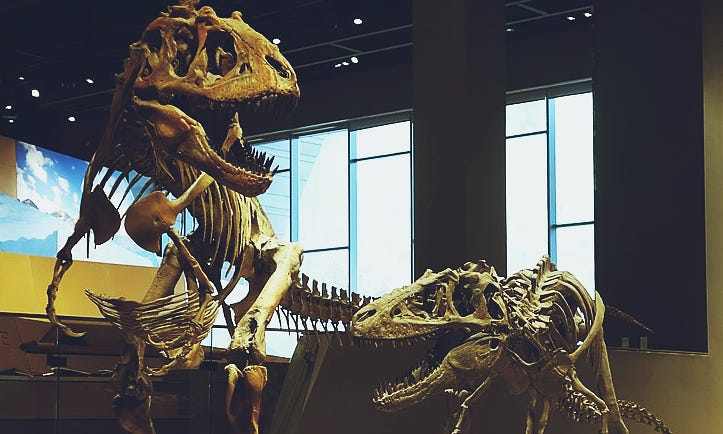
During the Late Jurassic Period, certain dinosaurs may have migrated hundreds of miles across what is now the American Midwest.
Scientists made this assumption based on evidence coming from gastroliths, stomach stones that help some animals better digest their food. They suggest the dinosaurs gulped down these stones in what is now Wisconsin, trekked westward over 1,000 kilometers (600 miles), and then died in the area that’s now Wyoming, leaving the stones in a new location.
The sediment in the Morrison Formation which dates from the Late Jurassic largely came from eastward-flowing rivers that originated out west. But these stones originate in the east. In addition, there weren’t any rivers connecting Wisconsin to Wyoming that flowed with enough energy to carry such large stones that entire distance. Perhaps, the team reasoned, dinosaurs migrating long distances carried them there.
We will never know for sure which species of dinosaur traveled this distance, but scientists find more frequently gastroliths in sauropods than in large-bodied theropods. Fossils of long-necked sauropods such as Camarasaurus, Diplodocus, and Apatosaurus are much more common than carnivores in the Morrison Formation. Therefore, the animals responsible for transporting the stones were most likely some type of these giant creatures.
New mammal relatives from Cretaceous China
This month saw the discovery and description of two new genera of mammaliformes from the Cretaceous rocks of the Jehol ecosystem in China.
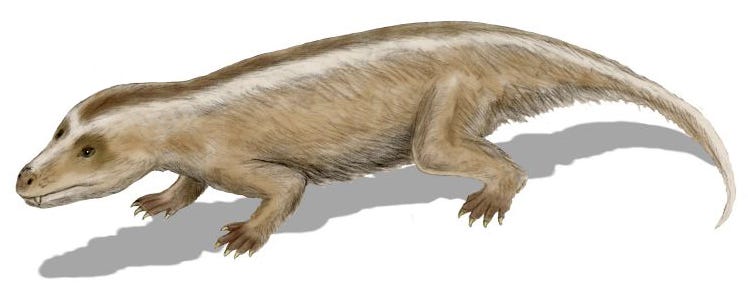
Mammaliaformes is the group containing all mammals and their closest extinct relatives. Scientists named the first of these creatures Fosiomanus sinensis and classified it as a non-mammalian cynodont. The other was named Jueconodon cheni and paleontologists suggest it could have been a true mammal.
Fosiomanus and Jueconodon lived between 133 and 120 million years ago, and despite being distantly related to each other, both had convergently evolved features related to digging. This makes them the first scratch-digging animals known from the location, while their discovery further adds to the variety of Chinese mammals from the Mesozoic Era.
Paleontologists found the world’s smallest stegosaur footprint
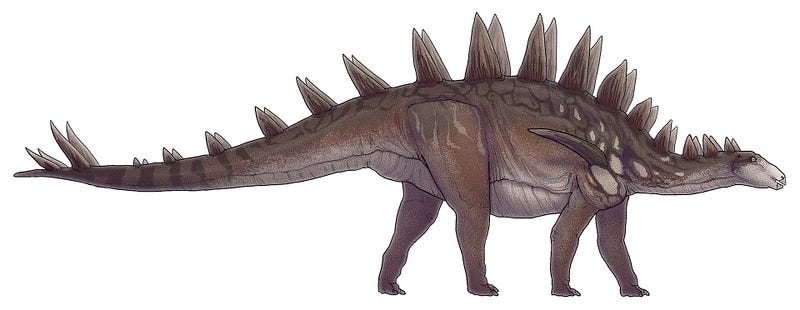
Also in April, an international team of paleontologists identified in China the tiniest known stegosaur footprint.
Preserved in the 100-million-year-old stone in the Xinjiang Province, the print measures just 5.7 centimeters (2.24 inches) long and was made by a baby stegosaur around the size of a cat. Based on the print, scientists suggest that baby stegosaurs may have walked differently from the adults.
“Stegosaurs typically walked with their heels on the ground, much like humans do, but on all fours, which creates long footprints. The tiny track shows this dinosaur had been moving with its heel lifted off the ground, much like a bird or cat does today,” said paleontologist Anthony Romilio of the University of Queensland in Australia.
Stegosaurs were quadrupedal herbivores that had spikes on their tail and bony plates along their back. Fossils of these animals have been recovered from North America, Europe, Asia, and Africa. The clade includes the eponymous Stegosaurus, one of the most famous dinosaur genera in popular culture.
Gigantic pterosaurs had spoked vertebrae to support their ‘ridiculously long’ necks
Massive pterosaurs with ‘ridiculously long necks’ were able to take to the sky and carry large prey while flying due to spoked vertebrae, according to a new study.
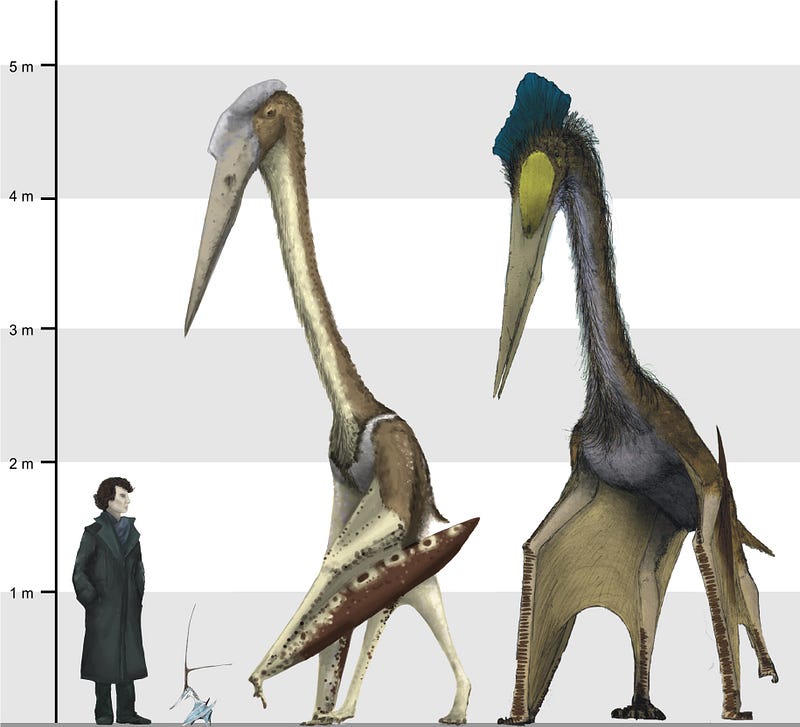
Researchers from the University of Portsmouth used CT scans to examine fossils of the giant pterosaurs known as azhdarchids and found the vertebrae in their necks were arranged like spokes of a bicycle wheel.
Some azhdarchid genera like Arambourgiania and Quetzalcoatlus stood almost 5m tall (18ft) -higher than a modern-day giraffe- and had an impressive wingspan between 10 and 12 meters (33–39 ft). Their neck was equally enormous, measuring sometimes over 2.5 meters (8.2 ft) in length.
Azhdarchids were the biggest flying creatures that ever lived, and this unique spoke-like anatomical phenomenon explains how these animals could hold their prey without breaking their elongated necks.
A new hadrosaur from Japan
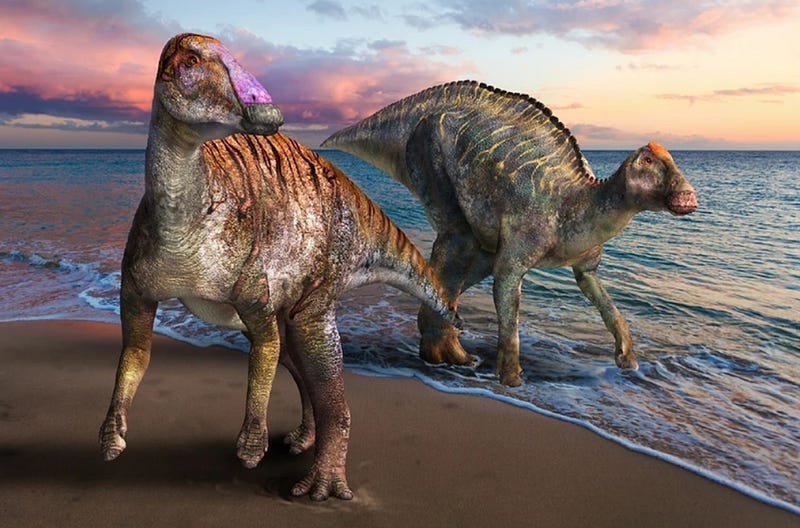
And finally, for this month, an international team of paleontologists has identified another hadrosaur — this time from Japan. The new duck-billed dinosaur was named Yamatosaurus izanagii after Yamato, the ancient name for Japan, and Izanagi the god from Japanese mythology who created the Japanese islands.
Yamatosaurus could grow up to 7m (23 ft) in length and, despite being placed in a relatively basal position within the hadrosaurids, it lived during the final stage of the Cretaceous Period. This led paleontologists to suggest that East Asia may have acted as a refuge for relict duck-billed dinosaur lineages.
The discovery of Yamatosaurus yields new information about the evolution of hadrosaurs and presents an intermediate form between duck-bills that walked upright and the large, more derived species that evolved to walk on all fours.
Epilogue
To sum up, April was a remarkable month in the field of paleontology. Scientists learned more about the biology and behavior of a wide range of extinct animals and discovered exciting new species.
Hungry for more paleontology news? Check out the top discoveries from May below:
References
Federico A. Gianechini, Ariel H. Méndez, Leonardo S. Filippi, Ariana Paulina-Carabajal, Rubén D. Juárez-Valieri & Alberto C. Garrido (2021) A New Furileusaurian Abelisaurid from La Invernada (Upper Cretaceous, Santonian, Bajo De La Carpa Formation), Northern Patagonia, Argentina, Journal of Vertebrate Paleontology, DOI: 10.1080/02724634.2020.1877151
Hodnett, J-.P. M; Grogan, E. D.; Lund, R.; Lucas, S. G.; Suazo, T.; Elliott, D. K.; Pruitt, J. (2021). “Ctenacanthiform sharks from the late Pennsylvanian (Missourian) Tinajas Member of the Atrasado Formation, Central New Mexico”. New Mexico Museum of Natural History and Science Bulletin. 84: 391–424.
Mónica R. Carvalho, Carlos Jaramillo, Felipe de la Parra, Dayenari Caballero-Rodríguez, Fabiany Herrera, Scott Wing, Benjamin L. Turner, Carlos D’Apolito, Millerlandy Romero-Báez, Paula Narváez, Camila Martínez, Mauricio Gutierrez, Conrad Labandeira, German Bayona, Milton Rueda, Manuel Paez-Reyes, Dairon Cárdenas, Álvaro Duque, James L. Crowley, Carlos Santos, Daniele Silvestro. Extinction at the end-Cretaceous and the origin of modern Neotropical rainforests. Science, 2021; 372 (6537): 63 DOI: 10.1126/science.abf1969
Wei X, Pêgas RV, Shen C, Guo Y, Ma W, Sun D, Zhou X. 2021. Sinomacrops bondei, a new anurognathid pterosaur from the Jurassic of China and comments on the group. PeerJ 9:e11161 https://doi.org/10.7717/peerj.11161
Charles R. Marshall, Daniel V. Latorre, Connor J. Wilson, Tanner M. Frank, Katherine M. Magoulick, Joshua B. Zimmt, Ashley W. Poust, Absolute abundance and preservation rate of Tyrannosaurus rex, Science 16 Apr 2021: Vol. 372, Issue 6539, pp. 284–287, DOI: 10.1126/science.abc8300
Leah Travis Taylor, Rebecca Totten Minzoni, Celina A. Suarez, Luis A. Gonzalez, Larry D. Martin, W. Joe Lambert, Dana J. Ehret, T. Lynn Harrell, Oxygen isotopes from the teeth of Cretaceous marine lizards reveal their migration and consumption of freshwater in the Western Interior Seaway, North America, Palaeogeography, Palaeoclimatology, Palaeoecology, 2021, 110406, ISSN 0031–0182, https://doi.org/10.1016/j.palaeo.2021.110406
McDonald AT, Wolfe DG, Freedman Fowler EA, Gates TA. 2021. A new brachylophosaurin (Dinosauria: Hadrosauridae) from the Upper Cretaceous Menefee Formation of New Mexico. PeerJ 9:e11084 https://doi.org/10.7717/peerj.11084
Wang, Xiaolin; Kellner, Alexander W.A.; Jiang, Shunxing; Cheng, Xin; Meng, Xi & Rodrigues, Taissa (2010). “New long-tailed pterosaurs (Wukongopteridae) from western Liaoning, China” (PDF). Anais da Academia Brasileira de Ciências. 82 (4): 1045–1062. doi:10.1590/S0001–37652010000400024. PMID 21152776.
Titus AL, Knoll K, Sertich JJW, Yamamura D, Suarez CA, Glasspool IJ, Ginouves JE, Lukacic AK, Roberts EM. 2021. Geology and taphonomy of a unique tyrannosaurid bonebed from the upper Campanian Kaiparowits Formation of southern Utah: implications for tyrannosaurid gregariousness. PeerJ 9:e11013 https://doi.org/10.7717/peerj.11013
Laura Geggel(Apr. 2021), Long-necked dinosaurs migrated hundreds of miles, ‘stomach stones’ reveal, Live Science, Link: https://www.livescience.com/jurassic-dinosaurs-migrated.html
Mao, F., Zhang, C., Liu, C. et al. Fossoriality and evolutionary development in two Cretaceous mammaliamorphs. Nature (2021). https://doi.org/10.1038/s41586-021-03433-2
Lida Xing, Martin G. Lockley, W. Scott Persons, Hendrik Klein, Anthony Romilio, Donghao Wang, Miaoyan Wang. Stegosaur Track Assemblage from Xinjiang, China, Featuring the Smallest Known Stegosaur Record. PALAIOS, 2021; 36 (2): 68 DOI: 10.2110/palo.2020.036
Williams et al. Helically arranged cross struts in azhdarchid pterosaur cervical vertebrae and their biomechanical implications. iScience, 2021 DOI: 10.1016/j.isci.2021.102338
Yoshitsugu Kobayashi, Ryuji Takasaki, Katsuhiro Kubota, Anthony R. Fiorillo. A new basal hadrosaurid (Dinosauria: Ornithischia) from the latest Cretaceous Kita-ama Formation in Japan implies the origin of hadrosaurids. Scientific Reports, 2021; 11 (1) DOI: 10.1038/s41598–021–87719–5


