avatarPanos Grigorakakis

Free AI web copilot to create summaries, insights and extended knowledge, download it at here

9294

Abstract

te Cretaceous. It also suggests centrosaurines originated in the southern portions of western North America and later moved up north in localities like Canada and Alaska.</p><figure id="7844"><img src="https://cdn-images-1.readmedium.com/v2/resize:fit:800/1*1PDWqTgZPNq8394_qssr9Q.jpeg"><figcaption>Skull of Centrosaurus, a relative of the newly discovered Menefeeceratops sealeyi / Flesh for Blood / <a href="https://commons.wikimedia.org/wiki/File:Centrosaurus_Smithsonian.jpg">Wikimedia Commons</a></figcaption></figure><h1 id="4153">A new mosasaur from Morocco</h1><p id="da79">Also, this month scientists named a new species of mosasaur called Pluridens <i>serpentis</i>. Found in the Late Cretaceous rocks of Morocco, Pluridens was an interesting marine animal with a very specialized lifestyle.</p><p id="f61d">Its small orbits indicate that rather than relying on vision, this mosasaur would use touch and chemoreception to locate and capture its prey. Since the jaws in some specimens are robust and sometimes show injuries, scientists suggest they may have been used for fighting over mates or territories. Paleontologists estimate that large individuals of this species may have reached up to 8 or 9 meters (26–29 ft) in length.</p><p id="17f0">The discovery of Pluridens adds to the variety of Late Cretaceous mosasaurs and shows how these animals diversified right before the mass extinction event that eventually killed them off 66 million years ago.</p><figure id="839d"><img src="https://cdn-images-1.readmedium.com/v2/resize:fit:800/1*goaws5W41jccVvgbtKVklA.png"><figcaption>Pluridens shown to scale with Halisaurus arambourgi and Homo sapiens. Digital artwork by Nick Longrich / <a href="https://commons.wikimedia.org/wiki/File:Pluridens_and_halisaurus_by_Nick_Longrich.png">Wikimedia Commons</a></figcaption></figure><h1 id="0f78">A new titanosaur from Brazil</h1><p id="93a8">A new titanosaur sauropod from Brazil has been described in May. Scientists had discovered the specimen back in 2011 in the Late Cretaceous rocks of the Adamantina Formation of São Paulo.</p><p id="faf6">Paleontologists had originally classified it as a species of Aeolosaurus, a medium-sized long-necked titanosaur from South America. This month though and under closer examination, they separated the species into its own genus, calling it Arrudatitan<i> maximus</i>.</p><p id="fe8f">Arrudatitan was relatively gracile for a titanosaur and could stretch up to 15 meters (49 ft) when fully grown. It lived between 72 and 68 million years ago and shared its ecosystem with fellow-titanosaur genera like Gondwanatitan, Adamantisaurus, and Aeolosaurus.</p><figure id="505a"><img src="https://cdn-images-1.readmedium.com/v2/resize:fit:800/1*nIjLeEop7GtUXkIOy81dMw.png"><figcaption>Scale of Aeolosaurus, the closest relative of Arrudatitan / Slate Weasel / <a href="https://commons.wikimedia.org/wiki/File:Aeolosaurus_Scale.svg">Wikimedia Commons</a></figcaption></figure><h1 id="1805">Other mammals, not dinosaurs, held our ancestors back</h1><p id="d4b9">A new study that challenges old assumptions about why modern mammals seemed to diversify only after the extinction of the non-avian dinosaurs was published this month.</p><p id="245b">Paleontologists traditionally thought that, before the extinction, mammals lived in the shadow of the dinosaurs. This supposedly prevented them from occupying the niches that were already occupied by the giant reptiles, keeping them relatively small and unspecialized in terms of diet and lifestyle.</p><p id="b9a6">The newest study led by researchers from the Oxford University Museum of Natural History, University of Oxford, and the University of Birmingham points to a more complex story of competition between distinct mammal groups. Scientists looked at the anatomy of all the different kinds of mammals living alongside dinosaurs, including the ancestors of modern placental and marsupial groups, also known as therians.</p><p id="b014">By measuring how frequently new features appeared, such as changes in the size and shape of their teeth and bones, and the pattern and timing of their appearance before and after the mass extinction, the researchers determined that the modern mammals were more constrained during the time of the dinosaurs than their close relatives.</p><p id="5244">This meant that while their relatives were exploring larger body sizes, different diets, and novel ways of life such as climbing and gliding, they were excluding modern mammals from these lifestyles, keeping them small and generalist in their habits.</p><p id="13d9">“This result makes very little sense if you assume that it was the dinosaurs constraining the therians,” said Dr. Neil Brocklehurst of the University of Oxford, who led the research. “There is no reason why the dinosaurs would be selectively competing with just these mammals and allowing others to prosper. It instead appears that the therians were being held back by these other groups of mammals.”</p><figure id="b813"><img src="https://cdn-images-1.readmedium.com/v2/resize:fit:800/1*spdUDRDfoplffdnxYyLe2g.jpeg"><figcaption>Gobiconodon, a non-therian Early Cretaceous mammal from Asia and North America. Animals like this likely prevented our ancestors from diversifying during the Mesozoic Era / DiBgd / <a href="https://commons.wikimedia.org/wiki/File:GobiconodonDB15.jpg">Wikimedia Commons</a></figcaption></figure><h1 id="a464">A new genus of crested dinosaur found in Mexico</h1><p id="d7ce">Also in May, a team of paleontologists has identified a new and interesting genus of a crested dinosaur from Mexico.</p><p id="c534">Named Tlatolophus <i>galorum</i>, the new dinosaur’s name comes from the word tlatolli, which means “word”, combined with Greek lophos (“crest”) due to the crest’s resemblance to the glyph “word” in Aztec iconography. The species is named after the Garza and López families for their collaboration in collecting and preserving the specimen.</p><p id="3962">Tlatolophus was a member of the duck-billed lambeosaurines, a group of crested hadrosaurs that flourished during the Late Cretaceous Period. This animal lived 72 million years ago and was closely related to the North American Parasaurolophus <i>walkeri,</i> a 10-meter-long (30ft) hadrosaur<i> </i>known for its large, elaborate cranial crest. Scientists estimate that Tlatolophus could have grown to similar proportions.</p><p id="0d9c">The discovery of Tlatolophus is extremely important as it is the most complete lambeosaurine known from Mexico.</p><figure id="8cac"><img src="https://cdn-images-1.readmedium.com/v2/resize:fit:800/1*FkvZM1y7ZVTSwqmH0xbO4Q.png"><figcaption>Life restoration of Tlatolophus by Joaquin Eng Ponce / <a href="https://commons.wikimedia.org/wiki/File:Tlatolophus.png">Wikimedia Commons</a></figcaption></figure><h1 id="d5ea">Ancient mammal tracks discovered in aquatic environments</h1><p id="0510">It was during this month that scientists also discovered in southern Wyoming the earliest evidence for the use of marine habitats by mammals.</p><p id="6526">Several five and four-toed fossil tracks that date from between 59 and 56 million years ago record animals repeatedly walking across submerged and partially emergent tidal flats. Hundreds of different tracks are preserved representing at least two species of mammals.</p><p id="391b">Scientists suggest the tracks made from the five-toed mammals might have belonged to the group of pantodons, a family of relatively large mammals that evolved during the Paleocene. The tracks with four toes might be evidence of previously undescribed large-bodied artiodactyls or taperoids. If so, these tracks could support the origin of the artiodactyls near the Cretaceous-Paleogene boundary.</p><figure id="ccb1"><img src="https://cdn-images-1.readmedium.com/v2/resize:fit:800/1*prGONIIhurAHGM9ucdBi6A.jpeg"><figcaption>Barylambda, a pantodont from the Paleocene of North America / Nobu Tamura / <a href="https://commons.wikimedia.org/wiki/File:Barylambda_BW.jpg">Wikimedia Commons</a></figcaption></figure><h1 id="0076">South African sauropodomorph had irregular growth</h1><p id="3f83">A recent study lead by Dr. Kimberley Chapelle of the American Museum of Natural History in New York City and Honorary Research Fellow at the University of the Witwatersrand suggested that a famous South African dinosaur species had irregular growth patterns.</p><p id="61a5">The study examined specimens of Massospondylus <i>carinatus</i>, a medium-sized sauropodomorph dinosaur that lived in the Early Jurassic Period, almost 200 million years ago. This dinosaur grew to around 4 meters (13 ft) in length and fed on plants like ferns.</p><p id="dadb">By looking at its fossilized thigh bones under a microscope, researchers could count growth lines, like those of a tree, allowing them to study how much the individuals grew each year. By examining growth rings in the bones of the creature, Dr. Chapelle could show that its growth varied season-to-season, more like a tree than a human.</p><p id="009e">“These things were just all over the show,” said Chapelle. “One year, they might gain 100kg of body weight and the next year they’d only grow by 10kg!”</p><p id="bca4">The study suggests that Massospondylus’ growth directly responded to its

Options

environmental conditions. In a good year with lots of rain and food, the species might race ahead, almost doubling their size. In a poor year where nutrients were scarce, it might hardly grow at all.</p><figure id="0c03"><img src="https://cdn-images-1.readmedium.com/v2/resize:fit:800/1*x9yYLdvG4RLPQKWFjDnxXw.png"><figcaption>Life reconstruction of Massospondylus / Emily Willoughby / <a href="https://commons.wikimedia.org/wiki/File:Massospondylus_reconstruction.png">Wikimedia Commons</a></figcaption></figure><h1 id="79fe">Prehistoric whale grew both teeth and baleen</h1><p id="5f9e">Scientists from the San Diego State University and the San Diego Natural History Museum discovered that an evolutionary cousin of today’s baleen whales called Aetiocetus <i>weltoni </i>grew both teeth and baleen in its mouth.</p><p id="0dbd">The paleontologists examined the 25 million-year-old skull of the prehistoric whale and found grooves and holes on the roof of the animal’s mouth that connect internally with a vascular canal in a fashion consistent with the pattern of blood vessels that lead to baleen in modern whale genera.</p><p id="b5c2">Aetiocetus’s skull also revealed separate connections between the major internal canal and smaller canals that would have delivered blood to the upper teeth, which is consistent with the pattern of blood supply to teeth in living toothed whales such as sperm whales and killer whales, porpoises, dolphins, and terrestrial mammals.</p><p id="51f1">“We have found evidence that supports a co-occurrence of teeth and baleen, indicating the tooth-to-baleen transition occurred in a stepwise manner from just teeth, to teeth and baleen, to only baleen,” lead study author Dr. Ekdale said.</p><figure id="6237"><img src="https://cdn-images-1.readmedium.com/v2/resize:fit:800/1*WFg013Qtl4Kz8DVLBIpj8A.jpeg"><figcaption>Life reconstruction of Aetiocetus by Nobu Tamura / <a href="https://commons.wikimedia.org/wiki/File:Aetiocetus_BW.jpg">Wikimedia Commons</a></figcaption></figure><h1 id="3ff3">A new species of dinosaur from the Australian outback?</h1><p id="d7e4">And finally, for this month, a team of Australian paleontologists discovered the remains of what they suspect to be a brand-new species of herbivorous dinosaur buried in western Queensland.</p><p id="c88d">“Most things found in Australia in terms of dinosaurs have a very good chance of being new to science because of the nature of how we’ve been separated from Gondwana and South America for so long,” said Robyn Mackenzie, director, and paleontologist of the Eromanga Natural History Museum.</p><p id="73bb">The remains that have been recovered so far primarily consist of vertebrae, the bony components of the spine. However, scientists are optimistic about their chances of finding additional sections of the skeleton because they have only dug a meter (about 3.3 feet) down so far.</p><p id="3f99">Based on preliminary observations of the bones, the team believes the dinosaur was likely a long-necked sauropod. The fossil dates from 95 million years ago, which makes the new find one of the geologically youngest dinosaurs to have ever been found in Australia.</p><figure id="62a0"><img src="https://cdn-images-1.readmedium.com/v2/resize:fit:800/1*Yl2rKmMMjSKu_EtdqCK2Lw.png"><figcaption>Life reconstruction of the Australian sauropod Wintonotitan by T. Tischler / <a href="https://commons.wikimedia.org/wiki/File:Wintonotitan.png">Wikimedia Commons</a></figcaption></figure><h1 id="df20">Epilogue</h1><p id="3413">To sum up, May was a remarkable month in the field of paleontology. Scientists learned more about the biology and behavior of a wide range of extinct animals and discovered exciting new species.</p><p id="21fe">Hungry for more paleontology news? Check out the top discoveries from June below:</p><div id="6519" class="link-block"> <a href="https://readmedium.com/exciting-paleontological-discoveries-you-probably-missed-in-june-928c1bf7a8d"> <div> <div> <h2>Exciting Paleontological Discoveries You Probably Missed in June</h2> <div><h3>Tetrapods conquered land later than previously thought…</h3></div> <div><p>medium.com</p></div> </div> <div> <div style="background-image: url(https://miro.readmedium.com/v2/resize:fit:320/1*4Q7fJjqqasxtAU2ADZTjhQ.jpeg)"></div> </div> </div> </a> </div><h1 id="0f2e">References</h1><p id="d437"><i>Jonah N. Choiniere, James M. Neenan, Lars Schmitz, David P. Ford, Kimberley E. J. Chapelle, Amy M. Balanoff, Justin S. Sipla, Justin A. Georgi, Stig A. Walsh, Mark A. Norell, Xing Xu, James M. Clark, Roger B. J. Benson, Evolution of vision and hearing modalities in theropod dinosaurs, Science 07 May 2021: Vol. 372, Issue 6542, pp. 610–613, DOI: 10.1126/science.abe7941</i></p><p id="e4dd"><i>Orcutt, J.D., Calede, J.J. Quantitative Analyses of Feliform Humeri Reveal the Existence of a Very Large Cat in North America During the Miocene. J Mammal Evol (2021). <a href="https://doi.org/10.1007/s10914-021-09540-1">https://doi.org/10.1007/s10914-021-09540-1</a></i></p><p id="493b"><i>Gallagher T, Poole J, Schein JP. 2021. Evidence of integumentary scale diversity in the late Jurassic Sauropod Diplodocus sp. from the Mother’s Day Quarry, Montana. PeerJ 9:e11202 <a href="https://doi.org/10.7717/peerj.11202">https://doi.org/10.7717/peerj.11202</a></i></p><p id="0d63"><i>Manuel Pérez-Pueyo, Eduardo Puértolas-Pascual, Miguel Moreno-Azanza, Penélope Cruzado-Caballero, José Manuel Gasca, Carmen Núñez-Lahuerta & José Ignacio Canudo (2021) First record of a giant bird (Ornithuromorpha) from the uppermost Maastrichtian of the Southern Pyrenees, northeast Spain, Journal of Vertebrate Paleontology, DOI: <a href="https://doi.org/10.1080/02724634.2021.1900210">10.1080/02724634.2021.1900210</a></i></p><p id="73af"><i>Nicholas R. Longrich, Nathalie Bardet, Fatima Khaldoune, Oussama Khadiri Yazami, Nour-Eddine Jalil, Pluridens serpentis, a new mosasaurid (Mosasauridae: Halisaurinae) from the Maastrichtian of Morocco and implications for mosasaur diversity, Cretaceous Research, 2021, 104882, ISSN 0195–6671, <a href="https://doi.org/10.1016/j.cretres.2021.104882">https://doi.org/10.1016/j.cretres.2021.104882</a>.</i></p><p id="bbbf"><i>Santucci, R.M.; De Arruda-Campos, A.C. (2011). <a href="https://biotaxa.org/Zootaxa/article/view/zootaxa.3085.1.1">“A new sauropod (Macronaria, Titanosauria) from the Adamantina Formation, Bauru Group, Upper Cretaceous of Brazil and the phylogenetic relationships of Aeolosaurini”</a>. Zootaxa. <b>3085</b> (1): 1. <a href="https://en.wikipedia.org/wiki/Doi_(identifier)">doi</a>:<a href="https://doi.org/10.11646%2Fzootaxa.3085.1.1">10.11646/zootaxa.3085.1.1</a>. <a href="https://en.wikipedia.org/wiki/ISSN_(identifier)">ISSN</a> <a href="https://www.worldcat.org/issn/1175-5334">1175–5334</a></i></p><p id="9198"><i>“Mammaliaform extinctions as a driver of the morphological radiation of Cenozoic mammals” by Neil Brocklehurst, Elsa Panciroli, Gemma Louise Benevento and Roger B.J. Benson, 17 May 2021, Current Biology. <a href="https://doi.org/10.1016/j.cub.2021.04.044">DOI: 10.1016/j.cub.2021.04.044</a></i></p><p id="0030"><i>Wroblewski, A.FJ., Gulas-Wroblewski, B.E. Earliest evidence of marine habitat use by mammals. Sci Rep 11, 8846 (2021). <a href="https://doi.org/10.1038/s41598-021-88412-3">https://doi.org/10.1038/s41598-021-88412-3</a></i></p><p id="024d"><i>Ramírez-Velasco, Á. A.; Aguilar, F. J.; Hernández-Rivera, R.; Gudiño Maussán, J. L.; Rodriguez, M. L.; Alvarado-Ortega, J. (2021). “Tlatolophus galorum, gen. et sp. nov., a parasaurolophini dinosaur from the upper Campanian of the Cerro del Pueblo Formation, Coahuila, northern Mexico”. <a href="https://en.wikipedia.org/wiki/Cretaceous_Research">Cretaceous Research</a>. in press: Article 104884. <a href="https://en.wikipedia.org/wiki/Doi_(identifier)">doi</a>:<a href="https://doi.org/10.1016%2Fj.cretres.2021.104884">10.1016/j.cretres.2021.104884</a></i></p><p id="7560"><i>Dalman, Sebastian G.; Lucas, Spencer G.; Jasinki, Steven G.; Lichtig, Asher J.; Dodson, Peter (2021). <a href="https://link.springer.com/article/10.1007%2Fs12542-021-00555-w">“The oldest centrosaurine: a new ceratopsid dinosaur (Dinosauria: Ceratopsidae) from the Allison Member of the Menefee Formation (Upper Cretaceous, early Campanian), northwestern New Mexico, USA”</a>. PalZ. <a href="https://en.wikipedia.org/wiki/Doi_(identifier)">doi</a>:<a href="https://doi.org/10.1007%2Fs12542-021-00555-w">10.1007/s12542–021–00555-w</a></i></p><p id="f56e"><i>Kimberley E. J. Chapelle et al. Extreme growth plasticity in the early branching sauropodomorph Massospondylus carinatus, Biology Letters (2021). <a href="http://dx.doi.org/10.1098/rsbl.2020.0843">DOI: 10.1098/rsbl.2020.0843</a></i></p><p id="e8d4"><i>Eric G Ekdale, Thomas A Deméré, Neurovascular evidence for a co-occurrence of teeth and baleen in an Oligocene mysticete and the transition to filter-feeding in baleen whales, Zoological Journal of the Linnean Society, 2021;, zlab017, <a href="https://doi.org/10.1093/zoolinnean/zlab017">https://doi.org/10.1093/zoolinnean/zlab017</a></i></p></article></body>

Exciting Paleontological Discoveries You Probably Missed in May

A new species of a giant saber-toothed cat once terrorized North America…
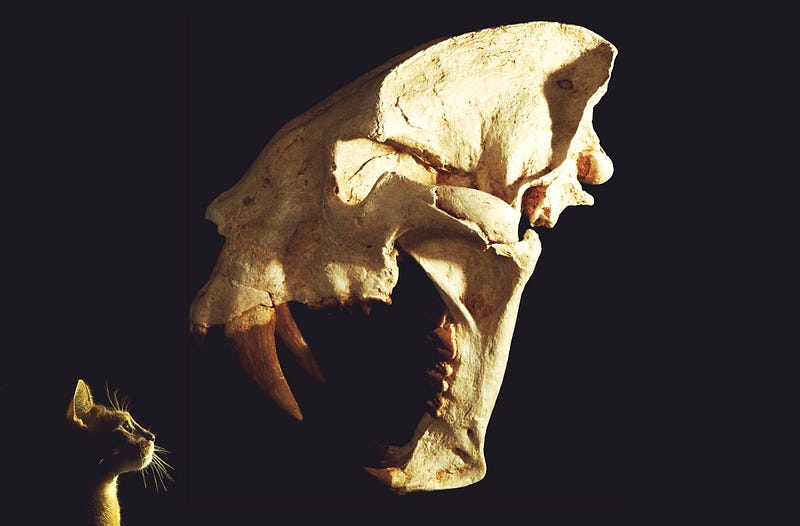
Size comparison between Machairodus giganteus and the common house cat, Felis catus / Coluberssymbol / Wikimedia Commons

Several fascinating paleontological discoveries are taking place each month. Scientists working in the field publish numerous studies, describe new prehistoric species, and propose exciting theories about the biology and behavior of many extinct animals.

This article will do a quick recap of the most important paleontological discoveries and updates from May 2021.

Before that, be sure to check the most memorable ones from April below:

Ready? Let’s go!

The dinosaur that hunted in the dark

Starting off with an intriguing study concerning the comparison of visual and hearing capabilities among 100 species of birds and dinosaurs.

The study which was published in the journal Science showed that many carnivorous dinosaurs, including the all-time favorite Tyrannosaurus, had vision optimized for the daytime and better-than-average hearing.

However, a genus of a diminutive theropod dinosaur called Shuvuuia deserti, possessed visual and auditory capabilities akin to a barn owl, indicating it could hunt in total darkness.

To learn more about the study that changes the conventional thinking about diurnal and nocturnal dinosaurs, read the article below:

New giant saber-toothed cat once terrorized North America

This month also saw the discovery of a new species of the famous saber-toothed cat, Machairodus. The newly described Machairodus lahayishupup weighed around 410 kg (900 lb)making it was one of the largest cats in Earth history.

According to the scientists involved in the study, this animal was capable of taking down bison-sized prey and its diet included rhinoceroses, giant camels, and giant ground sloths.

M. lahayishupup lived between 9 million and 5 million years ago and is the first species of the genus Machairodus to be found in North America. “It’s been known that there were giant cats in Europe, Asia, and Africa, and now we have our own giant saber-toothed cat in North America during this period as well,” said study co-author Jonathan Calede, an assistant professor of evolution, ecology, and organismal biology at The Ohio State University’s Marion campus.

The particular discovery suggests that either there was a widespread population of Machairodus throughout Africa, Eurasia, and North America, or simultaneous instances of independent evolution in machairodonts on multiple continents during the Miocene.
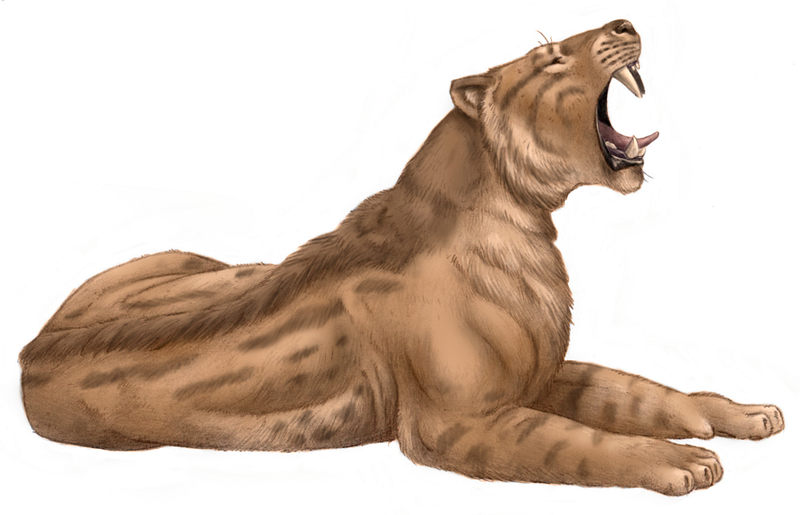
Life restoration of Machairodus / Jesus Gamarra Gonzalez / Wikimedia Commons

Fossilized skin of iconic sauropod discovered

A fascinating discovery for the study of non-avian dinosaur life and appearance took place in May. Paleontologists working on Mother’s Day Quarry, a fossil site in the Morrison Formation rocks of Montana, announced the description of a fossilized skin belonging to the iconic Late Jurassic sauropod Diplodocus.

The fossil exhibits several scale shapes including rectangular, polygonal, pebble, ovoid, dome, and globular. These scales range in size and shape depending upon their location on the integument, with the smallest reaching about 1mm and the largest 10 mm. The skin fossil itself is small, reaching less than 70 cm (27.5 in) in length.

The vast amount of scale diversity seen within such a small area, the relatively small size of the scales, and the presence of small and potentially “juvenile” material at the Mother’s Day Quarry suggest that the sample skin originated from a young or even juvenile Diplodocus.
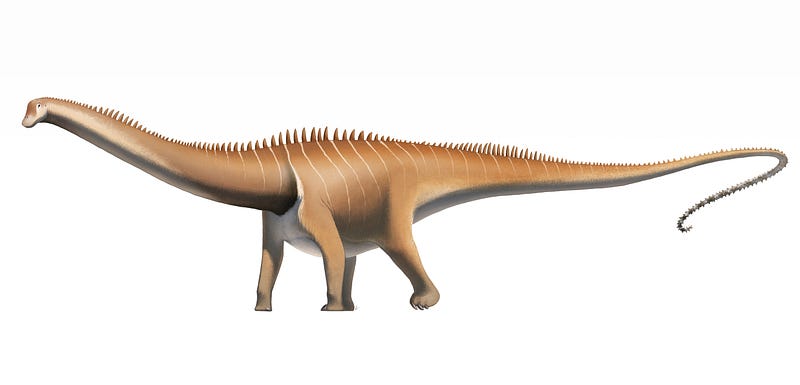
Life restoration of Diplodocus / Fred Wierum / Wikimedia Commons

A giant bird lived along with the last European dinosaurs

Scientists identified a new species of a giant bird that likely coexisted with the last European non-avian dinosaurs right before the extinction event that wiped them out 66 million years ago.

“We are talking about hundreds of thousands of years before the meteorite fell to earth and caused the massive extinction,” said lead study author Pérez-Pueyo. “There were no giant birds registered in Europe at the time. There are other birds found in Europe, but they are older than this one.”

The discovery is based on a single vertebrate found in the Tremp Formation, a geological site in the Catalonian Pre-Pyrenees area of northern Spain. Scientists compared it with other bones of non-avian and avian dinosaurs, before confirming that it belonged to a yet unidentified genus of prehistoric bird.

According to their estimations, this animal could have been 1.5–1.8 m. (5 to 6 ft) tall when alive. Scientific analysis of the fossil is still ongoing, and paleontologists are exploring the discovery site hoping to uncover more information.
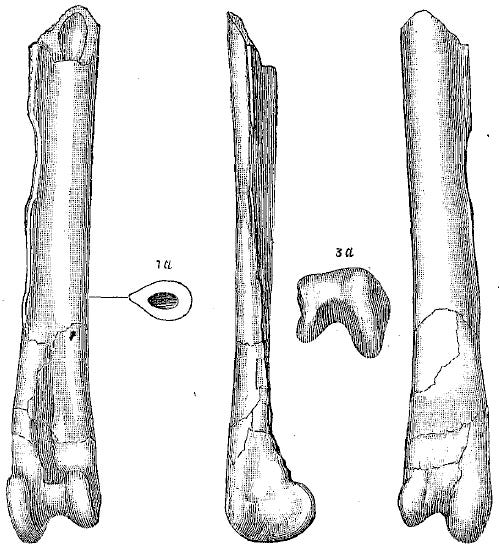
Right tibia of a Cretaceous bird / Marsh / Wikimedia Commons

The oldest centrosaurid yet found?

In May, paleontologists also described a new genus of a Triceratops-like dinosaur from New Mexico. The newly identified genus belongs to the centrosaurines, a group of ceratopsid dinosaurs that had well-developed nasal horns, short and rectangular frills, and elaborate spines on the back of the frill.

Named Menefeeceratops sealeyi, this animal could grow up to 4–4.6 m (13–15 feet) long and lived 82 million years ago. Its date makes it one of the, if not the, oldest member of its group.

“Ceratopsids are better known from various localities in western North America during the Late Cretaceous near the end of the time of dinosaurs,” said Dr. Steven Jasinski, a paleontologist in the Section of Paleontology and Geology at the State Museum of Pennsylvania. “But we have less information about the group, and their fossils are rarer when you go back before about 79 million years ago.”

The discovery of Menefeeceratops provides new information about the diversity of ceratopsids and their distribution throughout North America during the Late Cretaceous. It also suggests centrosaurines originated in the southern portions of western North America and later moved up north in localities like Canada and Alaska.
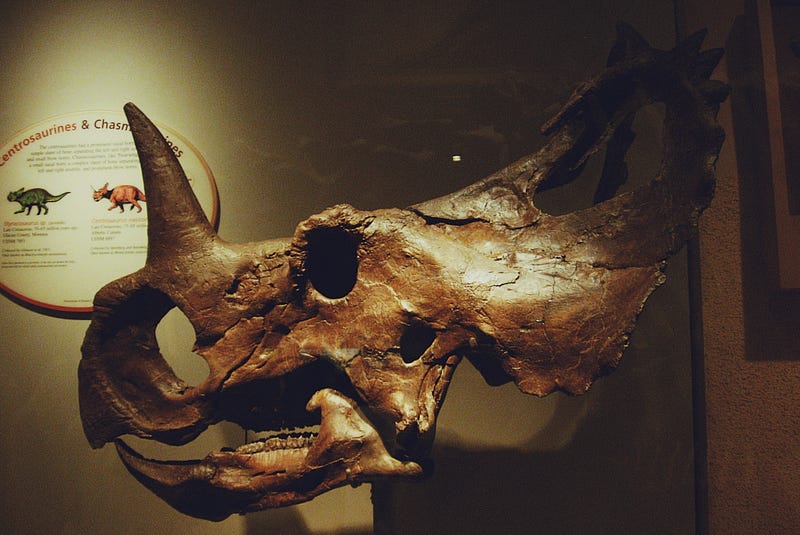
Skull of Centrosaurus, a relative of the newly discovered Menefeeceratops sealeyi / Flesh for Blood / Wikimedia Commons

A new mosasaur from Morocco

Also, this month scientists named a new species of mosasaur called Pluridens serpentis. Found in the Late Cretaceous rocks of Morocco, Pluridens was an interesting marine animal with a very specialized lifestyle.

Its small orbits indicate that rather than relying on vision, this mosasaur would use touch and chemoreception to locate and capture its prey. Since the jaws in some specimens are robust and sometimes show injuries, scientists suggest they may have been used for fighting over mates or territories. Paleontologists estimate that large individuals of this species may have reached up to 8 or 9 meters (26–29 ft) in length.

The discovery of Pluridens adds to the variety of Late Cretaceous mosasaurs and shows how these animals diversified right before the mass extinction event that eventually killed them off 66 million years ago.
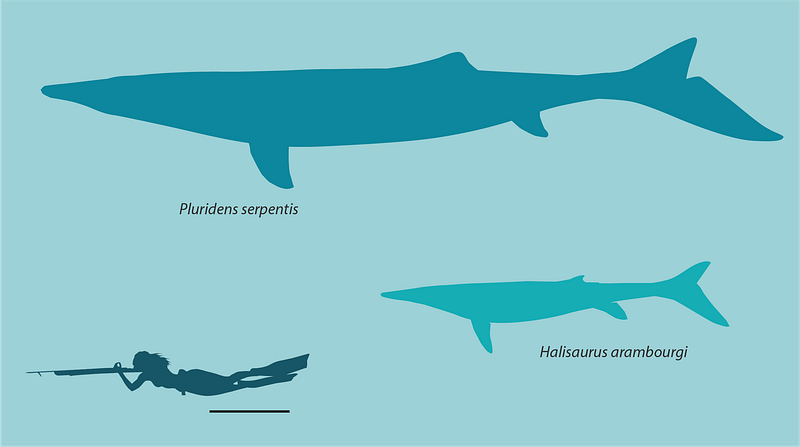
Pluridens shown to scale with Halisaurus arambourgi and Homo sapiens. Digital artwork by Nick Longrich / Wikimedia Commons

A new titanosaur from Brazil

A new titanosaur sauropod from Brazil has been described in May. Scientists had discovered the specimen back in 2011 in the Late Cretaceous rocks of the Adamantina Formation of São Paulo.

Paleontologists had originally classified it as a species of Aeolosaurus, a medium-sized long-necked titanosaur from South America. This month though and under closer examination, they separated the species into its own genus, calling it Arrudatitan maximus.

Arrudatitan was relatively gracile for a titanosaur and could stretch up to 15 meters (49 ft) when fully grown. It lived between 72 and 68 million years ago and shared its ecosystem with fellow-titanosaur genera like Gondwanatitan, Adamantisaurus, and Aeolosaurus.
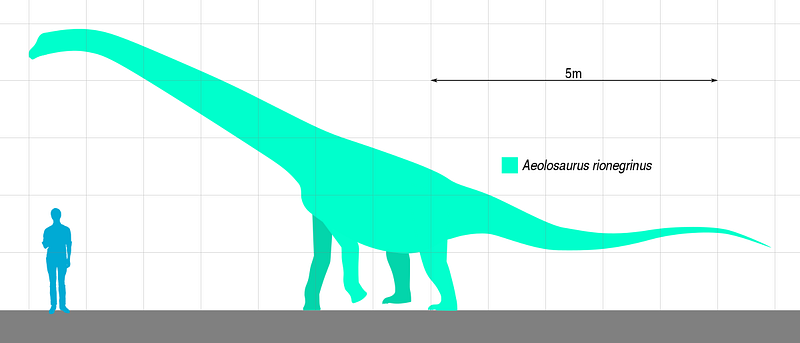
Scale of Aeolosaurus, the closest relative of Arrudatitan / Slate Weasel / Wikimedia Commons

Other mammals, not dinosaurs, held our ancestors back

A new study that challenges old assumptions about why modern mammals seemed to diversify only after the extinction of the non-avian dinosaurs was published this month.

Paleontologists traditionally thought that, before the extinction, mammals lived in the shadow of the dinosaurs. This supposedly prevented them from occupying the niches that were already occupied by the giant reptiles, keeping them relatively small and unspecialized in terms of diet and lifestyle.

The newest study led by researchers from the Oxford University Museum of Natural History, University of Oxford, and the University of Birmingham points to a more complex story of competition between distinct mammal groups. Scientists looked at the anatomy of all the different kinds of mammals living alongside dinosaurs, including the ancestors of modern placental and marsupial groups, also known as therians.

By measuring how frequently new features appeared, such as changes in the size and shape of their teeth and bones, and the pattern and timing of their appearance before and after the mass extinction, the researchers determined that the modern mammals were more constrained during the time of the dinosaurs than their close relatives.

This meant that while their relatives were exploring larger body sizes, different diets, and novel ways of life such as climbing and gliding, they were excluding modern mammals from these lifestyles, keeping them small and generalist in their habits.

“This result makes very little sense if you assume that it was the dinosaurs constraining the therians,” said Dr. Neil Brocklehurst of the University of Oxford, who led the research. “There is no reason why the dinosaurs would be selectively competing with just these mammals and allowing others to prosper. It instead appears that the therians were being held back by these other groups of mammals.”
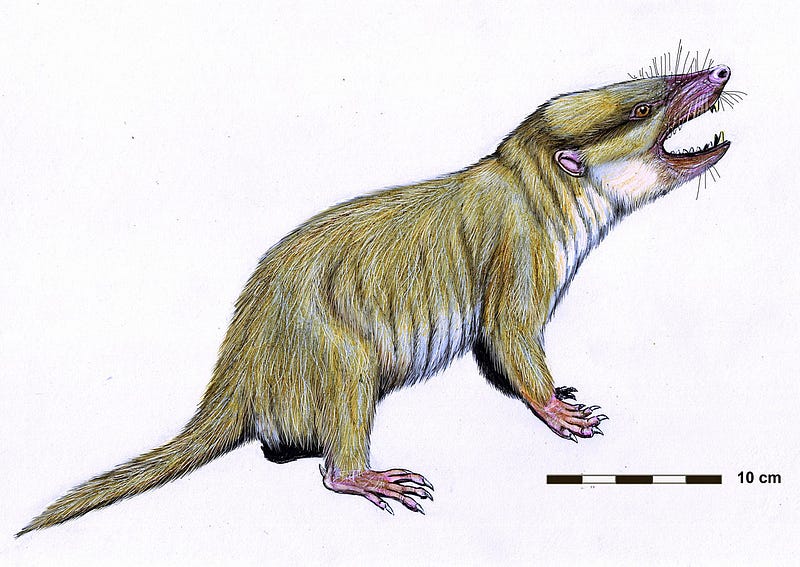
Gobiconodon, a non-therian Early Cretaceous mammal from Asia and North America. Animals like this likely prevented our ancestors from diversifying during the Mesozoic Era / DiBgd / Wikimedia Commons

A new genus of crested dinosaur found in Mexico

Also in May, a team of paleontologists has identified a new and interesting genus of a crested dinosaur from Mexico.

Named Tlatolophus galorum, the new dinosaur’s name comes from the word tlatolli, which means “word”, combined with Greek lophos (“crest”) due to the crest’s resemblance to the glyph “word” in Aztec iconography. The species is named after the Garza and López families for their collaboration in collecting and preserving the specimen.

Tlatolophus was a member of the duck-billed lambeosaurines, a group of crested hadrosaurs that flourished during the Late Cretaceous Period. This animal lived 72 million years ago and was closely related to the North American Parasaurolophus walkeri, a 10-meter-long (30ft) hadrosaur known for its large, elaborate cranial crest. Scientists estimate that Tlatolophus could have grown to similar proportions.

The discovery of Tlatolophus is extremely important as it is the most complete lambeosaurine known from Mexico.
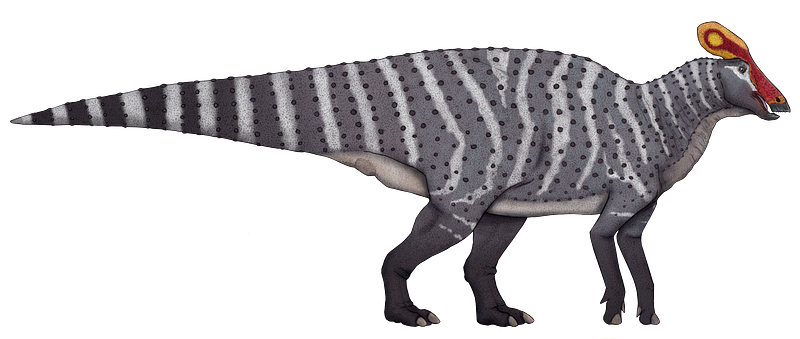
Life restoration of Tlatolophus by Joaquin Eng Ponce / Wikimedia Commons

Ancient mammal tracks discovered in aquatic environments

It was during this month that scientists also discovered in southern Wyoming the earliest evidence for the use of marine habitats by mammals.

Several five and four-toed fossil tracks that date from between 59 and 56 million years ago record animals repeatedly walking across submerged and partially emergent tidal flats. Hundreds of different tracks are preserved representing at least two species of mammals.

Scientists suggest the tracks made from the five-toed mammals might have belonged to the group of pantodons, a family of relatively large mammals that evolved during the Paleocene. The tracks with four toes might be evidence of previously undescribed large-bodied artiodactyls or taperoids. If so, these tracks could support the origin of the artiodactyls near the Cretaceous-Paleogene boundary.
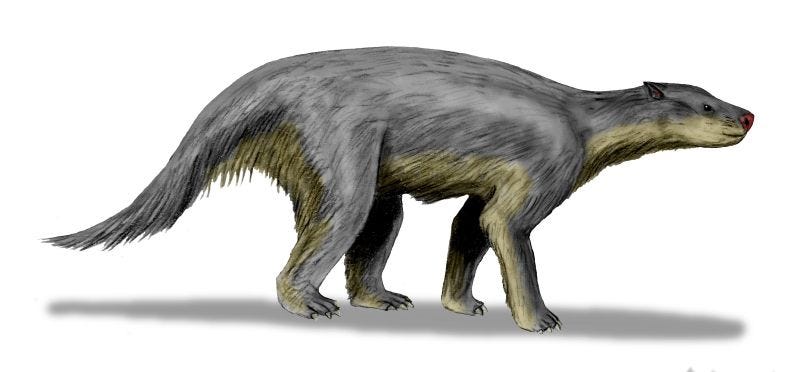
Barylambda, a pantodont from the Paleocene of North America / Nobu Tamura / Wikimedia Commons

South African sauropodomorph had irregular growth

A recent study lead by Dr. Kimberley Chapelle of the American Museum of Natural History in New York City and Honorary Research Fellow at the University of the Witwatersrand suggested that a famous South African dinosaur species had irregular growth patterns.

The study examined specimens of Massospondylus carinatus, a medium-sized sauropodomorph dinosaur that lived in the Early Jurassic Period, almost 200 million years ago. This dinosaur grew to around 4 meters (13 ft) in length and fed on plants like ferns.

By looking at its fossilized thigh bones under a microscope, researchers could count growth lines, like those of a tree, allowing them to study how much the individuals grew each year. By examining growth rings in the bones of the creature, Dr. Chapelle could show that its growth varied season-to-season, more like a tree than a human.

“These things were just all over the show,” said Chapelle. “One year, they might gain 100kg of body weight and the next year they’d only grow by 10kg!”

The study suggests that Massospondylus’ growth directly responded to its environmental conditions. In a good year with lots of rain and food, the species might race ahead, almost doubling their size. In a poor year where nutrients were scarce, it might hardly grow at all.
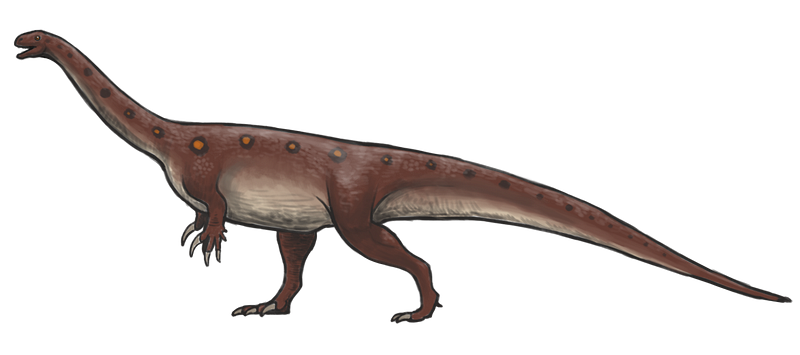
Life reconstruction of Massospondylus / Emily Willoughby / Wikimedia Commons

Prehistoric whale grew both teeth and baleen

Scientists from the San Diego State University and the San Diego Natural History Museum discovered that an evolutionary cousin of today’s baleen whales called Aetiocetus weltoni grew both teeth and baleen in its mouth.

The paleontologists examined the 25 million-year-old skull of the prehistoric whale and found grooves and holes on the roof of the animal’s mouth that connect internally with a vascular canal in a fashion consistent with the pattern of blood vessels that lead to baleen in modern whale genera.

Aetiocetus’s skull also revealed separate connections between the major internal canal and smaller canals that would have delivered blood to the upper teeth, which is consistent with the pattern of blood supply to teeth in living toothed whales such as sperm whales and killer whales, porpoises, dolphins, and terrestrial mammals.

“We have found evidence that supports a co-occurrence of teeth and baleen, indicating the tooth-to-baleen transition occurred in a stepwise manner from just teeth, to teeth and baleen, to only baleen,” lead study author Dr. Ekdale said.
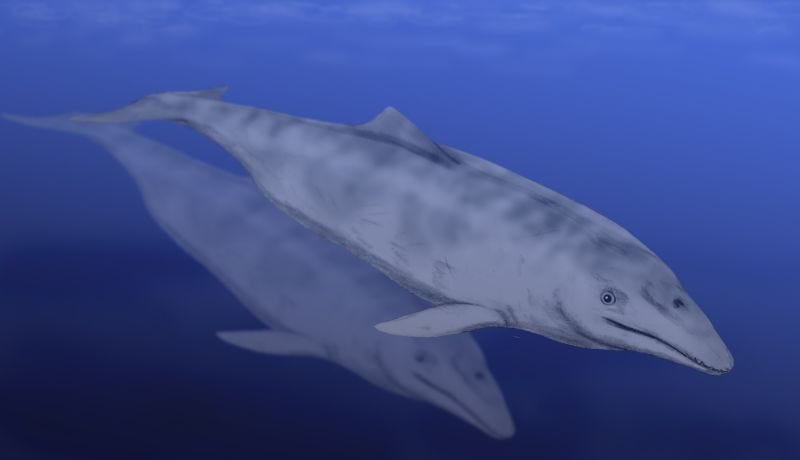
Life reconstruction of Aetiocetus by Nobu Tamura / Wikimedia Commons

A new species of dinosaur from the Australian outback?

And finally, for this month, a team of Australian paleontologists discovered the remains of what they suspect to be a brand-new species of herbivorous dinosaur buried in western Queensland.

“Most things found in Australia in terms of dinosaurs have a very good chance of being new to science because of the nature of how we’ve been separated from Gondwana and South America for so long,” said Robyn Mackenzie, director, and paleontologist of the Eromanga Natural History Museum.

The remains that have been recovered so far primarily consist of vertebrae, the bony components of the spine. However, scientists are optimistic about their chances of finding additional sections of the skeleton because they have only dug a meter (about 3.3 feet) down so far.

Based on preliminary observations of the bones, the team believes the dinosaur was likely a long-necked sauropod. The fossil dates from 95 million years ago, which makes the new find one of the geologically youngest dinosaurs to have ever been found in Australia.
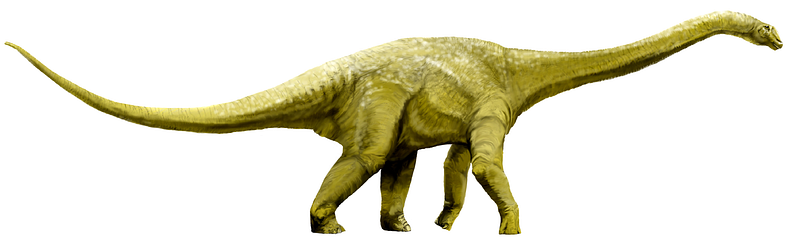
Life reconstruction of the Australian sauropod Wintonotitan by T. Tischler / Wikimedia Commons

Epilogue

To sum up, May was a remarkable month in the field of paleontology. Scientists learned more about the biology and behavior of a wide range of extinct animals and discovered exciting new species.

Hungry for more paleontology news? Check out the top discoveries from June below:

References

Jonah N. Choiniere, James M. Neenan, Lars Schmitz, David P. Ford, Kimberley E. J. Chapelle, Amy M. Balanoff, Justin S. Sipla, Justin A. Georgi, Stig A. Walsh, Mark A. Norell, Xing Xu, James M. Clark, Roger B. J. Benson, Evolution of vision and hearing modalities in theropod dinosaurs, Science 07 May 2021: Vol. 372, Issue 6542, pp. 610–613, DOI: 10.1126/science.abe7941

Orcutt, J.D., Calede, J.J. Quantitative Analyses of Feliform Humeri Reveal the Existence of a Very Large Cat in North America During the Miocene. J Mammal Evol (2021). https://doi.org/10.1007/s10914-021-09540-1

Gallagher T, Poole J, Schein JP. 2021. Evidence of integumentary scale diversity in the late Jurassic Sauropod Diplodocus sp. from the Mother’s Day Quarry, Montana. PeerJ 9:e11202 https://doi.org/10.7717/peerj.11202

Manuel Pérez-Pueyo, Eduardo Puértolas-Pascual, Miguel Moreno-Azanza, Penélope Cruzado-Caballero, José Manuel Gasca, Carmen Núñez-Lahuerta & José Ignacio Canudo (2021) First record of a giant bird (Ornithuromorpha) from the uppermost Maastrichtian of the Southern Pyrenees, northeast Spain, Journal of Vertebrate Paleontology, DOI: 10.1080/02724634.2021.1900210

Nicholas R. Longrich, Nathalie Bardet, Fatima Khaldoune, Oussama Khadiri Yazami, Nour-Eddine Jalil, Pluridens serpentis, a new mosasaurid (Mosasauridae: Halisaurinae) from the Maastrichtian of Morocco and implications for mosasaur diversity, Cretaceous Research, 2021, 104882, ISSN 0195–6671, https://doi.org/10.1016/j.cretres.2021.104882.

Santucci, R.M.; De Arruda-Campos, A.C. (2011). “A new sauropod (Macronaria, Titanosauria) from the Adamantina Formation, Bauru Group, Upper Cretaceous of Brazil and the phylogenetic relationships of Aeolosaurini”. Zootaxa. 3085 (1): 1. doi:10.11646/zootaxa.3085.1.1. ISSN 1175–5334

“Mammaliaform extinctions as a driver of the morphological radiation of Cenozoic mammals” by Neil Brocklehurst, Elsa Panciroli, Gemma Louise Benevento and Roger B.J. Benson, 17 May 2021, Current Biology. DOI: 10.1016/j.cub.2021.04.044

Wroblewski, A.FJ., Gulas-Wroblewski, B.E. Earliest evidence of marine habitat use by mammals. Sci Rep 11, 8846 (2021). https://doi.org/10.1038/s41598-021-88412-3

Ramírez-Velasco, Á. A.; Aguilar, F. J.; Hernández-Rivera, R.; Gudiño Maussán, J. L.; Rodriguez, M. L.; Alvarado-Ortega, J. (2021). “Tlatolophus galorum, gen. et sp. nov., a parasaurolophini dinosaur from the upper Campanian of the Cerro del Pueblo Formation, Coahuila, northern Mexico”. Cretaceous Research. in press: Article 104884. doi:10.1016/j.cretres.2021.104884

Dalman, Sebastian G.; Lucas, Spencer G.; Jasinki, Steven G.; Lichtig, Asher J.; Dodson, Peter (2021). “The oldest centrosaurine: a new ceratopsid dinosaur (Dinosauria: Ceratopsidae) from the Allison Member of the Menefee Formation (Upper Cretaceous, early Campanian), northwestern New Mexico, USA”. PalZ. doi:10.1007/s12542–021–00555-w

Kimberley E. J. Chapelle et al. Extreme growth plasticity in the early branching sauropodomorph Massospondylus carinatus, Biology Letters (2021). DOI: 10.1098/rsbl.2020.0843

Eric G Ekdale, Thomas A Deméré, Neurovascular evidence for a co-occurrence of teeth and baleen in an Oligocene mysticete and the transition to filter-feeding in baleen whales, Zoological Journal of the Linnean Society, 2021;, zlab017, https://doi.org/10.1093/zoolinnean/zlab017

Science
Paleontology
Discovery
Education
Recommended from ReadMedium