
Desert-living Dinosaur Was a Vicious Nocturnal Hunter
This bizarre creature had owl-like hearing abilities…
Dinosaurs have been traditionally portrayed as day-active animals. For many years this thought was partly stemmed from the lingering assumption they were cold-blooded creatures and therefore unable to maintain a high body temperature during the night.
Under this light, paleontologists often ignored the anatomical evidence that would suggest a different lifestyle and overlooked the examination of key sensory innovations — like the keen eyesight and hearing — some of these animals possessed. A recent study, however, came to challenge the aforementioned established views.
Lars Schmitz, an associate professor of biology at the W.M. Keck Science Center at Claremont McKenna, Pitzer, and Scripps colleges, collaborated with a team of international researchers to collect detailed information on the relative size of the eyes and inner ears of several bird and dinosaur species.
The results of the study suggested that at least one small and bizarre desert-living dinosaur was perfectly adapted for a nocturnal lifestyle.
The study
Researchers used CT scans and detailed measurements to collect information about 100 living birds and extinct dinosaur species. To measure hearing, they looked at the lagena, the organ that processes incoming sound information. To assess vision, the team measured the ring of bones that make up the eye socket. The larger the eye, the larger the pupil, which means more light can get in — enabling better night vision.
The study showed that many carnivorous dinosaurs including the all-time favorite Tyrannosaurus had vision optimized for the daytime and better-than-average hearing. However, a genus of a diminutive theropod dinosaur called Shuvuuia had not only extraordinary vision but also exceptional hearing.
‘Desert bird’
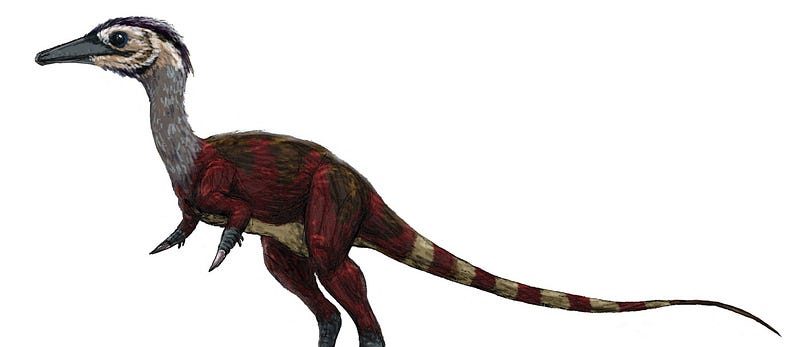
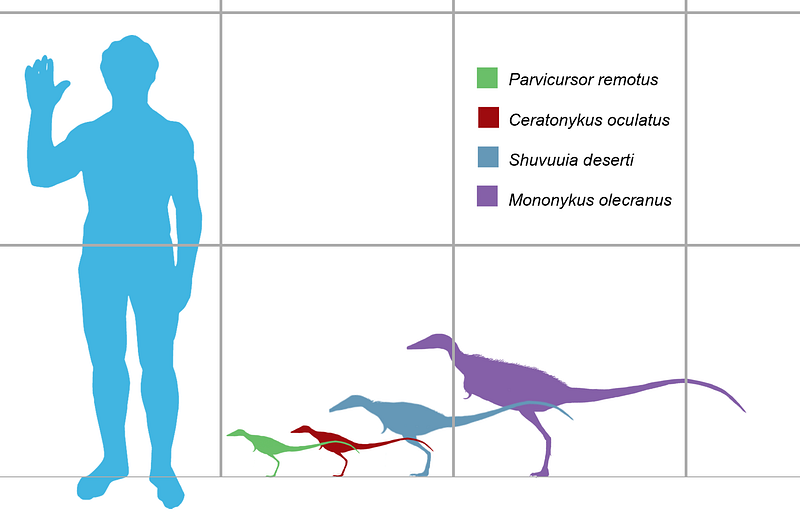
The name Shuvuuia is derived from the Mongolian word shuvuu (шувуу) meaning “bird” and its fossils have been discovered in the Late Cretaceous rocks of Mongolia. At only 60 cm (2 ft) in length, Shuvuuia was one of the smallest known non-avian dinosaurs. It was also among the most bizarre-looking.
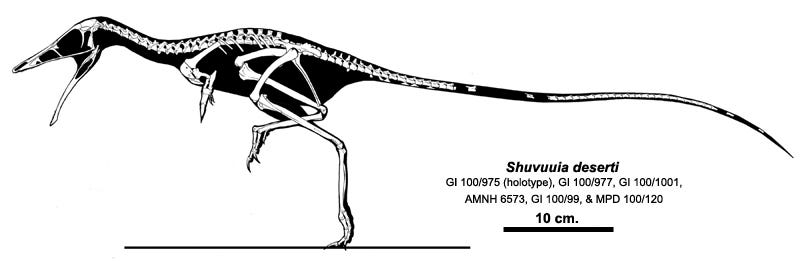
This creature had a fragile, bird-like skull; brawny, weightlifter arms with a single claw on each hand; and long, roadrunner-like legs. Shuvuuia was a member of the highly specialized group of small-bodied theropod dinosaurs known as alvarezsaurids.
Skeletons of these dinosaurs suggest they had massive breast and arm muscles, possibly adapted for digging or tearing. They had long, tube-shaped snouts filled with tiny teeth. Fossils attributed to alvarezsaurids have been found in North and South America and Asia, and range in age from about 86 to 66 million years ago.
Night hunter
Scientists found that Shuvuuia’s pupils were proportionally larger than any living bird or dinosaur. In addition, it possessed an extremely large lagena — almost identical in relative size to the barn owl. Barn owls have the longest lagena of any bird and can hunt in complete darkness using hearing alone.
These features suggest Shuvuuia was a highly specialized nocturnal hunter. According to the researchers, the animal’s remarkable vision and hearing were beneficial for life in the desert, where high temperatures discouraged daytime hunting.
“We think it would have stalked its prey — small mammals — at night when the temperatures were cooler,” Schmitz noted.
“Nocturnal activity, digging ability and long hind limbs are all features of animals that live in deserts today,” said study lead author Jonah Choiniere, a University of the Witwatersrand scientist. “But it’s surprising to see them all combined in a single dinosaur species that lived more than 65 million years ago.”
“This discovery is a great example of how evolution functions,” adds Schmitz. “It represents a solid understanding of how eyes and ears evolve in response to animals’ specific environments.”
“Like many paleontologists, I once considered that nighttime in the age of dinosaurs was when the mammals came out of hiding to avoid predation and competition. The importance of these findings is that it forces us to imagine dinosaurs like Shuvuuia evolving to take advantage of these nocturnal communities,” said Professor Jonah Choiniere of the University of the Witwatersrand in Johannesburg, South Africa.
Epilogue
The fact that the tiny Shuvuuia had adaptions that enabled it to hunt and thrive in the dark changes the conventional thinking about diurnal and nocturnal dinosaurs.
In addition, technological advances, like CT scanning, enable scientists to study not only in more detail the skeletons of extinct creatures but also examine parts of their anatomy previously overlooked.
The examination of the inner ear and bony eye rings of dinosaurs and their living descendants are opening new windows into the past and make up a remarkable step forward for paleontology.
Relevant Reads:
References
Jonah N. Choiniere, James M. Neenan, Lars Schmitz, David P. Ford, Kimberley E. J. Chapelle, Amy M. Balanoff, Justin S. Sipla, Justin A. Georgi, Stig A. Walsh, Mark A. Norell, Xing Xu, James M. Clark, Roger B. J. Benson, Evolution of vision and hearing modalities in theropod dinosaurs, Science 07 May 2021: Vol. 372, Issue 6542, pp. 610–613, DOI: 10.1126/science.abe7941
Michael Hanson, Eva A. Hoffman, Mark A. Norell, Bhart-Anjan S. Bhullar, The early origin of a birdlike inner ear and the evolution of dinosaurian movement and vocalization, Science 07 May 2021:Vol. 372, Issue 6542, pp. 601–609 DOI: 10.1126/science.abb4305


