
Hollywood Lied to You: This Is How the Real Jurassic World Would Have Looked Like
Meet the authentic dinosaurs of the Jurassic Period …
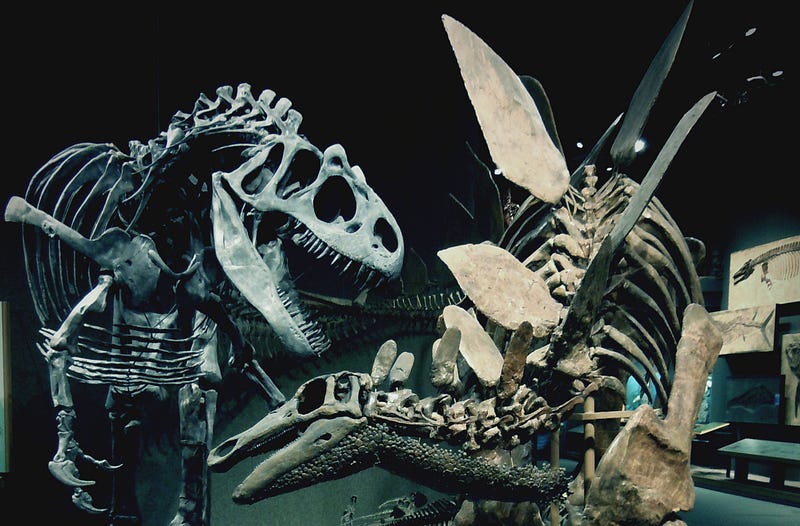
If you could somehow time travel 150,000,000 years ago you would find yourself in the Late Jurassic Period. During this time, dinosaurs dominated our planet.
Yet, you shouldn’t expect to stumble across a mighty T.rex, nor to lose yourself in a lush, tropical forest. Contrary to what depicts the famous Hollywood franchise, none of them existed during the Jurassic.
The Real Jurassic World
The climate back then was dry and the dominant flora included conifer trees, ginkgos, cycads, and tree ferns. Much of this vegetation was growing along the rivers which supported a great number of fish and amphibians. Terrestrial mini-fauna included various species of mammals, lizards, and turtles. Crocodiles were lurking across the streams, while pterosaurs were flying in the air.
Across this landscape, herds of gigantic sauropods, armored stegosaurs, and fast-moving ornithischians were constantly on the move, trying to find new feeding grounds and shelter. A plethora of predators, from cat-sized insectivores to bus-sized carnivores, hunted in the riparian forests.
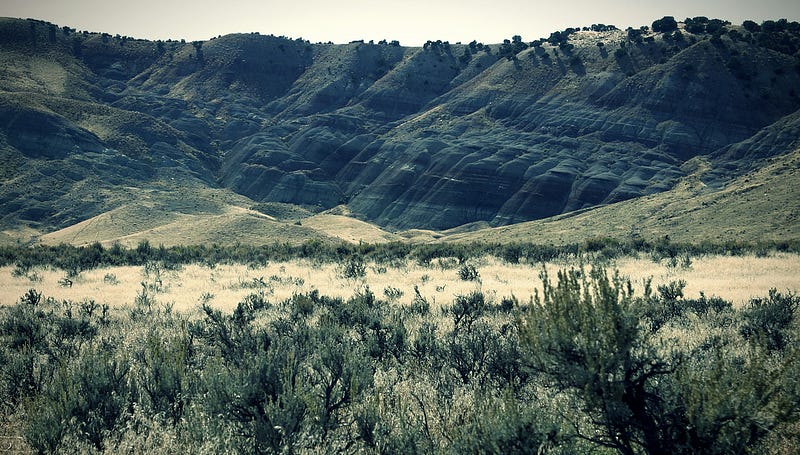
All this evidence comes from the study of the distinctive sequence of sedimentary rock known as the Morrison Formation. These quarries originate in the midwestern United States and form the most fertile source of dinosaur fossils in North America.
We will examine the great dino-fauna of the Morrison Formation in more detail below.
The Prey
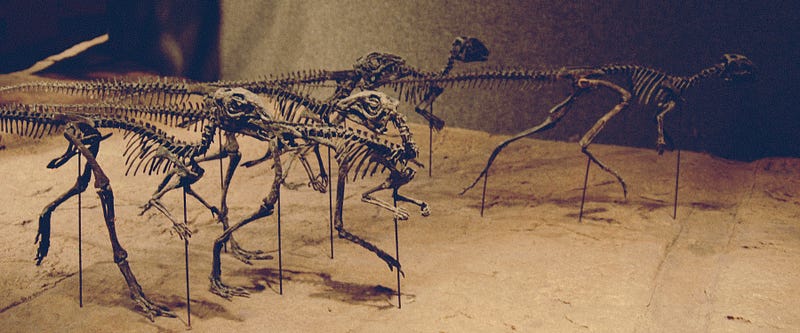
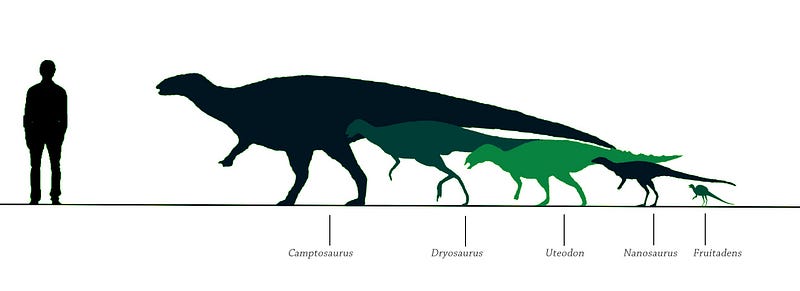
Although not the most common, the small to medium-sized neornithischian dinosaurs were an essential feature of the Morrison Formation ecosystem. They were bipedal and herbivorous, with the smallest forms being fast-runners. Notable species of this category include the early iguanodons Dryosaurus (2.4 to 4.3m/8 to 14 ft), and the somewhat larger Camptosaurus (6m/19.7 ft).
The Hunters
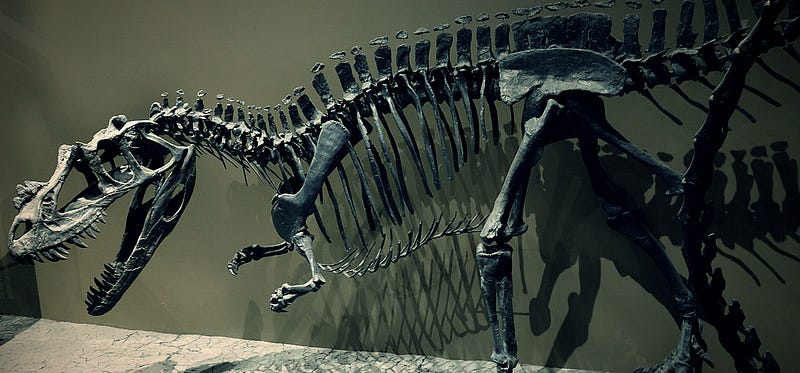
A great number of secondary predators roamed the Late Jurassic Morrison. The robust-build Ceratosaurus (6–7m/20–23 ft) could hunt down small to medium-sized prey, while the 89 centimeter-long (35 in) feathered Hesperornithoides would mostly feed on insects and small lizards. Morrison Formation was also the home of the primitive tyrannosaur Stokesosaurus. This agile 4 meter-long (13ft) predator possessed long front limbs, a feature gradually to be lost by its more advanced relatives.
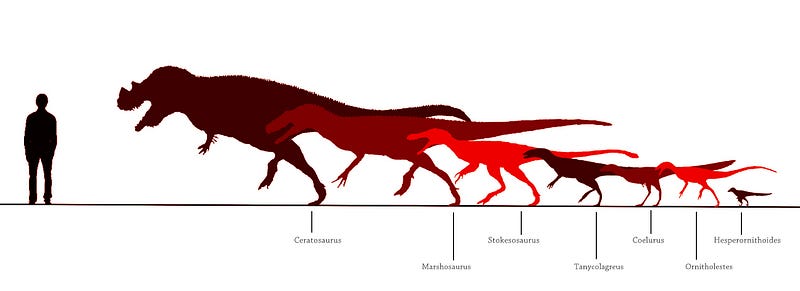
The Defenders
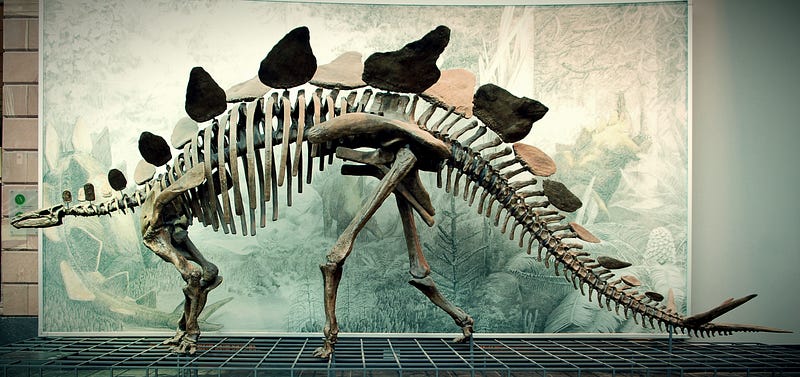
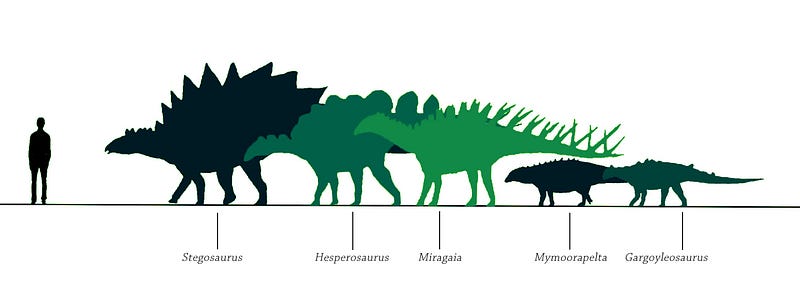
One of the most easily identifiable dinosaur genera, the plated Stegosaurus lived during the Upper Jurassic Morisson. The best-known species, Stegosaurus stenops reached lengths of 7m (23 ft), while other species could grow even larger [1].
Stegosaurus shared its environment with a bunch of other thyreophoran (armored) dinosaurs, including more genera of stegosaurids and primitive ankylosaurs. Those herbivores were slow-moving, low-browsers relying on their deadly thagomizers, their spikes, and body armor for defense.
The Giants
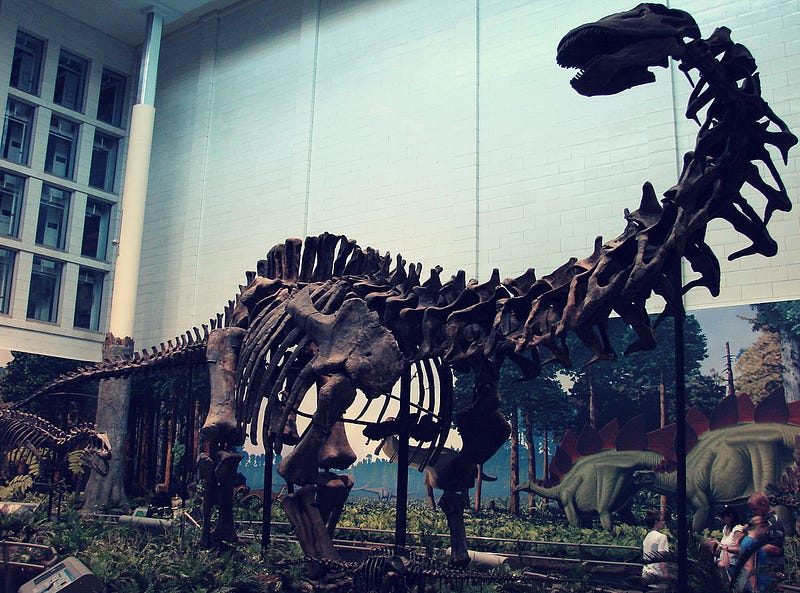
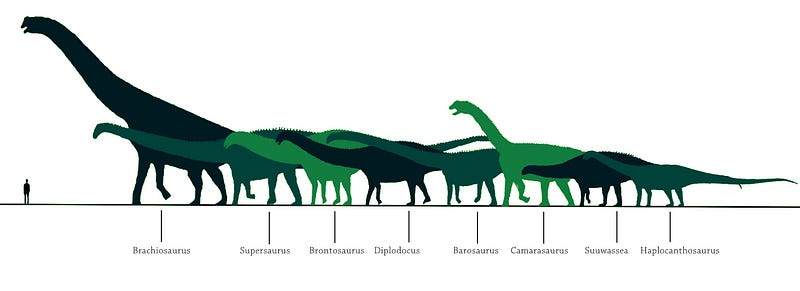
Probably the most iconic dinosaurs of the Jurassic Period were the long-necked sauropods. More than ten different genera from no less than five sauropod groups have been found in the Morrison Formation suggesting a great diversity of these giants during the Late Jurassic [2].
Most sauropod species would have been relatively immune to predation because of their massive size. Yet, juvenile, wounded, or sick individuals may have been potential targets for large predators.
Well-established names such as Brontosaurus (22m/72 ft), Diplodocus (24m/79 ft), and Brachiosaurus (21m/69 ft) were just a few of the many longnecks found in the area.
The ‘Top Dogs’
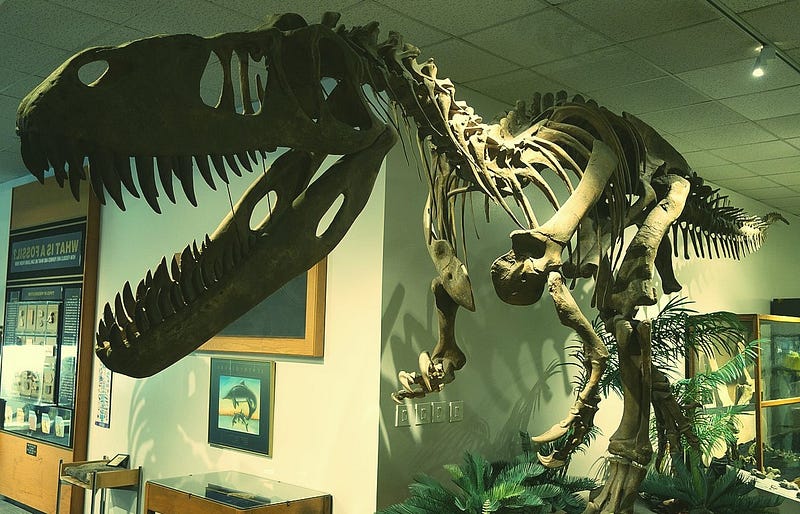
Contrary to Hollywood movies, the Jurassic was not an age ruled by the famous T.rex. That doesn’t mean that Morrison Formation was deprived of giant predatory dinosaurs; quite the opposite.
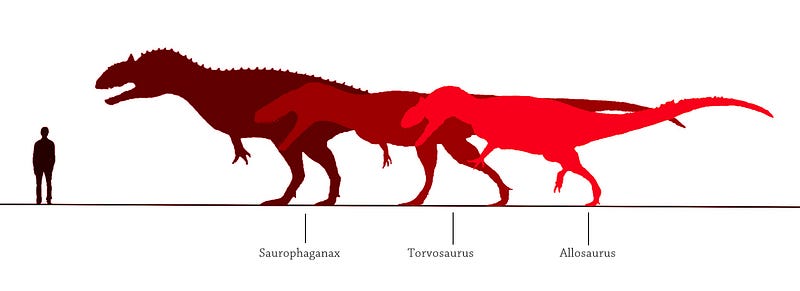
The most well-known large predator of the location was Allosaurus, a 9.5 meter-long (31 ft) theropod known from over 60 individuals. Larger still was Torvosaurus, a giant megalosaur measuring up to 11m (35 ft). The allosaurid Saurophaganax was also present in the area, yet less common than its more abundant relative, the Allosaurus [3]. According to some estimates, this giant carnivore could grow up to13 meters (43 ft).
These mega-theropods would have preyed upon well-defended thyreophorans, fast-moving ornithischians, or even giant sauropods.
Epilogue
Almost 85 million years before the evolution of Tyrannosaurus rex, some of the most famous and iconic dinosaurs roamed our planet: Stegosaurus, Allosaurus, Brontosaurus, and Diplodocus are household names in dino-folklore with heavy impressions on popular culture. They all thrived in the rich, upper Jurassic ecosystem of the Morrison Formation some 150 million years ago.
The Morrison Formation fully encapsulated the wonder of the age of dinosaurs. It would not be an exaggeration to proclaim this actual Jurassic World as even more majestic than the one we believe from popular culture.
Notes
[1] At 9m (29.5 ft), S.ungulatus was the longest species within the genus Stegosaurus. It might be synonymous with S. stenops.
[2] The official number of Morrison Formation sauropods is yet to be concluded, but it could contain the following species:
Haplocanthosaurids: Haplocanthosaurus
Rebbachisaurids: Maraapunisaurus
Dicraeosaurids: Dyslocosaurus, Suuwassea
Diplodocids: Amphicoelias, Apatosaurus, Brontosaurus, Diplodocus, Supersaurus, Barosaurus, Kaatedocus
Macronarians: Brachiosaurus, Camarasaurus, Cathetosaurus
In the resource-limited Morrison Formation, the wide sauropod diversity may seem strange considering the fact that the amount of food required to support these multi-tonne giants would have been incredible. Yet, it can be explained through the process of sophisticated resource partitioning. In other words, these creatures did not directly compete for the same food resources, and as a result, the ecosystem could support a large number of them.
[3] Some paleontologists consider Saurophaganax to be a junior synonym and species of Allosaurus (as A. maximus). Others consider it to be a basal carcharadontosaurid.
Relevant Reads:
References
D. J. Button, E.J. Rayfield, P M. Barrett (2014), “Cranial biomechanics underpins high sauropod diversity in resource-poor environments”, NCBI
Harris, J.D., and Dodson, P. (2004). “A new diplodocoid sauropod dinosaur from the Upper Jurassic Morrison Formation of Montana, USA.” Acta Palaeontologica Polonica 49 (2): 197–210.
“Dinosaur distribution (Late Jurassic; North America; Wyoming).” Weishampel, et al. (2004). Pg. 545.
Galton, Peter M. & Carpenter, Kenneth, 2016, “The plated dinosaur Stegosaurus longispinus Gilmore, 1914 (Dinosauria: Ornithischia; Upper Jurassic, western USA), type species of Alcovasaurus n. gen.”, Neues Jahrbuch für Geologie und Paläontologie — Abhandlungen 279(2): 185–208
Jurassic Knights: The Ankylosaur Dinosaurs; Mymoorapelta maysi,” Foster (2007) pp. 215–216
Lucas S, Herne M, Heckert A, Hunt A, and Sullivan R. Reappraisal of Seismosaurus, A Late Jurassic Sauropod Dinosaur from New Mexico. The Geological Society of America, 2004 Denver Annual Meeting (7–10 November 2004). Retrieved on 2007–05–24.
Galton, P.M. (2010). “Species of plated dinosaur Stegosaurus (Morrison Formation, Late Jurassic) of western USA: new type species designation needed”. Swiss Journal of Geosciences 103 (2): 187–198.
Paul G.S.,(2010), Dinosaurs A Field Guide, A&C Black Publishers Ltd


