
Mesozoic Quick Fact Series:
Brontosaurus & Its Kin: The Iconic Giants of the Jurassic
Meet some of the longest creatures to have ever walked the Earth…
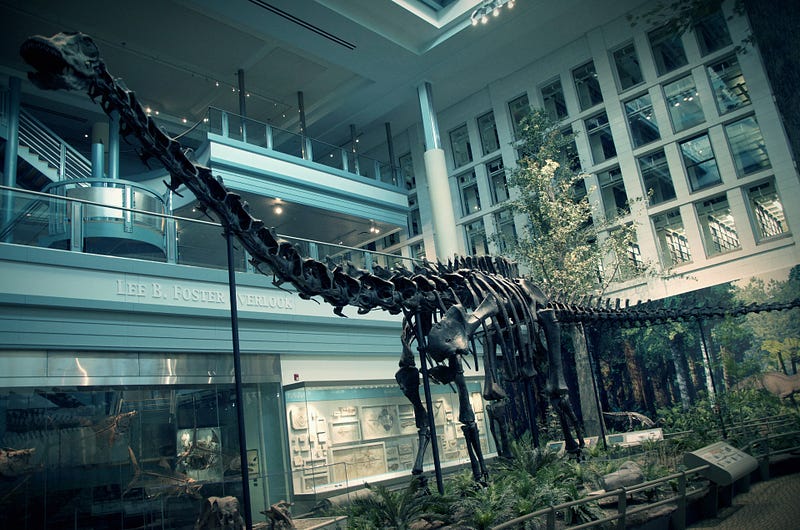
Mesozoic Quick Fact Series (MQFS) aims to provide interesting facts about various groups of extinct animals in a fun and readable way. We will focus on the highlights, so you don’t need to read extensive, time-consuming texts!
In this article, we will take a quick overview of the Diplodocidae, a group of iconic sauropods that flourished during the latter part of the Jurassic Period.
Let’s jump right through!
Starting with the basics…
The family is named after the genus Diplodocus. The animal’s generic name is a neo-Latin term derived from Greek diplós meaning ‘double’ and dokós meaning ‘beam’, regarding the double-beamed chevron bones in the animal’s underside of the tail.
Cladistically the group is divided into two subfamilies: the Diplodocinae which includes all dipolodocids more closely related to Diplodocus and the Apatosaurinae which includes the various species of the genera Apatosaurus and Brontosaurus.
When did they live?
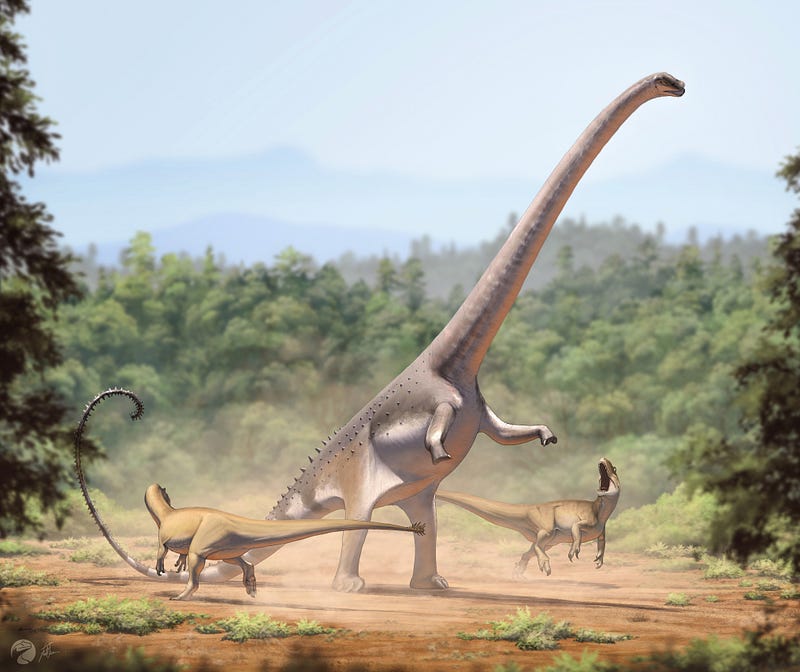
The Diplodocidae flourished during the Upper Jurassic Period, between 155 and 145 million years ago. While most genera had died out by 144 million years ago, at least one member of the group- Leinkupal laticauda, survived to the Early Cretaceous, some eight million years later.
…and where?
Most genera are known from North America and were part of the rich ecosystem of the famous Morrison Formation. However, there were species inhabiting Africa, Europe, and South America as well. Their presence in both the Laurasia and the Gondwana, the ancient supercontinents of the Mesozoic world, demonstrates that diplodocids were quite widespread.
How large were they?
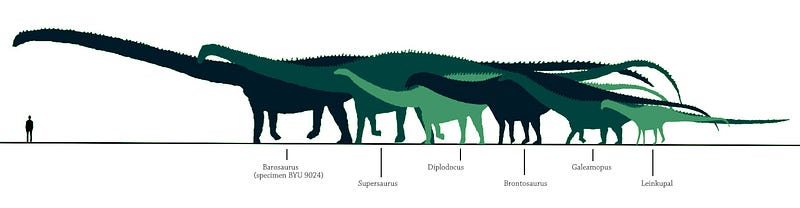
The family includes some of the longest creatures ever to walk the Earth. While they were massive, they were relatively slender when compared to the titanosaurs and brachiosaurids, two families of equally gigantic sauropods.
An isolated, enormous vertebra of Barosaurus lentus(specimen BYU 9024) is estimated to belong to an animal measuring 45 meters (148 ft) in length and 60 tons (66 short tons) in weight, making it one of the largest organisms to ever walk the planet.
Supersaurus vivianae, a diplodocid found in both North America and Europe, is among the largest dinosaurs known from good remains. It may have reached 33–34 meters (108–112 ft) in length, and a weight of 31.8–36.3 metric tons (35.1–40.0 short tons).
The more common Diplodocus carnegii had a total length of 24 meters (79 ft), while the famous Brontosaurus excelsus measured up to 22m (72 ft) long from head to tail.
Any cool names?
The coolest names in diplodocids are the ones that echo their gargantuan size. A familiar example is Brontosaurus, which translates to “thunder lizard”.
A species of Diplodocus, D. hallorum was once considered its own genus and was given the name Seismosaurus, meaning the “earthquake lizard”! Unfortunately, this cool name is not really in use anymore.
Apatosaurus translates to “deceptive lizard”, a somewhat ironic name considering the confusing story between this genus and the closely related Brontosaurus. The giant Supersaurus, the “super lizard”, has undoubtedly an interesting name too.
In popular culture:
The confusion between Apatosaurus and Brontosaurus as to whether they were the same genus or not resulted in the two dinosaurs appearing interchangeably as one another in popular culture.
These animals are the most recognizable diplodocids and have been often depicted in cinema, beginning with Winsor McCay’s 1914 classic Gertie the Dinosaur. Films such as The Lost World (1925), the Baby: Secret of the Lost Legend (1985), the Jurassic World (2015), the Good Dinosaur (2015), and Jurassic World: Fallen Kingdom (2018) are some of the most famous depictions of Brontosaurus/Apatosaurus in the silver screen.
The first-ever mounted skeleton of a sauropod dinosaur was that of an Apatosaurus wrongly referred to as a Brontosaurus. The skeleton (specimen FMNH P25112) was put on public display in the American Museum of Natural History in 1905.
Apatosaurus is the only sauropod featured in Michael Crichton’s famous novels, Jurassic Park (1989) and the Lost World (1995).
The Sinclair Oil Corporation has a green dinosaur logo and mascot based on Brontosaurus.
Did you know…?
. Some scientists proposed that the tail of diplodocids could have reached supersonic speeds, “producing a noise analogous to the ‘crack’ of a bullwhip”. The theory suggested that these dinosaurs may have supersonically whipped their enormous tails for purposes of defense, communication, same-species rivalry, or courtship. While interesting, this theory is not accepted by the majority of the scientific community.
Relevant Reads:
References
Paul G.S.,(2010), Dinosaurs A Field Guide, A&C Black Publishers Ltd
Brusatte S., (2018), “The Rise and Fall of the Dinosaurs: A New History of a Lost World”, William Morrow.
Lovelace, David M.; Hartman, Scott A.; Wahl, William R. (2007). “Morphology of a specimen of Supersaurus (Dinosauria, Sauropoda) from the Morrison Formation of Wyoming, and a re-evaluation of diplodocid phylogeny”. Arquivos do Museu Nacional. 65 (4): 527–544.
Knoll, F.; Galton, P.M.; López-Antoñanzas, R. (2006). “Paleoneurological evidence against a proboscis in the sauropod dinosaur Diplodocus”. Geobios. 39 (2): 215–221. doi:10.1016/j.geobios.2004.11.005
Myhrvold, Nathan P. (1997). “Supersonic sauropods? Tail dynamics in the diplodocids”. Paleobiology. 23 (4): 393–409.
Whitlock, J.A. (2011). “A phylogenetic analysis of Diplodocoidea (Saurischia: Sauropoda)”. Zoological Journal of the Linnean Society. 161: 872–915. doi:10.1111/j.1096–3642.2010.00665.
Geggel L. (2015), Dinosaur’s Tail Whips Could Have Cracked Sound Barrier, Live Science, Link: https://www.livescience.com/52538-supersonic-sauropods.html


