
MESOZOIC QUICK FACT SERIES:
Abelisauridae: The Rulers of the Cretaceous South
Meet the Abelisauridae, the theropods with spectacular cranial ornamentation, and strongly reduced forelimbs…
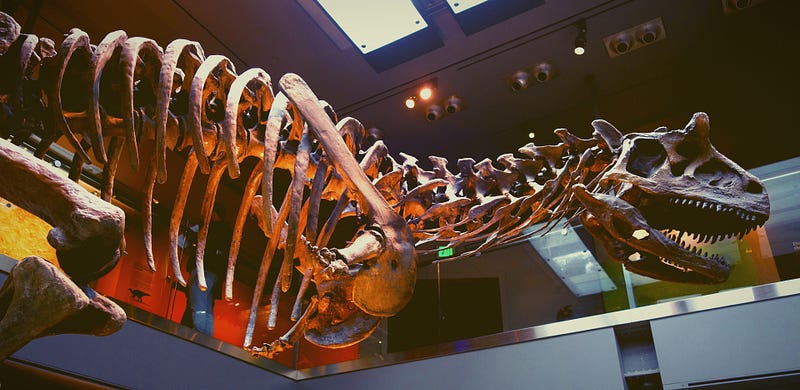
Mesozoic Quick Fact Series (MQFS) aims to provide interesting facts about various groups of extinct animals in a fun and readable way. We will focus on the highlights, so you don’t need to read extensive, time-consuming texts!
In this article, we will take a quick overview of the Abelisauridae, a group of carnivorous dinosaurs that ruled the Southern Hemisphere during the final stages of the Mesozoic Era.
Let’s jump right through!
Starting with the basics…
Abelisauridae literally means “Abel’s Lizards”, in honor of Roberto Abel who discovered the first genus of the family, Abelisaurus comahuensis.
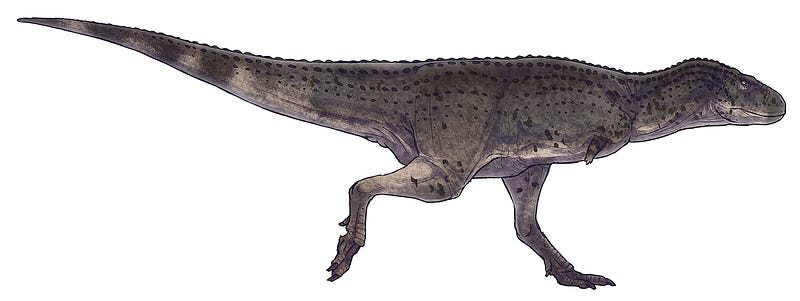
They were of ceratosaurian origin, meaning that they shared a more recent common ancestry with the famous Jurassic predator Ceratosaurus than with birds. Abelisaurids are characterized by the extensive ornamentation of their skull bones, which could bore horns, grooves, and pits.
When did they live?
Their origins date back to the Middle Jurassic Period, roughly 163 million years ago. The group went extinct 66 million years ago, along with the rest of non-avian dinosaurs during the Cretaceous-Paleogene Mass Extinction.
…and where?
Abelisaurid remains are most commonly found in South America, Africa, India, and Madagascar. Arcovenator escotae from France is the only definite member of the family discovered in Europe. Isolated teeth dating from Late Jurassic Portugal may also belong to an abelisaurid.
How large were they?
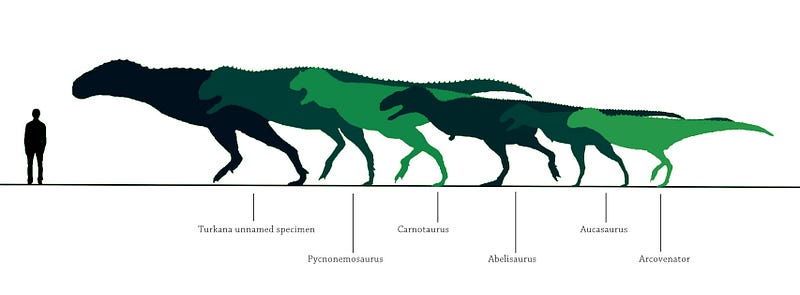
Most abelisaurids were medium-sized predators, measuring between 5 and 9 meters (17 to 30 ft) in length.
Pycnonemosaurus nevesi from Brasil currently holds the title of the largest officially described member of the family. It was between 8.9–9.3 meters (29.2 -30.5 feet)long and weighed an estimated 3.6 tonnes.
There’s also an abelisaurid specimen from Kenya which is thought to be even larger, reaching a possible length of 11–12 m (36 to 39 ft). This species has yet to be named.
Any cool names?
Carnotaurus bore two thick horns above the eyes and its name translates to “meat-eating bull”. Now that’s a cool name!
In addition, an abelisaurid found recently in Brasil has been named after the Marvel supervillain Thanos. Inspired by the Avengers franchise paleontologists Rafael Delcourt and Fabiano Vidoi Iori named their new discovery Thanos simonattoi.
In popular culture:
Carnotaurus is the abelisaurid featured most prominently in popular culture.
In Michael Crichton’s novel The Lost World (1995) the animal is given chameleon-like camouflaging abilities. The author used this fictional trait to set up some really suspenseful scenes.
Carnotaurus was also the main antagonist in Walt Disney’s film Dinosaur which was released in 2000. Unfortunately, its depiction was fairly inaccurate as the creature looked more like a tyrannosaur than anything else.
A more accurate representation of Carnotaurus took place in 2018 when the animal was introduced in Jurassic World: Fallen Kingdom. Carnotaurus was briefly featured in a couple of scenes.
Did you know…?
. Most advanced abelisaurids had vestigial front limbs that bore no wrist bones. Out of the four digits, only the second and the third had finger bones which were extremely short and immobile. The arms of T.rex would look large by comparison!
. Before the family was widely established, scientists sometimes interpreted fragmentary abelisaurid remains as possible South American tyrannosaurs. Those two families of theropod dinosaurs were the dominant predators of their ecosystems during the final chapters of the Cretaceous Period. Yet, they didn’t overlap, since abelisaurids were flourishing in the southern continents, while the tyrannosaurs are so far found exclusively in the Northern Hemisphere.
References
Paul G.S.,(2010), Dinosaurs A Field Guide, A&C Black Publishers Ltd
Brusatte S., (2018), “The Rise and Fall of the Dinosaurs: A New History of a Lost World”, William Morrow.
Tykoski, R.S. & Rowe, T. (2004). “Ceratosauria”. In: Weishampel, D.B., Dodson, P., & Osmolska, H. (Eds.) The Dinosauria (2nd edition). Berkeley: University of California Press. Pp. 47–70 ISBN 0–520–24209–2
Agnolin, Federico L.; Chiarelli, Pablo (2009). “The position of the claws in Noasauridae (Dinosauria: Abelisauroidea) and its implications for abelisauroid manus evolution”. Paläontologische Zeitschrift. 84 (2): 293. doi:10.1007/s12542–009–0044–2.
Tortosa, Thierry; Buffetaut, Eric; Vialle, Nicolas; Dutour, Yves; Turini, Eric; Cheylan, Gilles (2014). “A new abelisaurid dinosaur from the Late Cretaceous of southern France: Palaeobiogeographical implications”. Annales de Paléontologie. 100: 63–86.
Sereno, P.C. (2005). Abelisauridae Archived 2007–10–23 at the Wayback Machine. TaxonSearch. 7 November 2005. Retrieved 19 September 2006.
October/November 2013, Abstracts Of Papers, 73rd Annual Meeting” (PDF). Society of Vertebrate Paleontology. 2013. Archived from the original (PDF) on 2013–10–29. Retrieved 2013–10–27.


