avatarPanos Grigorakakis

Free AI web copilot to create summaries, insights and extended knowledge, download it at here

6595

Abstract

edator in its ecosystem.</p><p id="c98d">Giganotosaurus<a href="https://readmedium.com/jurassic-world-dominion-introduces-new-terrifying-dinosaur-fdc3c984d251"> is also set to appear in the upcoming Jurassic World movie</a> which will hit theaters June 10, 2022.</p><figure id="1c2f"><img src="https://cdn-images-1.readmedium.com/v2/resize:fit:800/1*Rc0hpjPAmkRn0mKS2UWM-Q.png"><figcaption>Giganotosaurus size comparison by KoprX / <a href="https://commons.wikimedia.org/wiki/File:Giganotosaurus_specimens.svg">Wikimedia Commons</a></figcaption></figure><h1 id="9cc1">Mapusaurus rosae</h1><figure id="1612"><img src="https://cdn-images-1.readmedium.com/v2/resize:fit:800/1*TgLHYdiL4c9I-wO3BRozBQ.jpeg"><figcaption>Mapusaurus skeleton / Kabacchi/ <a href="https://commons.wikimedia.org/wiki/File:Mapusaurus.jpg">Wikimedia Commons</a></figcaption></figure><p id="a108">Mapusaurus was another giant theropod from South America. This carnivore was roughly similar in appearance to its close relative Giganotosaurus. The largest known individuals of this species were between 11.5 meters (38 ft) to 12.6 meters (41 ft) long and weighed between 3 metric tons (3.3 short tons) to 5 metric tons (5.5 short tons).</p><p id="affa">The fossil remains of Mapusaurus were discovered in a bone bed containing at least seven individuals of various growth stages. The discovery led some scientists to suggest that this predator -and possibly its closest relatives- could live and hunt in deadly gangs.</p><p id="eb53">Mapusaurus lived between 97 and 93 million years ago in modern-day Argentina and shared its environment with the giant sauropod Argentinosaurus, one of the largest dinosaurs known so far.</p><figure id="13fc"><img src="https://cdn-images-1.readmedium.com/v2/resize:fit:800/1*qp5O_sy8XFxpkAhqLF8nVA.png"><figcaption>Mapusaurus size comparison by Slate Weasel / <a href="https://commons.wikimedia.org/wiki/File:Mapusaurus_Scale.svg">Wikimedia Commons</a></figcaption></figure><h1 id="7f51">Saurophaganax maximus</h1><figure id="cb12"><img src="https://cdn-images-1.readmedium.com/v2/resize:fit:800/1*GD8506ej7YFy4yhtbXJIug.jpeg"><figcaption>Saurophaganax skeleton mount / Chris Dodds / <a href="https://commons.wikimedia.org/wiki/File:Saurophaganax.jpg">Wikimedia Commons</a></figcaption></figure><p id="920c">The name Saurophaganax translates to “lord of lizard-eaters”. With such an incredibly cool name, it takes no effort to realize that this animal was a veritable beast. This dinosaur’s identity is still a matter of dispute.</p><p id="af5c">While some paleontologists describe Saurophaganax as its own genus, others consider it to be <a href="https://readmedium.com/was-this-iconic-jurassic-dinosaur-a-scavenger-after-all-e0fce5571eac">a junior synonym and species of Allosaurus</a> (as A. maximus). Some scientists even classify it as a basal carcharadontosaurid. Whichever the case, this carnivore was truly fearsome: it had an estimated length between 10.5 meters (34 ft) and 13 meters (43 ft) and was the largest predator of its environment.</p><p id="d474">Saurophaganax remains are known from the<a href="https://readmedium.com/hollywood-lied-to-you-this-is-how-the-real-jurassic-world-would-have-looked-like-8baabc71cb39"> Jurassic rocks of the Morrison Formation, the most fertile source of dinosaur fossils in North America</a>. This enormous predator lived 150 million years ago and shared its ecosystem with the popular armored dinosaur Stegosaurus and the famous long-necked sauropods <a href="https://readmedium.com/the-dinosaur-that-went-extinct-twice-fead96094704">Brontosaurus </a>and Diplodocus.</p><figure id="5cf3"><img src="https://cdn-images-1.readmedium.com/v2/resize:fit:800/1*pKtk8-NllqhvNp5ds9GNNQ.png"><figcaption>Saurophaganax size comparison by Slate Weasel / <a href="https://commons.wikimedia.org/wiki/File:Saurophaganax_Scale.svg">Wikimedia Commons</a></figcaption></figure><h1 id="9f6e">Spinosaurus aegyptiacus</h1><figure id="7ad1"><img src="https://cdn-images-1.readmedium.com/v2/resize:fit:800/1*L0zHaw4JL5z62QjrM3ZlGw.jpeg"><figcaption>Spinosaurus skeleton / Mike Bowler / <a href="https://commons.wikimedia.org/wiki/File:Spinosaurus_swimming.jpg">Wikimedia Commons</a></figcaption></figure><p id="9528">Perhaps the most bizarre theropod dinosaur on the list is <a href="https://readmedium.com/the-ever-changing-image-of-the-worlds-largest-predatory-dinosaur-789638fe40db">Spinosaurus</a>.</p><p id="a872">This aberrant creature had a skull similar to that of a modern crocodilian and bore straight conical teeth with no serrations. Its most prominent feature was its tall neural spines, some of which grew to at least 1.65 meters (5.4 ft) long and formed a unique sail-like structure on its back. Its large tail fin and its distinct center of gravity were adaptations that enabled it to swim better than any other giant theropod dinosaur. This creature could grow up to ≈14 meters (49 ft) and had a body mass of 4 metric tons (4.4 short tons).</p><p id="1769">Evidence shows the diet of Spinosaurus consisted mainly, but not exclusively, of fish. Scientists believe it hunted like a modern-day heron or stork — wading into the water and sticking part of its head underwater as it fished for prey. It must also have opportunistically hunted on land for terrestrial animals.</p><p id="b02c">Spinosaurus lived between 99 and 93.5 million years ago in what is now North Africa. It shared its environment with the giant theropod Carcharodontosaurus.</p><figure id="2365"><img src="https://cdn-images-1.readmedium.com/v2/resize:fit:800/1*FXKpJuCBovYYmzv7Yjei0A.png"><figcaption>Spinosaurus size comparison by KoprX / <a href="https://commons.wikimedia.org/wiki/File:Spinosaurus_size_comparison.svg">Wikimedia Commons</a></figcaption></figure><h1 id="f752">Tyrannotian chubutensis</h1><figure id="7018"><img src="https://cdn-images-1.readmedium.com/v2/resize:fit:800/1*24rgOtCWRW_1wwcaL8jhFQ.jpeg"><figcaption>Tyrannotitan skeleton / Tecnópolis Argentina /<a href="https://commons.wikimedia.org/wiki/File:Dinosaurios_los_gigantes_argentinos.jpg"> Wikimedia Commons</a></figcaption></figure><p id="e12e">Tyrannotitan is the oldest of the giant carcharodontosaurids found on the Southern Hemisphere, predating Carcharodontosaurus, Giganotosaurus, and Mapusaurus by a few million years. This predator was contemporary to the more basal Acrocanthosaurus from North America.</p><p id="86bb">Tyrannotitan had a roughly similar appearance to its equally terrifying cousins. Contrary to them, its teeth were thicker, while its spine was curved in a fashion similar to

Options

tyrannosaurs. It also had a relatively long and powerful tail. The overall length of this animal has been estimated at up to 11.4–12.2 meters (37–40 ft), and its weight between 4.9 and 7 tonnes (5.4 and 7.7 short tons).</p><p id="806e">The ‘tyrant titan’ lived during the latest part of the Early Cretaceous Period in Argentina and shared its environment with giant sauropod dinosaurs such as Chubutisaurus and Patagotitan.</p><figure id="8794"><img src="https://cdn-images-1.readmedium.com/v2/resize:fit:800/1*I9mnF4r02GoxARgEQ64VQA.png"><figcaption>Tyrannotitan size comparison by Slate Weasel / <a href="https://commons.wikimedia.org/wiki/File:Tyrannotitan_Scale.svg">Wikimedia Commons</a></figcaption></figure><h1 id="70c8">Zhuchengtyrannus magnus</h1><figure id="c086"><img src="https://cdn-images-1.readmedium.com/v2/resize:fit:800/1*VLh-OvmSh2OACriKnjgvFg.jpeg"><figcaption>Zhuchengtyrannus mount / Kumiko / <a href="https://commons.wikimedia.org/wiki/File:Zhuchengtyrannus_mount.jpg">Wikimedia Commons</a></figcaption></figure><p id="71fb">Zhuchengtyrannus is an overlooked giant tyrannosaur appearing just a few million years prior to Tyrannosaurus.</p><p id="de77">This predator lived in China 75 million years ago and looked incredibly similar to its more famous cousin: it had a deep skull, a powerful bite, and short forelimbs ending in two functional digits. Zhuchengtyrannus is estimated to have been 10–12 meters (33–39 ft) in length and up to 6 short tons (5.4 t) in weight.</p><p id="3bda">This Asian equivalent of T.rex, most probably preyed upon the ceratopsian Sinoceratops and the giant hadrosaurid Shantungosaurus which were found in the same rock formations.</p><figure id="2bf3"><img src="https://cdn-images-1.readmedium.com/v2/resize:fit:800/1*cgZM-9zQiX-E2KvnIXuvOA.png"><figcaption>Zhuchengtyrannus size comparison by PaleoNeolitic / <a href="https://commons.wikimedia.org/wiki/File:Zhuchengtyrannus_size.png">Wikimedia Commons</a></figcaption></figure><h1 id="8b03">Epilogue</h1><p id="e7c3">Tyrannosaurus was by no means the only hyper-carnivore of the Mesozoic world. On the contrary, there were several other carnivorous dinosaurs that were equally gigantic and terrifying. These mighty predators, instead of being constantly overshadowed by T.rex, rightfully deserve more attention and screen time in popular media.</p><h1 id="7a61">References</h1><p id="cbb6"><a href="https://en.wikipedia.org/wiki/J._Willis_Stovall"><i>Stovall, J. Willis</i></a><i>; <a href="https://en.wikipedia.org/wiki/Wann_Langston_Jr.">Langston, Wann</a>. (1950). “Acrocanthosaurus atokensis, a new genus and species of Lower Cretaceous Theropoda from Oklahoma”. American Midland Naturalist. <b>43</b> (3): 696–728. <a href="https://en.wikipedia.org/wiki/Doi_(identifier)">doi</a>:<a href="https://doi.org/10.2307%2F2421859">10.2307/2421859</a>. <a href="https://en.wikipedia.org/wiki/JSTOR_(identifier)">JSTOR</a> <a href="https://www.jstor.org/stable/2421859">2421859</a>.</i></p><p id="fdbd"><i>Sereno, P. C.; Dutheil, D. B.; Iarochene, M.; Larsson, H. C. E.; Lyon, G. H.; Magwene, P. M.; Sidor, C. A.; Varricchio, D. J.; Wilson, J. A. (1996). “Predatory Dinosaurs from the Sahara and Late Cretaceous Faunal Differentiation”. Science. <b>272</b> (5264): 986–991.</i></p><p id="86bd"><i>Coria, R. A.; Salgado, L. (1995). “A new giant carnivorous dinosaur from the Cretaceous of Patagonia”. Nature. <b>377</b> (6546): 224–226. <a href="https://en.wikipedia.org/wiki/Bibcode_(identifier)">Bibcode</a>:<a href="https://ui.adsabs.harvard.edu/abs/1995Natur.377..224C">1995Natur.377..224C</a>. <a href="https://en.wikipedia.org/wiki/Doi_(identifier)">doi</a>:<a href="https://doi.org/10.1038%2F377224a0">10.1038/377224a0</a>. <a href="https://en.wikipedia.org/wiki/S2CID_(identifier)">S2CID</a> <a href="https://api.semanticscholar.org/CorpusID:30701725">30701725</a>.</i></p><p id="8ecf"><i>Coria, R. A.; Currie, P. J. (2006). <a href="https://www.researchgate.net/publication/228655543">“A new carcharodontosaurid (Dinosauria, Theropoda) from the Upper Cretaceous of Argentina”</a>. Geodiversitas. <b>28</b> (1): 71–118. <a href="https://en.wikipedia.org/wiki/ISSN_(identifier)">ISSN</a> <a href="https://www.worldcat.org/issn/1280-9659">1280–9659</a>. <a href="https://en.wikipedia.org/wiki/CiteSeerX_(identifier)">CiteSeerx</a>: <a href="http://citeseerx.ist.psu.edu/viewdoc/summary?doi=10.1.1.624.2450">10.1.1.624.2450</a> — via ResearchGate.</i></p><p id="2ae0"><i>Chure, Daniel J. (1995). “A reassessment of the gigantic theropod Saurophagus maximus from the Morrison Formation (Upper Jurassic) of Oklahoma, USA”. In A. Sun; Y. Wang (eds.). Sixth Symposium on Mesozoic Terrestrial Ecosystems and Biota, Short Papers. Beijing: China Ocean Press. pp. 103–106.</i></p><p id="3864"><i>Greshko, Michael (September 23, 2020). <a href="https://www.nationalgeographic.com/science/2020/09/case-for-river-monster-spinosaurus-strengthened-by-new-fossil-teeth/">“Case for ‘river monster’ Spinosaurus strengthened by new fossil teeth — Newfound troves from the Moroccan desert suggest that the immense predator spent much of its time in the water”</a>. <a href="https://en.wikipedia.org/wiki/National_Geographic">National Geographic</a>. Retrieved September 24,2020.</i></p><p id="2320"><i>Novas, F. E.; S. de Valais; P. Vickers-Rich; T. Rich (2005). <a href="https://www.semanticscholar.org/paper/4152a8aa5a78ab4dfe7e11fe5ed4a376ef7e36f5">“A large Cretaceous theropod from Patagonia, Argentina, and the evolution of carcharodontosaurids”</a>. Naturwissenschaften. <b>92</b> (5): 226–230. <a href="https://en.wikipedia.org/wiki/Bibcode_(identifier)">Bibcode</a>:<a href="https://ui.adsabs.harvard.edu/abs/2005NW.....92..226N">2005NW…..92..226N</a>. <a href="https://en.wikipedia.org/wiki/Doi_(identifier)">doi</a>:<a href="https://doi.org/10.1007%2Fs00114-005-0623-3">10.1007/s00114–005–0623–3</a>. <a href="https://en.wikipedia.org/wiki/PMID_(identifier)">PMID</a> <a href="https://pubmed.ncbi.nlm.nih.gov/15834691">15834691</a>. <a href="https://en.wikipedia.org/wiki/S2CID_(identifier)">S2CID</a> <a href="https://api.semanticscholar.org/CorpusID:24015414">24015414</a></i></p><p id="9c44"><i>Hone, D. W. E.; Wang, K.; Sullivan, C.; Zhao, X.; Chen, S.; Li, D.; Ji, S.; Ji, Q.; Xu, X. (2011). “A new, large tyrannosaurine theropod from the Upper Cretaceous of China”. Cretaceous Research. <b>32</b> (4): 495–503. <a href="https://en.wikipedia.org/wiki/Doi_(identifier)">doi</a>:<a href="https://doi.org/10.1016%2Fj.cretres.2011.03.005">10.1016/j.cretres.2011.03.005</a>.</i></p></article></body>

Move on From T.rex: These Theropods Were Equally Terrifying

A selection of fearsome, yet underrated theropod dinosaurs…
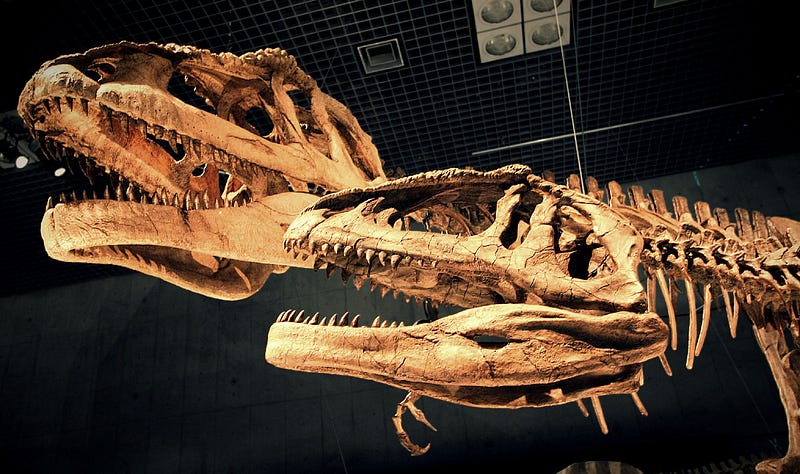
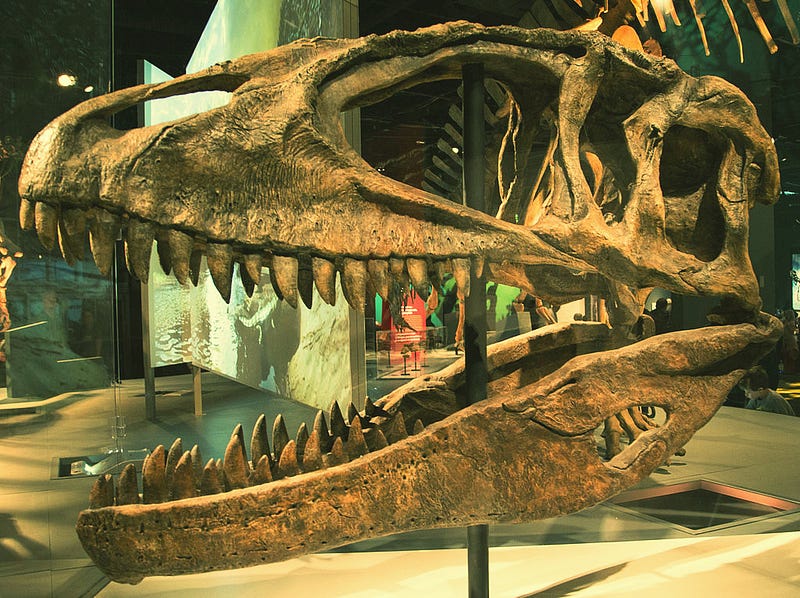
Mapusaurus skulls / Kabacchi/ Wikimedia Commons

Tyrannosaurus rex is the most famous dinosaur, a prehistoric icon, and a popular culture monster that frequently attracts media attention. There are plenty of reasons why T.rex immediately captures our imagination: its gigantic size, its fearsome jaws, and its huge teeth are only a few of them.

Yet, through the course of hundreds of millions of years, evolution produced some equally terrifying carnivorous dinosaurs that terrorized their respective ecosystems with similar might. These creatures, albeit fearsome, get frequently overlooked in popular culture in favor of the ‘tyrant lizard king’.

In the paragraphs below, you will be introduced to some of them.

Acrocanthosarus atokensis
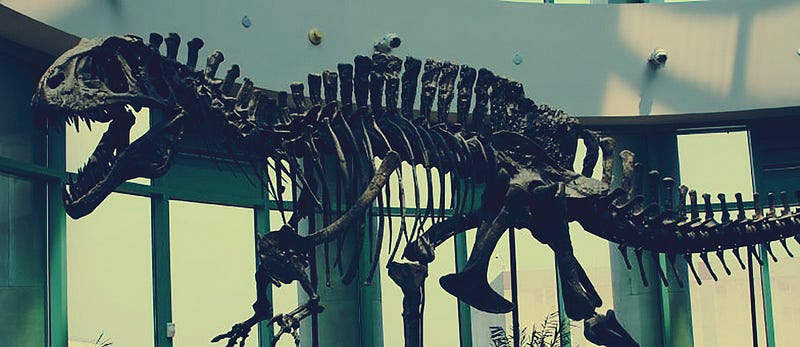
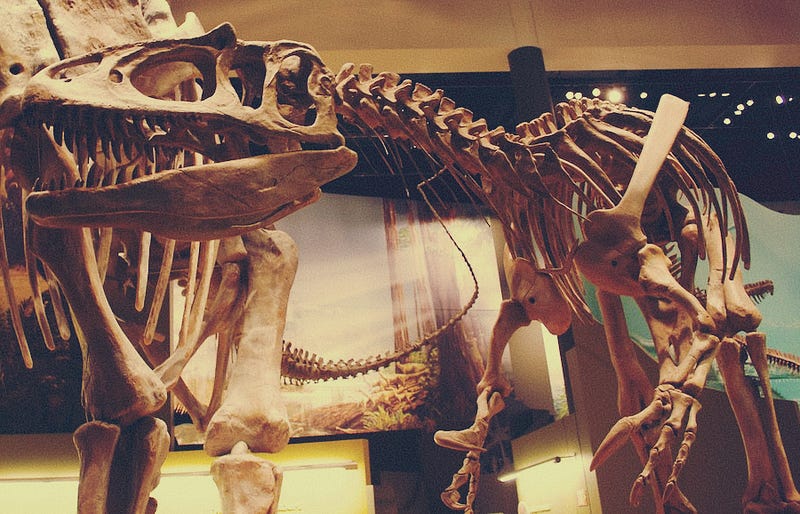
Mounted skeleton of Acrocanthosaurus / Family Wielosz-Caron / Wikimedia Commons

Acrocanthosaurus was the apex predator of North America between 116 and 110 million years ago. With an estimated length of 11.5 meters (38 ft) and weighing up to 6.2 metric tons (6.8 short tons), this animal is among the largest carnivorous dinosaurs found on the continent, second only to T.rex.

The most characteristic feature of Acrocanthosaurus is the high neural spines on most of its vertebrae, which probably supported a ridge of muscle over the animal’s neck, back, and hips. This predator had a long and narrow skull and jaws with curved, serrated teeth. Unlike Tyrannosaurus, it had long, powerful three-clawed forelimbs.

Potential prey of Carcharodontosaurus included the iguanodontid Tenontosaurus, the nodosaur Sauropelta, and possibly the giant sauropod Sauroposeidon. This enormous predator shared its environment with the feathered dromaeosaur Deinonychus.
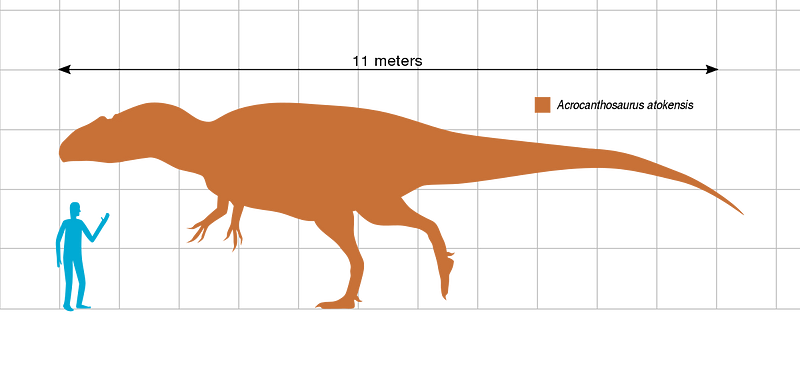
Acrocanthosaurus size comparison by Slate Weasel / Wikimedia Commons

Carcharodontosaurus saharicus

Carcharodontosaurus skull / Matthew Deery / Wikimedia Commons

According to scientists, North Africa 100 million years ago was the most dangerous place in the history of our planet, and surely Carcharodontosaurus played a part in it.

This enormous creature could stretch up to 12 meters (39ft) in length and weigh as much as 7.8 metric tons (8.6 short tons). It had terrifying jaws and long, serrated teeth. Its arms were short, yet quite strong, while its legs were long and muscular.

Carcharodontosaurus most likely fed on the iguanodontid Ouranosaurus, and possibly even on the large long-necked sauropod Paralititan. It also shared its environment with the giant semi-aquatic theropod Spinosaurus (see further below).
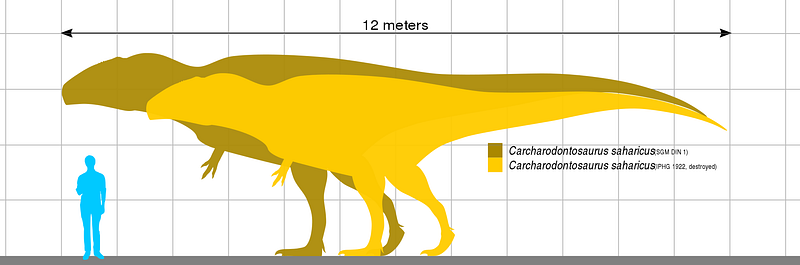
Carcharodontosaurus size comparison by KoprX / Wikimedia Commons

Giganotosaurus carolini

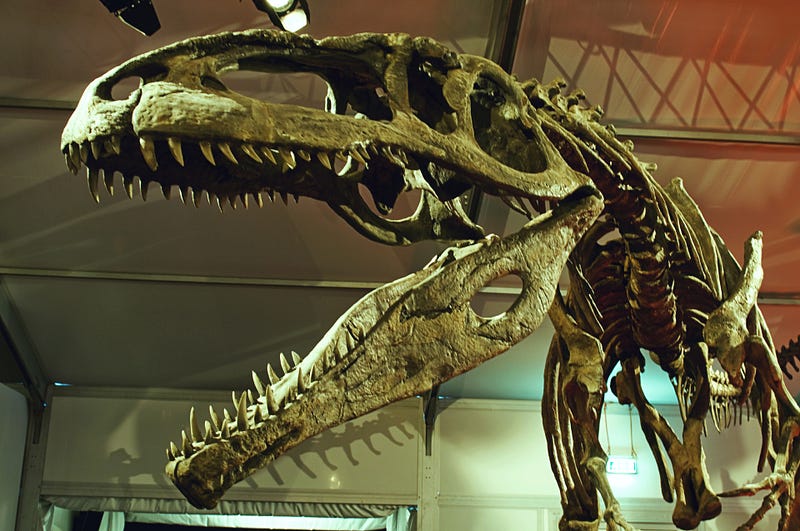
Skeleton of Giganotosaurus carolinii / Eva K./ Wikimedia Commons.

When your name begins with the prefix ‘Giga’, one can reasonably assume that you are big. In this case, we are not only talking about a giant animal but also a terrifying predator.

Giganotosaurus could grow between 12 and 13 meters (39 to 43 ft). It had a massive skull, a long tail, muscular arms with three clawed fingers, and powerful back legs.

The ‘giant southern lizard’ was a member of the derived carcharodontosaurs which includes Carcharodontosaurus itself, Mapusaurus, and Tyranotitan. These giant predators were the largest allosauroids ever evolved and all of them rivaled the eponymous Tyrannosaurus in size.

To find more about the mighty allosauroid lineage, read the article below:

Giganotosaurus lived in Argentina between 98 and 97 million years ago. It shared its environment with the titanosaurian sauropod Andesaurus, and the rebbachisaurid sauropods Limaysaurus and Nopcsaspondylus. Needless to say, it was the apex predator in its ecosystem.

Giganotosaurus is also set to appear in the upcoming Jurassic World movie which will hit theaters June 10, 2022.
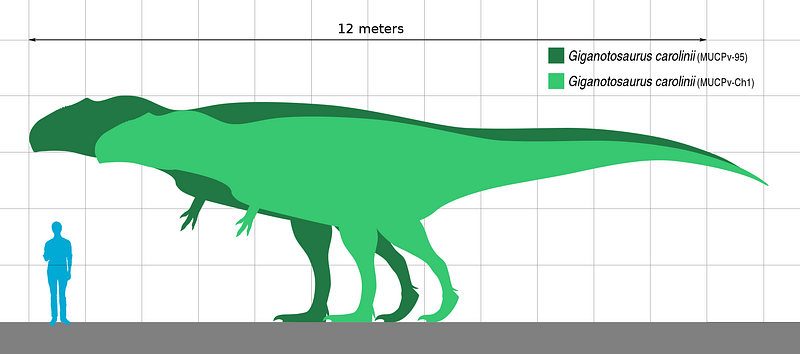
Giganotosaurus size comparison by KoprX / Wikimedia Commons

Mapusaurus rosae

Mapusaurus skeleton / Kabacchi/ Wikimedia Commons

Mapusaurus was another giant theropod from South America. This carnivore was roughly similar in appearance to its close relative Giganotosaurus. The largest known individuals of this species were between 11.5 meters (38 ft) to 12.6 meters (41 ft) long and weighed between 3 metric tons (3.3 short tons) to 5 metric tons (5.5 short tons).

The fossil remains of Mapusaurus were discovered in a bone bed containing at least seven individuals of various growth stages. The discovery led some scientists to suggest that this predator -and possibly its closest relatives- could live and hunt in deadly gangs.

Mapusaurus lived between 97 and 93 million years ago in modern-day Argentina and shared its environment with the giant sauropod Argentinosaurus, one of the largest dinosaurs known so far.
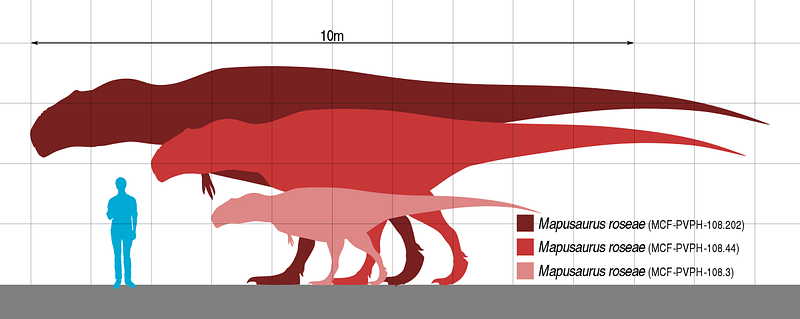
Mapusaurus size comparison by Slate Weasel / Wikimedia Commons

Saurophaganax maximus

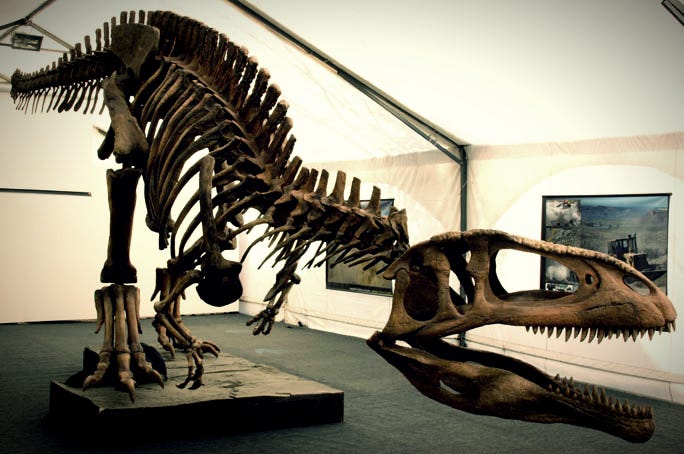
Saurophaganax skeleton mount / Chris Dodds / Wikimedia Commons

The name Saurophaganax translates to “lord of lizard-eaters”. With such an incredibly cool name, it takes no effort to realize that this animal was a veritable beast. This dinosaur’s identity is still a matter of dispute.

While some paleontologists describe Saurophaganax as its own genus, others consider it to be a junior synonym and species of Allosaurus (as A. maximus). Some scientists even classify it as a basal carcharadontosaurid. Whichever the case, this carnivore was truly fearsome: it had an estimated length between 10.5 meters (34 ft) and 13 meters (43 ft) and was the largest predator of its environment.

Saurophaganax remains are known from the Jurassic rocks of the Morrison Formation, the most fertile source of dinosaur fossils in North America. This enormous predator lived 150 million years ago and shared its ecosystem with the popular armored dinosaur Stegosaurus and the famous long-necked sauropods Brontosaurus and Diplodocus.
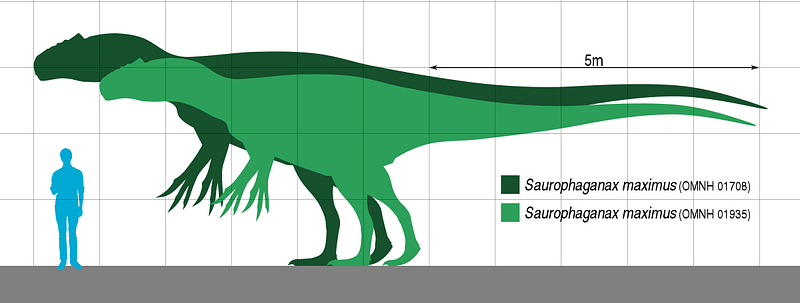
Saurophaganax size comparison by Slate Weasel / Wikimedia Commons

Spinosaurus aegyptiacus

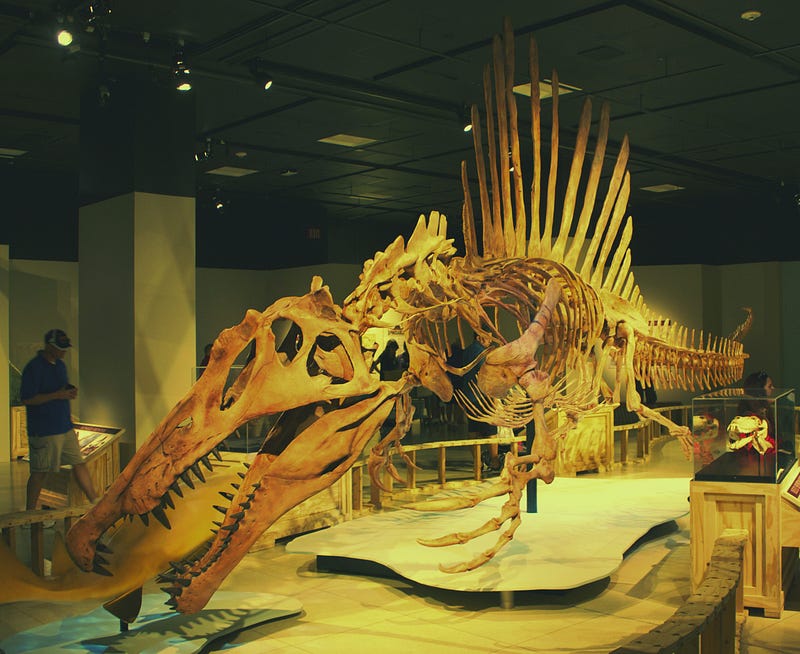
Spinosaurus skeleton / Mike Bowler / Wikimedia Commons

Perhaps the most bizarre theropod dinosaur on the list is Spinosaurus.

This aberrant creature had a skull similar to that of a modern crocodilian and bore straight conical teeth with no serrations. Its most prominent feature was its tall neural spines, some of which grew to at least 1.65 meters (5.4 ft) long and formed a unique sail-like structure on its back. Its large tail fin and its distinct center of gravity were adaptations that enabled it to swim better than any other giant theropod dinosaur. This creature could grow up to ≈14 meters (49 ft) and had a body mass of 4 metric tons (4.4 short tons).

Evidence shows the diet of Spinosaurus consisted mainly, but not exclusively, of fish. Scientists believe it hunted like a modern-day heron or stork — wading into the water and sticking part of its head underwater as it fished for prey. It must also have opportunistically hunted on land for terrestrial animals.

Spinosaurus lived between 99 and 93.5 million years ago in what is now North Africa. It shared its environment with the giant theropod Carcharodontosaurus.
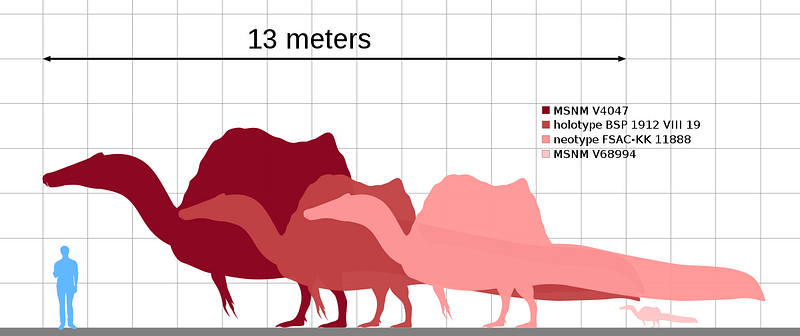
Spinosaurus size comparison by KoprX / Wikimedia Commons

Tyrannotian chubutensis

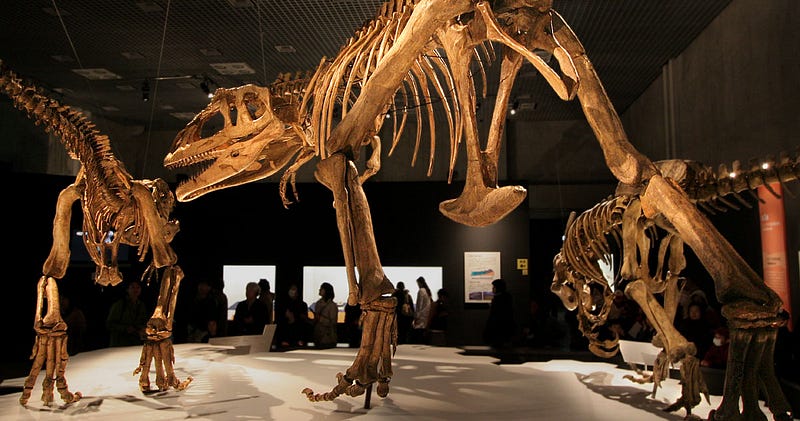
Tyrannotitan skeleton / Tecnópolis Argentina / Wikimedia Commons

Tyrannotitan is the oldest of the giant carcharodontosaurids found on the Southern Hemisphere, predating Carcharodontosaurus, Giganotosaurus, and Mapusaurus by a few million years. This predator was contemporary to the more basal Acrocanthosaurus from North America.

Tyrannotitan had a roughly similar appearance to its equally terrifying cousins. Contrary to them, its teeth were thicker, while its spine was curved in a fashion similar to tyrannosaurs. It also had a relatively long and powerful tail. The overall length of this animal has been estimated at up to 11.4–12.2 meters (37–40 ft), and its weight between 4.9 and 7 tonnes (5.4 and 7.7 short tons).

The ‘tyrant titan’ lived during the latest part of the Early Cretaceous Period in Argentina and shared its environment with giant sauropod dinosaurs such as Chubutisaurus and Patagotitan.
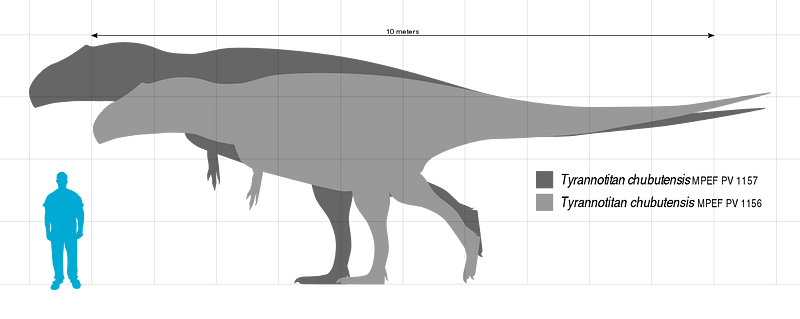
Tyrannotitan size comparison by Slate Weasel / Wikimedia Commons

Zhuchengtyrannus magnus

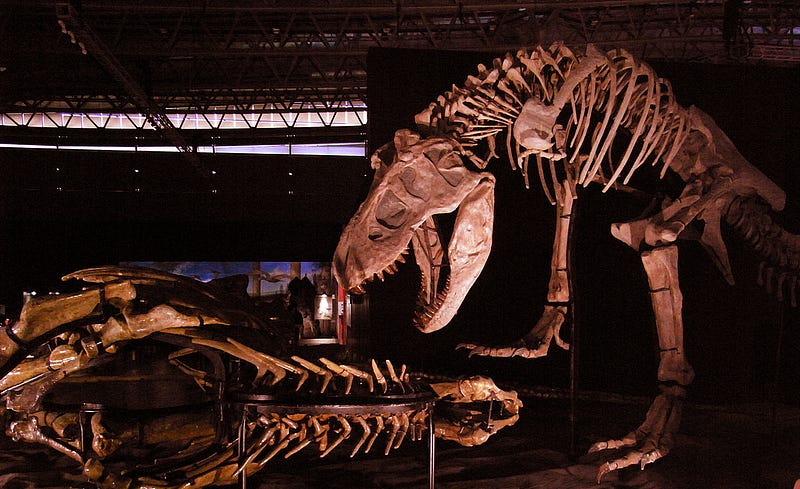
Zhuchengtyrannus mount / Kumiko / Wikimedia Commons

Zhuchengtyrannus is an overlooked giant tyrannosaur appearing just a few million years prior to Tyrannosaurus.

This predator lived in China 75 million years ago and looked incredibly similar to its more famous cousin: it had a deep skull, a powerful bite, and short forelimbs ending in two functional digits. Zhuchengtyrannus is estimated to have been 10–12 meters (33–39 ft) in length and up to 6 short tons (5.4 t) in weight.

This Asian equivalent of T.rex, most probably preyed upon the ceratopsian Sinoceratops and the giant hadrosaurid Shantungosaurus which were found in the same rock formations.
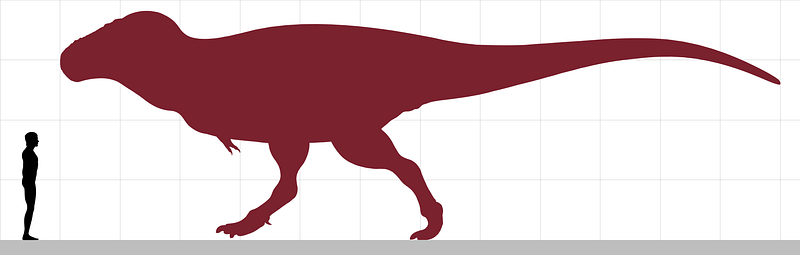
Zhuchengtyrannus size comparison by PaleoNeolitic / Wikimedia Commons

Epilogue

Tyrannosaurus was by no means the only hyper-carnivore of the Mesozoic world. On the contrary, there were several other carnivorous dinosaurs that were equally gigantic and terrifying. These mighty predators, instead of being constantly overshadowed by T.rex, rightfully deserve more attention and screen time in popular media.

References

Stovall, J. Willis; Langston, Wann. (1950). “Acrocanthosaurus atokensis, a new genus and species of Lower Cretaceous Theropoda from Oklahoma”. American Midland Naturalist. 43 (3): 696–728. doi:10.2307/2421859. JSTOR 2421859.

Sereno, P. C.; Dutheil, D. B.; Iarochene, M.; Larsson, H. C. E.; Lyon, G. H.; Magwene, P. M.; Sidor, C. A.; Varricchio, D. J.; Wilson, J. A. (1996). “Predatory Dinosaurs from the Sahara and Late Cretaceous Faunal Differentiation”. Science. 272 (5264): 986–991.

Coria, R. A.; Salgado, L. (1995). “A new giant carnivorous dinosaur from the Cretaceous of Patagonia”. Nature. 377 (6546): 224–226. Bibcode:1995Natur.377..224C. doi:10.1038/377224a0. S2CID 30701725.

Coria, R. A.; Currie, P. J. (2006). “A new carcharodontosaurid (Dinosauria, Theropoda) from the Upper Cretaceous of Argentina”. Geodiversitas. 28 (1): 71–118. ISSN 1280–9659. CiteSeerx: 10.1.1.624.2450 — via ResearchGate.

Chure, Daniel J. (1995). “A reassessment of the gigantic theropod Saurophagus maximus from the Morrison Formation (Upper Jurassic) of Oklahoma, USA”. In A. Sun; Y. Wang (eds.). Sixth Symposium on Mesozoic Terrestrial Ecosystems and Biota, Short Papers. Beijing: China Ocean Press. pp. 103–106.

Greshko, Michael (September 23, 2020). “Case for ‘river monster’ Spinosaurus strengthened by new fossil teeth — Newfound troves from the Moroccan desert suggest that the immense predator spent much of its time in the water”. National Geographic. Retrieved September 24,2020.

Novas, F. E.; S. de Valais; P. Vickers-Rich; T. Rich (2005). “A large Cretaceous theropod from Patagonia, Argentina, and the evolution of carcharodontosaurids”. Naturwissenschaften. 92 (5): 226–230. Bibcode:2005NW…..92..226N. doi:10.1007/s00114–005–0623–3. PMID 15834691. S2CID 24015414

Hone, D. W. E.; Wang, K.; Sullivan, C.; Zhao, X.; Chen, S.; Li, D.; Ji, S.; Ji, Q.; Xu, X. (2011). “A new, large tyrannosaurine theropod from the Upper Cretaceous of China”. Cretaceous Research. 32 (4): 495–503. doi:10.1016/j.cretres.2011.03.005.

Science
Dinosaurs
Tyrannosaurus
Giants
Paleontology
Recommended from ReadMedium