
Ten Dinosaurs You Should Know From Africa
And why they are important…
Africa is rich in dinosaur fossils spanning every period of the Mesozoic Era. The oldest dinosaurs from the continent date from ~220 million years ago; with recent discoveries in Morocco representing the latest species to roam Africa before the Cretaceous–Paleogene (K–Pg) extinction event that wiped out all non-avian dinosaurs 66 million years ago.
Some of the most impressive discoveries have been made in “Mother Continent” including possibly the most bizarre mega-predatory dinosaur that ever existed. At the same time, some paleontologists renounced Late Cretaceous North Africa as ‘arguably the most dangerous place in the history of planet Earth’.
Below are 10 dinosaurs you should know from the African continent presented in alphabetic order.
Adratiklit boulahfa
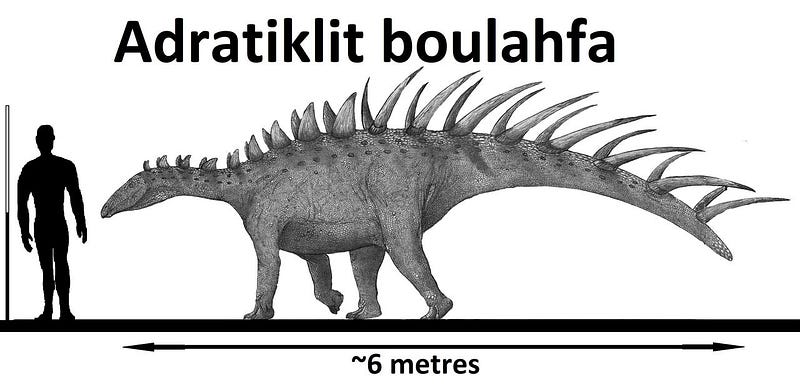
Adratiklit was an armored stegosaur that lived between 168 and 164 million years ago in what is today Morocco. Like all members of its family, it was herbivorous and had arrays of spikes and plates running along its back, hips, and tail. Scientists estimated it could have grown up to 6 meters (20 ft) in length.
Despite being from the African continent phylogenetic analysis indicated that, surprisingly, Adratiklit is more closely related to European stegosaurs such as Dacentrurus and Miragaia than it is to Kentrosaurus and Paranthodon, the two genera known from southern Africa.
Adratiklit’s discovery in 2019 was of particular importance since it was the first stegosaur to be found in North Africa, as well as the oldest definitive member of the family.
Ajnabia odysseus
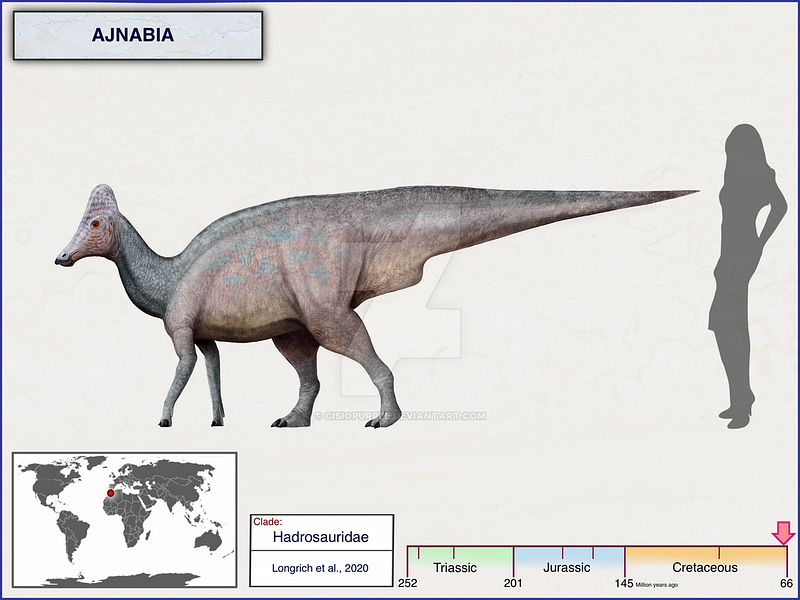
Ajnabia is the first definitive hadrosaur to be found in Africa, and its discovery came as a surprise to paleontologists. That’s because Africa was isolated by water from the rest of the world during the time this animal lived which made some scientists suggest that Ajnabia must have crossed the seas to reach the continent.
You may read the full story of this amazing discovery below:
Reaching only about 3 meters (10 ft) in length, Ajnabia was one of the smallest if not the smallest known hadrosaurids.
Carcharodontosaurus saharicus
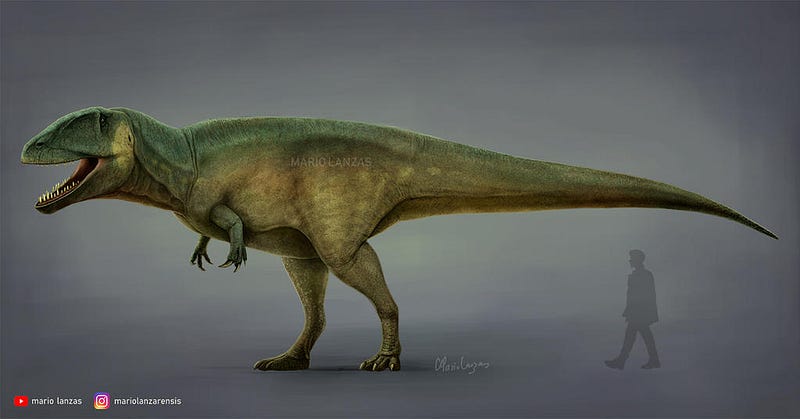
Carcharodontosaurus was one of the longest and heaviest known carnivorous dinosaurs, comparable in size to the famous Tyrannosaurus rex.
This enormous creature could stretch up to 12 meters (39ft) in length and weigh as much as 8 tonnes. Its skull alone was between 1.42–1.63 m. (4.7–5.3 ft )long and its terrifying jaws possessed 20 cm-long (8 in) serrated teeth. Its arms were short, yet quite strong, while its legs were long and muscular.
Although colossal, Carcharodontosaurus was not the only giant theropod that had similar proportions to Tyrannosaurus rex. You may find similarly enormous predatory dinosaurs in the story below:
Remains of Carcharodontosaurus were found in modern-day Morocco and Egypt. This enormous predator lived between 99–94 million years ago and shared its environment with the giant semi-aquatic theropod Spinosaurus (see further below).
Giraffatitan brancai
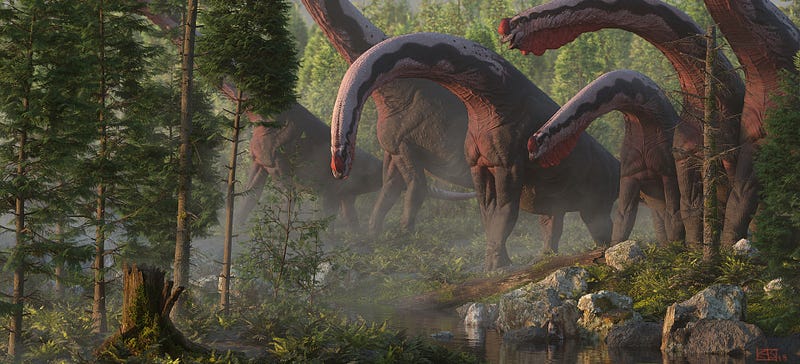
Giraffatitan was a dinosaur with a long neck and tail, four pillar-like legs, and massive size. For many decades it was known as the largest dinosaur since it could grow up to 25 meters (82 ft) in length and 48 tonnes in weight.
Giraffatitan translates to “titanic giraffe”, a name paleontologists inspired by the animal’s giraffe-like build. The dinosaur was originally named as an African species of the more famous Brachiosaurus, before being moved to its own separate genus.
Back in 1993, the film Jurassic Park had based its Brachiosaurus on the more complete Giraffatitan specimen which at the time was known as Brachiosaurus brancai. That means that the movie’s ‘Brachiosaurus’ is in fact a Giraffatitan brancai!
To find out more things Jurassic Park got wrong about dinosaurs, read the story below:
Giraffatitan lived between 150 and 145 million years ago in what is today Tanzania and was one of the most emblematic creatures of the Late Jurassic Period.
Heterodontosaurus tucki
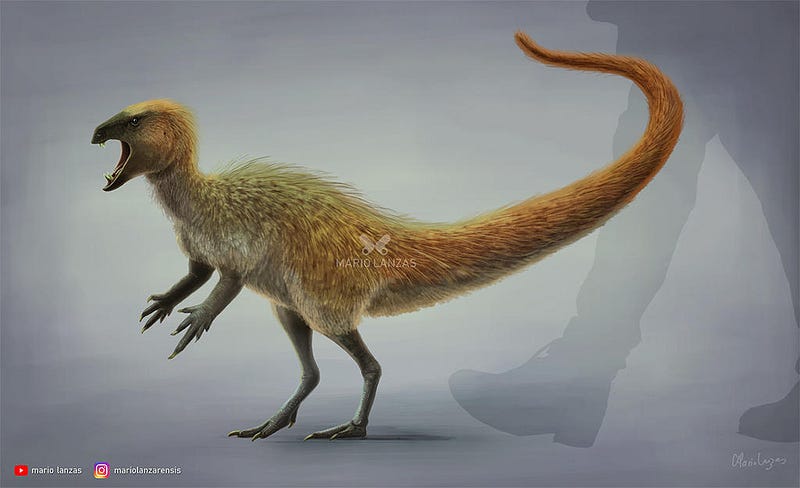
Heterodontosaurus was a small dinosaur that lived roughly 200–190 million years ago, during the Early Jurassic Period. What is interesting about this animal is the fact that it possessed three types of teeth.
The front of the animal’s jaws was covered in a horny beak. In the upper jaw, Heterodontosaurus had small, incisor-like teeth followed by long, canine-like tusks. Finally, a gap divided the tusks from its chisel-like cheek teeth. This characteristic gave the animal its name which translates to “different-toothed lizard”.
Heterodontosaurus reached between 1.18 m (3 ft 10 in) and possibly 1.75 m (5 ft 9 in) in length, and weighed between 2 and 10 kg (4.4 and 22.0 lb). Its body was short with a long tail and long, relatively robust five-fingered forelimbs. Its hind limbs were also long, and slender, ending in four toes.
Despite its tusks, Heterodontosuaurs is thought to have been herbivorous, or at least omnivorous.
Ledumahadi mafube
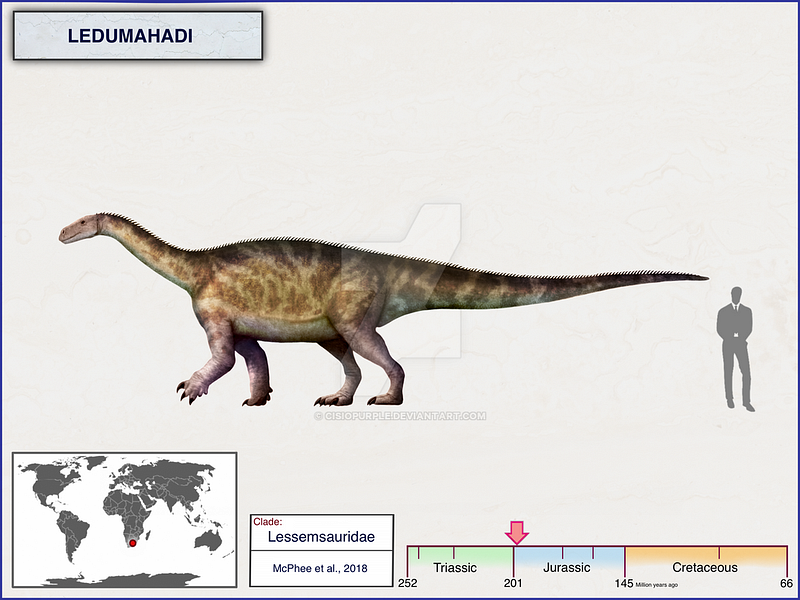
Ledumahadi was a genus of sauropodomorph dinosaur that lived in South Africa during the Early Jurassic Period between 200–195 million years ago.
From its fossil which consists of a singular incomplete postcranial specimen, paleontologists suggested it was quadruped and would have had very large, robust forelimbs, consistent with those of its relatives. Unlike those of later sauropods, these limbs were naturally flexed, as opposed to being purely columnar.
Ledumahad is estimated to have reached a maximum size of around 12 tonnes in body mass (significantly bigger than its contemporary relatives), making it the largest land animal of its time.
Massospondylus carinatus
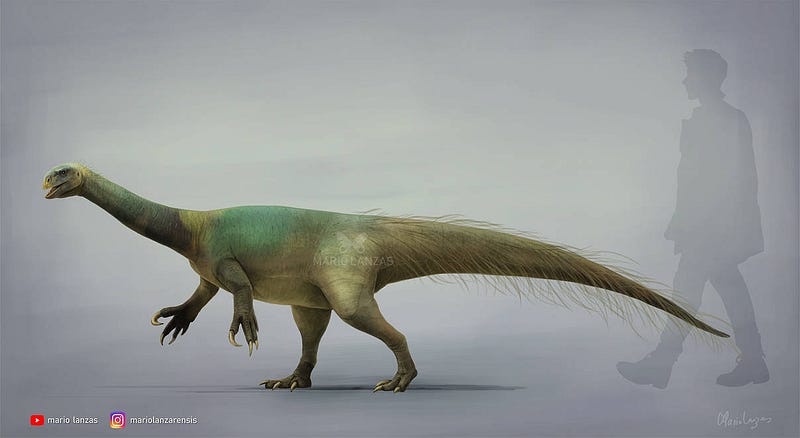
Massospondylus is a distant relative of Ledumahadi. It also had a long neck and tail and a small head but its body was more slender. Adult members of this genus could grow between 4–6 meters (13–20 ft) long.
Massospondylus was described by Sir Richard Owen in 1854 making it one of the first dinosaurs to have been named. Recent studies indicate that this sauropodomorph grew steadily throughout its lifespan, possessed air sacs similar to those of birds, and may have cared for its young.
Similar to Ledumahadi, Massospondylus lived in what is today South Africa during the Early Jurassic Period between 200–183 million years ago.
Nigersaurus taqueti
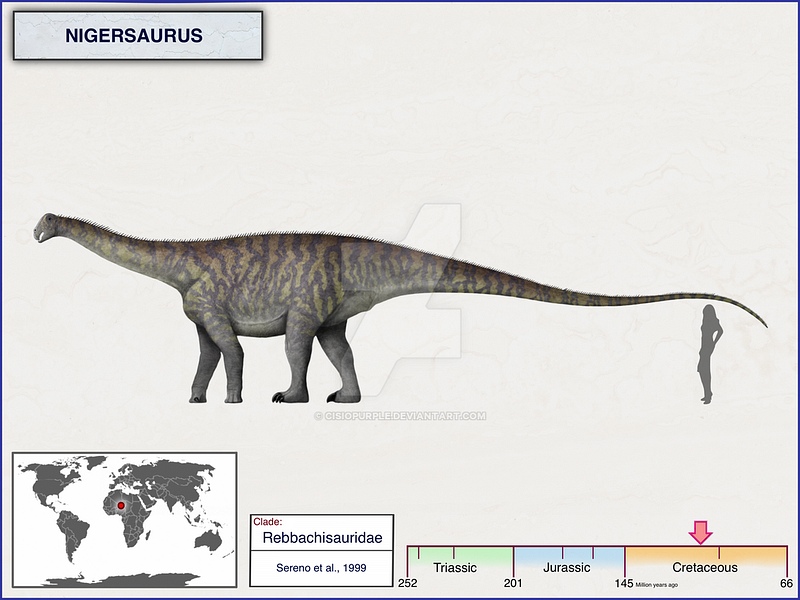
Nigersaurus was a unique genus of sauropod dinosaur that lived during the Middle Cretaceous Period, about 115 to 105 million years ago in Niger.
Its skeleton was filled with air spaces connected to air sacs, but the limbs were robustly built. Nigersaurus was relatively small for sauropod standards: it weighed as much as an adult African elephant and could stretch up to about 9 meters (30 ft).
What's special about the Nigersaurus is its skull. This dinosaur had a wide muzzle filled with more than 500 teeth, which were replaced at a rapid rate (around every two weeks!). Unlike other tetrapods, the tooth-bearing bones of its jaws were rotated transversely relative to the rest of the skull, so that all of its teeth were located far to the front. The jaws may have borne a keratinous sheath.
Spicomellus afer
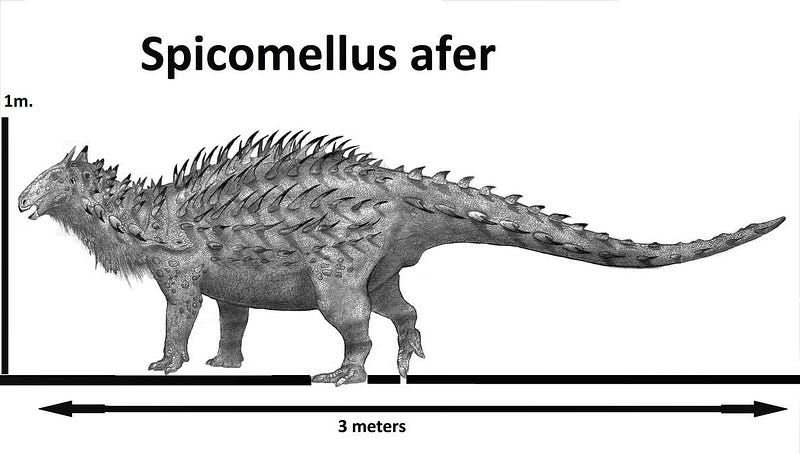
Spicomellus was an ankylosaurian dinosaur that lived in Morocco during the Middle Jurassic Period, about 168–164 million years ago.
It was a rather small herbivore, no longer than 3 meters (9.8 ft) when fully grown. Despite its modest size, the bizarre creature stands out for its unique body armor. Ankylosaurs had armored spikes that were usually embedded in their skin and not fused to the bone. In Spicomellus case, scientists noticed a series of spikes attached to the rib, which must have protruded above the skin covered by a layer of something like keratin.
Spicomellus is not only the oldest ankylosaur ever found but also the first from the African continent. Its discovery helped paleontologists to fill an important gap in their knowledge of dinosaur evolution and suggests that ankylosaurs may have had a global distribution.
Spinosaurus
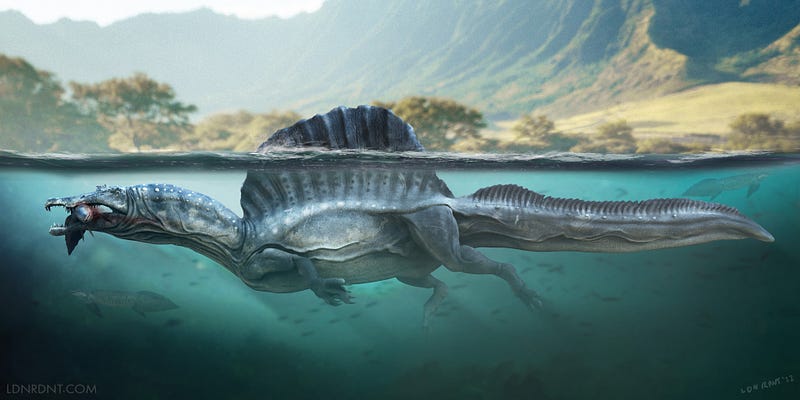
Spinosaurus was probably the most bizarre mega-predatory dinosaur that ever existed. It lived between 99 and 93.5 million years ago in what is now North Africa and shared its environment with the giant theropod Carcharodontosaurus.
With an estimated length of ≈14 meters (49 ft), Spinosaurus is the longest-known predatory dinosaur. Its skull was similar to that of a modern crocodilian and bore straight conical teeth with no serrations. Its most prominent feature was its tall neural spines, some of which grew to at least 1.65 meters (5.4 ft) long and formed a unique sail-like structure on its back. Its large tail fin and its distinct center of gravity were adaptations that enabled it to swim better than any other giant theropod dinosaur.
Evidence shows the diet of Spinosaurus consisted mainly, but not exclusively, of fish. Scientists believe it hunted like a modern-day heron or stork — wading into the water and sticking part of its head underwater as it fished for prey. It must also have opportunistically hunted on land for terrestrial animals.
Epilogue
Vast and mysterious, Africa was once home to some of the most bizarre dinosaurs. The continent’s enormous size and the evergrowing number of paleontological expeditions organized there make us confident that there are many more impressive discoveries waiting to be made.
Sources
Maidment, Susannah C. R.; Raven, Thomas J.; Ouarhache, Driss; Barrett, Paul M. (2020). “North Africa’s first stegosaur: Implications for Gondwanan thyreophoran dinosaur diversity”. Gondwana Research. 77: 82–97. doi:10.1016/j.gr.2019.07.007. ISSN 1342–937X
Longrich, Nicholas R.; Suberbiola, Xabier Pereda; Pyron, R. Alexander; Jalil, Nour-Eddine (2021). “The first duckbill dinosaur (Hadrosauridae: Lambeosaurinae) from Africa and the role of oceanic dispersal in dinosaur biogeography”. Cretaceous Research. 120: 104678. doi:10.1016/j.cretres.2020.104678. S2CID 228807024
Sereno, P. C.; Dutheil, D. B.; Iarochene, M.; Larsson, H. C. E.; Lyon, G. H.; Magwene, P. M.; Sidor, C. A.; Varricchio, D. J.; Wilson, J. A. (1996). “Predatory Dinosaurs from the Sahara and Late Cretaceous Faunal Differentiation” (PDF). Science. 272 (5264): 986–991. Bibcode:1996Sci…272..986S. doi:10.1126/science.272.5264.986. PMID 8662584. S2CID 39658297
Paul, G.S. (1988). “The brachiosaur giants of the Morrison and Tendaguru with a description of a new subgenus, Giraffatitan, and a comparison of the world’s largest dinosaurs” (PDF). Hunteria. 2 (3): 1–14. Archived (PDF) from the original on 27 June 2022.
Crompton, A.W.; Charig, A.J. (1962). “A new ornithischian from the Upper Triassic of South Africa”. Nature. 196 (4859): 1074–1077. Bibcode:1962Natur.196.1074C. doi:10.1038/1961074a0. S2CID 4198113
McPhee, Blair W.; Benson, Roger B.J.; Botha-Brink, Jennifer; Bordy, Emese M. & Choiniere, Jonah N. (2018). “A giant dinosaur from the earliest Jurassic of South Africa and the transition to quadrupedality in early sauropodomorphs”. Current Biology. 28 (19): 3143–3151.e7.
Owen, Richard (1854). “Descriptive catalogue of the Fossil organic remains of Reptilia and Pisces contained in the Museum of the Royal College of Surgeons of England.” London pp. 80, 97 OCLC 14825172
Wilson, J. A.; Sereno, P. C. (2005). “Structure and evolution of a sauropod tooth battery”. In Curry Rogers, K.; Wilson, J.A. (eds.). The Sauropods: Evolution and Paleobiology (PDF). University of California Press. pp. 157–177. ISBN 978–0–520–24623–2.
Maidment, Susannah C. R.; Strachan, Sarah J.; Ouarhache, Driss; Scheyer, Torsten M.; Brown, Emily E.; Fernandez, Vincent; Johanson, Zerina; Raven, Thomas J.; Barrett, Paul M. (2021–09–23). “Bizarre dermal armour suggests the first African ankylosaur”. Nature Ecology & Evolution. 5 (12): 1576–1581. doi:10.1038/s41559–021–01553–6. ISSN 2397–334X. PMID 34556830. S2CID 237616095
Elbein, Asher (January 26, 2021). “Was This Dinosaur More Subaquatic Killer or Giant Wading Bird? — A new study challenges the hypothesis that spinosaurus pursued its prey in the currents of prehistoric rivers”. The New York Times. Retrieved January 26, 2021.


