avatarPanos Grigorakakis

Free AI web copilot to create summaries, insights and extended knowledge, download it at here

4321

Abstract

, Magnapaulia laticaudus, Edmontosaurus regalis, Parasaurolophus walkeri, Rhinorex condrupus, Maiasaura peeblesorum, Hadrosaurus foulkii, Ajnabia odysseus (chart by the author, 2024).</figcaption></figure><h1 id="48d4">Any cool names?</h1><p id="7ae1">Many hadrosaurs had cool names, but let’s just now focus on three: <b>Olorotitan, Rhinorex, </b>and<b> <a href="https://readmedium.com/recently-discovered-dinosaur-swam-hundreds-of-miles-to-reach-new-continents-7ca9b5d9b7a9">Ajnabia</a></b>. Olorotitan means <b>“titanic swan”</b> because its neck is longer when compared with other hadrosaurs. Thanks to its hook-shaped nasal bone, Rhinorex translates to the <b>“nose king”</b>. Finally, Ajnabia derives from the Arabic ajnabi, meaning<b> “stranger”</b> or<b> “foreigner”</b>, referring to the animal as part of a lineage that immigrated to Africa from Europe.</p><figure id="de35"><img src="https://cdn-images-1.readmedium.com/v2/resize:fit:800/1*yDpkri7b3WIqVafn03CXLw.jpeg"><figcaption>Olorotitan arharensis by <a href="https://www.deviantart.com/sphenaphinae/gallery">sphenaphinae</a> on <a href="https://www.deviantart.com/sphenaphinae/art/Olorotitan-arharensis-858695602">DevianArt</a></figcaption></figure><h1 id="c283">In popular culture:</h1><p id="b7d0"><b>Parasaurolophus</b> is probably the most famous hadrosaur. This dinosaur with the characteristic long, tube-like crest has been prominently portrayed in many movies, books, and video games.</p><p id="1830">More precisely, Parasaurolophus was featured in all<b> Jurassic Park</b> (1993, 1997, 2001) and <b>Jurassic World </b>(2015, 2018, 2022) films as well as <b>Michael Crichton’s</b> novel <b>The Lost World</b> (1995).</p><p id="3fb0">The success of the movies resulted in Parasaurolophus appearing in many Jurassic Park-related media including during the credits scene of the short feature film <b>Battle at Big Rock </b>(2019) and the <b>Netflix</b> animated series <b>Jurassic World: Camp Cretaceous</b> (2020–2022).</p><p id="8b9a">The animal was also featured in the 1993 children's animated film <b>We’re Back! A Dinosaur’s Story,</b> as well as in numerous dinosaur documentaries including <b>Clash of the Dinosaurs </b>(2009).</p> <figure id="633c"> <div> <div> <img class="ratio" src="http://placehold.it/16x9"> <iframe class="" src="https://cdn.embedly.com/widgets/media.html?src=https%3A%2F%2Fgiphy.com%2Fembed%2F8Yg2w3ch8ZuneHvKYp%2Ftwitter%2Fiframe&amp;display_name=Giphy&amp;url=https%3A%2F%2Fmedia.giphy.com%2Fmedia%2Fv1.Y2lkPTc5MGI3NjExdnI4c3BoMmxjaDhqNTZsaWE2OGY2YXQxaGQ5bnB6M2ZyMjdsdmhneCZlcD12MV9pbnRlcm5hbF9naWZfYnlfaWQmY3Q9Zw%2F8Yg2w3ch8ZuneHvKYp%2Fgiphy-downsized-large.gif&amp;image=https%3A%2F%2Fmedia2.giphy.com%2Fmedia%2Fv1.Y2lkPTc5MGI3NjExdmZjbXBtdThwajQ0bWI1b2ZtNXRydmRsNDk5d3E2Z3UzbTV1NXNpMSZlcD12MV9pbnRlcm5hbF9naWZfYnlfaWQmY3Q9Zw%2F8Yg2w3ch8ZuneHvKYp%2Fgiphy.gif&amp;key=a19fcc184b9711e1b4764040d3dc5c07&amp;type=text%2Fhtml&amp;schema=giphy" allowfullscreen="" frameborder="0" height="248" width="248"> </div> </div> </figure></iframe></div></div></figure><h1 id="2dc8">Did you know…?</h1><p id="513f">The discovery of <b>Maiasaura</b> in 1978 in Montana established the idea that dinosaurs <b>cared for their young</b>. Adult specimens of this hadrosaur were found next to the remains of fourteen nests of infants each about 1 meter (3.3 feet) long. In the nests, paleontologists also found clutches of eggs and many broken eggshells. The bones of the infants were not fully ossified, which meant the young could not have walked immediately upon hatching and would have required some degree of parental care. The caring behavior Maiasaura showed towards its young is reflected in its name, which translates to <b>“good mother lizard”.</b></p><figure id="fe06"><img src="https://cdn-images-1.readmedium.com/v2/resize:fit:800/1*57v0r86Vgr9dIepASXDB4Q.jpeg"><figcaption>Maiasaura peeblesorum by <a href="https://www.deviantart.com/camusaltamirano/gallery">CamusAltamirano</a> on <a href="https://www.deviantart.com/camusaltamirano/art/Maiasaura-peeblesorum-313569794">DevianArt</a></figcaption></figure><p id="6662">From the mid-19th century through much of the 20th century, hadrosaurs were considered <b>aquatic anim

Options

als</b> that fed on softwater plants. Some paleontologists of the time argued hadrosaur<b> crests </b>were used as<b> tubes</b> helping them to breathe while their heads were underwater. This idea is no longer acceptable though since subsequent analysis of their physiology and bones proved that hadrosaurs were <b>fully terrestrial animals.</b></p><figure id="b859"><img src="https://cdn-images-1.readmedium.com/v2/resize:fit:800/1*RxyqJbpylKQ9eBpd_rpCNQ.jpeg"><figcaption>Restoration inaccurately depicting the lambeosaurine hadrosaur <i>Corythosaurus casuarius</i> as aquatic / Richard Beckert on <a href="https://commons.wikimedia.org/wiki/File:Corythosaurus_snorkel.jpg">Wikimedia Commons</a></figcaption></figure><h1 id="cc86">Relevant Reads:</h1><div id="9b2f" class="link-block"> <a href="https://readmedium.com/recently-discovered-dinosaur-swam-hundreds-of-miles-to-reach-new-continents-7ca9b5d9b7a9"> <div> <div> <h2>Recently Discovered Dinosaur Swam Hundreds of Miles to Reach New Continents</h2> <div><h3>Meet Ajnabia odysseus, the first duck-billed dinosaur to be found in Africa…</h3></div> <div><p>medium.com</p></div> </div> <div> <div style="background-image: url(https://miro.readmedium.com/v2/resize:fit:320/1*C9QzMlwFl7b8bqWlkjQbhQ.jpeg)"></div> </div> </div> </a> </div><div id="b4ac" class="link-block"> <a href="https://readmedium.com/horns-beaks-impressive-frills-the-mighty-ceratopsians-a4a246b43db6"> <div> <div> <h2>Horns, Beaks & Impressive Frills: The Mighty Ceratopsians</h2> <div><h3>Introducing the remarkable Triceratops and its kin…</h3></div> <div><p>medium.com</p></div> </div> <div> <div style="background-image: url(https://miro.readmedium.com/v2/resize:fit:320/1*zwr56LOi6sTcancTltSRXQ.jpeg)"></div> </div> </div> </a> </div><h1 id="4964">References</h1><p id="008d"><a href="https://en.wikipedia.org/wiki/John_Ostrom"><i>Ostrom, John H.</i></a><i> (1964). “A reconsideration of the paleoecology of the hadrosaurian dinosaurs”. American Journal of Science. <b>262</b> (8): 975–997. <a href="https://en.wikipedia.org/wiki/Bibcode_(identifier)">Bibcode</a>:<a href="https://ui.adsabs.harvard.edu/abs/1964AmJS..262..975O">1964AmJS..262..975O</a>. <a href="https://en.wikipedia.org/wiki/Doi_(identifier)">doi</a>:<a href="https://doi.org/10.2475%2Fajs.262.8.975">10.2475/ajs.262.8.975</a>.</i></p><p id="abef"><i>Brett-Surman, Michael K. (1989). A revision of the Hadrosauridae (Reptilia: Ornithischia) and their evolution during the Campanian and Maastrichtian. Ph.D. dissertation. Washington, D.C.: George Washington University.</i></p><p id="8d99"><i>Weishampel, David B. (2015). “A history of the study of ornithopods: Where have we been? Where are we now? Where are we going?”. In Eberth, David A.; Evans, David C. (eds.). Hadrosaurs. Bloomington, Indiana: Indiana University Press. pp. 2–7. <a href="https://en.wikipedia.org/wiki/ISBN_(identifier)">ISBN</a> <a href="https://en.wikipedia.org/wiki/Special:BookSources/978-0-253-01385-9">978–0–253–01385–9</a>.</i></p><p id="b39f"><i>Williams, Vincent S.; Barrett, Paul M.; Purnell, Mark A. (2009). <a href="https://www.ncbi.nlm.nih.gov/pmc/articles/PMC2708679">“Quantitative analysis of dental microwear in hadrosaurid dinosaurs, and the implications for hypotheses of jaw mechanics and feeding”</a>. Proceedings of the National Academy of Sciences. <b>106</b>(27): 11194–11199. <a href="https://en.wikipedia.org/wiki/Bibcode_(identifier)">Bibcode</a>:<a href="https://ui.adsabs.harvard.edu/abs/2009PNAS..10611194W">2009PNAS..10611194W</a>. <a href="https://en.wikipedia.org/wiki/Doi_(identifier)">doi</a>:<a href="https://doi.org/10.1073%2Fpnas.0812631106">10.1073/pnas.0812631106</a>. <a href="https://en.wikipedia.org/wiki/PMC_(identifier)">PMC</a> <a href="https://www.ncbi.nlm.nih.gov/pmc/articles/PMC2708679">2708679</a>. <a href="https://en.wikipedia.org/wiki/PMID_(identifier)">PMID</a> <a href="https://pubmed.ncbi.nlm.nih.gov/19564603">19564603</a>.</i></p></article></body>

MESOZOIC QUICK FACT SERIES:

Hadrosaurs: The ‘Duckbills’ of the Cretaceous

Meet one of the most successful dinosaur groups of the Mesozoic…
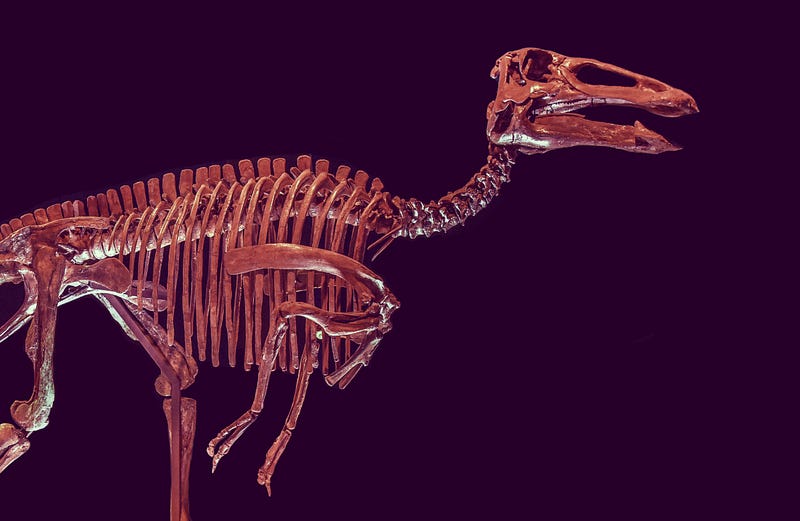
Mounted skeleton of an adult Edmontosaurus annectens on display at the Houston Museum of Natural Science, Houston, Texas, USA / Image credit: Evolutionnumber9 / WIkimedia Commons

Mesozoic Quick Fact Series (MQFS) aims to provide interesting facts about various groups of extinct animals in a fun and readable way. We will focus on the highlights, so you don’t need to read extensive, time-consuming texts!

In this article, we will take a quick overview of the Hadrosauridae, the group of the most dominant herbivores during the Late Cretaceous Period.

Let’s jump right through!
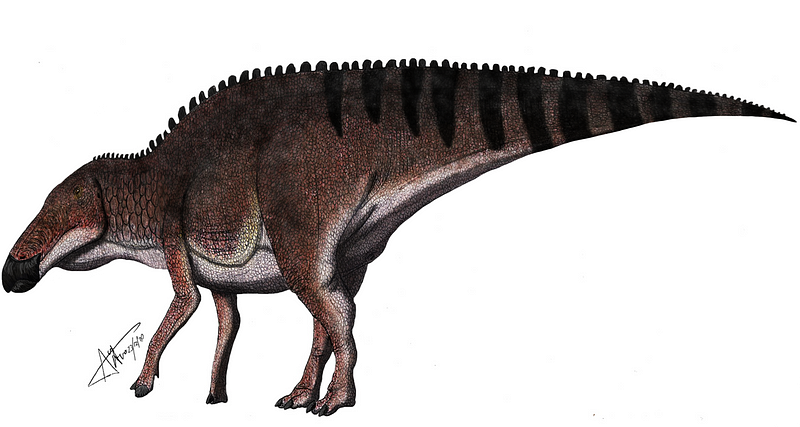
Edmontosaurus annectens by LADAlbarran2001 on DevianArt

Starting with the basics…

Hadrosaurs are known as duck-billed dinosaurs because of the flat duck-bill appearance of the bones in their snouts. The family was erected by paleontologist Edward Drinker Cope in 1869 which initially included only the namesake of the family, Hadrosaurus foulkii.

Hadrosaur teeth were stacked into complex structures known as dental batteries, which helped them chew efficiently vegetation. Scientists believe these dinosaurs were facultative bipeds, with the young animals walking mostly on two legs while the adults walked mostly on four.

Hadrosaurs are divided into two principal subfamilies: the lambeosaurines, which had hollow cranial crests; and the saurolophines, which lacked them (although some species did feature solid crests). The latter usually tended to be bulkier than the former.
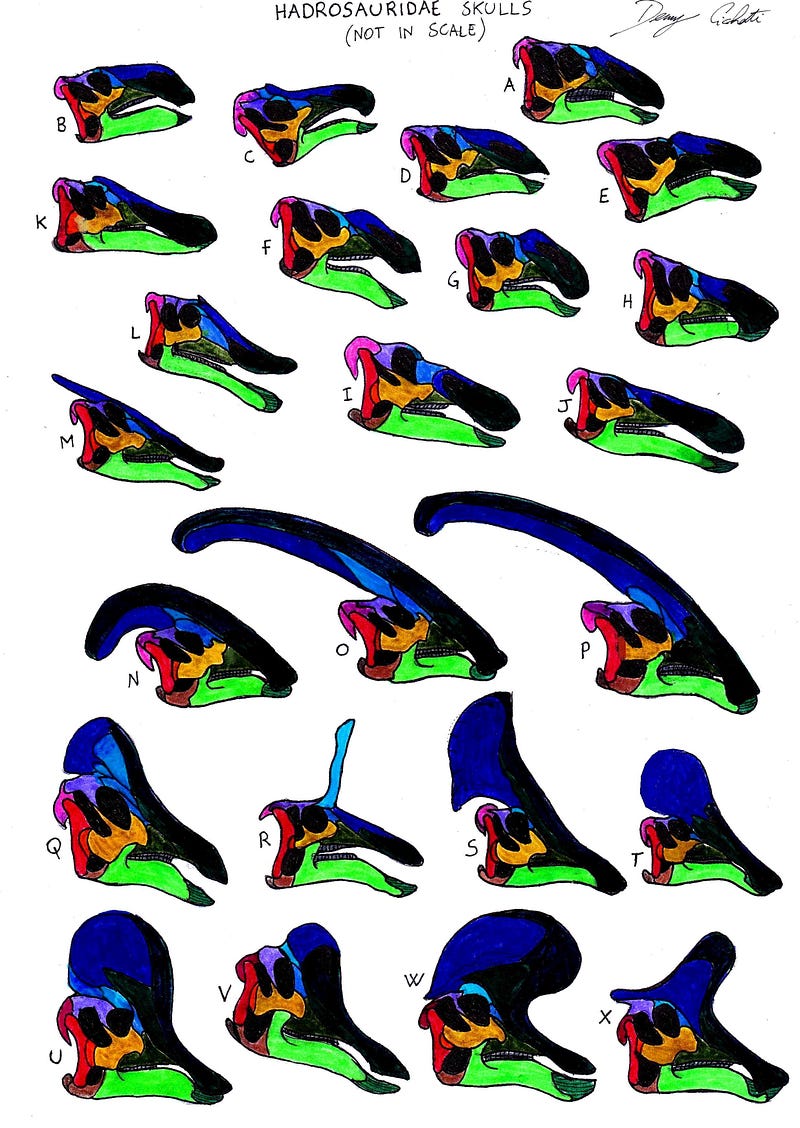
Skulls of several species of Hadrosaurs (not in scale) / Danny Cicchetti / Wikimedia Commons

When did they live?

Hadrosaur ancestors diversified from the iguanodontian dinosaurs during the Early Cretaceous Period, around 130 million years ago. True hadrosaurs though appeared around 86 million years ago. They survived until the Cretaceous–Paleogene mass extinction event that wiped out all non-avian dinosaurs roughly 66 million years ago.

…and where?

Hadrosaurs likely originated in North America and then dispersed into Asia and Europe. Although most species are known from the northern hemisphere, hadrosaur remains have been found in South America and Africa as well.

How large were they?

Hadrosaurs were typically large animals ranging from 7 to 8 meters (23 to 26 ft) in length and 2 to 4 tons in weight. The largest members of the family, like the saurolophine Shantungosaurus and the lambeosaurine Magnapaulia, grew between 12.5 meters (41 ft) and 15 meters (49 ft) in length making them the biggest herbivorous dinosaurs, except the long-necked sauropods. In contrast, Ajnabia was among the smallest hadrosaur species, reaching just 3 meters (10 ft) long.
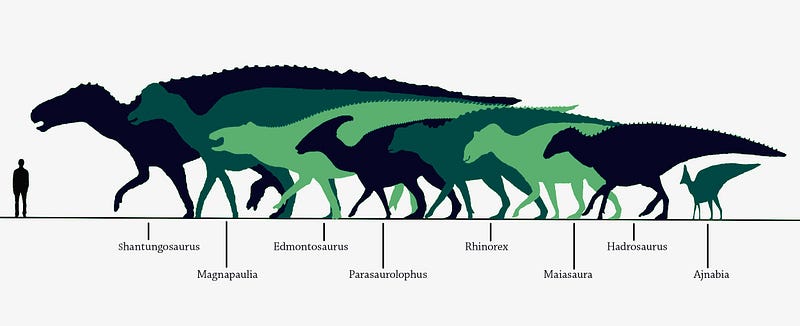
(Above) Hadrosaur species: (from left to right) Shantungosaurus giganteus, Magnapaulia laticaudus, Edmontosaurus regalis, Parasaurolophus walkeri, Rhinorex condrupus, Maiasaura peeblesorum, Hadrosaurus foulkii, Ajnabia odysseus (chart by the author, 2024).

Any cool names?

Many hadrosaurs had cool names, but let’s just now focus on three: Olorotitan, Rhinorex, and Ajnabia. Olorotitan means “titanic swan” because its neck is longer when compared with other hadrosaurs. Thanks to its hook-shaped nasal bone, Rhinorex translates to the “nose king”. Finally, Ajnabia derives from the Arabic ajnabi, meaning “stranger” or “foreigner”, referring to the animal as part of a lineage that immigrated to Africa from Europe.
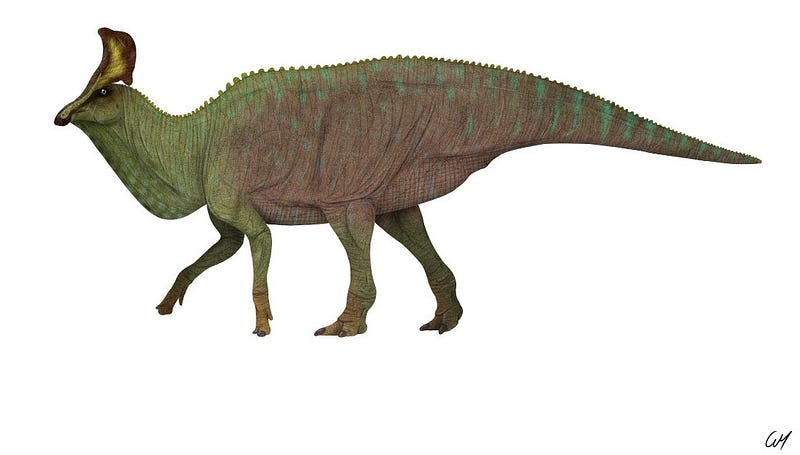
Olorotitan arharensis by sphenaphinae on DevianArt

In popular culture:

Parasaurolophus is probably the most famous hadrosaur. This dinosaur with the characteristic long, tube-like crest has been prominently portrayed in many movies, books, and video games.

More precisely, Parasaurolophus was featured in all Jurassic Park (1993, 1997, 2001) and Jurassic World (2015, 2018, 2022) films as well as Michael Crichton’s novel The Lost World (1995).

The success of the movies resulted in Parasaurolophus appearing in many Jurassic Park-related media including during the credits scene of the short feature film Battle at Big Rock (2019) and the Netflix animated series Jurassic World: Camp Cretaceous (2020–2022).

The animal was also featured in the 1993 children's animated film We’re Back! A Dinosaur’s Story, as well as in numerous dinosaur documentaries including Clash of the Dinosaurs (2009).

Did you know…?

The discovery of Maiasaura in 1978 in Montana established the idea that dinosaurs cared for their young. Adult specimens of this hadrosaur were found next to the remains of fourteen nests of infants each about 1 meter (3.3 feet) long. In the nests, paleontologists also found clutches of eggs and many broken eggshells. The bones of the infants were not fully ossified, which meant the young could not have walked immediately upon hatching and would have required some degree of parental care. The caring behavior Maiasaura showed towards its young is reflected in its name, which translates to “good mother lizard”.
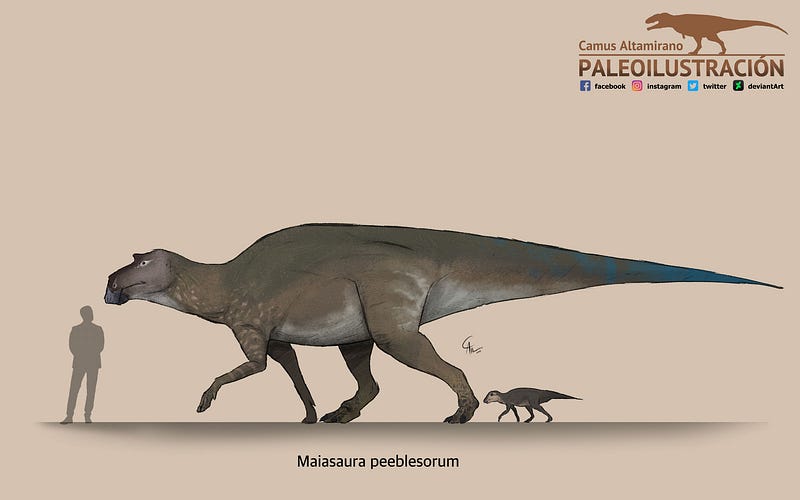
Maiasaura peeblesorum by CamusAltamirano on DevianArt

From the mid-19th century through much of the 20th century, hadrosaurs were considered aquatic animals that fed on softwater plants. Some paleontologists of the time argued hadrosaur crests were used as tubes helping them to breathe while their heads were underwater. This idea is no longer acceptable though since subsequent analysis of their physiology and bones proved that hadrosaurs were fully terrestrial animals.
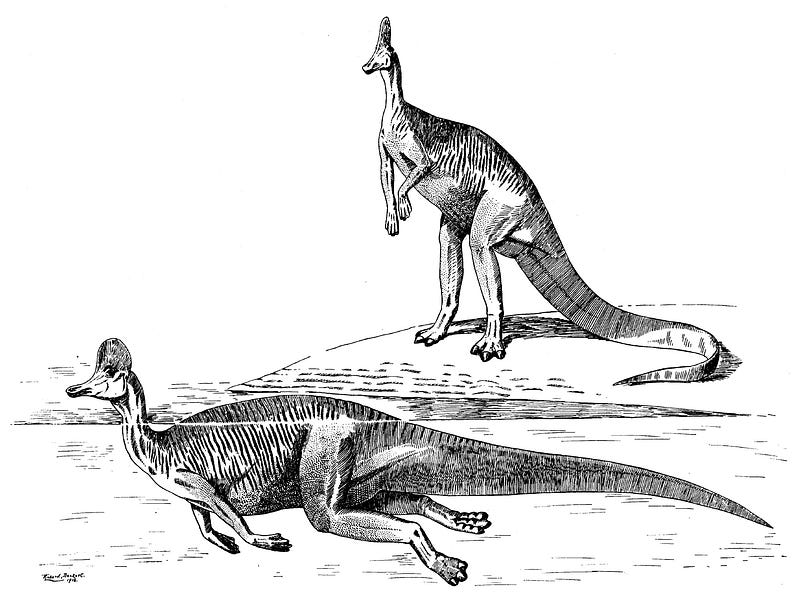
Restoration inaccurately depicting the lambeosaurine hadrosaur Corythosaurus casuarius as aquatic / Richard Beckert on Wikimedia Commons

Relevant Reads:

References

Ostrom, John H. (1964). “A reconsideration of the paleoecology of the hadrosaurian dinosaurs”. American Journal of Science. 262 (8): 975–997. Bibcode:1964AmJS..262..975O. doi:10.2475/ajs.262.8.975.

Brett-Surman, Michael K. (1989). A revision of the Hadrosauridae (Reptilia: Ornithischia) and their evolution during the Campanian and Maastrichtian. Ph.D. dissertation. Washington, D.C.: George Washington University.

Weishampel, David B. (2015). “A history of the study of ornithopods: Where have we been? Where are we now? Where are we going?”. In Eberth, David A.; Evans, David C. (eds.). Hadrosaurs. Bloomington, Indiana: Indiana University Press. pp. 2–7. ISBN 978–0–253–01385–9.

Williams, Vincent S.; Barrett, Paul M.; Purnell, Mark A. (2009). “Quantitative analysis of dental microwear in hadrosaurid dinosaurs, and the implications for hypotheses of jaw mechanics and feeding”. Proceedings of the National Academy of Sciences. 106(27): 11194–11199. Bibcode:2009PNAS..10611194W. doi:10.1073/pnas.0812631106. PMC 2708679. PMID 19564603.

Science
Series
Hadrosaur
Hadrosaurus
Extinct
Recommended from ReadMedium