avatarPanos Grigorakakis

Free AI web copilot to create summaries, insights and extended knowledge, download it at here

4615

Abstract

howed that the decline in diversity affected all six families, although some declined more than others. For instance, during the last ten million years of the Cretaceous Period, herbivore diversity declined sharply, especially among the ankylosaurs and ceratopsians. Troodontids, on the other hand, showed “a very small decline,” in the last five million years of that period.</p><p id="e8db">The decline appears to be linked to an increased extinction rate in older species, while new “fit” species don’t seem to emerge anymore.</p><p id="495c">But, what were the reasons behind this diversity recession?</p><h1 id="7bc3">Factors of decline</h1><p id="31df">Climatic cooling was probably a big driver for the dinosaurs' weakening. At the end of the Cretaceous Period, there was a stupendous 7 °C (12.6 °F) drop in temperature in the North Atlantic. As the climate cooled, herbivorous dinosaurs declined, and their plummeting numbers could have precipitated the carnivores’ decline, given that carnivores preyed on herbivores, Condamine said.</p><p id="0ec1">Herbivores are keystone species in every ecosystem, and their disappearance made the Cretaceous ecosystems unstable and prone to an extinction cascade. The team also found that the longer-lived dinosaur species were more liable to extinction, perhaps reflecting that they could not adapt to the new conditions on Earth.</p><p id="6787">The dropping temperatures may have an influence on dinosaur sex too, as they have in modern-day crocodiles and turtles. If this was the case, sex switching of embryos could have contributed to diversity loss with a cooling global climate at the end of the Cretaceous, the researchers added.</p><p id="0f4f">“This cooling is directly involved in the increase of the extinction of dinosaurs 10 million years before the fall of the asteroid,” Condamine said. “Indeed, dinosaurs were mesothermic (halfway between warm- and cold-blooded) organisms and therefore depended largely on the temperature of their environment for their activity.”</p><p id="a27e">Duck-billed dinosaurs may have been another culprit, at least among herbivorous dinosaurs. Every time a new hadrosaur species evolved, the extinction rate increased by 0.6% in ankylosaurs and by 9.1% in ceratopsians, the study found. Duck-billed dinosaur diversity also declined more slowly compared to other families. In other words, perhaps the duck-bills outcompeted some of their herbivorous relatives.</p><figure id="3172"><img src="https://cdn-images-1.readmedium.com/v2/resize:fit:800/1*UD2HiuXDSQAKW-IarxRFgA.jpeg"><figcaption>Edmontosaurus regalis, one of the latest-surviving hadrosaurs / <a href="https://commons.wikimedia.org/wiki/File:Edmontosaurus_BW.jpg">Wikimedia Commons</a></figcaption></figure><h1 id="63e5">Hold your horses</h1><p id="dc3a">While the methods in the new study have fewer caveats than earlier research aimed at answering the diversity question and the paper itself is a valuable contribution to the ongoing debate, its conclusions must be received with caution for several reasons.</p><p id="3fde">For one, we don’t know whether total diversity dropped because of increased extinction, decreased speciation, or both, noted David Černý, a doctoral candidate in the Department of the Geophysical Sciences at the University of Chicago.</p><p id="356f">“We are dealing with a long chain of inferences here, and if the first few links don’t hold up — if the diversification rate estimates are not reliable, for example — this will cause further problems down the line,” Černý added. “If we can’t be confident about whether non-bird dinosaurs underwent a period of decline, then asking about the causes of that decline is clearly beside the point.”</p><p id="84d9">In addition, not every dinosaur species or family was included in the study. The six major groups examined include species that lived almost exclusively in the Northern Hemisphere. In the southern continents, dinosaur groups such as the <a href="https://readmedium.com/the-rulers-of-the-cretaceous-south-31423abe7b49">carnivorous abelisaurids</a> or the herbivorous titanosaur sauropods had members that also survived till the uppermost part of the Cretaceous. The paper did not take into account those and several other dinosaur groups, so we don’t know whether these other families also showed signs of decline.</p><figure id="69e9"><img src="https://cdn-images-1.readmedium.com/v2/resize:fit:800/1*1yGTO9cNNcCSAsFvXybiDQ.jpeg"><figcaption>Restoration of the abelisaurid dinosaur Aucasaurus garridoi. Despite surviving till the end of the Mesozoic Era, abelisaurids were no

Options

t taken into account in this study / Paleocolour / Wikimedia Commons</figcaption></figure><p id="bcf1">Furthermore, a reduction in species diversity doesn’t necessarily mean fewer individual animals. A more diverse ecosystem is healthier and more resilient, but an abundance of one family doesn’t really suggest the dinosaurs were in grave danger or that they wouldn’t continue to rule the planet had the asteroid impact never happened.</p><p id="935b">“This diversity decrease may well have made dinosaurs more susceptible to the sudden and unpredictable terror unleashed by the asteroid. But I doubt that this decline meant that dinosaurs were in any serious trouble or that they would have been doomed to extinction if the asteroid didn’t hit,” added Steve Brusatte a paleontologist at the University of Edinburgh who was not involved in the study.</p><p id="105a">Meanwhile, the Atlantic Ocean at the time supported more large predator species than any ecosystem we know of before or since. Since all these large predators went extinct at the same time as the dinosaurs did on land, it’s certainly not the case that only the animals already in decline were pushed over the edge by the asteroid’s impact.</p><h1 id="9058">Epilogue</h1><p id="1b46">The new paper is the latest of a slew of studies tackling the question of whether dinosaurs were in decline before the asteroid hit our planet and wiped them out. However, while the new research uses a new statistical modeling technique that limits problems tied to gaps in the fossil record, it still doesn’t definitively answer the million-dollar question.</p><p id="df1c">Thus, more evidence is necessary to reach firmer conclusions.</p><h1 id="7586">Relevant Reads:</h1><div id="476e" class="link-block"> <a href="https://readmedium.com/tyrannosaurs-the-kings-of-the-cretaceous-bdc066bb021e"> <div> <div> <h2>Tyrannosaurs: The ‘Kings’ of the Cretaceous</h2> <div><h3>Meet the famous T.rex and its kin…</h3></div> <div><p>medium.com</p></div> </div> <div> <div style="background-image: url(https://miro.readmedium.com/v2/resize:fit:320/1*1kCTbz0j0sH9rUeQULnIbA.jpeg)"></div> </div> </div> </a> </div><div id="471b" class="link-block"> <a href="https://readmedium.com/hadrosaurs-the-duckbills-of-the-cretaceous-25c90aaadd1"> <div> <div> <h2>Hadrosaurs: The ‘Duckbills’ of the Cretaceous</h2> <div><h3>Meet one of the most successful dinosaur groups of the Mesozoic…</h3></div> <div><p>medium.com</p></div> </div> <div> <div style="background-image: url(https://miro.readmedium.com/v2/resize:fit:320/1*ba6Jc5zeT2Oc4w6NHmvgEQ.jpeg)"></div> </div> </div> </a> </div><div id="8998" class="link-block"> <a href="https://readmedium.com/horns-beaks-impressive-frills-the-mighty-ceratopsians-a4a246b43db6"> <div> <div> <h2>Horns, Beaks & Impressive Frills: The Mighty Ceratopsians</h2> <div><h3>Introducing the remarkable Triceratops and its kin…</h3></div> <div><p>medium.com</p></div> </div> <div> <div style="background-image: url(https://miro.readmedium.com/v2/resize:fit:320/1*zwr56LOi6sTcancTltSRXQ.jpeg)"></div> </div> </div> </a> </div><div id="e43a" class="link-block"> <a href="https://readmedium.com/dromaeosauridae-meet-the-raptors-of-the-mesozoic-3f9ff7d6aee1"> <div> <div> <h2>Dromaeosauridae: Meet the “Raptors” of the Mesozoic</h2> <div><h3>The feathered predators with the sickle-shaped claws…</h3></div> <div><p>medium.com</p></div> </div> <div> <div style="background-image: url(https://miro.readmedium.com/v2/resize:fit:320/1*zqTSdfK_bA6jWLlzA5rcIA.jpeg)"></div> </div> </div> </a> </div><h1 id="7963">References</h1><p id="30f2"><i>Condamine, F.L., Guinot, G., Benton, M.J. et al. Dinosaur biodiversity declined well before the asteroid impact, influenced by ecological and environmental pressures. Nat Commun <b>12, </b>3833 (2021). <a href="https://doi.org/10.1038/s41467-021-23754-0">https://doi.org/10.1038/s41467-021-23754-0</a></i></p></article></body>

Were the Dinosaurs Already Dying Out When the Asteroid Struck the Earth?

A new study adds more light on the ongoing debate…
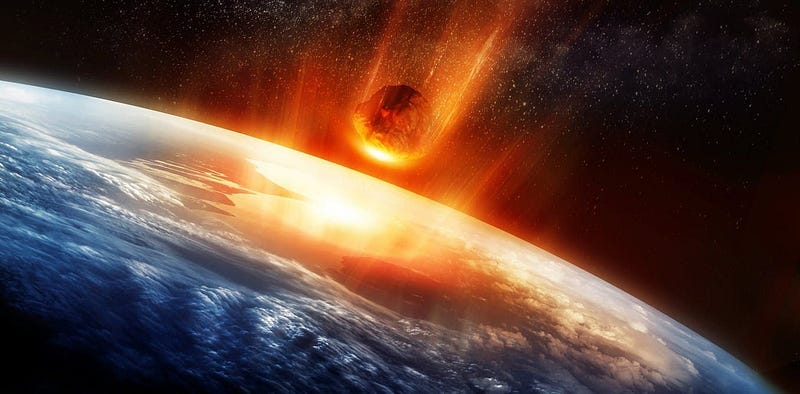
The asteroid which struck the Earth 66 million years ago years ago / Photo posted by Raspberry Shake on Twitter

After emerging during the Late Triassic Period some 230 million years ago, dinosaurs occupied every continent and were dominant in most terrestrial ecosystems for almost 150 million years. Around 66 million years ago, an enormous asteroid struck the Yucatán peninsula in Mexico triggering a wave of extinction that led to the disappearance of three-quarters of the plant and animal species on Earth. This cataclysmic event is known as the Cretaceous–Paleogene (K–Pg) extinction and marks the end of the Mesozoic Era. Except for birds, all dinosaurs were wiped out during this time.

Some scientists suggest dinosaurs were already beginning to lose their edge even before this calamity hit, while others believe they would have continued to thrive had it not been for the asteroid. A recent study adds more light on the ongoing debate.

According to the paper published in Nature Communications, dinosaurs that lived during the latest part of the Cretaceous Period were facing a situation where die-offs outpaced the emergence of new species making them particularly prone to extinction.

The study

To perform the study, Fabien Condamine, a research scientist at the French National Center for Scientific Research and the Institute of Evolutionary Science of Montpellier, and his colleagues put together a list of over 1,600 dinosaur fossils. These fossils comprised 247 Late Cretaceous species coming from six major dinosaur families.

The families included the herbivorous ankylosaurs (armored dinosaurs), the ceratopsians (horned dinosaurs), the hadrosaurs (duck-billed dinosaurs), as well as the carnivorous tyrannosaurs, the dromaeosaurids, and the troodontids (both were groups of maniraptoran bird-like dinosaurs).
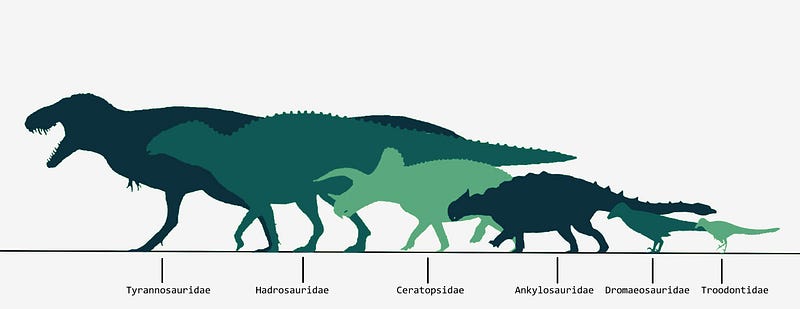
Dinosaurs families examined in the study / chart by author

The examination showed that both herbivorous and carnivorous dinosaurs were in decline for about 10 million years before the Cretaceous-Paleogene mass extinction event:

“We looked at the six most abundant dinosaur families through the whole of the Cretaceous, spanning from 150 to 66 million years ago, and found that they were all evolving and expanding and clearly being successful. Then, 76 million years ago, they show a sudden downturn. Their rates of extinction rose, and in some cases, the rate of origin of new species dropped off,” Condamine said.

The scientists documented all fossil occurrences so they would know the approximate geologic age of appearance and disappearance for each species. Of course, recovered fossils do not tell the complete story since they represent only a fraction of the actual Late Cretaceous dinosaur fauna. The truth is most dinosaurs never got fossilized, and even for those that did, many specimens remain undiscovered. According to Condamine, the team accounted for these limitations when they modeled the diversity and extinction rates.

“These models allow us to estimate the ‘true’ ages of appearance and extinction of each species, and by doing this for all species, we can then deduce diversity curves from their origin to their extinction,” Condamine said.

The models shed light on how many dinosaur species existed at different times over the last 40 million years of the dinosaur era. The results showed that the decline in diversity affected all six families, although some declined more than others. For instance, during the last ten million years of the Cretaceous Period, herbivore diversity declined sharply, especially among the ankylosaurs and ceratopsians. Troodontids, on the other hand, showed “a very small decline,” in the last five million years of that period.

The decline appears to be linked to an increased extinction rate in older species, while new “fit” species don’t seem to emerge anymore.

But, what were the reasons behind this diversity recession?

Factors of decline

Climatic cooling was probably a big driver for the dinosaurs' weakening. At the end of the Cretaceous Period, there was a stupendous 7 °C (12.6 °F) drop in temperature in the North Atlantic. As the climate cooled, herbivorous dinosaurs declined, and their plummeting numbers could have precipitated the carnivores’ decline, given that carnivores preyed on herbivores, Condamine said.

Herbivores are keystone species in every ecosystem, and their disappearance made the Cretaceous ecosystems unstable and prone to an extinction cascade. The team also found that the longer-lived dinosaur species were more liable to extinction, perhaps reflecting that they could not adapt to the new conditions on Earth.

The dropping temperatures may have an influence on dinosaur sex too, as they have in modern-day crocodiles and turtles. If this was the case, sex switching of embryos could have contributed to diversity loss with a cooling global climate at the end of the Cretaceous, the researchers added.

“This cooling is directly involved in the increase of the extinction of dinosaurs 10 million years before the fall of the asteroid,” Condamine said. “Indeed, dinosaurs were mesothermic (halfway between warm- and cold-blooded) organisms and therefore depended largely on the temperature of their environment for their activity.”

Duck-billed dinosaurs may have been another culprit, at least among herbivorous dinosaurs. Every time a new hadrosaur species evolved, the extinction rate increased by 0.6% in ankylosaurs and by 9.1% in ceratopsians, the study found. Duck-billed dinosaur diversity also declined more slowly compared to other families. In other words, perhaps the duck-bills outcompeted some of their herbivorous relatives.
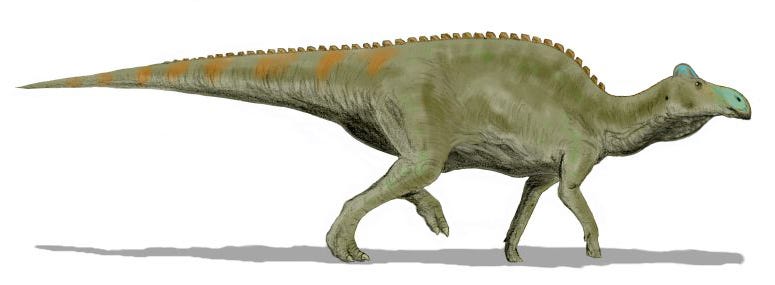
Edmontosaurus regalis, one of the latest-surviving hadrosaurs / Wikimedia Commons

Hold your horses

While the methods in the new study have fewer caveats than earlier research aimed at answering the diversity question and the paper itself is a valuable contribution to the ongoing debate, its conclusions must be received with caution for several reasons.

For one, we don’t know whether total diversity dropped because of increased extinction, decreased speciation, or both, noted David Černý, a doctoral candidate in the Department of the Geophysical Sciences at the University of Chicago.

“We are dealing with a long chain of inferences here, and if the first few links don’t hold up — if the diversification rate estimates are not reliable, for example — this will cause further problems down the line,” Černý added. “If we can’t be confident about whether non-bird dinosaurs underwent a period of decline, then asking about the causes of that decline is clearly beside the point.”

In addition, not every dinosaur species or family was included in the study. The six major groups examined include species that lived almost exclusively in the Northern Hemisphere. In the southern continents, dinosaur groups such as the carnivorous abelisaurids or the herbivorous titanosaur sauropods had members that also survived till the uppermost part of the Cretaceous. The paper did not take into account those and several other dinosaur groups, so we don’t know whether these other families also showed signs of decline.
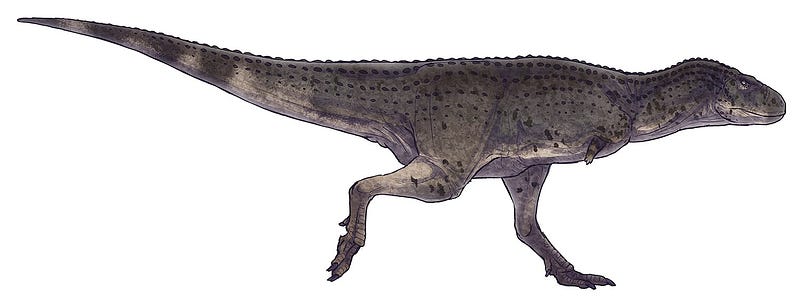
Restoration of the abelisaurid dinosaur Aucasaurus garridoi. Despite surviving till the end of the Mesozoic Era, abelisaurids were not taken into account in this study / Paleocolour / Wikimedia Commons

Furthermore, a reduction in species diversity doesn’t necessarily mean fewer individual animals. A more diverse ecosystem is healthier and more resilient, but an abundance of one family doesn’t really suggest the dinosaurs were in grave danger or that they wouldn’t continue to rule the planet had the asteroid impact never happened.

“This diversity decrease may well have made dinosaurs more susceptible to the sudden and unpredictable terror unleashed by the asteroid. But I doubt that this decline meant that dinosaurs were in any serious trouble or that they would have been doomed to extinction if the asteroid didn’t hit,” added Steve Brusatte a paleontologist at the University of Edinburgh who was not involved in the study.

Meanwhile, the Atlantic Ocean at the time supported more large predator species than any ecosystem we know of before or since. Since all these large predators went extinct at the same time as the dinosaurs did on land, it’s certainly not the case that only the animals already in decline were pushed over the edge by the asteroid’s impact.

Epilogue

The new paper is the latest of a slew of studies tackling the question of whether dinosaurs were in decline before the asteroid hit our planet and wiped them out. However, while the new research uses a new statistical modeling technique that limits problems tied to gaps in the fossil record, it still doesn’t definitively answer the million-dollar question.

Thus, more evidence is necessary to reach firmer conclusions.

Relevant Reads:

References

Condamine, F.L., Guinot, G., Benton, M.J. et al. Dinosaur biodiversity declined well before the asteroid impact, influenced by ecological and environmental pressures. Nat Commun 12, 3833 (2021). https://doi.org/10.1038/s41467-021-23754-0

Science
Dinosaurs
Paleontology
Extinction
Asteroids
Recommended from ReadMedium