
Mesozoic Quick Fact Series
Dromaeosauridae: Meet the ‘Raptors’ of the Mesozoic
The feathered predators with the sickle-shaped claws…
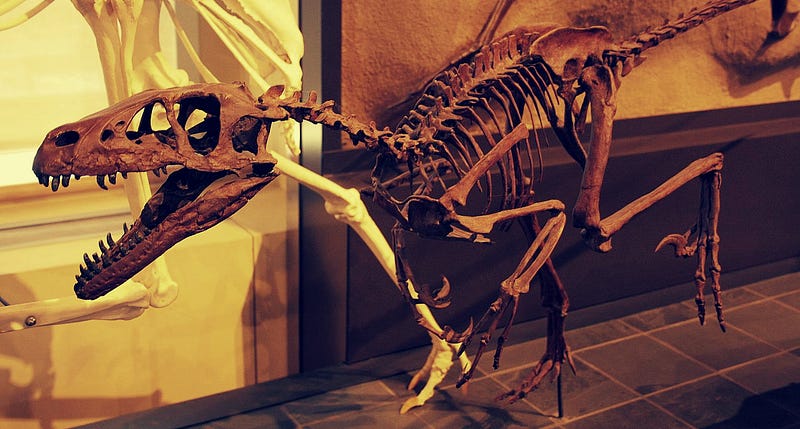
Mesozoic Quick Fact Series aims to provide interesting facts about various groups of extinct animals in a fun and readable way. We will focus on the highlights, so you don’t need to read extensive, time-consuming texts!
In this article, we will take a quick overview of the Dromaeosauridae, the group of feathered theropods known in popular culture as ‘raptors’ thanks to their bird-like appearance and speculated bird-like behavior.
Let’s jump right through!
Starting with the basics…
Dromaeosauridae translates to ‘running lizards’, from Greek δρομεῦς meaning ‘runner’ and σαῦρος meaning ‘lizard’. These dinosaurs had a relatively large skull, a narrow snout, a moderately long S-curved neck, a short, deep trunk, and a long, slender tail. Their most characteristic feature, however, was their enlarged second toe that bore an unusually large, curved, sickle-shaped claw.
Dromaeosaurids are most commonly divided into the following groups: the halszkaraptorines, the unenlagiines, the microraptorians, and the eudromaeosaurians.
The Halszkaraptorinae is the most basal known subfamily of dromaeosaurids. They were bizarre creatures with long fingers and necks, numerous small teeth, and possible semiaquatic habits. The group includes the diminutive and enigmatic genera Halszkaraptor, Mahakala, and Hulsanpes.
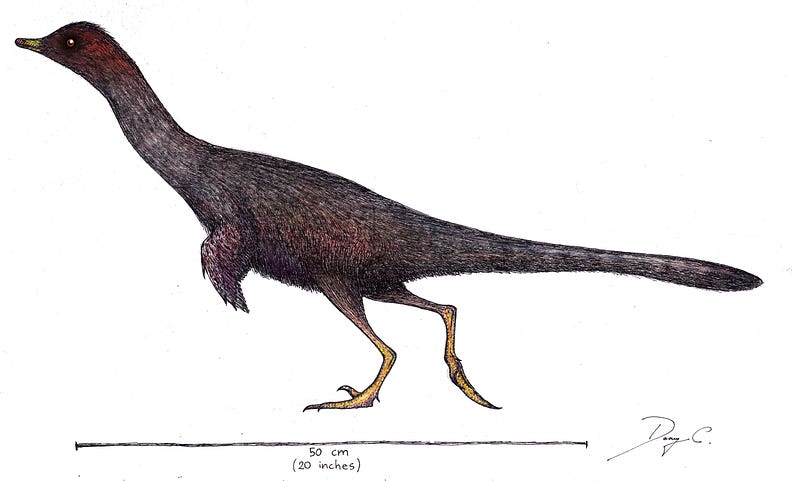
The Unenlagiinae is the most poorly supported subfamily of dromaeosaurids and it is possible that some or all of its members belong outside of Dromaeosauridae. Unenlagiines had better capacities for running and pursuit predation than other dromaeosaurids since they were more gracile and had modified metatarsals that were relatively thin and lengthened. This obscure group includes the giant Austroraptor, as well as some more modest forms like Buitreraptor and Unenlagia.
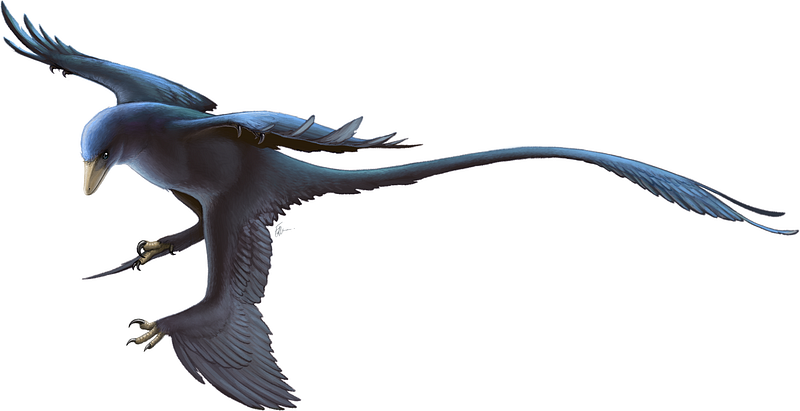
An additional primitive clade of dromaeosaurids is the microraptorians. This group includes many of the smallest dromaeosaurids, which show adaptations for living in trees. Well-known microraptorians include Microraptor itself and Sinornithosaurus. According to some scientists, some microraptorians may have been capable of active flight.
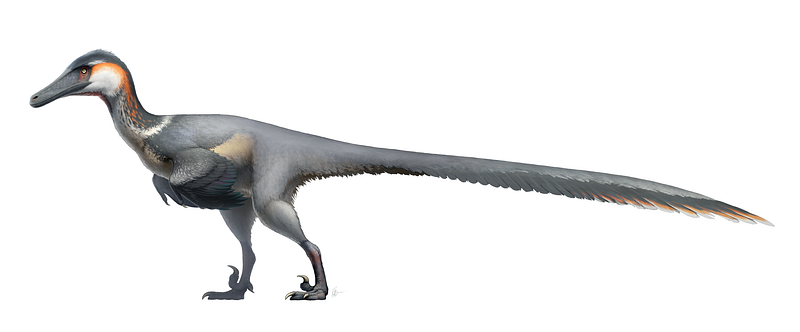
The most advanced subgroup of dromaeosaurids was the Eudromaeosauria. The family includes stocky and short-legged genera which were likely ambush hunters. This family comprises the Velociraptorinae, the Dromaeosaurinae, and in some studies, a third group called the Saurornitholestinae. Velociraptor, Deinonychus, and Dromaeosaurus are famous examples of eudromaeosaurians.
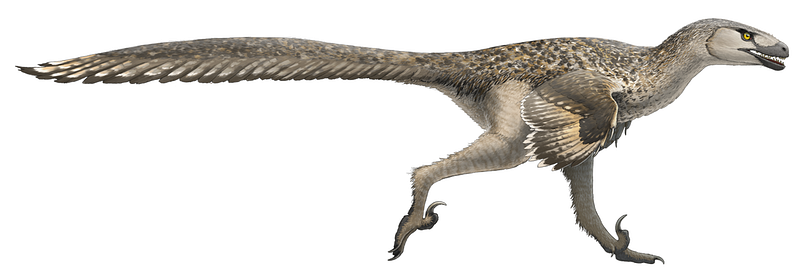
When did they live?
The earliest dromaeosaurids evolved during the mid-Jurassic Period about 167 million years ago. The presence of dromaeosaurids as early as the Middle Jurassic has been suggested by the discovery of isolated fossil teeth, though no dromaeosaurid body fossils have been found from this period.
It was during the Cretaceous Period that followed, however, when these animals truly flourished. Dromaeosaurids survived until the Cretaceous–Paleogene mass extinction event that wiped out all non-avian dinosaurs 66 million years ago.
…and where?
Dromaeosaurid fossils have been discovered across the globe demonstrating that the family was immensely widespread. In particular, paleontologists have found their remains in North America, Europe, Africa, Asia, South America, and Antarctica. Fossilized teeth give credence to the possibility that they inhabited Australia as well.
How large were they?
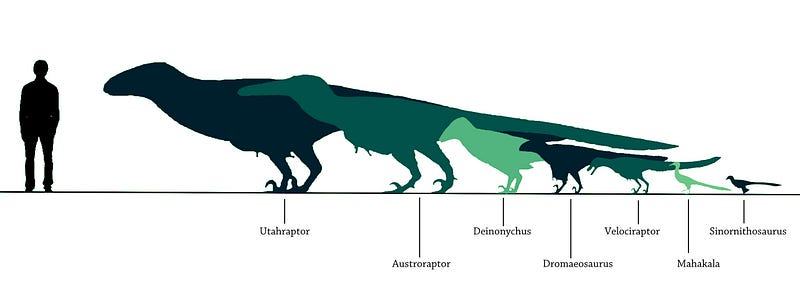
Dromaeosaurids were generally small to medium-sized dinosaurs.
The largest dromaeosaurid genera include the eudromeosaurines Utahraptor, Achillobator, and Dakatoraptor, as well as the unenlagiine Austroraptor. All of these “raptors” grew over 5m [16 ft] in length.
In contrast, most microraptorians and all halszkaraptorines were relatively small. For example, adult specimens of Microraptor range between 70 and 90 centimeters long (2.53–2.95 ft) and weigh up to 1 kilogram (2.2 lb), making them some of the smallest known non-avialan dinosaurs.
Any cool names?
Many dromaeosaurids had cool names, but let’s just now focus on four: Deinonychus, Wulong, Pyroraptor, and Achillobator.
The famous Deinonychus comes from the Greek words deinós (δεινός) and ónux (ὄνυξ) and translates to ‘terrible claw’. The name of the crown-sized microraptorian Wulong means “dancing dragon” in Chinese and references the active position the beautifully articulated specimen was found. Pyroraptor translates to “fire thief” because its remains had been discovered after a forest fire occurred in 1992. For its part, the large-bodied Achillobator translates to “Achilles hero”.
In popular culture:
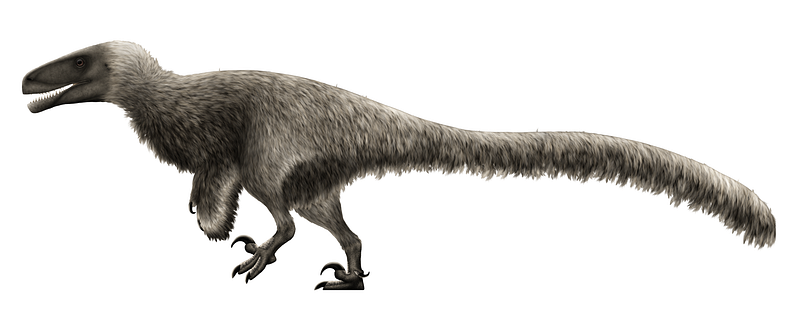
The most famous dromaeosaurids in popular culture are Deinonychus and Velociraptor.
The discovery of the former during the 1960s set the stage for what we know today as the ‘dinosaur renaissance’, the scientific revolution that challenged the long-held view of dinosaurs as slow, cold-blooded reptiles. After its discovery, paleontologists would suggest that many dinosaurs were active, warm-blooded creatures instead. In addition, the description of Deinonychus would provide further evidence that birds evolved from dinosaurs, a view that gradually gained support among scientists, and is today universally accepted.
Velociraptor was established in popular culture thanks to its role as a vicious and cunning killer in the 1990 novel Jurassic Park by Michael Crichton and its 1993 film adaptation, directed by Steven Spielberg. Funnily enough, the “raptors” portrayed in Jurassic Park were actually modeled after the closely related Deinonychus and not the actual Velociraptor mongoliensis. Thanks to the film’s success though, Velociraptor became a household dinosaur name and has since portrayed in countless dinosaur media, documentaries, films, and games.
Did you know…?
. Contrary to what most popular culture media depict, dromaeosaurid dinosaurs did not necessarily hunt in big, coordinated packs. Though widely accepted, evidence for this behavior is relatively weak. Paleontologists have proposed a different model for dromaeosaurs that is more similar to Komodo dragons, where individuals of the same species may attack the same animal, but cooperation is limited.
. Dromaeosaurs did not use their famous sickle-shaped foot claws to disembowel other animals. According to a recent theory, they most likely leaped into their prey and used their famous claws to keep it pinched down before killing it with their snouts.
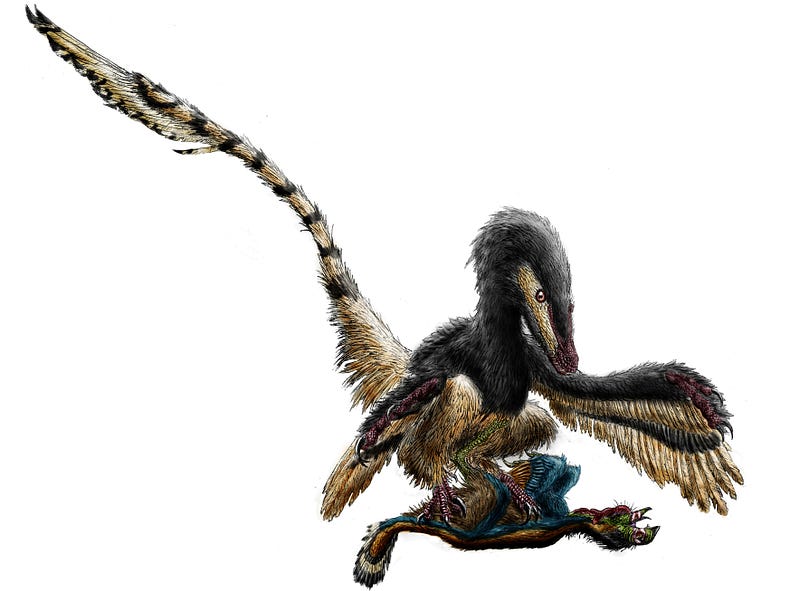
. The four-winged dromaeosaurid Microraptor is one of the few dinosaurs for which paleontologists have determined its coloration. Scientists compared the arrangement of its preserved melanosomes to those of modern birds and found that the winged dinosaur sported a black, glossy coloration.
Relevant Reads:
References
Metcalf, S.J.; Vaughan, R.F.; Benton, M.J.; Cole, J.; Simms, M.J.; Dartnall, D.L. (January 1992). “A new Bathonian (Middle Jurassic) microvertebrate site, within the Chipping Norton Limestone Formation at Hornsleasow Quarry, Gloucestershire”. Proceedings of the Geologists’ Association. 103 (4): 321–342. doi:10.1016/S0016–7878(08)80129–0
Ostrom, J. H. (1969). “Osteology of Deinonychus antirrhopus, an unusual theropod from the Lower Cretaceous of Montana” (PDF). Peabody Museum of Natural History Bulletin. 30: 1–165.
Agnolin, Federico L.; Novas, Fernando E. (March 2011). “Unenlagiid theropods: are they members of the Dromaeosauridae (Theropoda, Maniraptora)?”. Anais da Academia Brasileira de Ciências. 83 (1): 117–162. doi:10.1590/s0001–37652011000100008. PMID 21437379
Senter, Phil; Barsbold, R.; Britt, Brooks B.; Burnham, David B. (2004). “Systematics and evolution of Dromaeosauridae (Dinosauria, Theropoda)”. Bulletin of the Gunma Museum of Natural History. 8: 1–20.
Xu, Xing; Zhou, Zhonghe; Wang, Xiaolin; Kuang, Xuewen; Zhang, Fucheng; Du, Xiangke (January 2003). “Four-winged dinosaurs from China”. Nature. 421 (6921): 335–340. Bibcode:2003Natur.421..335X. doi:10.1038/nature01342. PMID 12540892. S2CID 1160118
Senter, Phil (2009). “Pedal function in deinonychosaurs (Dinosauria: Theropoda): a comparative study” (PDF). Bulletin of the Gunma Museum of Natural History. 13: 1–14.
Chiappe, L.M. (2007–02–02). Glorified Dinosaurs: The Origin and Early Evolution of Birds. Sydney: UNSW Press. ISBN 978–0–471–24723–4.
Czerkas, S.A., Zhang, D., Li, J., and Li, Y. (2002). “Flying Dromaeosaurs”, in Czerkas, S.J. (ed.): Feathered Dinosaurs and the Origin of Flight: The Dinosaur Museum Journal 1. Blanding: The Dinosaur Museum, 16–26.


.png)


