
Who Said We Don’t Know The True Color of The Dinosaurs?
At least for some species, there is little room for speculation…
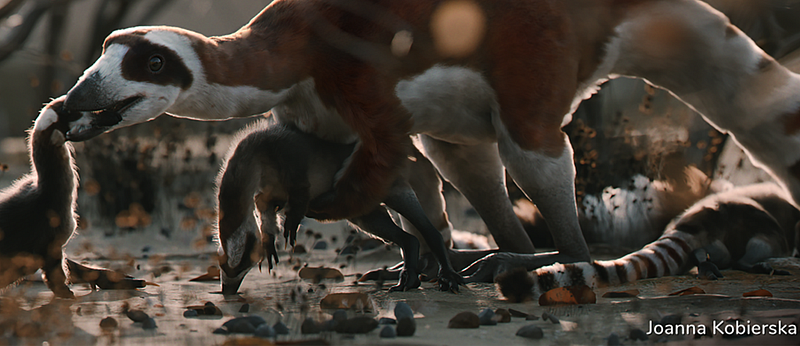
For almost the entire history of paleontology, there was no way to tell what colors the dinosaurs actually were. Paleontologists believed the true coloration of these creatures was beyond the reach of detection and for a long time, the debate about dinosaur color remained a topic of wild speculation.
Not anymore.
In the past decade, scientists working in the field succeeded in solving a mystery many million years in the making.
But how?
The Clues
The key to solving the coloration puzzle comes down to minuscule structures called melanosomes. Melanosomes are tiny organelles that contain pigment, or melanin, and are present in soft tissues such as skin, scales, and feathers. These organelles are responsible for color and photoprotection in animal cells and tissues. Unfortunately, during fossilization, these details are usually cast aside as fossil bacteria. Not always, though.
In some rare cases of delicate preservation and with the help of advanced imaging technology, scientists are able to examine the microscopic details of fossils and find the relationship between these tiny structures and the colors of their fossilized owners. Thanks to these meticulous examinations, scientists have been able to identify the color palette of some dinosaur species.
Below follow some notable examples of dinosaur genera in which such examinations have performed.
1. Anchiornis huxleyi
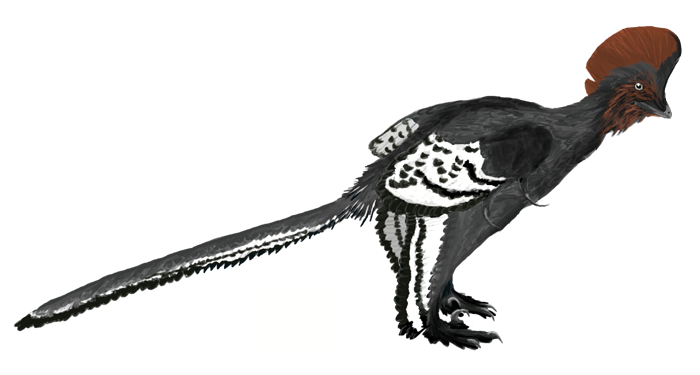
The first dinosaur on our list is Anchiornis huxleyi, a small bipedal theropod that lived 160 million years ago in China.
Anchiornis was about the size of a crow and had long, wing-bearing arms, long legs, and a long tail. It was covered in feathers, though it also had scales on certain parts of the body.
In 2010, a team of scientists examined the feathers of an extremely well-preserved Anchiornis specimen to survey the distribution of melanosomes in the plumage surrounding its skeleton. The analysis showed that Anchiornis spotted feathers of black, grey, and white — similar to a magpie — with a splash of red feathers on the top of its head.
Thus, Anchiornis became the first Mesozoic dinosaur for which almost the entire life coloration was known [1].
2. Sinosauropteryx prima
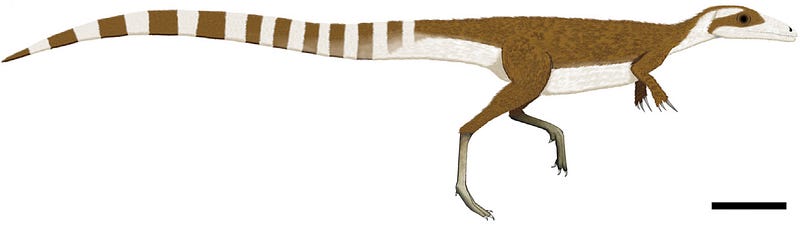
Another dinosaur for which paleontologists have determined its coloration is the compsognathid Sinosauropteryx. Described in 1996, this animal is the first non-avian dinosaur to be found with evidence of feathers.
Sinosauropteryx lived 122 million years ago in China, and, like Anchiornis, it was a small bipedal theropod. The largest known specimen reaches up to only 1.07m (3.5 ft) in length. Sinosauropteryx was anatomically similar to its famous European relative, the Compsognathus.
Thanks to the type specimen’s exquisite preservation, paleontologists were able to examine the melanosome structure and distribution along its coat of filament-like feathers.
Their analysis confirmed the presence of light and dark bands of color in its tail. By comparing its melanosome types to those of modern birds, scientists concluded that the darker feathers were chestnut or reddish-brown. Further research also revealed Sinosauropteryx had a raccoon-like bandit mask and countershading patterns most likely associated with an open habitat.
3. Psittacosaurus mongoliensis
Next up to our list is Psittacosaurus, an early ceratopsian dinosaur that is distantly related to the famous Triceratops.
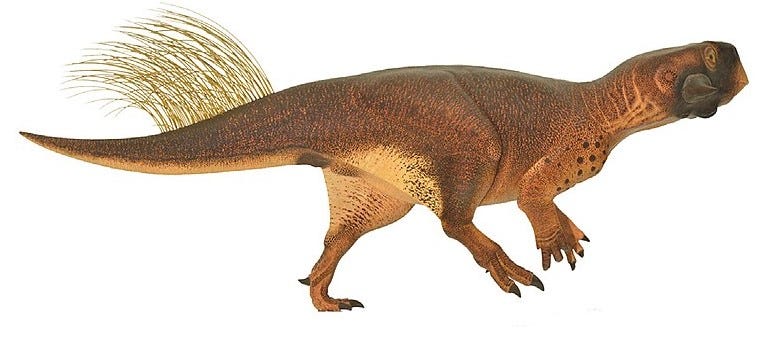
Measuring about 2 meters (6.5 ft) long, Psittacosaurus spent most of its time walking on two legs. Its skull was high and narrow and its anterior region was shaped very much like a parrot’s beak. This animal lived between 126 and 101 million years ago in what is now Asia.
Psittacosaurus is in many regards a special creature. For one, it is notable for being the most species-rich dinosaur genus with up to 12 species known so far. In addition, it is one of the most completely known dinosaurs. Scientists have found the fossils of hundreds of individuals, including many complete skeletons. And finally, it is one of the few dinosaurs the paleontologists can tell its coloration.
A 2016 study examined the melanosomes of a beautifully preserved specimen of Psittacosaurus and showed that the animal was counter-shaded, much like many modern species of forest-dwelling deer and antelope. The specimen had dense clusters of pigment on its shoulders, face, and cloaca as well as large patagia on its hind legs that connected to the base of the tail.
The authors of the study pointed out that there might have been variation in coloration across the range of the animal, depending on differences in the light environment. The dark above, light below pattern and stripes of the specific Psittacosaurus might indicate that this animal lived in a forested habitat with diffuse light.
4. Microraptor gui
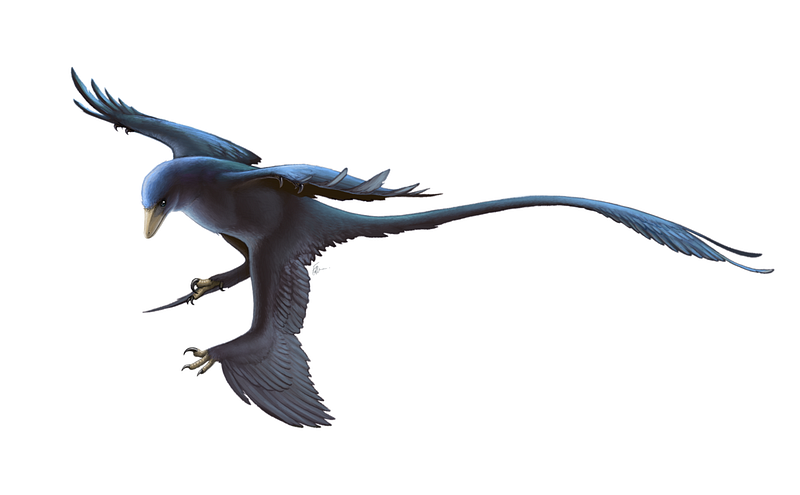
Microraptor was a four-winged dromaeosaurid that lived in Liaoning, China some 120 million years ago. At only 77 centimeters long (2.53 ft) and with a weight estimated up to 1 kilogram (2.2 lb), Microraptor was among the smallest-known non-avian dinosaurs. Fossil specimens of this creature show it had long pennaceous feathers on the arms, tail, and legs.
Paleontologists determined the plumage coloration of Microraptor by analyzing the fossilized melanosomes of the extremely well-preserved specimen BMNHC PH881.
Scientists compared the arrangement of Microraptor’s melanosomes to those of modern birds and found that the winged dinosaur sported a black, glossy coloration. The rod-shaped, narrow melanosomes were arranged in stacked layers, much like those of a modern starling, indicating iridescence in the plumage of Microraptor.
Though the true function of the iridescence is yet unknown, scientists suggest that the tiny dromaeosaur was using its glossy coat as communication or sexual display, much as in modern iridescent birds.
5. Borealopelta markmitchelli
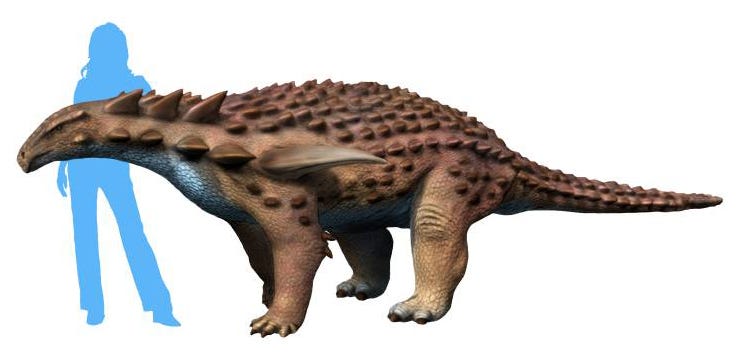
Borealopelta is the largest dinosaur on our list. Stretching to about 4m (13ft) long, it belonged to the ankylosaur family, the group of armored dinosaurs that were covered in bony osteoderms[2]. Ankylosaurs were herbivorous, bulky quadrupeds, and Borealopelta was no exception.
This creature lived between 113 to 100 million years ago during the Early Cretaceous Period in what is today Canada. Discovered at an oil sands mine north of Fort McMurray in Alberta, the specimen is remarkable for being among the best-preserved dinosaur fossils of its size ever found.
The fossil preserved not only the osteoderms in their life positions but also the remains of their keratin sheaths, overlying skin, and stomach contents from the animal’s last meal.
This individual appears to have sunk upside-down onto the seafloor shortly after its death, causing the top half of the body to be quickly buried with minimal distortion. The result is a specimen that preserves the animal almost as it would have looked in life, without flattening or shriveling.
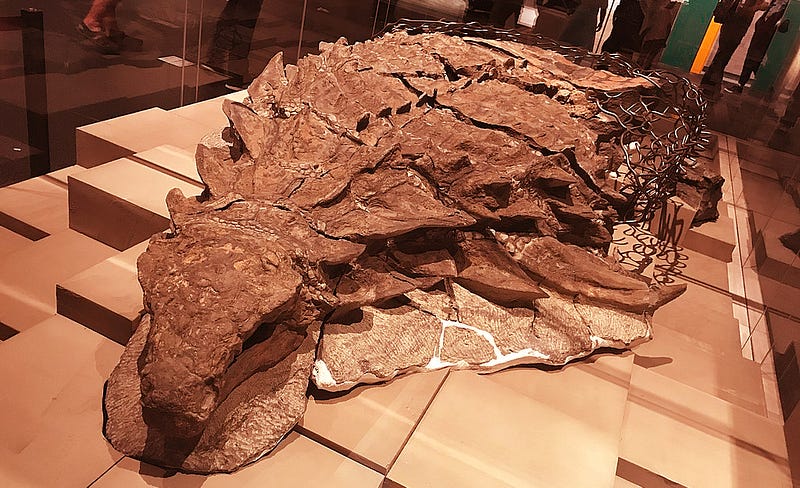
Paleontologists examined the pigments present in Borealopelta’s preserved skin and scales and found that the animal most likely had a reddish-brown coloration in life, with a counter-shaded pattern. According to the scientists who conducted the study, the counter-shade pattern could have helped the dinosaur to camouflage in its surroundings.
Epilogue
The study of melanosomes in exquisitely preserved fossils is a remarkable step forward for paleontology. It allows scientists and artists to reconstruct these remarkable animals with an accuracy never previously imagined.
We often think of dinosaurs as a sort of mythical creatures, distant from our understanding. The identification of their color patterns gives not only a more authentic look at the way we perceive them. In a way, it helps us bring them back to life.
Notes
[1] Unfortunately, the tail of the Anchiornis specimen was not preserved.
[2] Ankylosaurs are divided into two main families, the Nodosauridae and the Ankylosauridae. Borealopelta belongs to the nodosaurid group.
Relevant Read
References
Li, Q.; Gao, K.-Q.; Vinther, J.; Shawkey, M. D.; Clarke, J. A.; d’Alba, L.; Meng, Q.; Briggs, D. E. G.; Prum, R. O. (2010). “Plumage color patterns of an extinct dinosaur” (PDF). Science. 327 (5971): 1369–1372. Bibcode:2010Sci…327.1369L
Zhang, F.; Kearns, S.L.; Orr, P.J.; Benton, M.J.; Zhou, Z.; Johnson, D.; Xu, X.; Wang, X. (2010). “Fossilized melanosomes and the colour of Cretaceous dinosaurs and birds” (PDF). Nature. 463 (7284): 1075–1078. Bibcode:2010Natur.463.1075Z. doi:10.1038/nature08740. PMID 20107440.
Sloan, C. (27 January 2010). “Dinosaur true colors revealed for first time”. National Geographic Magazine. Retrieved 14 January 2011.
Li, Q.; Gao, K.-Q.; Meng, Q.; Clarke, J.A.; Shawkey, M.D.; D’Alba, L.; Pei, R.; Ellision, M.; Norell, M.A.; Vinther, J. (2012). “Reconstruction of Microraptor and the Evolution of Iridescent Plumage”. Science. 335 (6073): 1215–1219. Bibcode:2012Sci…335.1215L. doi:10.1126/science.1213780. PMID 22403389. S2CID 206537426.
Panciroli, Elsa (2016–09–14). “Scientists reveal most accurate depiction of a dinosaur ever created”. The Guardian. Retrieved 2016–09–15.
Vinther, Jakob; Nicholls, Robert; Lautenschlager, Stephen; Pittman, Michael; Kaye, Thomas G.; Rayfield, Emily; Mayr, Gerard; Cuthill, Innes C. (2016). “3D Camouflage in an Ornithischian Dinosaur”. Current Biology. 26 (18): 2456–2462. doi:10.1016/j.cub.2016.06.065. PMC 5049543. PMID 27641767.
Brown, C.M.; Henderson, D.M.; Vinther, J.; Fletcher, I.; Sistiaga, A.; Herrera, J.; Summons, R.E. (2017). “An Exceptionally Preserved Three-Dimensional Armored Dinosaur Reveals Insights into Coloration and Cretaceous Predator-Prey Dynamics”. Current Biology. 27 (16): 2514–2521.e3. doi:10.1016/j.cub.2017.06.071. PMID 28781051.


