
‘Jurassic World: Dominion’ Will Feature Feathered Dinosaurs but Many Fans Have Reasons to Feel Disappointed
Seems as if the famous franchise takes one step forward and two steps back…
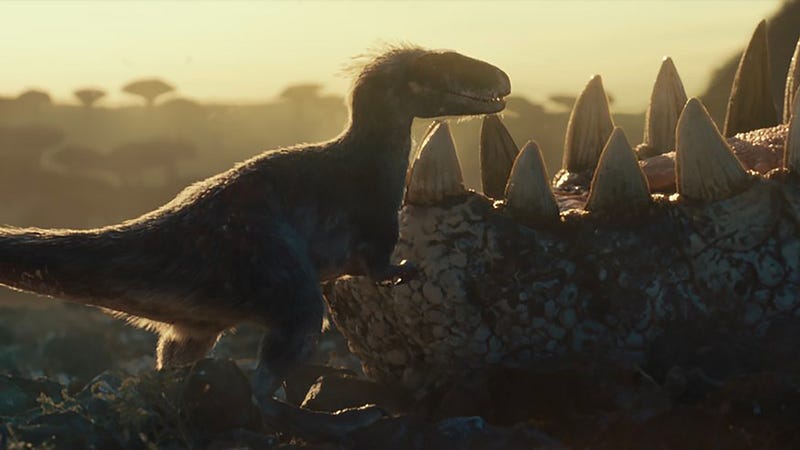
Moviegoers in more than 40 countries across the globe will have the chance to watch a special extended preview of Jurassic World: Dominion ahead of every IMAX screening of Fast and the Furious 9. What is exciting about the five-minute-long preview is that it will — for the first time — feature dinosaurs with feathers on the silver screen.
While the decision to include feathered dinosaurs in the upcoming film received a lot of positive reactions, those who are fond of scientific accuracy have also reasons to feel a bit disappointed.
The good news…
The appearance of feathered dinosaurs has been long requested by many fans and experts who thought the famous franchise should have gotten in line with the latest paleontological discoveries sooner.
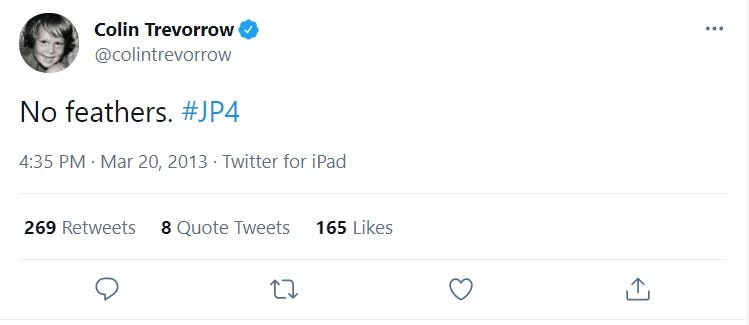
Back in 2013, when the fourth installment was in production, director Colin Trevorrow tweeted that the dinosaurs of Jurassic Park 4 (later to be renamed Jurassic World) will not bear feathers. The decision sparked a debate since scientists had long determined that certain dinosaur groups, including the cunning “raptors” of the films, were fully feathered in real life.
This time, circumstances have apparently changed. Trevorrow, who will yet again direct the next Jurassic Park movie, posted a photo on Twitter with the caption “Feathers #JurassicWorldDominion” officially announcing what was so long expected.
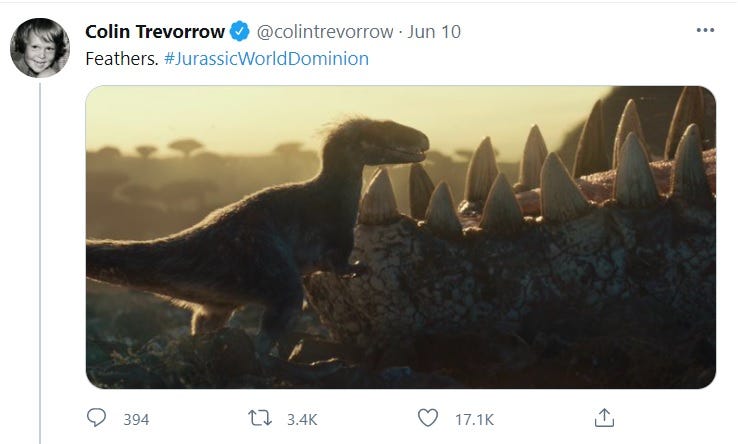
Trevorrow posted a photo portraying a small tyrannosaurid called Moros intrepidus which sports a full coat of feathery plumage. A juvenile Moros is seen close to the terrifying jaws of another dinosaur which the director himself revealed to be the much anticipated Giganotosaurus, the giant carnivore that will fight and kill T.rex during the film’s opening. Moros and Giganotosaurus are set to appear for the first time in a Jurassic Park/World film. And they are not alone.
Colin Trevorrow admitted that during the five-minute special extended preview, a total of seven new species will be showcased. Apart from the carnivores mentioned above, the prehistoric assembly will include the giant sauropod Dreadnoughtus, the feathered Oviraptor, the enormous azhdarchid pterosaur Quetzalcoatlus, the spike-thumb Iguanodon, and Nasutoceratops — the horned dinosaur featured in the 2019 short film Battle at Big Rock.
The introduction of recently discovered or lesser-known dinosaur species in the film is something the famous franchise deserves praise for. Jurassic Park movies are a popular medium through which wider audiences get in touch with paleontology and science in general.
It is no secret that the success of the original Jurassic Park in 1993 was responsible for turning many young people towards a career in paleontology. Today it is this generation of scientists that vastly contributes to some of the latest and most important discoveries in the field.
…and the letdown
Unfortunately, the popularity of these films has also its downside. Every time they portray something inaccurate or entirely fictional as fact, experts find it hard to reverse the public’s false perceptions.
According to Colin Trevorrow, the preview includes a prologue to the film’s narrative and is set in the actual Late Cretaceous Period some 65 million years ago. This throwback intends to show the origin story of the individual Tyrannosaurus rex that first appeared in Jurassic Park back in 1993.
So far, so good.
The problem is the dinosaur species that are going to appear for the first time in the film not only were not contemporaries of Tyrannosaurus but some of them even lived on entirely different continents. Dreadnoughtus lived in South America (84–66 million years ago), Oviraptor in Asia (75–71 million years ago), and Iguanodon in Europe (126–122 million years ago). Moros and Nasutoceratops are North American dinosaurs, but the former lived 30 and the latter 15 million years before Tyrannosaurus.
As for the Giganotosaurus, the creature that is supposed to fight and kill the Tyrannosaurus rex during the Late Cretaceous throwback? It was separated from Tyrannosaurus by more time than when humans evolved from primates! Furthermore, it lived in Argentina, not in the United States.
Of all the prehistoric creatures that are going to be featured in the preview, only the flying pterosaur Quetzalcoatlus lived alongside T.rex.
This is…careless to say the least. In an age of misinformation, the misplacement of dinosaur species is frustrating to hear and brings a huge hindrance to proper paleo-science education. Since the preview is supposed to take place in an actual and specific geological period and place, movie producers should have been more careful.
True, Hollywood movies are not natural history documentaries, so no one should expect a 100% level of scientific accuracy. Many experts and members of the paleo-community though are disappointed because those inaccuracies will unnecessarily spread misinformation and confusion among the audience about a specific geological epoch.
What makes it worse, is that those anachronisms could have been avoided without having to compromise on the spectacle of the final product. For example, the exciting new dinosaurs could have been introduced later in the film when the original age and location of de-extinct animals do not matter. Besides, Tyrannosaurus shared its environment with some of the most remarkable dinosaurs that ever existed. All dinosaur genera that are going to be introduced in this preview could have been easily replaced by scientifically sound counterparts [1]. This makes it even less excusable for a film that claims to revive the paleontological essence of the franchise.
Epilogue
Jurassic World: Dominion will finally feature dinosaurs with feathers, something many people have long been asking for. In addition, the film will introduce some amazing new dinosaur species. Most of them are not yet popular with the public, but they have the potential to inspire a new interest in these amazing creatures.
Unfortunately, the movie will also contribute to spreading misinformation and confusion by portraying dinosaurs from different continents and eras as though they actually coexisted. These anachronisms naturally disappoint the ones who are more knowledgeable on the subject and expect a higher level of paleontological accuracy from the film.
Jurassic World: Dominion is scheduled to be released in theaters on June 10, 2022.
Notes
[1] Dreadnoughtus could have been replaced by the equally enormous Alamosaurus, Oviraptor by the large feathered oviraptorosaurid Anzu, Nasutoceratops by the all-time favorite Triceratops, Iguanodon by the duck-billed Edmontosaurus, Moros by the dromaeosaur Acheroraptor, and Giganotosaurus by…another Tyrannosaurus.
There is enough scientific evidence to support that tyrannosaurs sometimes engaged in cannibalistic behavior and interspecies fights. Thus, the idea of a Tyrannosaurus killing a member of its own species is quite plausible.
To learn more on the subject, read the article below:
Relevant Reads:
References
Chris Pugh, June 2021, ‘Jurassic World Dominion’ Opening to Take Place 65 Million Years in the Past & Features Seven New Species (plus Feathers)!, Jurassic Outpost, Link: https://jurassicoutpost.com/jurassic-world-dominion-opening-to-take-place-65-million-years-in-the-past-features-seven-new-species-plus-feathers
Nick De Semlyen, June 2021, Exclusive: Colin Trevorrow Talks Jurassic World: Dominion IMAX Preview, Empire, Link: https://www.empireonline.com/movies/news/exclusive-colin-trevorrow-talks-jurassic-world-dominion-imax-preview/


