
WORK
Sounding Out the New Work Environment of the Future
A discussion about what lies ahead for businesses in the post-lockdown world

Our brains were programmed at an early age to adopt the concept of work routine. Waking up each morning, dashing to the office during rush hour, and arriving home in the evening to spend time with family.
Repeating the same every day, five days a week.
Throughout the pandemic, our working patterns were disturbed, dispersed, and fragmented. We had little choice but to “work from home”.
This article will discuss the challenges and solutions faced by those working from home after lockdown.
Challenges
At the height of the crisis, most companies and employees didn't know how to work from home (WFH). For most, there was no precedence. There were no procedures to adopt in a time of crisis.
The business-world always operated on a nine-to-five basis. Our working schedule and employment contract spelled out ways of working, codes, guidelines, incentives, promotions, and ethics for employees to develop behaviors that reflect the vision and culture of the organization.
In 2020 employees were thrown into a mysterious work-world, from home, with little guidance on operating procedures, if any, making the transition much more difficult for the masses.
To tackle the working WFH puzzle, we need to learn how to “work from home”, as it differs vastly compared to a traditional 9-to-5 job.
Communication
Contemporary offices are designed to facilitate seamless communication. Employees’ can understand how a colleague is feeling and openly share thoughts to enhance team productivity.
All of a sudden everything was transferred to a virtual world.
This is near impossible in a WFH situation as much of our communication is now non-verbal. Tools like Skype or Zoom facilitate collaboration but cannot replicate the office balance.
The environment
The WFH environment can vary drastically from one employee to another. For some the home environment is simply not conducive to work. It’s not fit for purpose. Distractions by children, spouses, roommates, pets, or other external factors made WFH all the more challenging.
Bonding collectively
At work employees engage, bond, and build trust. This solidifies team cohesion. Information is shared, displayed visually at the office on notice boards, post-its, or through print outs.
Such artifacts are absent in the home setting.
This facet can startle some, disrupting their work-cognition, which can impede an employees’ ability to manage assigned tasks efficiently while feeling part of the team.
So, how do we manage the WFH situation given that it’s now a thing and will be a permanent fixture in the future?
Harmony
There is no ‘one-size-fits-all’ solution for WFH. That said, before the industrial revolution many of our ancestors worked from home. For instance, in careers such as crafts, like sculpting, poetry, or garment making WFH was the norm.
This is an indication that WFH is in our DNA. It’s part of our human makeup, but it needs to be unlocked for the modern world.
Simplicity
Moreover, it’s unwise to neglect lower-order skills, the run of the mill tasks, because they have the potential to have a positive impact on productivity.
The key skill is WFH rhythms — repeat actions, tones with regular or irregular beats, just like music — that resonate with the wellbeing of employees.
Rhythmic organizations form when workers carry out tasks routinely, in tune. Leaders interact with workers in a rhythm that resides in the organizational ethos. This creates a systematic process, in manageable bite-size-chunks, for team performance.
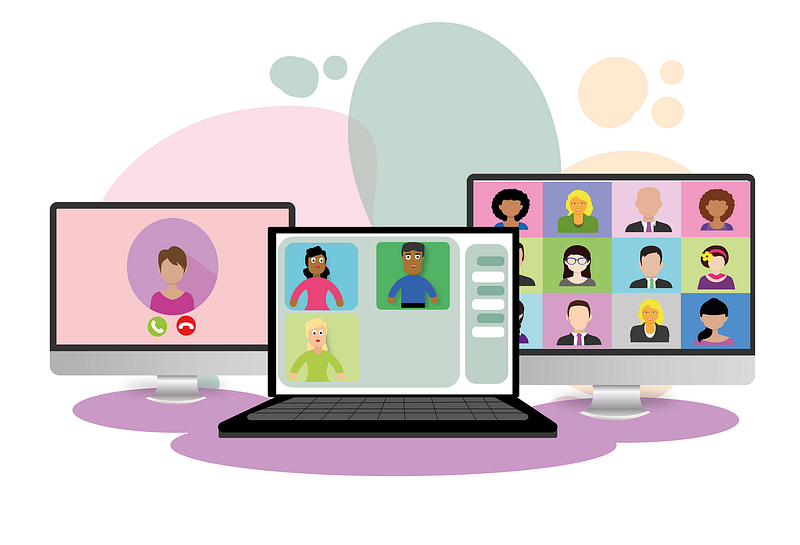
A virtual meeting with positive intent, an optimistic undertone, creates an upward rhythm that enhances job satisfaction, employee happiness, and connection, resulting in better WFH productivity.
Final Thoughts
Change is afoot, that’s clear, but a rhythmic organization is a more harmonious workplace, regardless of location.
An iterative rhythm is better than monotone in the virtual workspace, meaning that teams should alternate, pivot, and adjust their work tone to be more productive on demand for all stakeholders.
This is crucial because talented workers are now evaluating their work-life balance by taking stock of their careers.
Leaders must recognize that the global pandemic does not equate to an ordinary WFH situation, so attentive care and agile diligence is called for.
In order for organizations to be successful at WFH going forward, they need to orchestrate rhythmic-skillsets, a harmony that resonates with employees.


