Remote Working: 4 Reasons to Join the Digital Nomad Generation
Remote Working may not be for everyone, but it’s growing at lightning speed, so what are the benefits?
When Shopify came to Ireland back in 2015 they initially hired 50 remote workers to support their ever-growing European Customer base — This move ignited Remote Working en-masse, others soon following suit, like eBay.
“Shopify’s growth in Ireland has been staggering but at the same time unique because of the remote working model.”
— John Kennedy, Siliconrepublic.com
In Ireland, Shopify has grown from a team of 50 to more than 150, based remotely across Galway, Ireland. In 2017 the company announced plans to hire another 100 people by 2018, increasing its workforce to 250 people.
So what are the benefits for advocates of the Digital Nomad Generation like me?
№ 1: Time — Escape The Metal Box
Horror stories abound for legions of Irish commuters, especially during these dark midwinter days when weeks of endless rainfall turns a manageable car journey into motorway hell.

Over dinner last weekend I learned from a former colleague that it took him “nearly two hours to get home from work yesterday!”
“That’s nothing”, said another friend at the table, who recently bought a new home just 25km outside the Capital City, Dublin. She was horrified to learn that the commute to her new job is now “taking me nearly three hours.”
You don't have to be a mathematician to work out that these commuters are spending 4–6 hours a day in a metal box — their car. That’s 20–30 hours a week. Add this to the typical working week, 40 hours, equates to 60–70 hours. Oh, let’s not forget the 30–60 minutes that every worker spends each morning to shower, dress and prepare the kids for the day — 75 hours is not uncommon.
So, what does this mean? Well, we all have 168 hours in a week, that’s non-negotiable unless you have a time-machine, therefore the worst-case scenario for a non-remote Worker looks like this:
- Sleep: 8*7 = 56 Hours
- Travel: 5*6 = 30 Hours
- Daily Prep: 5*1 = 5 Hours
- Work: 5*8 = 40 hours, ignoring overtime or working late
- TOTAL: 131 Hours
Let’s break this down — 168 hours less 131 hours = 27 hours — That’s all the time left to enjoy life, to relax, to travel or spend time with your loved ones — 16% of your time each week is Free, 84% is gone.
Remote workers don’t have this dilemma. In contrast, their total week could be as low as 98 hours (including sleep), leaving 70 waking hours a week to live — almost three times that of commuters — 41.6% free time a week.
№ 2: Health — Wellbeing at work
Businesses are better when their people are healthy, that’s a no-brainer, a statement of fact really. Visible Benefits of this include fewer sick days, increased energy levels, improved focus and concentration levels while encouraging culture to attract new hires thus further elevating productivity.

The health benefits extended to Remote Workers are two-fold: a) the physical and b) the mental wellbeing of working alone.
a) Physical Health
According to Airtasker, remote workers gained more exercise each week, squeezing in an extra 25 minutes of physical activity compared to their office-bound counterparts.
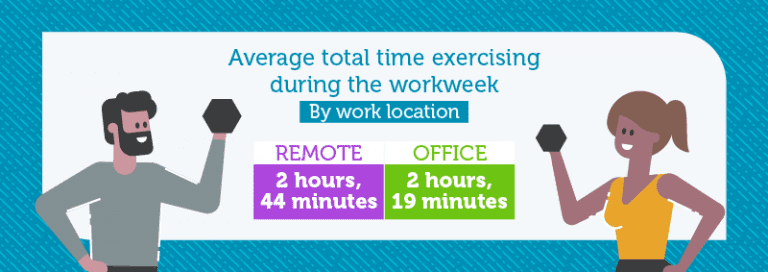
In my opinion, that may be a lot higher in Ireland given the huge disparity in free time, 70 hours versus 27 hours.
b) Mental Health
Mental health is a sticking point; the onus is on employers to combat this by understanding the risks in order to minimize the impact on their employees
“The potential negative mental health impacts include loneliness, feelings of isolation and the potential negative physical impacts such as neck, back and shoulder pain from poor work stations.”
The potential negative physical impacts of Remote Workers noted above are no different than that of office workers, who also have to endure the implications associated with commuting, particularly those traveling by car.
Mental health lacks longitudinal evidence given that Remote Working research is in its infancy, so work in progress is a fair conclusion.
№ 3: Productivity — Getting More Done
Productivity plays an integral role in bolstering business, as such Airtasker took a deeper look at this topic.
The research undertaken by Airtasker found that people working outside an office environment get more work done, clocking up an additional 16 days a year while accomplishing more each day.
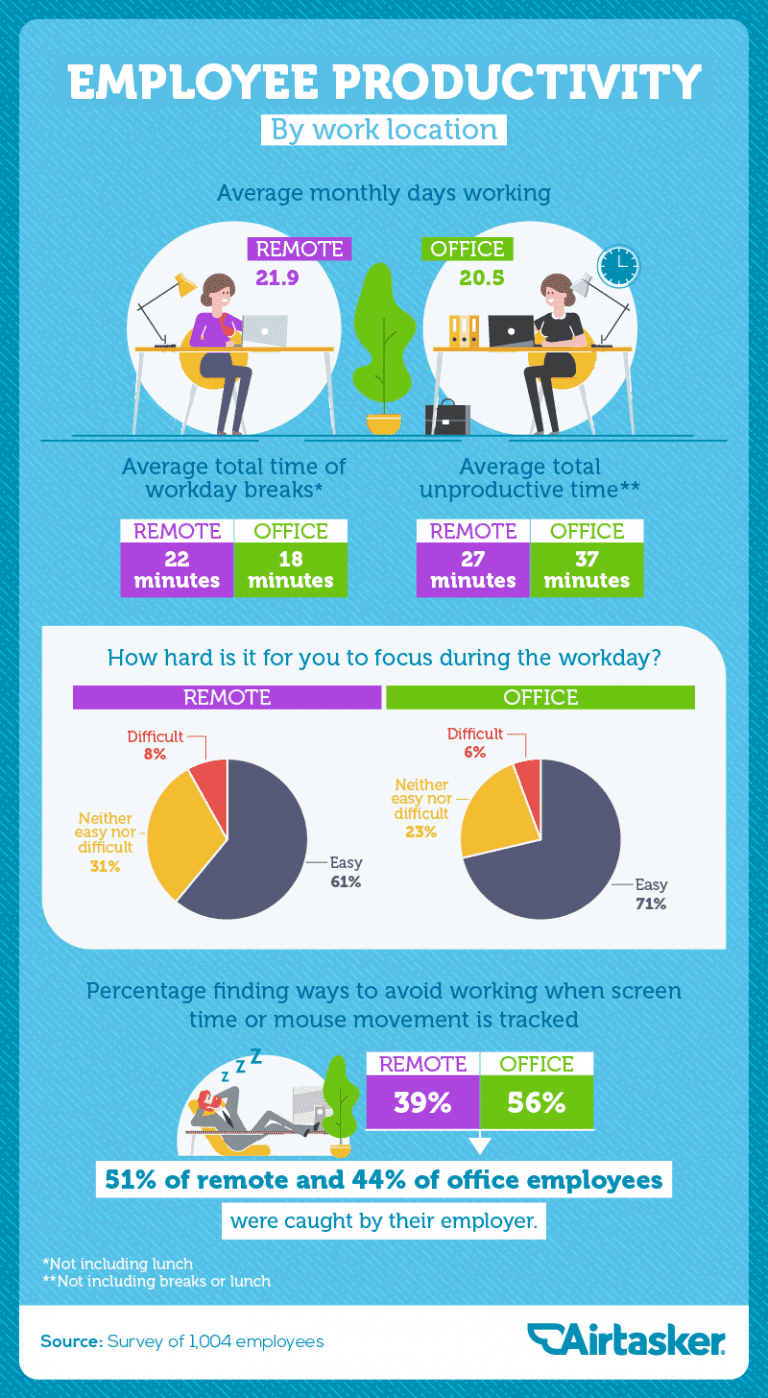
One of the main drivers behind this disparity included fewer distractions; described as interruptions by managers or bosses in addition to chatting with colleagues about random topics, unrelated to their job.
Also, Airtasker reported that 33pc of remote employees said that set working hours was the most effective way to stay productive. Whereas 25pc remained productive by choosing the same location every day, although these observations are not that different from office workers.
For another viewpoint it’s worth reading Daniel Sines article, he claimed that Hiring Remote Workers Made My Entire Team More Productive.
№ 4: Cost — Lean Operation
Working remotely is cost-effective for all stakeholders. For example, the Airtasker report noted that time and financial costs were drastically different between both groups when analyzed. This study discovered that “remote workers saved an annual average of $4,523 on fuel alone, as well as 17 days of extra free time.” — Lisa Ardill, Siliconrepublic.com
Also, there is tax relief available for Home-working — further savings. According to the 2016 Census in Ireland, “56,774 people (excluding those in the agriculture, forestry and fishing sector) are homeworkers. This is an increase of 20% from the 2011 figure, which was 47,193” — dbei.gov.ie

The number of free days, however, could be significantly higher considering the calculation shown in No 1 above:
- Δ = (70 hours –27 hours)= 43 hours a week gained in free time
- 48 working weeks p.a. = (48 *43) = (2,064 / 24 hours)
- TOTAL = 86 days of Free time
So extra free time could in fact much higher, ranging anywhere from 17 Days to 86 Days, substantial nonetheless. 86 days / 30 = 2.86 months. So remote workers could regain 1 year of their time for every 4.2 years in the workforce, in extreme cases.
That’s Mind-Blowing.
“Remote work can be cost effective. This includes reductions in overhead costs, allowing firms to reduce desks or engage with hubs to reduce the need for a large-scale headquarters.”
Shared working spaces are popping up across the globe to supply the demand of the seismic shift towards Remote working. There are numerous articles published on Medium about WeWork, such as:
- WeWork owes $18 Billion in Leases? by Alexander Muse
- WeWork Dropped the Best Idea They Had by Will Hayward
- Microsoft Should Buy WeWork and Merge It with LinkedIn by Vlad Pavlov
While WeWork has attracted a lot of criticism, there is no denying its conceptual business model. This side of the Atlantic, thinkbusiness.ie recorded over 70 shared working places nationwide.
According to the American Bureau of Labour Statistics, 40% of the workforce will be freelancers, independent contractors or ‘solopreneurs’ by 2020. A trend that’s “likely to be replicated in Ireland.” — thinkbusiness.ie
Final Thought — Reflection
Being a Remote worker I can certainly relate to the 4 Benefits outlined above, at least on a personal level — I’ve experienced an improvement in happiness & fulfillment as a result. While not without challenges, for me the benefits far outweigh the disadvantages.
Leadership is one aspect that I believe is somewhat unproven in a remote working culture. The article on Leadership & Entrepreneurship published by The Startup last month is more relevant than ever. That said, I’m no expert, so I’d suggest reading articles by Shauna Moran who is an expert on the topic of Remote Working.
“Either you run the day or the day runs you.” — Jim Rohn