Top 4 Skills for Entrepreneurs & Leaders

General Douglas MacArthur arguably defined E-Commerce Leadership long before the industry even existed. His choice of words: “equality of his actions and the integrity of his intent” resonates with Stogdill’s’ proposal that leadership is “the ability to bring about positive change” (Stoghill, 1974). By “intent” E-commerce Leaders and Entrepreneurs have delivered “positive change” for modern society.
Notably many E-commerce leaders of today did “not set out to be a leader”. For example, Sophie Amaruso (founder of Nastygal.com) said recently “I never wanted to be a CEO” (Daily Mail, 2014), echoing the sentiment of online business owners. Yet today Nastygal.com employs over 300 people while boasting a turnover in excess of $130 million, within six years of trading, with Amaruso at the helm.
Paul Mooney wrote about his personal experience in Accidental Leadership in the opening chapter he states:
“In my experience very few kids or young adults decide (Consciously) that they want to become leaders. Most people end up in Leadership roles — Accidental leaders as it were” (Paul Mooney, 2009)
With accidental leadership in mind, visionary Entrepreneurial founders have often stumbled across unique ideas— by accident — or rather through accidental persistence to rebut conformance.
For example, the concept of online retailing was born from a non-conformist mind-set, a mind that resides in a constant state transformation, almost dissatisfied with the way things are. Their intuitive drive never seems to rest, indicating a subconscious acknowledgment that complacency always precedes extinction, an alien destination for Entrepreneurs.
So what are these FOUR skills:
High energy and Stress Tolerance
The capacity to maintain a demanding role “with healthy vigour and an upbeat attitude through good times and bad” is without question a vital skillset (Welch et al, 2006).
Trait research shows that energy level, physical stamina and stress tolerance are associated with managerial effectiveness, particularly relevant in situations such as:
- Dealing with punitive stakeholders
- Dealing with stressful situations
- Calmness while supporting staff under pressure
- Confrontation and dealing with problematic issues
- Resistance associated with change or business transformation
- Communicating effectively
- Conveying confidence in all situations
Energy fuels the ability to motivate and synergize followers while managing stress. Stress can be positive or negative. Eustress, the pleasurable stress that accompanies positive events which excites and energizes; Distress on the other hand is the unpleasant stress that accompanies negative events. This type of stress crushes and oppresses if not managed correctly.
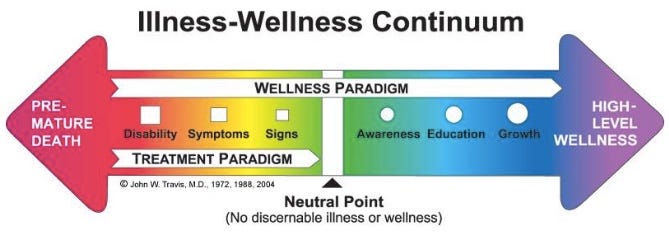
The wellness paradigm indicates milestones along the wellness continuum. Leaders and Entrepreneurs who aim to maintain a position of neutrality, preferably towards the right hand side of the wellness scale, robustly defend their mental state and energy levels. Tim Denning proposed that habitual activities like exercise was important in his story, I would add meditation, relaxation and mindfulness for stress management and energy preservation.
One of the biggest challenges for Leaders and Entrepreneurs is to manage the ever expanding list of actions, most of which could be outsourced or discarded.
In his Book, Good to Great, Author Jim Collins noted that: “Most of us lead busy but undisciplined lives. We have ever-expanding ‘to do’ lists, trying to build momentum by doing, doing, doing — and doing more. And it rarely works. Those who built the good-to-great companies, however, made as much use of ‘stop doing’ lists as ‘to do’ lists” (Collins, 2011). Here Collins correlates trait dependencies by applying Intelligence through smart elimination of tasks, thus promoting Stress Management to protect energy levels.
1) Self Confidence
Self Confidence is a by-product of High Energy and Stress Management. Low energy coupled with elevated stress levels can erode confidence over time by attacking esteem.

As a trait Self Confidence includes a number of related themes like self-esteem and self-efficacy. So people with higher levels of Self Confidence are more likely to seek responsibility, look for and act upon problems, seek out opportunities, overcome challenges while gaining the respect and confidence of colleagues, subordinates and partners through their assured actions and behaviours.
In his book Instant Confidence Paul McKenna wrote that “as a leader you must expect resistance and even rejection, because they are the price of innovation. So if you’re going to be a leader you’re going to have to be willing to lead” (McKenna, 2006). The same applies to Entrepreneurs. McKenna supported this view using Apple as an example:
“When Steve Jobs and Steve Wozniak were trying to build a prototype for the Apple computer they attempted to get Atari and Hewlett-Packard interested. They even offered to give the companies all the rights in exchange for funding and a nominal salary. Not only were they rejected, Hewlett-Packard actually said: We don’t need you — you haven’t got through college yet!” — (McKenna, 2006).
According to McKenna the price of innovation is taxed by resistance and rejection, whereas the armour which defends against this inevitable onslaught is Self Confidence. If Jobs and Wozniak lacked this trait, Apple and subsequently the iPhone may not exist today.
The impact of a scenario such as this may have had far reaching effects. For example, a generation could have been denied smartphone technology, considering that Apple raised the bar and redefined market boundaries when they presented the world with the iPhone. In doing so Apple also prompted competitors like Samsung into action (and others into decline), causing Innovation to accelerate at faster rate than the previous decade in mobile technology.
Michael Porter’s Five-Forces model predicts that ‘new entrants’ will always pose a credible threat in any market. You can read more about the application of the 5-Forces in a story published by Michael Tan.
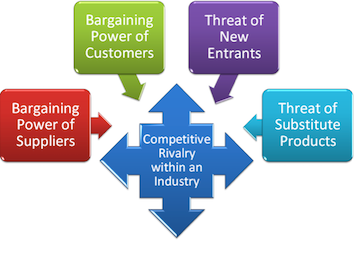
We’ve all witnessed this unfold in the mobile phone industry where one casualty, Nokia, is testament to the impact of relentless Self Confidence. The concept that Self Confidence can impact future generations coupled with it being an underlying force that validates one of Porter’s Five-Forces (New Entrant). As such, it magnifies its value as a leadership trait . Apple proved that Self Confidence can incubate the ability to influence the trajectory of future events with profound social implications. Technological advancement was essentially born out of this trait, nurtured along the way in order to navigate a path littered by resistance and rejection.
2) Internal Locus of Control
Environmental changes can be either attributed to the success or failure of things that one has control over or can be attributed to forces outside direct influence. Essentially it means that a person’s orientation choice has a bearing on long-term success. This is known as locus of control. Those with high Self Confidence tend to have high Internal Control, they go hand in hand.
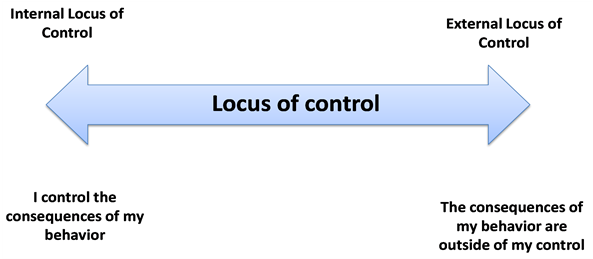
In 1966 Julian Rotter conducted a study on how people’s behaviours and attitudes affect the outcomes within their lives. “Locus of control describes the degree to which individuals interpret that outcomes result from their own behaviours, or from forces that are external to themselves, producing a continuum (above) with external control at one end and internal control at the other” (Mindtools.com, 2014).
Leaders and Entrepreneurs with a strong Locus of Control orientation believe they can effectively guide situations and influence outcomes by their actions, whereas people with a low orientation believe events are decided by chance or fate and their actions have little or no effect.

Rotter’s research established a correlation between ‘Internal Control’ and effectiveness, characterised with respect to leadership, by the likelihood to take action in order to influence the outcome of future events. In short, future orientated ecommerce planners are visionaries.
There are numerous examples of such occurrences to validate Rotter’s study, such as when Amazon was created. When Jeff Bezos, an ex-stockbroker, brought the book world online his internal control was not fazed by the might of Barnes and Noble, he didn’t allow the fact that they were not selling online stand in the way of his vision. Similarly, Jobs and Wozniak demonstrated this despite the negative feedback from Atari and Hewlett Packard, resulting in the birth of Apple.
3) Emotional Intelligence
Self Confidence and Locus of Control are the catalysts for Emotional Intelligence. In 1998 Daniel Goleman wrote an article, published in the Harvard Business review, in which he identified common traits associated with management and leadership, namely:
- Intelligence
- Toughness
- Vision and
- Determination
According to Goleman however, these traits alone are insufficient for modern organisations and The Startup by proposing the emergence of Emotional Intelligence as the most essential tool in an effective leaders’ repertoire of skill sets. Goleman cited that Emotional Intelligence encompasses five skills, which he specified as:
- Motivation
- Self-awareness
- Self-regulation
- Empathy and
- Social skills.
The significance of these competencies equips leaders and managers to inspire those around them during transformational journeys.
“Great leaders move us. They ignite our passion and inspire the best in us. When we try to explain why they are so effective, we speak of strategy, vision, or powerful ideas. But the reality is much more primal: Great leadership works through the emotions” (Goleman, 2014)
Goleman implies that empathy for example doesn’t mean that an effective leader allows the feelings of others to guide his/her decision making, nor does he suggest that he/she will undertake or become burdened by others problems. On the contrary it is a conscious ability and awareness of the potential impact on followers as a result of their decisions.
Likewise, highly developed social skills enable Leaders and Entrepreneurs to build rapport with others in order to nurture a collaborative environment all the while moving towards defined goals. It is in essence the ability to inspire while developing and solidifying relationships with others with a keen eye on the purpose at hand.

While continuing controversy surrounds the usefulness of Emotional Intelligence, with some critics claiming it uses known traits and skills and adds no new insights to effective leadership, Goleman does present a compelling argument.
Traits or not, Emotional Intelligence is about understanding and dealing with relationships within organisations — management of oneself under pressure. The aforementioned trifecta of traits, Emotional Intelligence, Locus of Control and Self Confidence are intimately linked, woven together to form a co-dependent existence, executed with precision by proficient leaders.
4) Achievement Orientation
Achievement Orientation encompasses a set of related needs and values. As one might expect, Achievement Orientation is about achieving results, striving towards excellence, or simply a personal desire to improve and develop oneself.
Achievement oriented Leaders and Entrepreneurs not only set high standards for themselves but also those around them. These individuals tend to be critical thinkers who set aside time to think, seek out new and better ways to improve their own skills and performance and also those of others.

Leaders and Entrepreneurs try to anticipate any challenges and opportunities ahead. When required they are prepared to take calculated risks to achieve what they want; governed by a burning appetite to continuously move forward they are almost never entirely satisfied and complacency, the concept is alien.
“Conversely, people who lack this competency will tend to work within their comfort zone. They will rely on others to set deadlines and standards. Whilst studying, they might still be satisfied if they do just enough to scrape through or hand in work a little over the deadline. They are often found to be catching up on missed work or running late.” (Coventry University, 2010)
Achievement oriented Leaders and Entrepreneurs get things done. They maintain high standards and at the core are customer centred, more crucial in industry than ever before. Driven by a competitive edge they strive to stay ahead of the curve and endeavour to establish competitive advantage, acutely aware of the 3 Types of Innovation.
This trait excels in finding new ways of doing things — Innovation. High AO Leaders are likely to take responsibility, set challenging goals, plan ahead and take action with a strong concern for task with a level of risk.

Effectiveness is commonly linked to power orientation but achievement orientation does likewise if entwined in social power orientation, as its involves the collective…a Group or Team.
On the other hand it can be destructive or counter-productive when driven by personalised power orientation.
Final Thought
To conclude I’ll leave you with a reference, a citation even:
The Startup published a Tim Denning story — 33 Things Successful Leaders Have Given Up — all 33 points have a direct correlation with the top 4 Skills for Entrepreneurs & Leaders.