THE WORKPLACE
Will Workers Ever Go Back to the Way It Was?
The office workspace is undergoing a monumental transformation
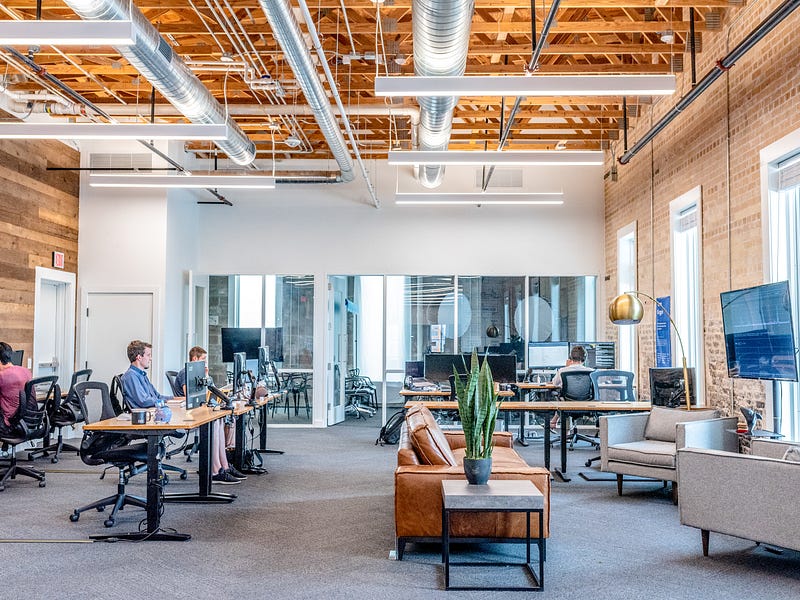
In the new world of social distancing, many office workers around the world haven't seen their desks for over a month now. So what happens when lockdown eases?
There may be fewer desks to return to.
Businesses are facing a sudden need to cut costs. Leaders have indicated that their property portfolios look like a good starting place to start considering the ease with which their organizations have adapted, adopting remote working almost instantaneously.
The notion of thousands of people in an office block may be a thing of the past. One thought is in the air that it's possible that we don’t need all the offices we currently have around the world.
Discussion
Think about it. In just over six weeks we’ve almost taken the entire corporate office population into the kitchens and living rooms of workers and did so seamlessly. People are adapting. Dogs barking or a wandering child are common features of conference calls and is accepted. Many don't seem to miss the office either.
“I have been so much more connected to 20,000 employees in the last six weeks than I have in the last six months thanks to the technology we are using,” — Jim Collins, CEO at Corteva
It's easy to book video conference meetings with employees or clients from home, removing the tie and cost to travel to meet face to face. If this continues there is little need to rush back, in fact, many will remain home workers.
This will bring permanent change to our working practices.
Real Estate
This movement will be alarming for commercial property owners, who have cast doubt on the sustainability of remote working.
Thomas Durels, an Empire State Realty Trust executive said: “most of us have now experienced the inefficiencies of working from home and miss the connectivity and productivity an office environment provides.”
I can't help but smell a strong odor of bias in Durels statement, I think he’s wrong, at least in part.
Fair enough, the work environment and daily interactions bring about social energy. But can this be replicated by working from home with another feature, like meet-up huddles in smaller shared spaces two or three times a week? I believe so.
What’s certain is that social distancing will impact commercial real estate’s high-density trend, squeezing more people into smaller spaces. At least in the short term.
Recovery
The first phase of the post-pandemic recovery will see commercial tenants to rearrange to a lower density arrangement. There will be a need for office space in the future, albeit in a different form. Each employee will need more space with bigger communal areas, with implications on the ROI per square foot, which will impact demand.
Some families are struggling to juggle homeschool and childcare alongside their day job, but this will change when schools reopen. Junior employees who are sharing living space don't have the same problem so they offer a ready-made test case.
The immediate preoccupation for leaders now is how to get employees back to work safely. Considerations like how many employees can work in a building if an elevator is limited to two at a time.
There’s also a shortage of perspex to separate desks, while the price of PPE like gloves, hand sanitizer, and masks have risen sharply, adding a new cost.
A staggered return or shift is possible over a seven-day week, with only 50 percent occupancy to maximize the distance between colleagues. Although this presents other issues that some have not considered like elevator buttons and door handles that can transfer Covid-19.
You can’t even share the same kettle or teapot with others.
This calls for a whole new protocol in order to return to a healthy and safe workspace. If this is the route that companies want to take.
Businesses also need to consider a better IT infrastructure, if 50 percent of workers work remotely on a given day going forward. The impact is that they will need less space, driving down property values.
Skyscrapers
Certain offices, like skyscrapers, are incompatible with national guidelines to combat Covid-19. Vertical transportation systems cannot move thousands of people vertically with the current social distancing measures.
In some instances, social distancing rules may only accommodate 25 percent of workers in skyscrapers. The main roadblock being the mass transit of workers on elevators.
Distance
One solution is thermal imaging at reception to determine the body temperature of those entering the building. Lifts could have yellow markings to remind workers to maintain a safe distance and disinfected hourly.
There’s also the stairwell.
If anything the coronavirus has accelerated trends that were already underway in changing the workplace:
- Open-plan
- Hot-desking
- Shared spaces
- Flexible hours, and
- Using technology to work from home
Outsourcing companies like WeWork could have a smaller property footprint once this pandemic is over. Shared office blocks could be used less to house modules of standalone desks and more to bring clusters of teams together.
Not every industry can or want to work remotely, in flexible ways. Heavily regulated businesses, like banks, may not have the luxury of choice. Every company is using this situation as an experiment in order to make a strategic call going forward.
The demand for disaster recovery sites, fully equipped building that lay idle, is under threat given that they proved pointless during this pandemic. Companies carrying this expense are likely to explore disposal options
Disaster recovery sites were for an era past.
Final Thoughts
It’s likely that employees will spend fewer days at an office going forward. People do like going into the office. Meeting with colleagues face to face. The workplace is an important community.
To recap, the likely impact of the coronavirus will see the following implications on the commercial world:
- PPE for all office workers
- Staggered working hours or shifts
- 50 percent occupancy
- Employees will attend the office 2–3 times a week, if at all
- Smaller off-site team huddles
- An explosion in remote working, permanently
- Investment in remote IT infrastructure
- Fall in commercial property value
- Fall in morning commutes
- Fall in commercial travel
Balance is the most likely outcome, but the new workplace is unfolding before our eyes, just at a much faster rate than expected.