
Working From Home: A Solution To The Earth’s Healing
If employers allow workers to continue using remote access.
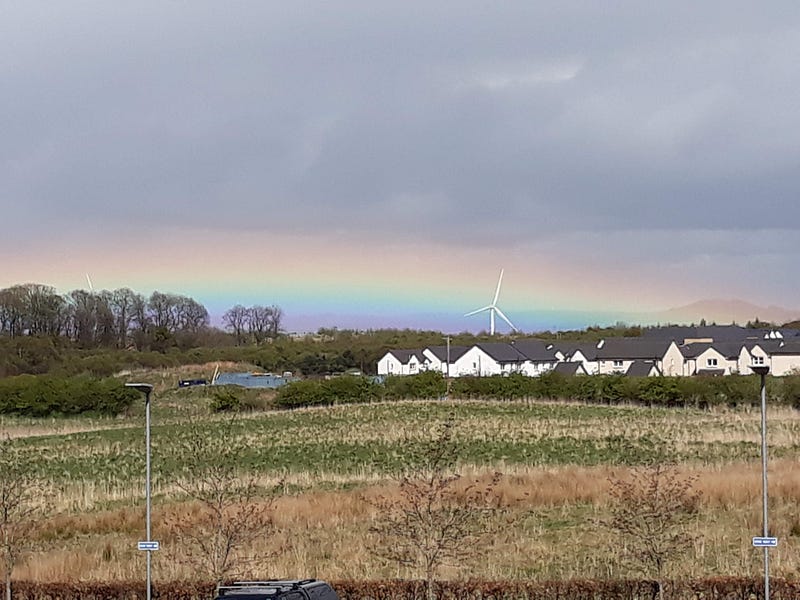
While many people are thinking that the sky is falling and life as we know it is crumbling, I'd like to think we can all stand together and face up to our governments, our employers and the extremely rich folk who are destroying our planet, our lives and the lives of our children.
Let the sky fall When it crumbles We will stand tall Face it all together ~ Adele
With millions of people working remotely, many of whom were previously restricted by company policy and or micromanagers, I wonder if employers will extend this ‘perk’ to the time when we are all vaccinated and or immunised against this year’s virus strains.
I can foresee immense benefits in several areas.
Companies could introduce hot desks for the days when essential meetings are required. They could reduce the size of their office space and in turn reduce the rent they pay or sell their existing monoliths to find smaller premises.
Empty commercial buildings could then be rezoned by local councils and converted to affordable housing in major cities. Key workers, who cannot currently afford to live near their place of work, could buy reasonably priced homes.
Fewer cars on the road every day of the week would reduce the emissions that pollute our atmosphere, cause allergies, and asthma.
Noise pollution would be reduced, sadly not to the current levels where we can hear the sparrows and blackbirds singing in bushes and trees but it would be an improvement, wouldn’t it?
Have you noticed how brave rabbits, deer, and birds of prey have become since the drastically reduced traffic volumes?
I watched a bunny lollop across the road from one green area to a roundabout which was abundant with fresh plants and bushes to eat and explore. This was at 8.30 AM. Pre-coronavirus that roundabout would have been heaving with workers speeding to work.
I have to ask why did we do it? What was it that spurred us on to assume ‘as a car driver I have the god-given right to use my vehicle to plough down a road at high speed to get to my office on time, do work that will pay me — generously, fairly or outrageously poorly — to make astronomical profits for the owners, the shareholders and or the government?’ Maybe you’ve asked yourself the same question.
Does spending time with your family, partner or alone bring you a sense of calm or are you climbing the walls with boredom?
Some are embracing this freedom of furlough as a period to make the most of with their families. Using their allocated hour for walking together across the fields, enjoying the rabbits, deer and birds of prey, sharing the sighting of a land rainbow with fellow walkers, and appreciating the fresh air and spring flowers.
Another, previously, rare sight is the lesser-spotted male Halford’s homo-sapien. Desperate to escape the walls that are crushing their hunter-gatherer natures, they queue — mostly two metres apart — in a semi-orderly fashion (indicative of a more relaxed, less time-restrained era) to enter the hallowed grounds of the motoring and cycling accessories superstore. Halfords also sell bicycles.
There’s a brisk trade of contactless cash being exchanged for shiny metal frames with chunky tyres and then being proudly wheeled through the, set on open mode, sliding doors, witnessed by the eager onlookers.
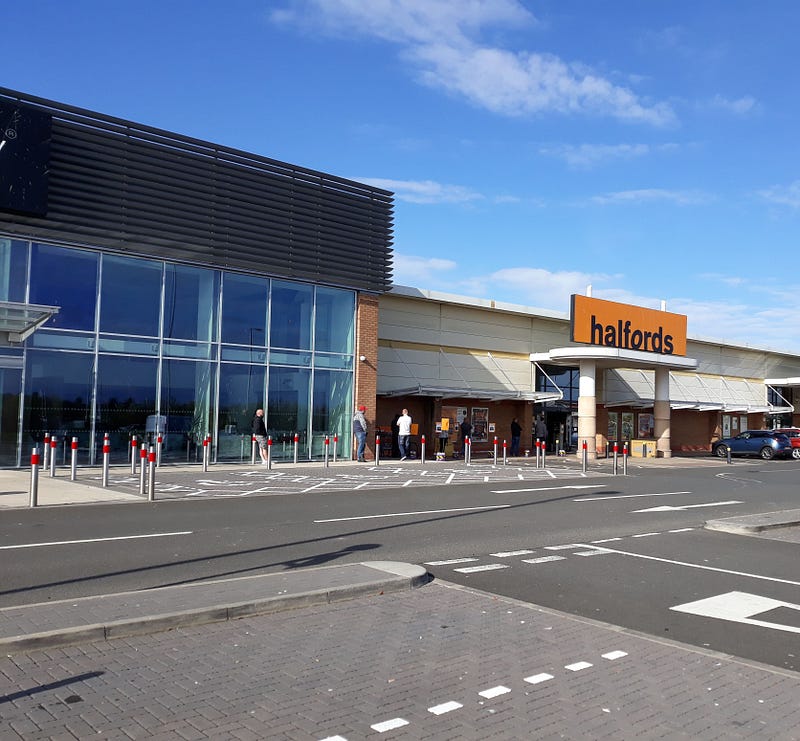
The dark side of consumerism.
Although buying new stuff holds no fascination for me, I’d recommend, for others, a shift from wandering zombie-like around shopping centres in the future.
I’ve never understood the attraction and decided the lure of a luxury designer or cheap attractive and anything in-between was not for me long ago. I’m also definitely not buying from a monster-sized maze where it’s possible to get so lost you can’t find your way out! It happened to me. Never again, thank you very much.
On the other end of the spectrum, spare a thought for hospitality workers who were sacked due to — or in some cases — before the COVID-19 caused lockdowns of the restaurants, coffee shops, and hotels. They are now forced to sleep rough in doorways because they were unable to pay their rent.
Despicable employers, agencies, and landlords should be named and shamed. I hope they adhere to the rules and are unable to replacement tenants.
In theory, viewings of a property are not permitted — I know because I tried through an estate agent but was advised it was not possible at this time. But you can guarantee that unscrupulous people will get their way.
As the Guardian further reports, some of these minimum wage earners were already living on the gold-paved streets of London before the pandemic hit them.
The advent of lockdown has served to spotlight the absolute impossibility for zero-hour or casual contract, minimum wage earners, in whatever roles they play, to have a chance of looking after themselves without their jobs.
Many of these ex-service providers seem to be, for whatever reasons, ineligible for Universal Credit. In addition, the organisations (including hotels being funded by the government) that want to help them appear to be overwhelmed by the numbers of recently homeless workers. Either that or they have no knowledge or have lost sight of hundreds of street dwellers.
Repeal employment laws.
This is an opportunity to repeal employment laws. Outlawing zero-hour and casual contracts would be a good start. But that might be a little radical for some. Instead, how about mandatory holiday and sick pay to be made by employers and agencies for all minimum wage earners?
Why should minimum wage and or self-employed gig or freelance earners have less than employed workers? If anything, they should have the same basic rights as workers with permanent employment. We’d have a fighting chance of improving our lot instead of dropping further down the valued-worker chain and into poverty when something unexpected like a broken leg or a pandemic happens.
Work is already starting on affordable housing in Manchester.
We could rejuvenate derelict or abandoned buildings and why not build on scrub and wasteland? I’m sure there are many legal reasons why this can’t happen but, again, why not? Why can’t we make this happen?
There are whole swathes of Manchester that were abandoned years ago. The rows and rows of terraced houses could be rented and or bought by people who, with a good internet connection, could work from home. Take a look at this plan from March 2020.
Accept immigrants, they are here to help.
Motivated by @GaryLineker’s shared tweet everyone in the UK needs to accept the immigrants who have been slaving away tirelessly to keep us alive, from cleaners to consultants and fresh fruit and veg pickers in the fields to shopkeepers. And when we have survived and we are eating out in our favourite restaurant, consider those immigrants serving us our avocado toast brunch or steak and chips.
We are all human beings, from the lowest-paid to the richest, we need each other to survive. There are no acceptable reasons why we should think otherwise.
We now have a prime opportunity to put the world to rights.
A Universal Basic Income for everyone could wipe out hopelessness and hunger for so many people. I believe Scotland has the right idea.
Right now, while millions of us are at home, there are abundant possibilities for retraining, re-educating or recreating ourselves and our world.
Stop stripping the world of — vital to our ability to breathe — elements such as trees, which meets the demand for more cows and turkeys, coffee and cacao, and palm oil. Lines the pockets of that famous 1% and aids obesity.
Let’s think before consuming, edible or otherwise. Do I really need to eat that Big Mac, buy that designer whatever, or drive my SUV to work five days a week?
Governments should be creating policies that put the planet first, this would then work in tandem with people working the land, creating and producing on smaller scales for their communities and possibly those nearby. Working in harmony with rather than against the environment.
Businesses, small, medium or large, should operate not for shareholders’ dividends or profits but for the survival of the planet and its inhabitants.
We brought this virus upon ourselves.
By craving new and more, by consuming foods in outrageous quantities, by creating demand we have — using our capitalist system — created a monster that will not be sated until it has cleared every tree off the face of the earth, mined every useful element for our designer technology, and killed off every pollinator with chemicals designed to create higher-yield crops.
“Pathogens do not respect species boundaries,” says disease ecologist Thomas Gillespie, an associate professor in Emory University’s department of environmental sciences, who studies how shrinking natural habitats and changing behaviour add to the risk of diseases spilling over from animals to humans.
Corporations and manufacturers will claim they are only meeting the needs of the consumers. Unless they are stopped.
We, the people of the planet, need to make use of what we’ve already got and pursue the changes we’ve achieved (intentional and inadvertent) during the lockdown. Use our imaginations to build novel careers that protect the planet and all of its inhabitants.
The writing has been on the wall for a long time.
We now have to read, comprehend, and act on it.
The writing’s on the wall.
How do I live? How do I breathe?~Sam Smith
I say, let the sky fall, because we are all in this together and we can build a better environment for every living being.
The future.
Can you see the benefits of working from home three days a week, to consuming less to save the remaining forests, to making the world a better place for everyone to live in?
What are you going to do to change the way you live? Who are you going to challenge to make positive changes?
I promise Greta Thunberg did not pay me to write this. I based it on tweets, YouTube, The Guardian newspaper research, and my own opinion.
The James Bond 007 theme tunes added an element of saving the world from a different angle, I thought. I also really, really like both of the songs.


