
DATA FOR BUSINESS
Tiny Data: How to Look For Clues That Reveal Powerful Trends
Small data is often overlooked but it holds the key to unlock amazing insights

Today’s business world is saturated with information. Bursting with all sorts of data. Information that companies are hungry to mine, consume, acquire, and interpret.
Why? They’re ravenous to gain insights about you, and me.
They have a ferocious appetite too!
Their primary objective is to extract as much value from this (your) data to understand the relationship between their brand, their products/services, and their customers — us.
Capturing and analyzing large datasets, touchpoints, and interactions is challenging for a human analyst, but hardly presents a problem for an intelligent algorithm.
So from a big data perspective, business and technology work closely together to feed a famished enigma.
This raises two important questions:
- Are they eating at the right table?
- And, who’s serving them?
What about tiny data? The sprinkles of dust, magical data mist, overlooked, and unseen because of the secrets it holds.
“Connect the Dots” — Kathryn A. LeRoy, Ph.D.
This article will explore tiny data, in the context of big data in business, with a splash of human behavior to top it off.
Big Data
Okay, I’ll not bore you with a definition, take your pick from Forbes “12 Big Data Definitions” (Press, 2014).
But I’ll ask you this — what are organizations looking for?
Wait. Let me rephrase:
What would cause someone to sacrafice their living, their career, their relationships, their life— by life I mean exactly that — Life (almost)?
The answer is simple — integrity.
The cause, however, is Data or misuse of it rather. Information that organizations record about us to be specific, and how they manage it. Acquire, capture, call it what you will, but use it without our knowledge or approval.
This is a form of “Big Data.” Actually, it’s corruption, fraud even, but let’s call it big data for now.
Allow me to expand, in two words:
- First word: Edward
- Second word: Snowden
Enough said. You get the point. I hope.
The Truman effect
Remember the Truman show? Well, today companies are seeking and banking a lot of information about us. With or “without your consent”, according to Snowden (Lepore, 2019).
We’re all part of the Truman show today folks.
All digital players use data to label us — you and me — we’re categorized into groups, segments, lookalikes based on our behaviors, frequency, monetary spend, and engagement.
Every cluster or group is targetted by an engineered, tailor-made campaign, designed to convert based on our preferences.
There are pros and cons for consumers, but ultimately our data has become a currency that’s traded by others.
For example, if one brand has 5 clusters with 100,000 consumers in each and knows that the average email campaign conversion rate is 2%, with an average spend of €50 per order, the predictive data looks like this:
- Segment A = 100,000 consumers
- Average order value (AoV)= €50
- Potential value (PV) = (€50 * 100k) = €5 million
- Conversion rate (CR) = 2%
- Predicted revenue = PV*CR = €100k in Sales
Apply this across each segment, assuming all data points are equal, suddenly €500k revenue lands within a few days.
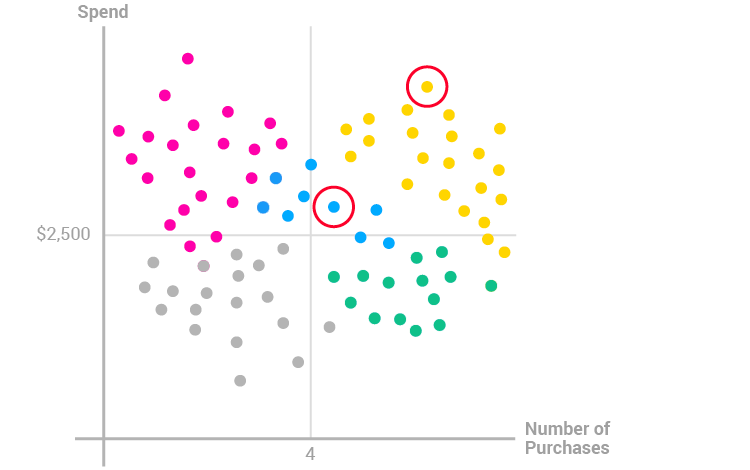
That's the power of how data is used to build email marketing campaigns for revenue predictability. In effect, a collection of tiny data.
Data cha-ching
This data can be sold. Our data. Let’s say you just launched a new product and identified a non-compete brand that sold a different product to the same profile of consumers. A perfect audience, worth something.
For instance, take a nutrition brand and a sportswear brand. The brand that owns the database, our data, could negotiate like this:
- I will sell you 3 email marketing campaigns
- The first is expected to convert at 2% = €100k in revenue
- The second should convert at an additional 1% = €50k in revenue
- The third should convert by 0.5% = €25k in revenue
- Total potential revenue = €175k
With this in mind, if one brand sold its audience to enable another brand to promote a new product launch, the deal could look like:
- For €175k in potential revenue, the fee is 11.5%
- An upfront payment of €20k … thank you very much
The (potential) benefit for a B2B buyer is three-fold:
- Potentially €175k in new sales, but a risk
- Exposure to 500k potential (ideal) consumers
- Acquisition of high-potential consumers
Easy money — That’s the value of tiny data, the value of you and me.
Outliers
Then there’s the outliers, circled above, small groups that convert at 5-10 percent and/or spend in excess of €200 per month, or €2,500 per annum. High-value consumers.
With this in mind, here’s what marketers should be asking:
- Who are these outliers?
- What do they look like?
- Where do they hang out?
- How can we find and retain more?
The Pareto principle applies, whereby 20 percent of customers represent 80 percent of your revenue. So if you had a €1 million annual marketing budget, where would you spend it? Or rather, who would you spend it on?

The fact is, you don't need to think too hard because tiny data has all the answers. Well, most of it.
Social media
Think about Facebook, Twitter, Instagram, or other brands in this space. We are their product, their most important asset — Fact!
Without people, social media would cease to exist.
If everyone stopped using social media tomorrow, for just 24 hours, share prices would collapse — Social media armageddon.
That said, big data and tiny data can be put to good use as easily as it can be abused. Unfortunately, the misuse of data along with corporate infractions is more common than we think.
Trust me, I’m writing from experience.
Back in 2014, Facebook launched its version of Adwords. Basically, brands could buy ads and define what profile of user each ad would be displayed to.
How? Easy — Facebook had a decade of intimate data, our data, becoming a social-gatekeeper. Indirectly they sold our information, albeit wrapped up in segments, to B2B buyers.
In 2014 eCommerce companies could do this:
- Upload their database to Facebook
- Facebook would connect users by email and/or phone number
- Done!
In effect, Facebook outsourced the groundwork to any brand that wanted to play their game. Brands willingly shared their customer list, empowering Facebook to become … more powerful.
Oh, here’s the real kicker, you paid for this luxury. By sharing your audience Facebook could pretty soon determine its value to your brand.
And they did.
Ads cost money, right? Initially, Facebook was a fraction of the AdWords cost. It was a false economy. Fast-forward to 2017 … guess what happened?
… Facebook Ad costs exploded tenfold thereafter.
This is “Tiny Data” in motion, in transition … transmitting your consumer insights to Mr. Zuckerberg and crew, for free I might add, so that Facebook can monetize your work and sell it back to you in the future — Cha-ching!
Facebook monetized our work, our content, our data in order to sell it back to us!

A river of data
Amazon is at the data-poker-table too. Not to burst your bubble but AWS doesn’t stand for All-Well Society. No. It’s not a charity, nor a goodwill gesture by Mr. Bezos. Nope. Amazon Web Services (AWS) is at the top table and playing to win.
Here’s a snapshot of Amazon’s hand:
№1 — Business insights A: High-level overview of metrics
- Customer acquisition
- Drilldown by month, Day
- No. of Orders
- Revenue split by Country / Channel
- A product category or variation split
- Segment — Churn, lapsed and lapsing
№2 — Business insights B: Margin
- Margin by SKU and by country
- Conversion rate by region
- Avg. margin by SKU
- Margin by SKU by month
- Drill down by week, by day
№3 — Business insights C: YoY Product trends
Product analysis — campaigns on products that are performing well, compared to others last year, month, week, day, or hour.
- Conversion rate
- Revenue
- Product sales by country
- Traffic — new versus returning customers by campaign/product
- Channel sales, by Country — PPC, Organic, e-mail

That’s just the tip of the iceberg. Like Facebook, once Amazon has your data in AWS the insights will be like the Northern Lights (Aurora borealis), 24–7.
Its the “Difference Between Data And Information”
— Terry Mansfield
Tiny Insights
There is another dimension. Allow me to explain:
We tend to arrive at insights by connecting “two things that previously haven't been combined.” As such, big data doesn't spark new insights due to the fact that it resides in a database, which is by definition “too narrow”, one-dimensional i.e. it looks at one piece of information (Lindstrom, 2016).
Data doesn't take emotions into account, as standard. For now.
Tiny data example
Take a bank for example. Banks know more about you, and me, than most other digital technologies and companies combined.
Let’s say that Sean just broke up with his partner. Sean’s bank knows that they’re both saving for a new home. Last week Sean and his partner had €39k in their joint savings account. Yesterday Sean transferred €1,000 to reach their target of €40k — their home deposit.
As Sean walked down the street, he was reeling having just learned that his partner was cheating on him. At that moment, as Sean passed his local bank branch, his phone pinged. It’s a notification from his bank:
“Hi Sean, Book an appointment with a Mortgage advisor today.”
Hmph!— It hit him like a tonne of bricks. Sean knew that his life plans had been altered — permanently.
Soon after he noticed mortgage ads from his bank appearing in his App feed, display adverts. Sean had his location setting activated and knew that his bank was geo-targetting him having walked past his local branch.
This angered Sean.
He immediately transferred half of his deposit, €20k, from their joint savings into his personal account, at another bank.

What Happened
The bank applied Big-data methodology for new business targeting, that's it, which is fair enough.
“Without big data analytics, companies are blind and deaf, wandering out onto the web like deer on a freeway.”
— Geoffrey Moore, Consultant and Author
Their intent was genuine — to sell Sean and his partner a financial product that they were seeking. So their goals were a match in the recent past.
When Sean and his partner hit their savings target, they matched the banks’ criteria for their Mortgage marketing campaign. At that moment, they moved from a warm lead to a hot lead, ripe for conversion.
Sean’s response was impulsive, childish even, fuelled by emotional fog.
I have to admit, Sean’s scenario is somewhat unfair. There’s no way that a bank could have known of Sean’s sudden change of circumstances.
Then again, is that good enough?
It’s challenging, yes, but not impossible. Banks are spending a lot of money on Google ads and App development to target me and you yet ignore or are blind to consumer emotions.
Why?
Is it important?
Yes, it is. But banks are beholden to Google, Amazon, and Facebook to gain such insights. Tiny data that costs a pretty penny today.
The point is that big or tiny data cannot measure emotion, your emotional state at a given moment. Unless of course, you play the game.
Final Thoughts
Tiny data looks at millions of minute pieces of information every millisecond, in microcosms, part of a global system. A virtual e-system that transcends borders, effortlessly, and instantaneously.
Big and tiny data is as useful as the information that it acquires. The information that we give, that we share, willingly.
As mentioned, “data cannot measure” our “emotional state at a given moment”, without our permission. Our participation. We give our permission by playing “the game.”
Our actions fuel others to profit from us!
Most of us permit marketers to make a buck, on our backs. On our data. It’s a choice. It’s as simple as that. We’re naked when we play “the game.”
“Unless you have direct exposure to groups like Deepmind, you have no idea how fast — it is growing at a pace close to exponential. The risk of something seriously dangerous happening is in the five-year timeframe. 10 years at most.”
— Elon Musk
We all participate — but at what cost?
References
- Press, G. (2014). 12 Big Data Definitions: What’s Yours?. [online] Forbes.com. Available at: https://www.forbes.com [Accessed 1 Feb. 2020].
- Lepore, J. (2019). Review: Edward Snowden and the Rise of Whistle-Blower Culture in “Permanent Record”. [online] The New Yorker. Available at: https://www.newyorker.com [Accessed 1 Feb. 2020].


