
Four Reasons Trump Will Leave Office
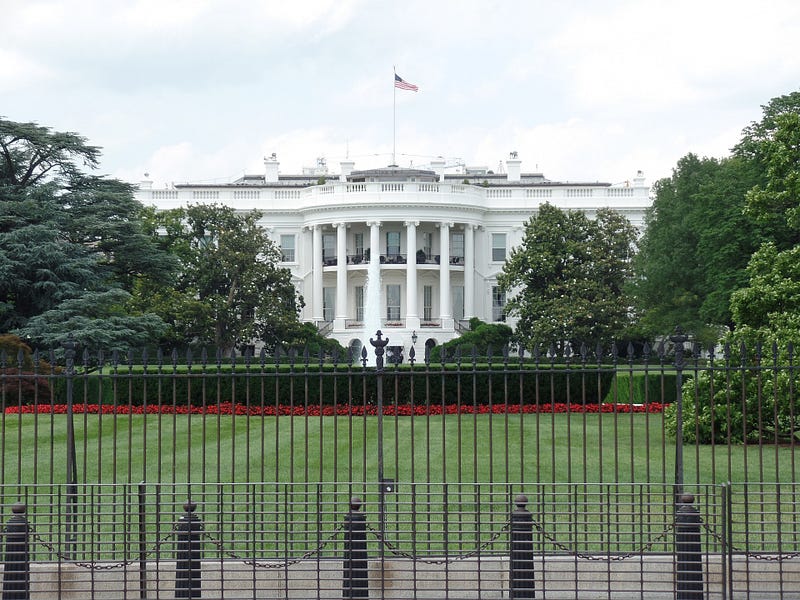
Ignore the fear mongers, democracy is safe.
Every election year, the same nutty paranoia flies around the internet. Conspiracy theorists push the idea that the president of the United States will refuse to leave office, overthrow democracy, and become a dictator. They are wrong for a lot of reasons. Whether in 2021 or 2025, Trump will exit.
For the 2016 election cycle, the theory was mostly pushed by far-right fringe outlets like WorldNetDaily.com, which may have taken notes from the AARP and BSA to just go by its initials, WND. Any time a government agency bought ammunition Infowars would report a secret government plot.
Today, mainstream outlets say the same kinds of things. The possibility has been pushed at The Atlantic, Washington Monthly, the New York Times, the Washington Post, MSNBC, CNN, and others. The prediction has also been pushed by celebrities like Bill Mahar. Joe Biden himself has jumped on board.
The best voice of reason seems to be Fred Kaplan at Slate. He doesn’t disregard the idea that Trump would try but lays out a detailed and convincing scenario explaining the futility, and why it’s just not something to worry about. In addition to the mechanics, though, what are the structural underpinnings of democracy? What would a president need in place to seize power? Does Trump have pieces in place?
Fortunately, the country maintains strong cultural safeguards for the American miracle, the peaceful transfer of political power.
#1 — Presidents are patriots
Those that believe the current president is a soulless narcissist will of course disagree, but Trump sees himself as an American patriot. Becoming a dictator in a coup would not align with his self-image as the savior of America. What would be the endgame for the 74-year-old billionaire? Seizing power to eventually die in office and set Jared Kushner up as his monarchistic successor? That is neither realistic nor the legacy he wants.
On common argument runs that staying in power is the only way Trump will avoid jail, but that’s unlikely. America has a tradition of overlooking past presidential transgressions. Ford pardoned Nixon. Obama didn’t seriously pursue torture charges against the Bush administration. Despite years of “Lock her up” chants, Trump himself never turned the full weight of the government against Hillary Clinton, though he did push Jeff Sessions to investigate the investigation. Trump will never go to jail.
Presidents strive for legacies. There is no path where the legacy of an attempted (or even successful) overthrow of the constitution beats the legacy of simply being president for four years.
#2 — Bureaucrats are patriots
Presidents lead the executive branch and appoint political leaders for key governmental positions. Bureaucrats do the actual work. Career civil service employees, from the TSA guards at the airports to high-level executives in the Senior Executive Service, drive the train.
In general, a president would need broad support in the bureaucracy to sustain a putsch. The administrative state functions as a complex system of systems. Obviously, all of the interlocking law enforcement agencies would need to be suborned, including the FBI, US Marshall’s Service, the Secret Service, the US Park Police, and numerous others in Washington D.C. alone.
But what about the more mundane functions? Who’s going to make the accountants cut the paychecks? How long would an administration last if the Fed stopped loaning money to banks and the economy froze solid. The notoriously liberal bureaucracy mostly hates the president. The Virginia suburbs where they live drag the entire state blue.
#3 — The military are patriots
Like any organization, the US military runs on relationships. It does not, however, run on personal loyalties. Military officers take an oath to “…support and defend the Constitution of the United States against all enemies, foreign and domestic.” During the Civil War, American generals were often primarily loyal to their state as their sovereign. Today’s military, officers and enlisted, are disconnected from their home states, living nomadic lives for decades and visiting home at Christmas.
Senior officers have personal political views but are far more concerned with the legitimacy of their institution than in the success of one person or party. Unlike Erdogan, who purged Turkey’s military of secularists both before and after the 2016 attempted coup, an American president cannot even begin to determine who might be personally loyal enough to support a dictatorship or get enough loyalists in place to take over the vast enterprise.
#4 — The people are patriots
Simply not enough Americans would support a presidential power grab. Suppose turnout follows 2016’s pattern, but instead of a narrow electoral victory the Republicans see a narrow loss. Perhaps 28 percent of the country votes for Biden, 26 percent for Trump, and 56 percent stay home.
Of the Republican voters, how many would seriously and actively support a coup? Generously, maybe 10 percent, on the theory that 10 percent of any group are crazy. That would equate to about 2.6 percent of the country, while the other 97.4 percent of the country would be in the streets. The protests and riots would dwarf the George Floyd protests, and the police, military, and bureaucrats would be shoulder to shoulder with the people.
Tyranny versus legacy
Any president trying to hold on to power would likely face a Ceaușescu moment. On December 21st, 1989, a crowd began to boo him at a routine speech. By the next day, he lost the support of the Army and the police. Following a lightning-fast revolution, Ceaușescu and his wife were tried and executed on Christmas day.
So why do respected thinkers traffic in silly conspiracies? Many reasons. They honestly believe that Trump lacks a moral center. The press throws words around like insane, psychotic, and unhinged. Their starting position is that the only reason the billionaire ran for president was to pump his hotel business.
Also, these stories are a chance to hurt Trump politically, another opportunity to cast him as a threat to all that’s good and decent. This is, after all, an election year, and some journalists have argued for years that duty requires the abandonment of objectivity. Finally, this lunacy gets clicks.
P.S…History is a funny thing. No one today can judge how any president will be viewed in a decade or a hundred years. Ceaușescu is far more well regarded now than he was in power. A surprising number of people would vote for him today.
Brian E. Wish works as a quality engineer in the aerospace industry. He has spent 29 years active and reserve in the US Air Force, where he holds the rank of Colonel. He has a bachelor’s from the US Air Force Academy, a master’s from Bowie State, and a Ph.D. in Public and Urban Administration from UT Arlington. The opinions expressed here are his own. Learn more at brianewish.com.


