
Will 2020 Re-Write Political Theory?
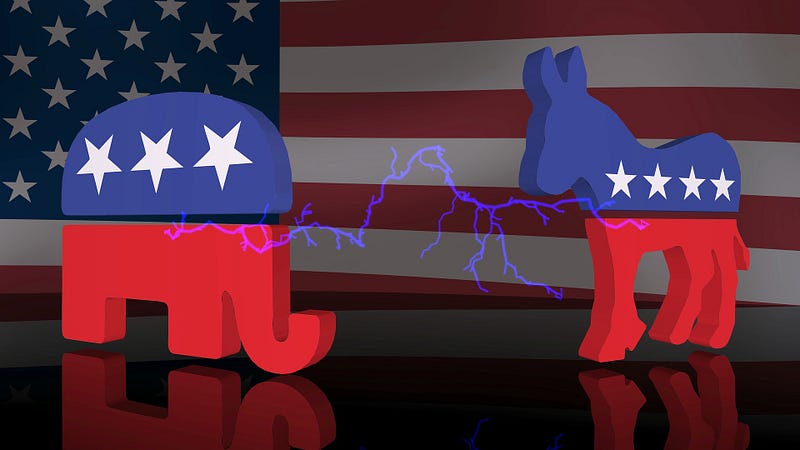
Political polarization, Anthony Downs, and the median voter theorem
Could 2020 change the way we look at elections? For sixty years, much of American political thought revolved around the ‘median voter theorem.’ This once revolutionary idea views democratic elections as market economies. Governments provide services to voters in return for votes, the same way private companies sell products for money.
In 1956, Anthony Downs, a prominent government and economic theorist to this day, postulated that government decisions are made to satisfy the most number of people, called ‘providing utility.’ The regime in power uses the stream of utility to satisfy voters, and the opposition party explains how the people would receive more utility with the opposition.
In practice, this paradigm explained electoral behavior, but like all models, the median voter theorem relies on assumptions. When those assumptions start to break down, the model no longer predicts behavior.
How it works
Imagine voter preferences as evenly distributed on a line from left to right, numbered from one to one hundred. Each voter, anywhere along that line, chooses the candidate closest to their position.
- If candidate A sits at position eighty and candidate B sits at position ninety, then A will get eighty-four votes, numbers one to eighty-four. B receives fifteen, from positions eighty-six to one hundred. Voter eighty-five could go either way.
- In a more typical election, with candidate A at position thirty-five and candidate B at position sixty, A receives votes one to forty-seven, and B receives the remaining 53.
Real-life complicates matters. Candidates address multiple issues, but in the United States and many other countries, a ‘Left’ has evolved that favors more centralized government control and a ‘Right’ that favors less government control. Sometimes these broad categories get twisted around…liberals become 10th Amendment states rights champions on legalization of marijuana, while conservatives champion federal prohibition. In the end, though, the issues average out and the candidate closest to the middle of the voters always gets the most votes.
Primary election systems. Systems with primary elections perform a two-step dance. In the primary, the voting audience consists primarily of either Republicans or Democrats, ranging from extreme liberal or conservative to moderate liberal or conservative. In primary elections, the candidate closes to the middle of the primary audience wins, but by nature will be further away from the center.
This explains how candidates like Bernie Sanders drive the conversation leftward during primaries. Less liberal Democrats try to capture more votes by moving to or across the middle of the Democratic field.
Once the primaries select candidates from both the left and the right for the general election, those candidates traditionally slither toward the center to capture more votes as above.
Other implications. Downs points to other possible consequences. As parties and candidates move towards the center to maximize their ideological reach, they alienate their extremes. To the voter sitting at a preference position of 95, candidates sitting at positions 49 and 51 look a lot alike. The implication is that voters may stay home, vote for the Greens or Libertarians, or a party could fracture.
George Wallace’s third-party run effectively split the Democratic Party in 1968. In the 2000 election, Ralph Nader’s far-left run arguably cost the Democrats the election by tipping the balance not just in Florida but also possibly New Hampshire. (On the other hand, if Gore had stayed far enough to the left to retain most of the Greens, he would certainly have lost more in the middle.) Parties move to the center, but must still pay attention to their periphery.
There’s something happening here
The 2020 election may be an election like no other. The country boils, resembling 1968 but with important differences. Models break down in two ways. First, all models build on underlying assumptions about the environment. When those underlying assumptions prove false, the model fails to a greater or lesser degree. Next, sometimes models prove false not just because conditions don’t meet the assumptions, but because the nature of the model itself proves inadequate to explain. What could that look like in 2020?
Vote suppression. The median voter preference may not prevail if all persons do not have equal rights to engage in political activity and vote. Sometimes this results from incompetence, like when Democrat-controlled election boards in Fulton and DeKalb counties failed during the June primary. Sometimes suppression is actively malicious, like when the IRS targeted conservative groups during the Obama administration.
Democrats point to efforts to identify voters, remove ineligible voters from the rolls, or scale back early voting as attempts to prevent minorities from voting. It’s unclear whether these efforts prevented enough voters who would otherwise have voted to swing any elections. The drop in black voting from record highs with Obama versus when Hilliary Clinton topped the ticket seems unsurprising.
Since the elimination of most abuses in the 1960s, these efforts just nibble at the edges of turnout. Now, however, with the chaos of the pandemic, it’s impossible to say who will vote in November and how they will do it. Mail-in ballots are seen as rife with fraud by conservatives, and liberals view polling places as Petri dishes of Coronavirus. Will Americans go to the polls? If not, will one group be more likely to vote less? Or will ballot harvesters delivering coronavirus to the elderly door-to-door increase turnout?
Rational actors. Another assumption is that candidates are all rational actors. In this context, it means that every action is taken to maximize votes. In 2020, both major parties and candidates are fueled not just by avarice for votes, but by rage. Opponents stake out intransigent positions on the left and the right.
The entire country, black and white, has gone all-in on social justice. Instead of pulling the sides who agree together, the country pulls further apart. The conversation has morphed from justice for George Floyd to the acceptability of disorder versus calls for law and order. Neither calling for pulling down statues of white Jesus or calling for using federal troops to quell disorder are moves to the center; these histrionics appeal only to the radical left and right.
The whole thing falls apart
Median voter theory has proved a reliable indicator of political behavior. Vote-seeking behavior tends to moderate any extreme tendencies of candidates or parties. What if the underlying template for the theory changes? Candidates no longer moderate their positions, but dig in?
Who shows up to vote is always important in an election. Every party tries to fire up their base. Enthusiasm on one side or the other in the electorate has the effect of moving the midpoint of the voters towards one candidate or the other while the candidate stays in one place. In some respects this can be good; honest ideologues can convince the country to be juster, more proud, tougher on crime, easier on immigration, etc.
What if, though, in 2020 candidates and parties completely disregard the idea of compromise, of reaching the middle voter? We could end up with a barbell-shaped electorate. Counting the entire electorate, the 2016 election was decided 28.4% to 27.2%, with the lesser winning the election.
Winning or losing doesn’t depend on winning the median voter of the entire electorate. Nearly half the country simply disengages. The battle hinges not on convincing a majority across the nation, but on turning out hardcore partisans in a few key battlegrounds. Liberal and conservative cheerleaders in non-competitive states also become more strident.
Political polarization is nothing new in American history, but if both parties shed even the pretense trying to reflect the majority then we may be in for an even rougher time.
You might also like:
Brian E. Wish works as a quality engineer in the aerospace industry. He has spent 29 years active and reserve in the US Air Force, where he holds the rank of Colonel. He has a bachelor’s from the US Air Force Academy, a master’s from Bowie State, and a Ph.D. in Public and Urban Administration from UT Arlington. The opinions expressed here are his own. Learn more at brianewish.com.


