
America Indivisible: Four Times Things Were Worse
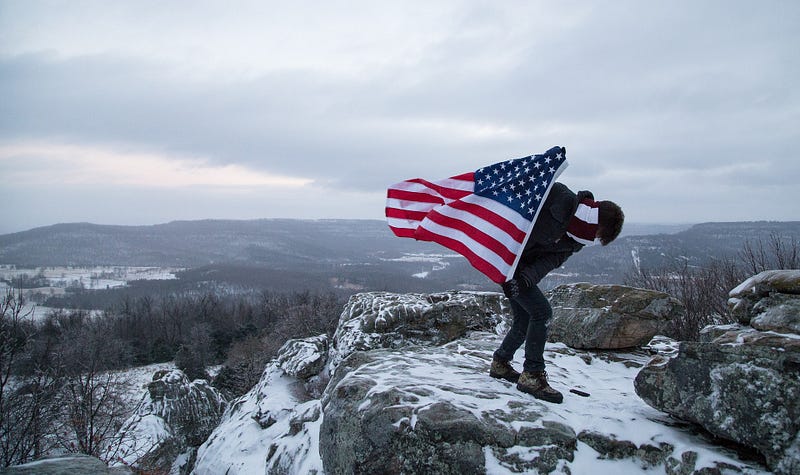
Why do we think our divisions are so bad when history tells us they are probably at least average?
The river of history rushes forward. Sometimes we get tossed against the rocks of the rapids or are helpless in a strong deep current. We judge the whole river from one small stretch! We only see from the last bend to the next. Even if we’ve been in the river scores of years, memories of our struggles upstream fade into the struggle of now.
Partisan polarization and tribalism plus racial tensions seem at an all-time high. Every holiday season self-help gurus breathlessly coach us on how to get through Thanksgiving or Christmas dinner with a relative that believes President Obama is a secret Muslim or that President Trump is a Russian agent. Tune in to Fox News to understand that liberals hate America. Tune to MSNBC and understand that conservative voters are all racists.
Thankfully, more and more Americans pull the plug and ignore the show. Sure, things are divided, but by historical standards Americans probably agree on fundamental values of freedom and equality more than ever.
Four times things were this bad or worse in America
A divided country? Political rancor? The United States has already been there and done that. It’s like a Billy Joel song, just more than two centuries long.
- The American Civil War
Americans don’t seriously contemplate killing each other over political disagreements. Internet trolls tell people to ‘drink bleach and die,’ but very few really, sincerely, want to end someone’s life, or could bring themselves to do it.
From 1861 to 1865, over 600K Union and Confederate soldiers died in uniform, with tens of thousands of civilians as collateral damage. The South felt that the institution of slavery was more important than political union, and the North felt that preserving the union was worth a war. Brothers from the same families literally fought each other and perished on the same battlefields.
There is no need to dwell on this one because clearly the country was ready to break apart. Because it did.
2. The 1960's
Vietnam. Civil Rights. The entire decade was consumed with strife as the left and the right fought it out in the streets over racial equality and the war.
Anti-war and civil rights activists, some peaceful and some dangerous, organized themselves into groups like the Student Non-Violent Coordinating Committee (SNCC), the Students for Democratic Society (SDS), the Black Panther Party, or the Weatherman. The establishment feared them and spied on them. Students seized campuses; four were shot dead at Kent State and two were similarly slain at Jackson State.
Hey, Hey, LBJ!
How many kids have you killed today?
The Chicago police fought protestors in the streets at the 1968 Democratic convention. Throw in the Berkely protests, assassinations of JFK, RFK, and MLK, federal troops deployed to Little Rock, and George Wallace. How do the protests in Ferguson and Baltimore stack up against the rage expressed in the Watts Rebellion in 1965 or the Detroit Riots of 1967 with dozens of deaths each?
Americans watching through their shiny, tiny new TV screens wondered if the republic would survive.
3. World War I and the early ‘20s
History as often taught in America sorta’ jumps from the end of World War I to the Great Depression, with some note of the Roaring ’20s. In reality, 1919 to around 1922 was like the 1960s without a happy-ish ending.
Union activity in the US had been growing for years and the Great Migration swelled the minority population in northern cities. Massive strikes and race riots (typically whites rioting against the blacks) were common. It all boiled over in 1919. May 1st, May Day, saw riots across the country plus an attempt by anarchists to deliver package bombs to thirty-six mayors, congressmen, and businessmen. Most failed, but anarchists followed up with bombings in eight cities in June. A bomb in June of 1920 killed thirty people on Wall Street.
At the same time the Great Red Scare was kicking off, 1919 had the Red Summer, a series of race riots around the country with whites rioting against blacks. Hundreds were killed across dozens of cities and towns. This era was capped off by the Tulsa Riots of 1921, alternately called the Tulsa Massacre, possibly the worst incident of racial violence in US history.
4. The post-revolutionary period
Again, history jumps from the American Revolution to the War of 1812, maybe briefly touching on Shay’s Rebellion, the Articles of Confederation, or the Whiskey Rebellion. In reality, the new country was far from unified.
In the 1783 Philadelphia Mutiny, soldiers surrounded Congress demanding payment for service during the revolution. The state refused to provide protection and Congress fled to New Jersey. George Washington sent 1,500 troops to put down the mutiny.
Shay’s Rebellion started around August of 1786, lasted the better part of a year, and involved thousands of armed insurgents and state militiamen on each side. The Western part of Massachusets was essentially ungovernable during the period. The Whiskey Rebellion saw Washington raise 12,000 militiamen in 1794 and personally march them through Virginia and Pennsylvania.
For a few short years, the idea of raising a militia and revolting seemed like a feasible alternative. The future of America as a going concern was in doubt.
Honorable mentions:
- Remember that time the government used tanks and soldiers to clear out Occupy Wall Street protestors? Or was that Douglas MacArthur leading federal troops to clear out the peaceful Bonus Army in 1932?
- Remember that razor-thin election with widespread allegations of fraud? Was it 2016? 2000? Wait, maybe that was 1960 with evidence of massive fraud in Cook County.
A dozen more cases could be made…the 1830’s had the Nullification Crisis of 1832 and the Secession Crisis of 1836 followed by an economic collapse in the Panic of 1837. The country nearly slipped back into civil war during the Reconstruction and the Teapot Dome Scandal tainted a presidency. In modern times, remember the economic upheavals of the late 1970s and early 1980s or the Los Angeles riots in 1992 or dozens of other events and controversies.
If there ever were true ‘Good Times’ in America where we had political harmony, we should identify and memorialize that brief 15 minutes of history with the largest monument we can finance by borrowing from China.
Yellow journalism and the hyping of division
Two journalists for a major New York newspaper fabricate racially charged evidence to smear the Republican President of the United States. A Democrat congressman picked up the fabricated story and used it as a political weapon. Quick, who was the president? Was it something about Trump and immigration? Or Bush and Katrina? Bush 41? Reagan?
If you didn’t know the story already, did you guess Abraham Lincoln? In 1864 an editor and a reporter for The New York World produced a pamphlet advocating ‘miscegenation’ and tied it to the abolition movement. Lincoln was accused of supporting a secret plan to mix the black and white races so that neither one would exist anymore. These smears dogged him through his election campaign and until his death.
America incentivizes sensationalism. Pundits on the left and right shout in ever more shrill tones about how evil and horrible the politicians on the other side are. There is money to be made through clicks and views. The screaming makes us forget that (most) politicians are real people that love dogs, kids, and their country.
Journalists covet the Pulitzer Prize, but Joseph Pulitzer, who took over The New York World in 1884, arguably co-parented fake news along with William Randolph Hearst. They pioneered tabloid reporting and shamelessly chased circulation like we chase clicks today, because at the end of the day they were businessmen trying to make money.
The middle is bigger than it appears
The United States clearly has challenges. The rich get richer; median incomes stagnated for decades. College grads drown in debt. Tech tycoons are the robber-barons of a new gilded age, making laws unto themselves, deciding what we are allowed to think and say in the public square.
Despite vast improvements from the 1860s or 1920s, the slaying of Ahmaud Arbery shocks the conscience. Kalief Browder lies dead in his grave. The idea that injustice is a cottage industry rather than mass production provides little consolation for the dead and their families. On the other hand, the fact that these events now shock the conscience of most Americans is reason for hope.
In 2016, 28.4 percent of eligible voters voted for Hillary Clinton, while 27.2 percent of eligible voters voted for Donald Trump. During an election won by razor-thin margins in a few states a plurality of the country, 44.4 percent, didn’t find voting compelling enough to outweigh their other concerns.
That 44% is the true center of the country. They hold opinions, maybe even strong ones, but at the end of the day most of the country would rather just get on with life than get bogged down in political division. Maybe we need to remind our leaders on both sides that 70+ percent of the country didn’t vote for their party.
You might also enjoy:
Brian E. Wish works as a quality engineer in the aerospace industry. He has spent 29 years active and reserve in the US Air Force, where he holds the rank of Colonel. He has a bachelor’s from the US Air Force Academy, a master’s from Bowie State, and a Ph.D. in Public and Urban Administration from UT Arlington. The opinions expressed here are his own.


