
Hardening America: Effects Based Analysis of Existential Threats
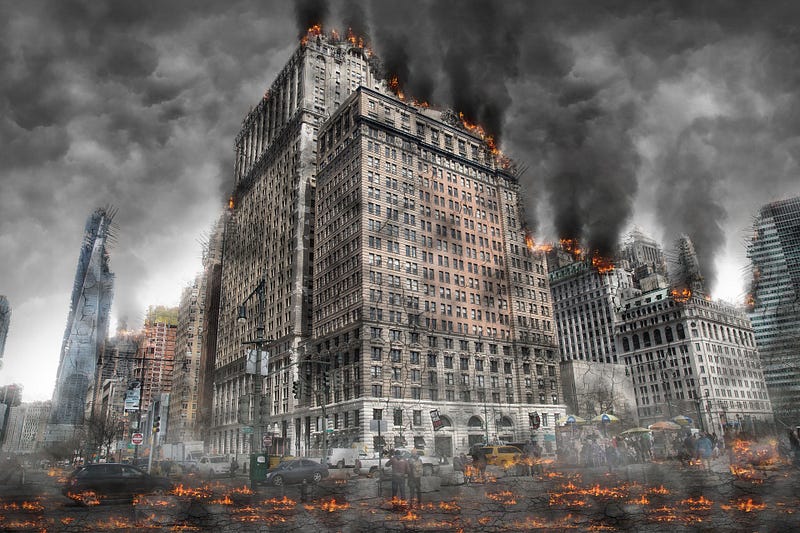
Four effects we need to avoid, and what could cause them.
Effects-based operations (EBO) was popularized in the first Gulf War. It seeks to identify critical vulnerabilities to achieve the desired effect. For example, if the desired effect is to knock out power to a city, destroying an electricity generating plant and destroying the main transmission tower just outside the plant have the same immediate effect, but one will take months and millions to rebuild after the war, while the other can be repaired in days or weeks. EBO was not really new; the Allies tried to destroy German industry during World War II by attacking ball-bearing plants.
Catastrophes happen. Like the rest of the world, America stumbles through history assuming that tomorrow will be like today. Civilization grows more and more fragile as decades and centuries pass. Like Icarus, the higher we fly the more precarious our situation becomes and the further our fall.
We can look at the delicate modern society we want to maintain and centers of gravity that provide pillars of support. From there, each support can be broken down into critical vulnerabilities for mitigation.
How we became fragile
Capitalism and market-based economies reward those who provide goods and services cheaply, driving behavior that exacerbates modern fragility. Comparative advantage encourages countries to specialize in agriculture, raw materials, or simply providing vast amounts of labor. Why would Saudi Arabia spend money growing food in the desert when petroleum industry investments yield higher profits?
On a microeconomic level, markets also encourage practices at odds with societal resiliency. Inventory is a cost burden; it costs time and money to produce, store, and handle. The holy grail of lean manufacturing is one-piece flow, where lots consist of a single item, produced at the exact time of demand. Just In Time (JIT) production and the inexorable laws of supply and demand rule every sector of every industry or service market, public and private.
Why would a state bother building a system that could handle a million unemployment claims in a week, when it typically only handles a half million claims in an entire year? What are the odds, and why would taxpayers want to pay for capacity that will never be used?
So what are the essentials that modern society needs to be considered modern society? No one wants to start subsistence farming in their backyard or forgo antibiotics. Not to mention that we would need the internet to tell us how.
Any number of threats imperil our way of life, but the threats can be organized by their effects. To maintain a modern society we need electricity, transportation, information, and food.
- Disruption of the electrical distribution system
How it could happen: Terrorism, electromagnetic pulse (EMP) attack, solar flare, human error, pandemic.
1965’s Great Northeastern Blackout left 30 million people without power when maintenance workers set the level of a single protective relay too low. Over 8,000 were trapped in New York’s subways for an incident that started in Ontario and also took down power in Quebec and eight US states. Did we learn? Think it couldn’t happen again? In 2003, 50 million went without power for two days.
EMP and solar flares come from different sources but work the same way. Electrical current electrical fields, and electrical fields generate electrical current. A Qi charger uses an electrical field to generate current in an iPhone to charge the battery. A scaled-up Qi charger might be able to fry your iPhone. An electrical field generated by a nuclear destination in the ionosphere or a solar flare might generate enough juice to fry electronics across the country.
Opinions differ as to the likelihood and effectiveness of an EMP attack but in theory its possible. On the other hand, Coronal Mass Ejections (CMEs) are very real, and the planet is overdue for another ‘Carrington Event.’
What we can do: Physically harden transmission and control facilities. Harden critical electronics against an electrical surge, whether from cascading failure, human error, EMP, or solar activity.
2. Disruption of the transportation system
How it could happen: Terrorism, international conflict, pandemic.
Transportation moves goods and services to markets. Traditionally, oil served as a proxy and symbolized the critical vulnerability of the transportation system. The United States established the strategic petroleum reserve (SPR) to provide a cushion. The oil supply risk declined as the US became energy independent, but the recent pandemic has shown that other vulnerabilities exist. Vulnerability is growing in the oil refining system as the number of refineries has sharply declined in recent decades, but is still low.
An international conflict could put a stop to the giant container ships that ply the oceans to bring us our iPhones and N95 masks. A more severe pandemic than COVID-19 could shut down trade and also impact internal transportation networks. A regional event affecting states along the Gulf of Mexico could disrupt both the SPR and refining capacity.
What we can do: Onshore critical industries. Increase the SPR. Support regional oil refineries outside of the gulf coast.
3. Disruption of the information system
How it could happen: Cyberattack, EMP attack, solar flare, terrorism, pandemic
The internet itself seems robust, but it is not invulnerable. Large scale cyber-attacks could cripple access to data. We may not have experienced the real-world Mr. Robot yet, but we have had massive security breaches that disrupted critical services.
Corporations around the country have moved away from storing their own data. It’s ‘in the cloud.’ Is the cloud vulnerable? Google would say no, but huge amounts of data are now centralized. Anything that can be built can be hacked. Plus, what about physical vulnerabilities? How redundant are data centers and how robust are they against EMP and solar flares?
What we can do: Ensure multiple redundancies with data
4. Disruption of the food supply
How it could happen: Secondary effect
Food in America is robust. There is no one critical component that can kill our food system. Unlike the Great Hunger in the 1840s, when the Irish Potato Famine killed up to a million people, our agriculture is widespread and varied. We might lose the banana again, but not the whole system.
However, the other effects listed here, singly or in concert, could destroy our ability to feed ourselves. The 2020 pandemic demonstrated that system disruption can lead to price spikes and local shortages.
Degradation of transportation, information, or electricity will affect the food supply, and what should be temporary limitations lead to panic buying. Grocery stores have ten days or more supply on the shelves at a normal buying rate, but people don’t buy at a normal rate when they are scared.
What we can do: Decentralize food production and processing. Create a dispersed strategic food reserve capable of feeding the country.
Defending the system of systems
The key to this kind of analysis is that each of the four named systems depends upon others. As explained, disruption of the other pillars of necessity is the primary way to impact the food system, but they are also secondary effects of each other.
If the electrical grid goes down, information flow will, transportation, and food processing will be impacted. Take away the internet, and everything in today’s networked society comes to a grinding halt. Take away food security, and we descend to savagery where we couldn’t care less about maintaining the internet, driving trucks, or refining gasoline.
One does not need to stress an individual pillar to the breaking point to cause civilization to break down. One can merely stress all of them at the same time until enough of a feedback loop does the rest of the work. The current mild pandemic has stressed the food supply and degraded our transportation networks.
In addition to the specific vulnerabilities listed, there are low-probability mega-causes that could also put civilization at risk, causing effects across all domains.
- Some evidence suggests that an asteroid strike in Greenland led to the fall of the Clovis civilization and extinction of megafauna just 12,800 years ago
- The Yellowstone volcano could erupt anytime between now and 200K years from now.
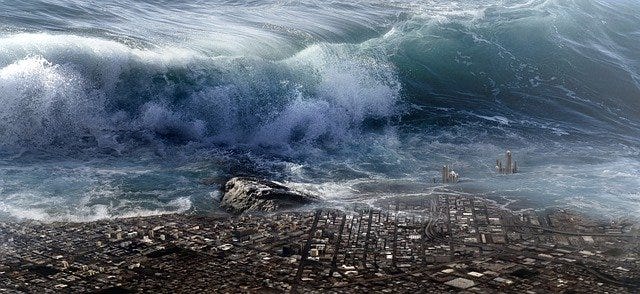
- A mega-tsunami could devastate one of the coasts of North America.
- Nuclear war is always an option
Individually, these are low probability events. In the aggregate, though, events like these have happened and will happen again. Do we keep crossing our fingers and hoping that we will be extinct anyway before one occurs? Then consider how little the parameters of COVID-19 would need to change to be just as devastating as any megadisaster.
The current pandemic has a handful of days of asymptomatic transmission and has somewhere between a .5% and 2% mortality rate. What if the next pandemic has asymptomatic communication for two weeks and a 20% fatality rate? Every pillar of modern society will crumble.
Planning for the future
Capitalism and markets are self-correcting in the long run, but the consequences of some market failures are too dire to wait for markets to run their courses. An airline that doesn’t maintain adequate safety will go out of business, or at least change names like ValueJet, but a lot of people might die in crashes before that happens, so we regulate.
With the current pandemic crisis, perhaps we have a window of opportunity to invest in readiness for low-probability, high-impact events. World War II changed how America viewed foreign policy and how it participated in the world. September 11th, 2001, changed how the country perceives and acts on external threats. Perhaps the pandemic is a significant emotional event that will likewise shape how we prepare for the future.
Brian E. Wish works as a quality engineer in the aerospace industry. He has spent 29 years active and reserve in the US Air Force, where he holds the rank of Colonel. He has a bachelor’s from the US Air Force Academy, a master’s from Bowie State, and a Ph.D. in Public and Urban Administration from UT Arlington. The opinions expressed here are his own.


