
LEADERSHIP
Neuroscience and Leadership of the Future
A discussion about the correlation between neuroscience and effective leadership

Daniel Goleman and Richard Boyatzis set out to understand how soft-skills influence leaders, and their ability to transform businesses.
From there, they conducted a piece of leadership research from a neuroscience perspective, with a geometrical shape in mind.
The pyramid model, proposed by Dr. Alan Watkins, illustrates the sequential neuroscience hierarchy that drives feelings — Emotions derived from external stimuli that manifest in behaviors, and physiological responses.
This article will discuss this facet of leadership.
Intelligence
Goleman put forth a range of skills that an individual with high emotional intelligence exhibits, which he argued translates into effective leadership.
Leadership emotional intelligence
The characteristics of emotional intelligence straddle two categories of self:
- Self-mastery, and
- Social awareness
Traits that complement these characteristics are self-discipline, motivation, drive, and a high-level of achievement orientation.
Leadership social intelligence
Now let’s consider social intelligence, defined by a set of interpersonal competencies (refined neural circuits) to inspire others from a leadership role.
Leaders with high social intelligence demonstrate skills like:
- Effective communication
- The ability to Influence
- Persuasiveness
- Developmental goals of self and others
- Growth mindset
- Inspirational speaker
- Purposeful actions
- Committed to others i.e. followers
We can deduct that those with high social intelligence recognize that their success is dependant on others, their followers.
Today this is considered a measure of effective leadership.
Tom Landry, a well known American football coach said:
“Leadership is a matter of having people look at you and gain confidence, seeing how you react. If you are in control, they are in control”
Landry indicates that a correlation exists between the level of connection, on an emotional and social level, is critical to getting the best out of people.

This concept is not new. In 1920 Psychologist Eduard Thorndike noted that:
“The best mechanic in a factory may fail as a foreman for lack of social intelligence.”
Another piece of research, conducted by Claudio Fernandez Araos, studied a group of executives who were hired for their self-discipline, drive, and perceived intelligence — focused on social and emotional.
When the results of his study were published, some executives were eventually fired due to their lack of social skills. Their inability to get along with others was seen to be a huge deficit.
Followers mirror leaders.
Mirror neurons allow us to communicate and navigate the social world around us. When we consciously or unconsciously detect someone else’s emotions through their actions, our mirror neurons replicate their emotions.
Collectively, neurons can create an instant sense of a shared experience.
Mirror neurons in leadership
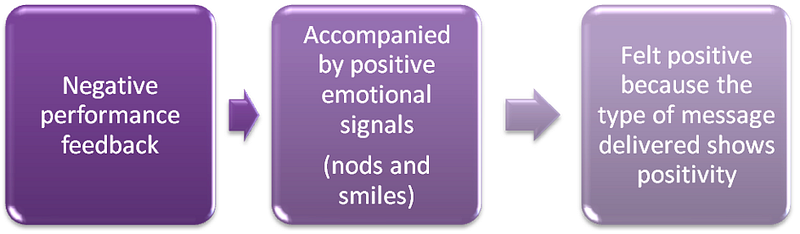
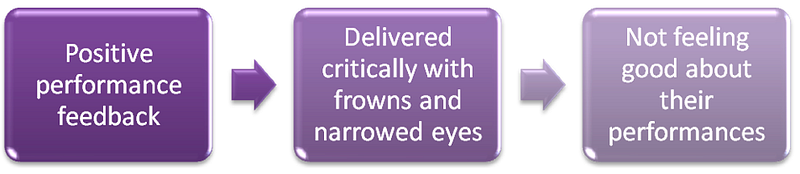
Araos concluded that a leader's emotions and actions prompt followers to mirror those feelings. A study of two groups showed the following:
Group 1
Group 2
To get the best out of followers, leaders can be demanding but in ways that foster positive interactions with others.
Boyatzis and Goleman's’ research found that:
- Top leaders “elicit laughter from followers on average three times more, compared to mid-performing leaders”
- A “positive mood resulted in employees taking in more information, responding with a higher degree of creativeness”
For example, with neuroscience in mind, mirror neurons detect energy from the smiles and laughter of others prompting the same in return.
The attuned leader
Great leaders talk about trusting their gut. This translates into gathering information and applying their experience to make the best decision.
Often leaders and managers are starved of time so they have to react quickly in certain situations.
Neuroscience suggests that this approach should be more cautious. Intuition can fire neurons called spindle cells, rapidly triggering thoughts and feelings.
Spindle cells are our internal social guidance system. Called upon when we’re faced with decisions. Some examples are:
- Routine tasks like prioritizing a to-do list
- Gauging whether someone is trustworthy or not
Leaders should use and trust their judgment, provided they’re attuned to other influencing moods to synchronize feelings that arise from mirror neurons or spindle cells.
Oscillators are neurons that coordinate people physically, regulating how and when our bodies move or respond. A skill empowers a leader to be at the same level as the people around them.
How to measure leadership social skills
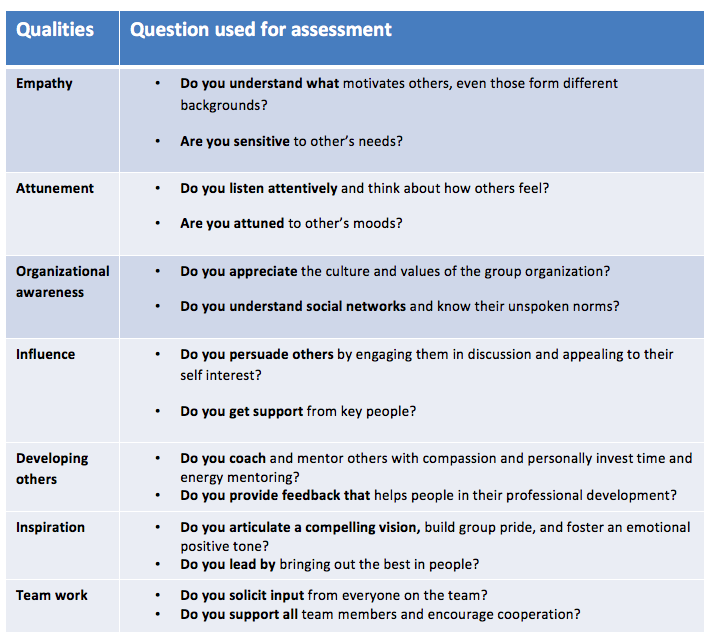
To measure a leader's social intelligence, there is a method known as the emotional and social competency inventory. This tool evaluates an individual according to 7 social intelligence competencies.
A piece of research recorded the behavior of top-performing leaders over the course of two decades. Below is an example of the type of questions they were asked to assess their leadership qualities:
Is a research questionnaire effective in measuring leadership qualities?
Yes… if the audience consists of followers only.
How leaders develop social neurons
One way leaders can effectively develop their social circuitry is through their own effort to modify, or rather improve behavior. So companies invested in leadership development should assess:
- The willingness of individuals to enter into a change program, and
- Candidates eager to develop a personal vision for change
And undergo assessments to:
- Identify individual social strengths and weaknesses
- With feedback for upskilling needs to develop a program
The different ways of training leaders are:
- Rehearsing ways of interacting with followers
- Being shadowed by a mentor and debriefed with observations thereafter
- Learning on the job, alongside a role model
Becoming a socially intelligent leader is a journey of self, seeking how:
- To become socially smarter
- To be a strategic thinker
- A straight talker
- Ability to anticipate business issues
All of which are highly recommended, in addition to Cavallo’s intrinsic evaluation:
- Self-reflection of successes and failures
- How to express ideas with conviction
- Anticipate how people might react
- Develop astute ways to present opinions
Spending time with a role-model, individuals with desirable behaviors (mentor or coach), is deemed to be an effective practice by thought leaders.
I disagree.
Spending time with you is far more important.
Final Thoughts
Our behaviors create, develop, and refine our neural networks. We’re not prisoners of our genes or our childhood experiences.
But gender is a factor — men and women perform differently.
Gender and socially intelligent leadership
- On average women are better than men at sensing the emotions of others
- Men tend to have higher social confidence in the work environment
On that note, social and emotional intelligence can be absent among successful leaders, despite gender. At least according to research.
But this is not our neural destiny.
The chemistry of leadership
Neuroscientists have proven that when we’re challenged in life the frontal part of our brain can shut down, resulting in a state of panic — fight or flight.
So leaders can learn to understand the biology of their emotions, to manage their panic-response under stress, through self-awareness.
Our neural destiny is therefore a choice.
Critique, cash, children, and conclusion
It’s difficult to validate theoretical results about how our brains function in the business world, where everything is driven by results, one-dimensional financial data anchored in money.
Leaders, managers, and executives benefit from self-reflection, social, and emotional awareness. Money, however, introduces behavioral economics, a factor that can distort leadership.
The fact is, we all develop into who we are at an early age. Right or wrong, parts of our personality are not easily discarded.
But we can change.
Start by changing the way you analyze you because self-awareness is the road to self-improvement.
In our multicultural business world today, it's challenging for leaders to connect with groups from different backgrounds, beliefs, values, and understanding of the work environment.
That’s a given, a statement of fact, not an excuse.
But it's not just leaders, we all need and should improve our cross-cultural intelligence.
You and me.
The onus is on us to map out a better way, here and now.
Why?
Because our children's future depends on us.
Neuroscience, the human brain is fascinating, but we control it from within; if we so choose. As such, we define, we create our future.
Future leaders are those who will immerse themselves in diverse group dynamics to deliver the best outcome for everyone — all God’s children.


