
Slow Cognition: It takes a village to raise a creative mind
Significant Insights Analysis: A case study of the historical-cognitive approach

On April 26, 2021, I sent an email to a friend of mine and introduced my book The ECHO Way which reflects on my journey of writing three books in six months.
I coined a new term called Slow Cognition to describe my favorite methods such as Howard E. Gruber’s evolving systems approach to creative work.
Scholars use Hot Cognition and Cold Cognition to describe two types of cognitive studies. Cold cognition refers to the pure cognitive processing of information that is independent of emotional involvement. Hot cognition considers emotional aspects.
You probably read Daniel Kahneman’s 2011 book Thinking, Fast and Slow which highlights two models of thought: System 1 and System 2.
My term Slow Cognition is related to System 2. However, I personally don’t like the System 1/System 2 framework because I adopt Keith E. Stanovich’s model of three types of mind: Autonomous mind, Algorithmic mind, and Reflective Mind.
The major difference between my term Slow Cognition and Kahneman/Stanovich’s terms is research methods. My term Slow Cognition refers to the historical-cognitive approach which is about the long-term development of thoughts. Cognitive psychologists focus on short-term thoughts.
On Jan 5, 2022, I designed the above logo for the notion of Slow Cognition and used it to announce the Slow Cognition Project. I also designed the Thematic Space Canvas and consider it an instrument for developing tacit knowledge.
The Slow Cognition Project (phase 1) focused on the Thematic Space Canvas and the outcome is a new possible book Knowledge Discovery: Developing Tacit Knowledge with Thematic Space Canvas. You can find more details here.
In the past four months, I captured several significant insights. This part shares 12 examples of these insights.
- Jan 5, 2022 — The notion of “Thematic Space”
- Jan 25, 2022 — The “Mandala“ thematic space and “Pair of Themes”
- Jan 29, 2022 — The notion of “Life Strategy”
- Feb 10, 2022 — The notion of “Service Thinking”
- Feb 13, 2022 — The Project-centered Approach
- Feb 27, 2022 — The notion of “Being by Doing”
- March 15, 2022 — The Curated Mind Framework
- March 19, 2022 — The “Thematic Spirit” activity
- March 27, 2022 — The AAS4LT Framework
- April 14, 2022 — The Landscape of Project Network
- April 20, 2022 — The “Domains — Works” Mapping and “Domains(Works)”
- April 22, 2022 — The notion of “Activity as Project Engagement”
If you want to know more about these insights, you can check out this link. Moreover, I also run a sub-project called Significant Insights Analysis by using the above 12 insights. This sub-project is a mini-milestone of the Slow Cognition project.
Significant Insights Analysis
On April 25, 2022, I adopted the following model to develop a method for the sub-project.
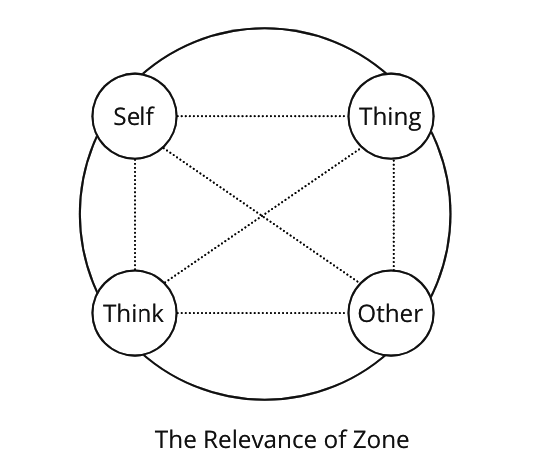
The above model is called the Relevance of Zone which considers Other as an important social context for the long-term development of thoughts. You can find more details here.
Based on the model, we can generate the following questions:
- Other: Who is the Significant Other for this insight?
- Thing: What’s the insight about? Why do I pay attention to it?
- Think: How did I get this insight? Is there a technique behind the process?
- Self: Where did I capture this insight?
- Self: When did I capture this insight?
- Activity: Is this insight part of an activity? What’s the activity?
- Activity: Has this insight led to a new action or a new activity?
All 12 case studies are conducted on a Coda doc.
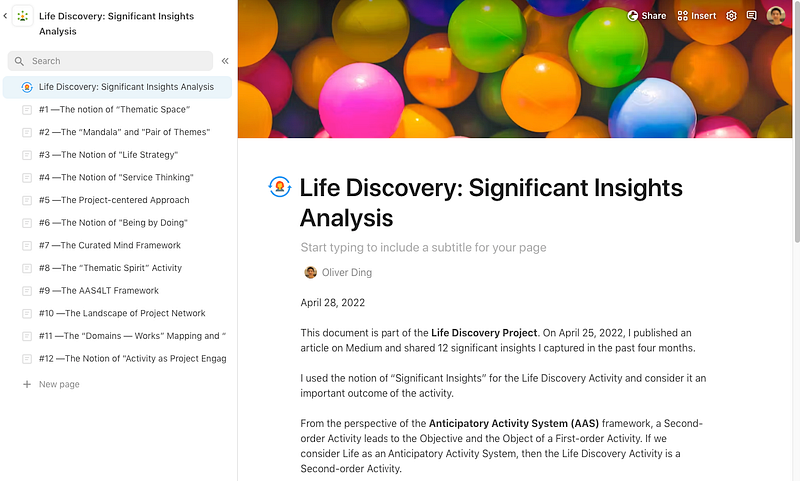
The following sections will summarize new insights from this sub-project.
Where did I capture this insight?
Let’s start with the question about space.
- 9 insights are captured at home (#1, #4 to #11)
- 2 insights are captured in my car (#2, #3)
- 1 insight is captured in a room without the Internet (#12)
The #2 is titled The “Mandala” and “Pair of Themes”, see the details:
I captured the insight of “Shaman’s Mandala” in my car on Jan 23, 2022.
I captured the insight of “Psychodrama-like Participatory Play” in the front yard of my house.
At around 3:00 p.m., I played basketball with kids. Then, kids moved to bicycling. I watched them and thought about the idea of a Psychodrama-like Participatory Play.
I captured the insight of “Pairs of Themes” in my bedroom when I was writing the article.
The #3 is titled The Notion of “Life Strategy”, see details below:
I captured the insight of “Life Strategy Dialogue” in my car on Jan 29, 2022, when I was in the parking lot of Costco with my two sons while my wife was shopping inside the store.
In the past month, I also captured some new significant insights at a park and at a music school on weekends.
It seems I can capture insights everywhere when I am not doing busy tasks.
Who is the Significant Other for this insight?
For the Significant Insights Analysis, I define two types of Significant Other from the perspective of the Model of Curated Mind (see diagram below).
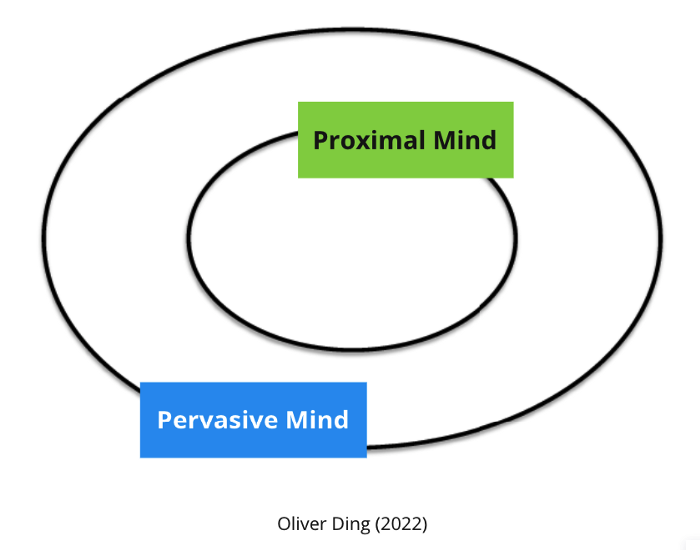
As a system, the Curated Mind has two parts: Proximal Mind and Pervasive Mind. This model adopted the ecological approach to reflect on the Mind. While Proximal Mind corresponds to Proximal Contexts, Pervasive Mind corresponds to Pervasive Mind.
- Proximal Contexts (Proximal Mind)
- Pervasive Contexts (Pervasive Mind)
I consider Significant Other as a part of Contexts. Thus we have two types of Significant Other: Pervasive Other and Proximal Other.
- Proximal Other: people whom we directly contact to
- Pervasive Other: people whom we don’t directly contact to
Three Significant Insights were inspired by Pervasive Others: #1 — Peter Gardenfors, #6 — Kenichi Ohmae, and Robert Kegan, #10 — Howard E. Gruber.
Two Significant Insights (#11, and #12) were born from self-reflection.
Seven Significant Insights were inspired by proximal others. See details below.
#2 — The “Mandala” and “Pair of Themes”
- The Mandala Diagram Network was formed by the following Mandala diagrams. Some diagrams were inspired by others.
- Dec 21, 2021 — The Founder’s Mandala — (inspired by Product Field)
- Dec 23, 2021 — The Creator’s Mandala
- Dec 24, 2021 — The Curator’s Mandala
- Jan 1, 2022 — The Strategist’s Mandala
- Jan 3, 2022 — The Designer’s Mandala (inspired by Frederick van Amstel’s paper about design)
- Jan 4, 2022 — Sailor’s Mandala (inspired by a friend who is the founder of an adult life development program)
- Jan 24, 2022 — Shaman’s Mandala (inspired by a friend who is a data scientist)
While I am an advisor of the adult life development program, I didn’t work with the data scientist on a collaborative project in the past year.
#3 — The Notion of “Life Strategy”
This insight refers to two meanings of the notion of “Life Strategy”. Originally, I was busy dealing with friends’ requests for practical suggestions about strategy. So, I framed the notion of “Life Strategy” as a practical toolkit. However, I realized that I could detach from the “toolkit” and attach to the “dialogue”.
The notion of the “Life Strategy Toolkit” was inspired by some friends and some authors. For example:
- I had a 91-minute talk with a friend on Jan 18, 2022. This talk inspired me to think about the idea of “Life Strategy for Indie Creators”
- I talked about the “Life Strategy Toolkit” with a friend on Jan 28, 2022. The friend saw my article about “Strategy as Anticipatory Activity System” and contacted me on Linkedin. Then, I made the toolkit for our discussion.
- I read Ed Morrison’s book about Strategic Doing on Jan 27, 2022.
The notion of the “Life Strategy Dialogue” was inspired by my work on knowledge curation and thematic space canvas. My notion of “Life Strategy” can be understood as a dialogue between my “Life” thematic space and my “Strategy” thematic space.
#4 — The Notion of “Service Thinking”
On Feb 9, 2022, I had a talk with Mani I who is a Service Designer. We talked about various topics such as design thinking, service design, strategic thinking, system thinking, cross-boundary thinking, Activity Theory, the Theory-Practice gap, etc.
The conversation inspired me to connect Activity Theory and Service Design by creating a new thematic space called “Service Thinking”.
#5 — The Project-centered Approach
This insight was born from writing about my “Project” thematic space and developing the Life Discovery toolkit.
On Jan 18, 2022, I published an article titled Thematic Space: The Project Engagement Toolkit for Creators and used the Project Engagement Toolkit as an example of “Toolkit as Knowledge Statue”.
On Jan 19, 2022, I had a virtual meeting with Susan Hasty. Later, I republished the Project Engagement Toolkit on the Activity Analysis site. This experience encouraged me to pay attention to the “Practitioners First” perspective.
Later, I started designing some toolkits, canvases, and developmental service programs. This type of activity of “Connecting Theory and Practice” was the primary theme of the first season of my 2022.
#7 — The Curated Mind Framework
In a Linkedin post, I mentioned the insights of “Collective Network of Enterprise” and “Project Network” which are driven by the change of my “Self — Other” relevance. In the past three months, many friends gave me wonderful feedback which guided the direction of my creative work.
For the development of the model of Curated Mind, I’d like to mention Maurizio Goetz who is the Co-founder presso Italian Institute for the Future — Speculative Design Hub.
On March 15, 2022, I shared the basic model “Curated Mind”. On March 21, 2022, I expanded the basic model with eight operational concepts. From March 15 to March 21, I discussed the notion of Curated Mind with several friends.
Maurizio Goetz encouraged me to explore Future Studies, Imagination Design, and Anticipative Communication /Storytelling. Our discussion inspired me to expand the level of Pervasive Mind from the original two practical perspectives to four perspectives:
- Representation (old version)
- Significance (old version)
- Imagination (new version)
- Anticipation (new version)
#8 — The “Thematic Spirit” Activity
Daiana Zavate is the Significant Other for this insight because we co-created the “thematic spirit” activity.
Daiana Zavate has been following my writing for several months. After reading and reproducing her version of the canvas, I was sure that she understood the spatial structure of the Thematic Space Canvas. I also read her creations of concept development about strategic design thinking. I believe she is a talent for conceptual thinking.
Since we share the same knowledge about Thematic Space Canvas and Concept Development, our first collaboration went quite well.
#9 — The AAS4LT Framework
The Anticipatory Activity System is an expanded version of the iART Framework which was born from an empirical research project about an adult development program.
I’d like to call the program SSL which stands for Shaper & Supporter Lab. Anyway, it is just a codename. SSL was founded by a friend of mine in April 2021.
My friend started the journey in Feb 2021. In Feb 2022, we worked on reflecting on her life transition in the past 12 months.
Wow! It takes a village to raise a creative mind!
How did I get this insight? Is there a technique behind the process?
This question is related to creative thinking. I highlight the following techniques:
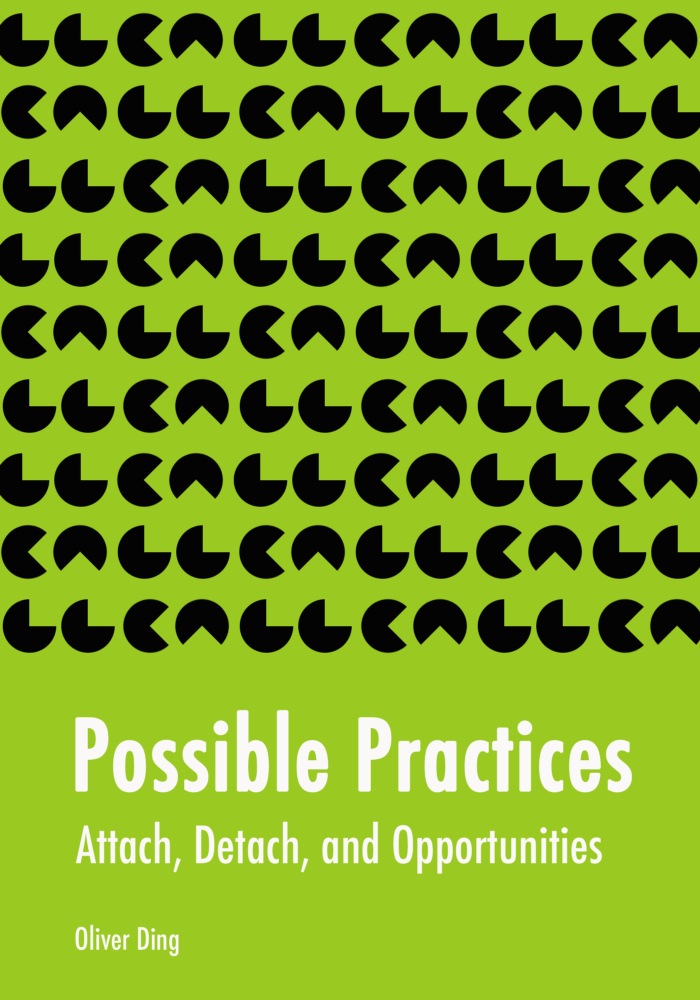
- Creative Attachance: #1, #2, #3, #5, #7, #10, #12
- Symbol Awareness: #1, #11
- Writing as Thinking: #2, #5, #11
- Double Container: #2
- Deep Analogy: #2, #11, #12
- Double Dialogues: #3
- Diagramming as Thinking: #4, #5, #6, #7
- The ECHO Way: #4
- Thematic Curation: #5, #12
- Concept Analysis: #6
- Expandness: #6, #7
- Co-creation: #8, #10
- Self-reflection: #8, #11
- Theoretical Development: #9, #12
- Empirical Research: #9
- Ecological Awareness: #10
- Immanent Development: #12
The most popular technique is Creative Attachance! It echoes the following picture!
Also, I’d like to promote the Deep Analogy technique.
The notion of Deep Analogy is inspired by Arthur L. Stinchcombe who is a leading practitioner of methodology in sociology and related disciplines. The following quote is found from a note about his 1978 book Theoretical Methods in Social History.
But if general concepts consist in the analogies between elements and if they are deeper if the analogies are deeper, then the basic investigatory task of concept formation is the deepening of analogies.
Far from it being the case that the most powerful general theorists ignore details, the precise opposite is true. Social theory without attention to detail is wind; the classes it invents are vacuous, and nothing interesting follows from the fact that A and B belong to the class; “theoretical” research appears as a species of wordy scholasticism, arranging conceptual angels in sixteen fold ranks on the head of a purely conceptual pin.
But if conceptual profundity depends on the deep building of analogies from one case to another, we are likely to find good theory in exactly the opposite place from where we have been taught to expect it. For it is likely to be those scholars who attempt to give a causal interpretation of a particular case who will be led to penetrate deeper analogies between cases.
My case is not an actual application of Stinchcombe’s notion of “Deep Analogy” of social theories. I just use the term to describe my experience. Basically, it refers to using a structure to connect two or more things deeply.
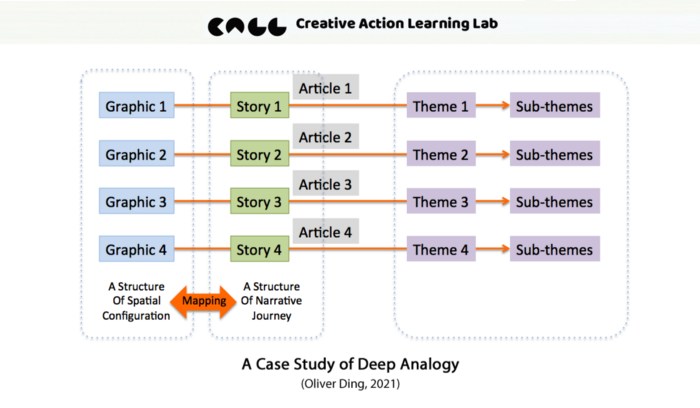
The above diagram is a case study of Deep Analogy. You can find more details in The Dynamics of Tacit Knowledge.
If you want to read the whole report, you can open the following doc on Coda.
Related articles
- Knowledge Discovery: The “Perspectives — Views” Mapping
- The Project Engagement Toolkit (2022)
- Life Discovery: The Life-as-Project Approach
- The Life Discovery Toolkit (v1)
- The Life Discovery Canvas (v1.0) — Part 1: Theoretical Background
- The Life Discovery Canvas (v1.0) — Part 2: Spatial Structure
- The Life Discovery Canvas (v1.0) — Part 3A: Concepts (THINK and LEARN)
- The Life Discovery Canvas (v1.0) — Part 3B: Concepts (SAY and DO)
- The Life Discovery Canvas (v1.0) — Part 4: Inspirations
- Life Discovery: The “Being by Doing” Principle
- Life Discovery: The “Performance as Experiment” Principle
- Life Discovery: The “Engagement as Projection” Principle
- Life Discovery: The “Discovery as Development” Principle
- CALL for LIFE: Anticipatory Activity System for Life Transitions
- CALL for LIFE: Modeling A Developmental Project
- CALL for LIFE: Oliver Ding @ 2021 and Second-order Activity
- Life Discovery: Twelve Significant Insights from Four Months
- Life Discovery: “Points of Observation” and “Significant Insights”
- Life Discovery: Significant Insights Analysis
- Life Discovery: The “Tacit” Type of Second-order Activity
- Life Discovery: The Unfoldness of Activity
I am also working on building a new website for the Platform Ecology project. You can save the following links:
- PlatformEcology.org
- Twitter: @PlatformEcology
- Linkedin: @PlatformEcology
You are most welcome to connect via the following social platforms:
Linkedin: https://www.linkedin.com/in/oliverding Twitter: https://twitter.com/oliverding Polywork: https://www.polywork.com/oliverding Boardle: https://www.boardle.io/users/oliver-ding


