
Slow Cognition: The Curated Mind
Every Mind A Curated Mind

One week ago, I wrote a short note about “the Curated Mind” on Linkedin.
In the past several days, I continuously worked on the idea. Finally, I designed the following diagram yesterday. The new diagram uses Proximal Mind and Pervasive Mind to form a nested whole.
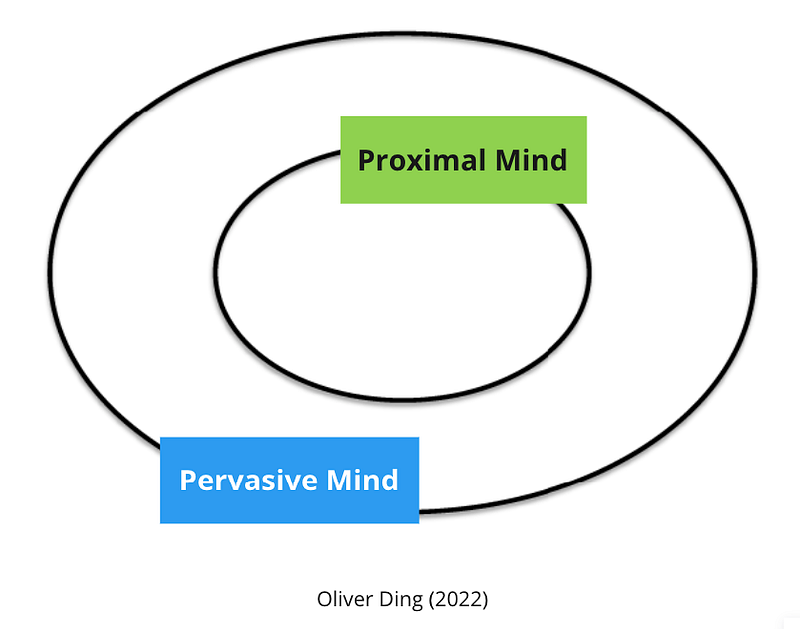
This is the model of the Curated Mind which is defined as an Anticipatory Activity System. As a system, the Curated Mind has two parts: Proximal Mind and Pervasive Mind.
This model adopted the ecological approach to reflect on the Mind. While Proximal Mind corresponds to Proximal Contexts, Pervasive Mind corresponds to Pervasive Mind.
- Proximal Contexts (Proximal Mind)
- Pervasive Contexts (Pervasive Mind)
A special meta-theory behind the model is Curativity Theory. The term Curativity refers to turning pieces into a meaningful whole. The Curated Mind means the ideal status of the mind. If a person claims that her or his mind is a meaningful whole, then she or he can understand the world as a meaningful whole.
To achieve the Curated Mind, a person has to curate the following dimensions:
- Near — Far
- Self — Other
- Present — Future
- Thing — Think
- etc.
From the perspective of the Ecological Practice approach, I use Context(Mind) as the primary unit of analysis to develop the model of the Curated Mind. The above other dimensions can be considered secondary dimensions.
This is just a rough idea. It’s a starting point of the Ecological Approach to the Mind. This article aims to share more ideas of the historical development of this model.
Contents
1. 2019: A Plan 2. 2017: A Personal Epistemological Framework 3. 2022: Flow, Story, and Model
4. Three-container Model 5. Proximal Mind and Pervasive Mind 6. Proximal Mind: Ecological Awareness 7. Pervasive Mind: Symbolic Awareness 8. An Interdisciplinary Approach 9. The Curated Mind of Lifesystem 10. Contexts (Mind) 11. Every Mind A Curated Mind 12. The Curated Mind and Possible Practice
1. 2019: A Plan
In 2019, I used “the Curated Mind” as the title of my plan about reflecting on the BagTheWeb project. See the picture below.
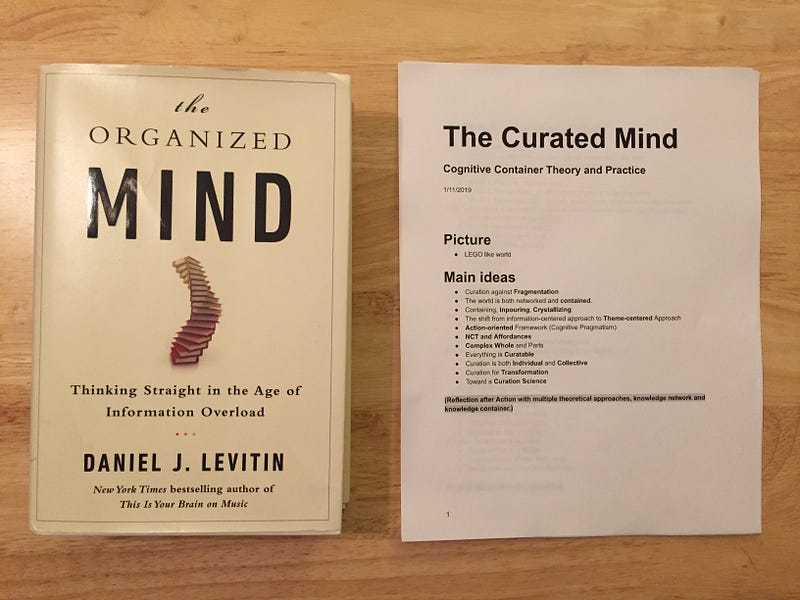
In 2018, I had a wonderful experience using BagTheWeb which was designed and launched around 2010. I was the Chief Information Architect of the product. Since 2010, I have been using it for my personal information and knowledge curation for many years.
We stopped developing the site around 2014 and moved to other directions. However, I still used it as a heavy user after 2014 since we kept the site live. In 2018, I discovered several insights from my own experience using the site. Eventually, I started planning to do a theory-based reflection around BagTheWeb in Sept 2018.
Inspired by the cognitive psychologist Daniel J. Levitin’s book The Organized Mind, I named my research plan The Curated Mind: Cognitive Container Theory and Practices. I wrote a 20-page outline and stopped the project because the original plan adopted Activity Theory as the theoretical resource.
In Oct 2018, I started a new project called Curativity and moved to Ecological Psychology and social practice theories. In March 2019, I finished Curativity: The Ecological Approach to General Curation Practice.
The last chapter of Curativity is titled The Epistemology of Curativity in which I reviewed my knowledge about epistemology and the epistemology of Curativity Theory.
2. 2017: A Personal Epistemological Framework
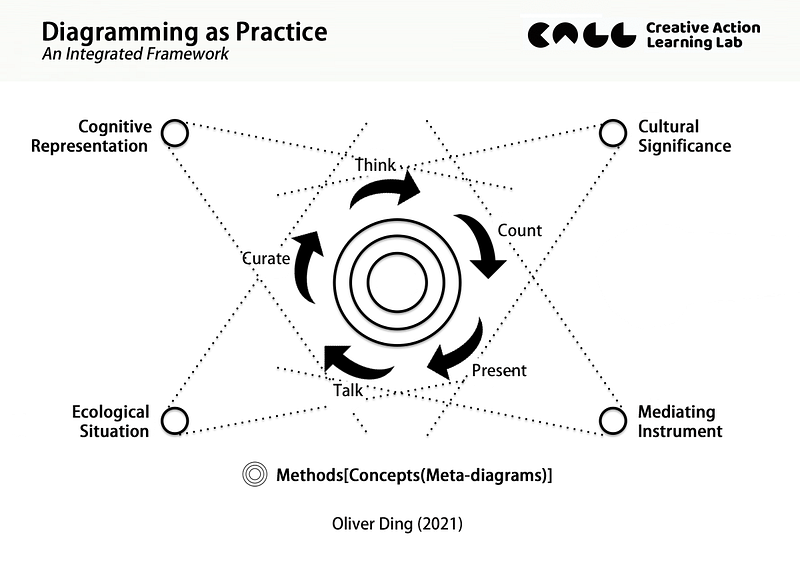
In 2017, I used the “Mind as Play” metaphor to developed an integrated epistemological framework that features the following perspectives:
- Cognitive Representation
- Cultural Significance
- Mediating Instrument
- Ecological Situation
Two months ago, I re-introduced the framework and used it for my book Diagramming as Practice.
From 2014 to 2016, I was fascinated with cognitive science because one of my friends founded a community about cognitive science and psychology in the middle of 2014. He invited over 180 PhDs and professors from psychology, anthropology, AI, linguistics, philosophy, media, and communication, and over 200 practitioners from various fields to join the community and hosted weekly discussions on a social media platform.
As a member and an advisor of the community, I was lucky to learn from weekly discussions and daily conversations about many topics. Eventually, I started reading books and papers about cognitive science. This is the starting point of my journey of interdisciplinary learning. There is a popular diagram about cognitive science, see the below.
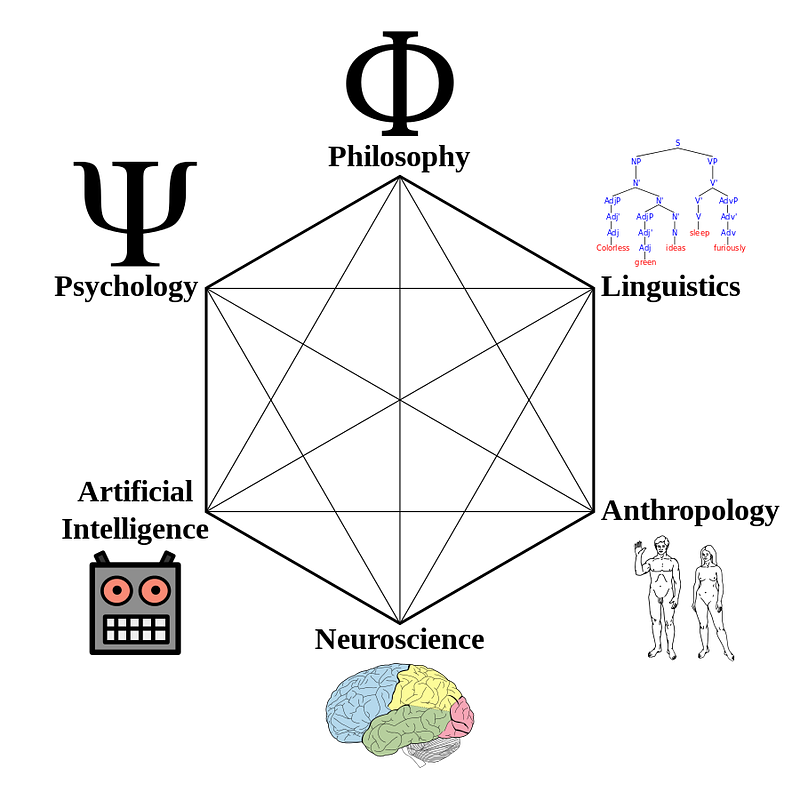
There are two views to understand the above diagram and the field of cognitive science. The first view sees it as a roughly connected collective science enterprise that shares the same object of study: cognition. In other words, it is all about the mind and it embraces different perspectives from different fields. The second view only considers it as a research of cognitivism which is a theoretical framework. Thus, the above diagram has an issue because cognitive anthropology, cognitive linguistics, and philosophy of mind don’t only think about cognitivism.
Scholars have been debating on these two views for many years. For ordinary learners such as me, the second view is a sub-set of the first view. Since I want to learn more perspectives from more disciplines, I think the above diagram is fine for me.
The newest development of the philosophy of mind moved to the direction of 4E cognition science (4E stands for Embodied, Embedded, Enacted, and Extended). While traditional cognitivism claims that the mind is about the brain and information processing, the 4E cognition emphasizes that cognition should be understood within the whole of Brain-Body-Environment coupling.
Inspired by the 4E cognition movement, I moved to Ecological Psychology and Activity Theory in 2017.
3. 2022: Flow, Story, and Model
If you follow my writings and you probably are familiar with the following diagram.
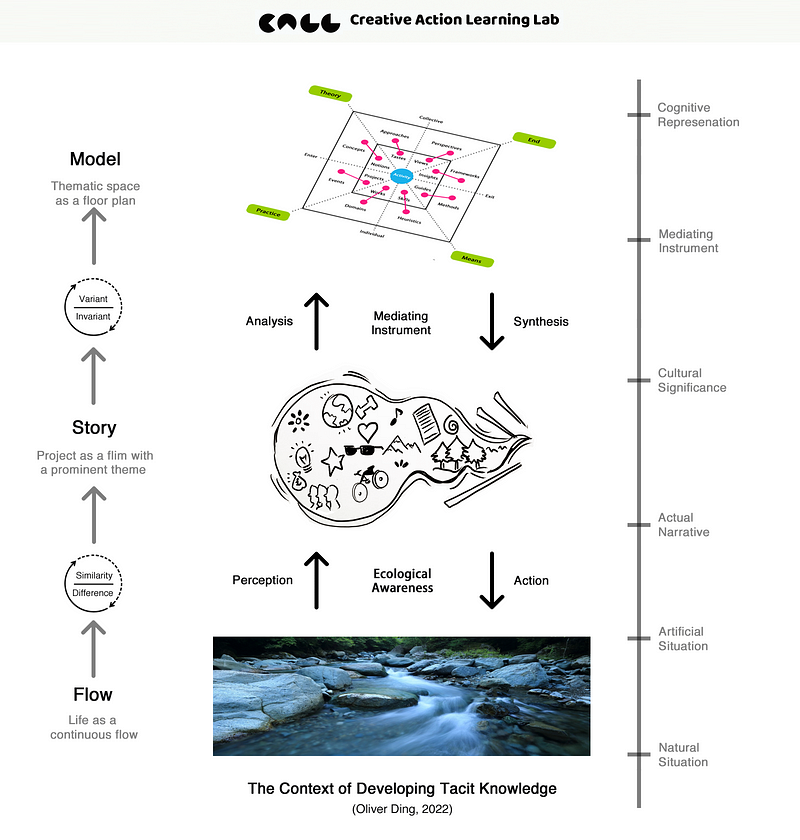
The above diagram is an updated version of the Context of Developing Tacit Knowledge. The original version was published on Jan 11, 2022. The difference between these two versions is the following ideas:
- The new version uses “Flow” to replace “Experience”.
- The new version separates “Ecological Situation” into “Artificial Situation” and “Natural Situation”.
The pair of concepts of “Artificial Situation” and “Natural Situation” was introduced for the Spark Space Canvas on Feb 9, 2022.
The new version is also called the “Flow — Story — Model” metaphor. Though the original title is called the Context of Developing Tacit Knowledge. I think it should be my new model of the mind or cognition.
- Flow: Life as a continuous flow
- Story: Project as a film with a prominent theme
- Model: all knowledge frameworks and models as floor plans
The model is about Developing Tacit Knowledge. What about if the Tacit Knowledge is about “Mind’? What about if the Tacit Knowledge is about “Self”? What about if the Tacit Knowledge is about Life?
The essential idea of Developing Tacit Knowledge is the Objective — Subjective Knowledge Curation which corresponds to the Outer Space — Inner Space Mapping of Thematic Space.
For example, you can know my knowledge about “Life” by reading my article Mapping Thematic Space #6: The “Life” thematic space. My “Life” thematic space is a large cognitive container that contains many ideas I developed in the past several years.
The “Flow — Story — Model” metaphor is also inspired by James G. March (1928–2018) who was an American political scientist, sociologist, and a pioneer of organizational decision making. He mentioned that there are three types of wisdom in his 2010 book The Ambiguities of Experience.
What are the three types of wisdom?
- Models: a model is an abstract cognitive representation.
- Stories: a story is a model too, but it is easy to understand.
- Actions: you just do it, then you get it.
What March suggested roughly echoes three types of social sciences.
- Models: Explanation (such as Systems and Rational Choices)
- Stories: Understanding (such as Culture and Subjective meanings)
- Actions: Intervention (Such as Critical theory and Action Science)
Why did I use a three-level structure? Because it is a normal form of hierarchy. However, there is a bug in the three-level structure because it doesn’t consider the direct connection between Flow and Model.
James March didn’t use such a hierarchy to discuss Models, Stories, and Actions.
4. Three-container Model
The original three-level diagram is for discussing the context of Developing Tacit Knowledge. If I want to turn it into a model of the mind, I have to kill the bug.
I use the three-container meta-diagram to made the following new diagram.
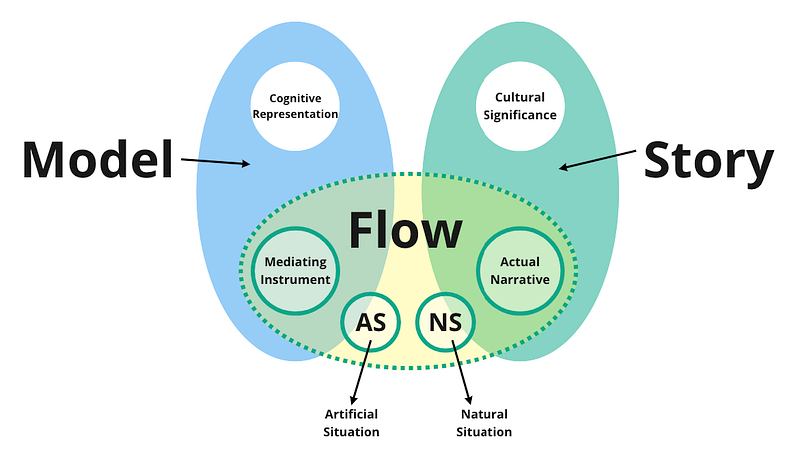
What’s the difference between the above three-container diagram and the above three-level diagram?
The three-level diagram doesn’t connect Model and Flow directly. It emphasizes two connections between three levels:
- Ecological Awareness: from Flow to Story.
- Symbolic Awareness: from Story to Model.
The three-level diagram was originally developed for discussing the Thematic Space Canvas. Its name is the Context of Developing Tacit Knowledge. I didn’t want to build a new framework of the Mind.
The three-container diagram places the Flow at the middle and suggests two directions of the transformation of Flow. The Left side is the Model while the Right side is the Story. Moreover, it has a Figure-ground structure:
- Figure: we can find four things inside the Flow container.
- Ground: there are “Cognitive Representation” and “Cultural Significance” out of the “Flow” container.
The Figure refers to Proximal Mind and the Ground refers to Pervasive Mind.
5. Proximal Mind and Pervasive Mind
Why do I coin these two new terms? Why do I use “Proximal” and “Pervasive”?
I am thinking of a new approach to mind: the Ecological Approach to Mind.
Proximal Mind and Pervasive Mind highlight two different contexts for the Mind. The picture below is called Optimal Context Canvas. The Inner Space refers to Proximal Contexts while Outer Space is about Pervasive Contexts. These two types of social contexts were inspired by Self-Determination Theory (SDT).
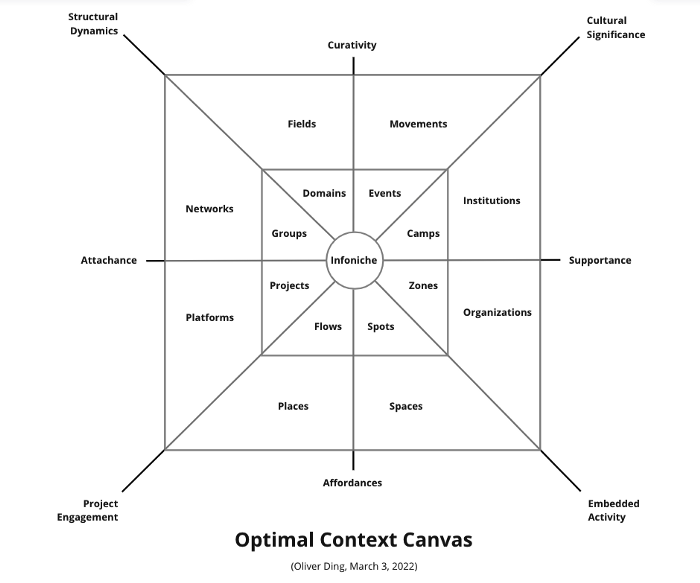
Self-Determination Theory (SDT) is a general psychological theory of human behavior and personality development. Richard M. Ryan and Edward L. Deci developed SDT as an empirical humanistic psychological theory.
Ryan and Deci point out, “…we have focused primarily on the influences of proximal social contexts — for example, families, peer groups, schools, teams, and work organizations — on the individuals’ motivation, development, and wellness. We describe these contexts as ‘proximal’ in the sense that the individuals have direct interpersonal contact with the people who make up these contexts. As SDT evidence has shown, proximal social contexts have a powerful impact on motivation, behavior, and experience, effects that are strongly mediated by basic psychological need satisfactions and frustrations.” (2017, p.561)
Pervasive social contexts refer to abstract social-cultural systems. According to Ryan and Deci, “Yet proximal social contexts are themselves embedded within broader or more encompassing social systems, both formal and informal, which influence need satisfaction and behavior in myriad ways. These pervasive contexts include the overarching cultural and religious identifications, political structures, and economic systems within which proximal social contexts are constructed and occur (Ryan & Deci, 2011).”(2017, p.562)
My notion of Proximal Mind and Pervasive Mind roughly echoes Ryan and Deci’s two types of social contexts.
6. Proximal Mind: Ecological Awareness
For the three-container diagram, the Flow container refers to the proximal mind. It emphasizes the following four perspectives:
- Natural Situation
- Artificial Situation
- Actual Narrative
- Mediating Instrument
Natural Situation refers to non-designed situations and environments while Artificial Situation refers to designed situations and environments.
Originally, I only used one term “Ecological Situation” for the Context of Developing Tacit Knowledge. Later, I considered Natural Space and Artificial Space as two sub-categories of the Ecological Situation and used these two sub-categories to design the Spark Space Canvas.
The distinction between Natural Space and Artificial Space also refers to different research methods. For example, Ecological Psychologists and Experimental Psychologists use different ways to collect data. Ecological psychologists get data from Natural Space while experimental psychologists get data from Artificial Space.
The notion of Actual Narrative comes from the discussion about the Story layer.
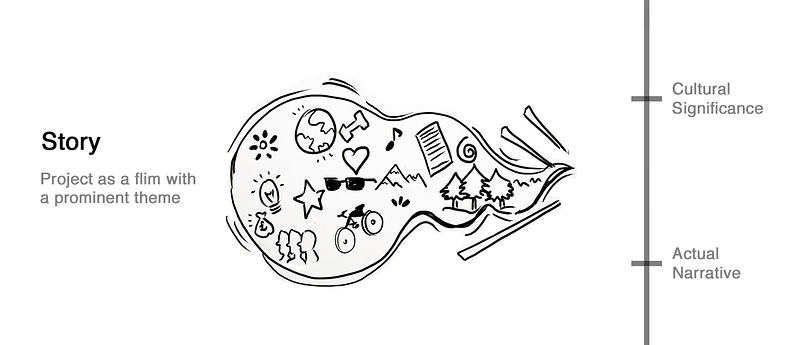
The Story layer is inspired by my experience of writing my learning autobiographies and working on learning narrative-related projects. I often write reflection notes for each project. I also share my journey with others. For example, I had a 99-minute conversation with a friend of mine on Jan 8, 2022. I briefly introduced my journey of epistemic development from 2019 to 2022. I spent about 60 minutes sharing my story and some core ideas of several major works. You can find more details from here.
To make a clear statement, I define two types of stories.
- Story 1: it is framed by Cultural Significance.
- Story 2: it refers to the Actual Narrative.
Story 1 emphasizes the Relevance aspect of the Story layer while Story 2 emphasizes the Architecture aspect of the Story layer.
Story 2 refers to the real story which is not been told yet. A Story 2 is a set of immediate actions (experience) with a structure. The structure could be a planned project, a real project, and an imagined project.
Story 1 refers to telling stories that are framed by Cultural Significance. Once a person starts to share his stories with others, he must consider Relevance in the communicative context. Thus, there is a difference between Story 1 and Story 2. You can find more discussions about Relevance here.
If we adopt some concepts and frameworks from Project-oriented Activity Theory, we can develop an insightful perspective about Cultural Significance and Actual Narrative. The diagram below roughly summarizes the discussion. You can find more details from the original article Thematic Space: Project as Story.
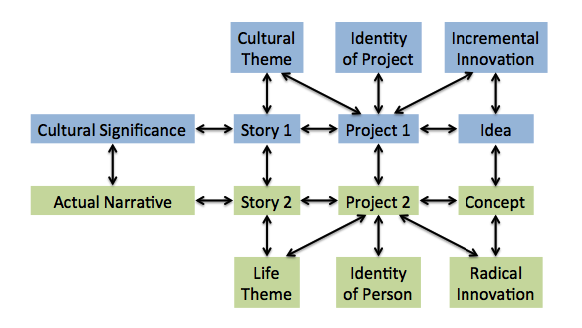
The Project as Story metaphor also considers imagination and communication. Thus, the mapping between Story 2 and Project 2 has room for more ideas. Story 2 refers to the real story which is not been told yet. A Story 2 is a set of immediate actions (experience) with a structure. The structure could be a planned project, a real project, and an imagined project.
Finally, Mediating Instrument refers to objects for activities. For example, diagrams and canvases are mediating instruments for thinking and communications. For discussing diagrams, I selected Mediating Instrument as a practical perspective. Though Mediating Instrument is adopted from Activity Theory, other social practice theories also emphasize the importance of Material in human activity and social practices. Scholars even use the Materiality Turn to describe this trend.
I adopt the Mediating Instrument perspective to discuss the diagramming practice and highlight four essential issues for the discussion.
- Mean v.s. End
- Past v.s. Present
- Part v.s. Whole
- Ambiguity v.s. Precision
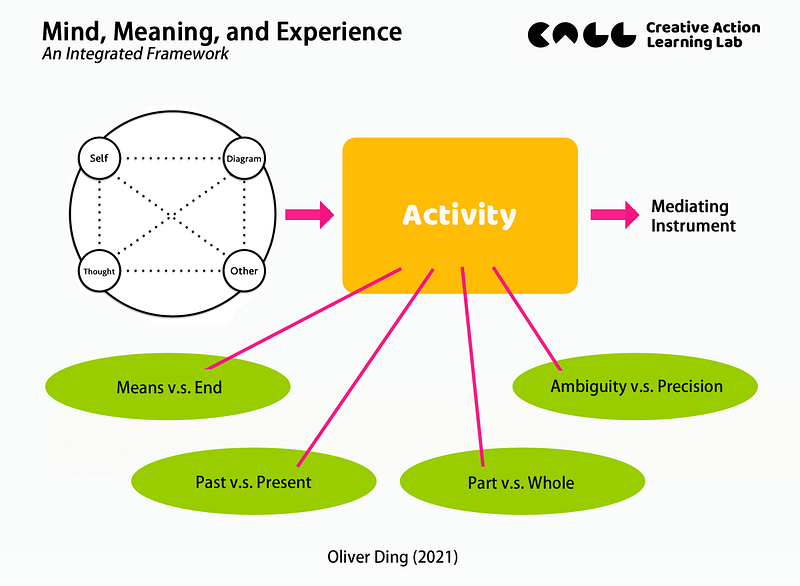
Some issues are inspired by Activity Theory, other issues are defined by the “Diagram — Thought” curating practice. You can find more details here.
7. Pervasive Mind: Symbolic Awareness
For the three-container diagram, the space outside of the Flow container refers to the pervasive mind. It emphasizes the following two perspectives:
- Cognitive Representation
- Cultural Significance
Cognitive Representation is a term of cognitive science. Though scientists and scholars have a various understanding of cognitive science, there are two simple goals of cognitive science: 1) explain cognitive phenomena, and 2) construct artificial systems that can solve various cognitive tasks (Peter Gardenfors, 2000).
For people who love diagrams, there is a very easy-to-understand goal: Putting thought in the world. According to the cognitive scientist Barbara Tversky, “We put thought in the world for so many reasons. To remember, remind, and record. To inform, to influence, to boast. To contemplate, compute, organize, rearrange, design, and create. To play the future. To reminisce about the past, or to use it to think about the present or to plan the future. To show others and collaborate, then we’re literally on the same page and we can point to, gesture on, and move around ideas, more efficient and precise than using words.” (2019, p.191)
Diagrams, models, theory, floor plan, etc, these things are Cognitive Representations for solving some cognitive tasks. For example, I was trained as an engineer in mechanical manufacturing. One of my favorite subjects is the mechanical drawing which is a technique used to represent a three-dimensional object on a two-dimensional piece of drawing paper.
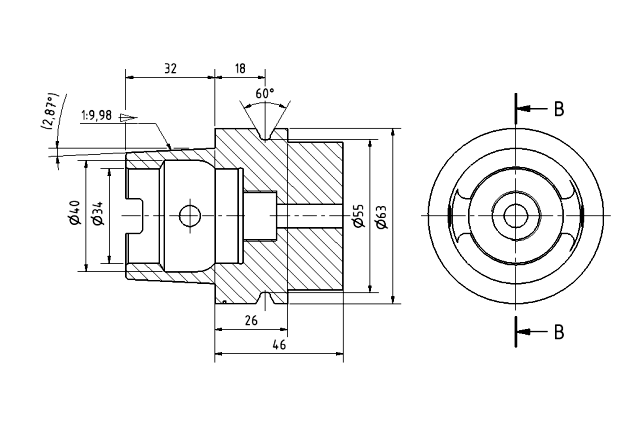
There is a real object, then we have to make a cognitive representation of the object to understand it, make it, change it, etc. This perspective requires accurate definition, measurement, and evaluation.
However, once we made a cognitive representation of an object, it detaches from the Pxorimal Mind and attaches to the Pervasive Mind. To understand a cognitive representation, we need to activate our symbolic thinking skills.
Making a cognitive representation for a real object or an imagined object also requires symbolic thinking skills too. For example, I often develop knowledge frameworks which are cognitive representations. In Lifesystem: Modeling Ice Skating and Other Social Practices, I use “modeling” to highlight the work of symbolic thinking.
Cultural Significance refers to the dynamic historical development of cultural signs and other symbolic cultures.
In August 2021, I conducted an empirical case study which is about a community design workshop. It was a three-day online learning program. The curator of the program divided students into groups of six. The activity of day 1 is an open discussion and brainstorming about the definition of community. To summarize conclusions from six groups, a volunteer suggested using the diagram of Star of David as a frame. Thus, they selected a primary element from each group and placed six elements around the Star of David. Later, the curator asked an advisor to review the framework. The advisor suggested some revision opinions. The volunteer designed a personalized version of the framework for the advisor. See the picture below.
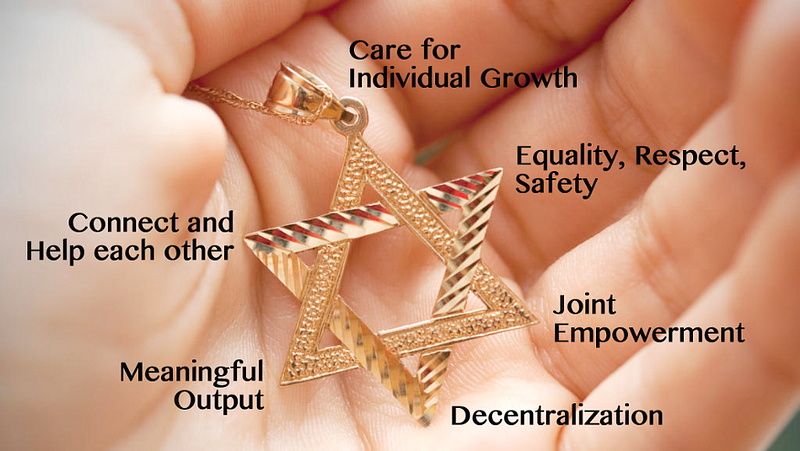
I started from this diagram and interviewed three key people: the curator, the volunteer, and the advisor. I wrote an 86-page report for the case study.
The curator is a Christian. The early offline weekly meetup was inspired by Christian communion/Koinonia. He used two nested triangles to represent his tacit knowledge about the community.
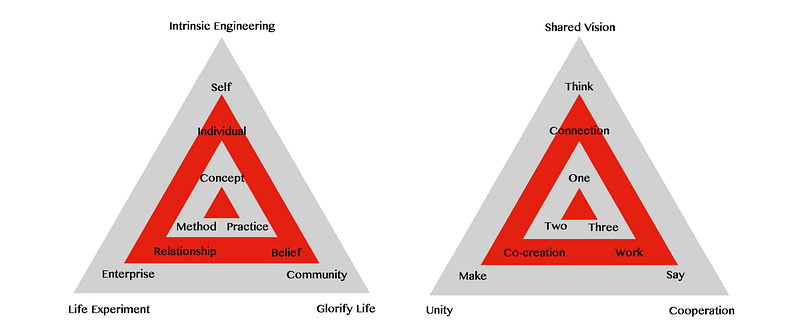
Inspired by the Trinity, the Curator used the above diagrams as a framework to design the Three Talks on Community online course.
This story echoes the above story of developing a framework with the Star of David. Both stories are about adopting symbolic cultural elements as instruments to represent tacit knowledge.
Both Cognitive Representation and Cultural Significance require Symbolic Awareness and a deep understanding of abstract symbols.
8. An Interdisciplinary Approach
Why do I put Cognitive Representation and Cultural Significance together?
Why not?
The diagram below is designed for discussing the concept of the Themes of Practice. It lists six disciplines.
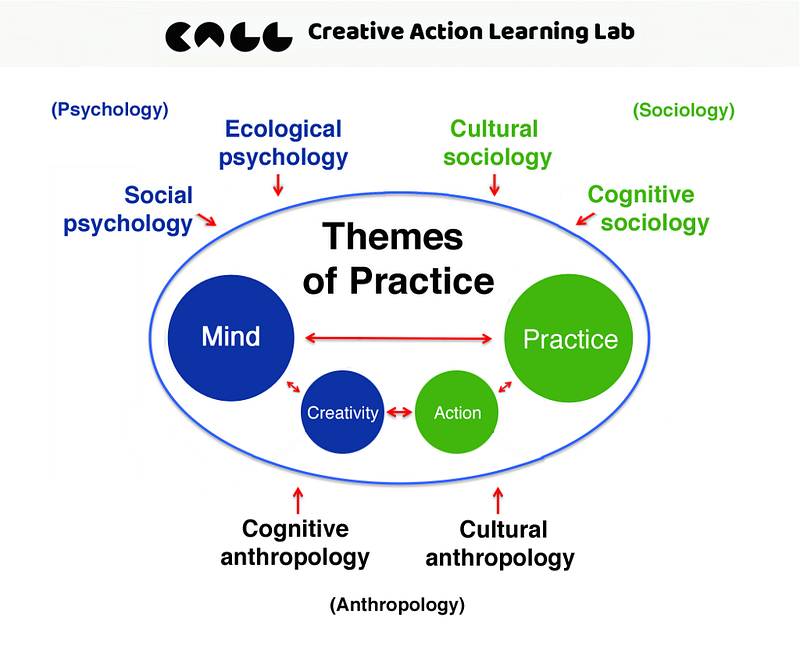
The Model — Flow — Story diagram echoes the above diagram. By using Proximal Mind — Pervasive Mind — Curated Mind, we can build a new container to curate ideas from these disciplines together.
If we return to the original three-level diagram, we can find the following loops:
- Ecological Awareness (the Perception — Affordance — Action loop)
- Symbolic Awareness (the Analysis — Instrument — Synthesis loop)
This model echoes the following diagram about the Attachance perspective.
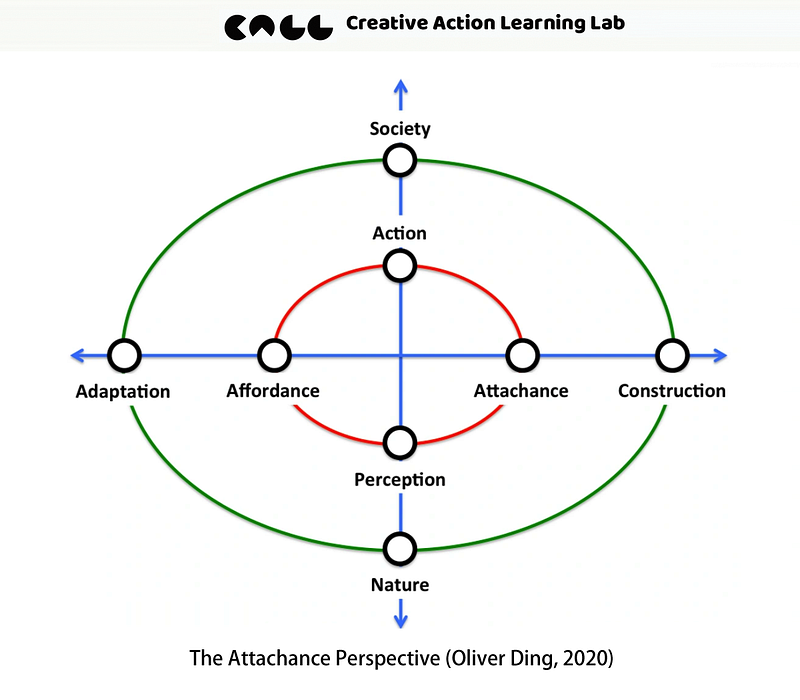
The diagram uses a nested structure to represent micro-level analysis and macro-level analysis. The micro-level is about the loop of “perception-action” while the macro level is about the loop of “nature-environment”.
The micro-level analysis is related to Proximal Mind and Ecological Awareness while the macro-level analysis is related to Pervasive Mind and Symbolic Awareness.
9. The Curated Mind of Lifesystem
Readers may find the Curated Mind is similar to the following diagram about Lifesystem. Both two diagrams are developed with the same meta-diagram: the NEST diagram.
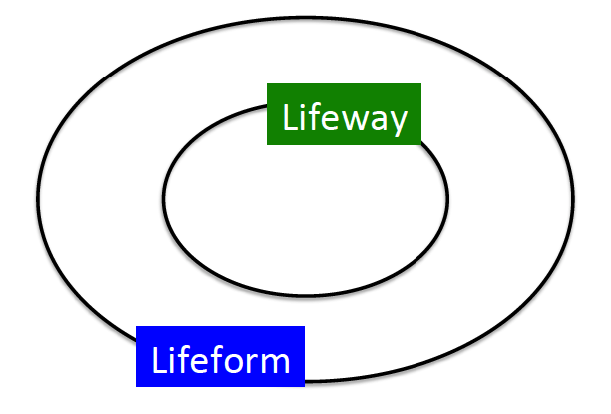
What’s the difference between the Curated Mind and the Lifesystem?
- The Curated Mind is about “Mind”
- The Lifesystem is about “Life”
These two models are developed for different purposes. The Curate Mind is more about “Mind, Meaning, and Experience” from the perspective of an individual. The Lifesystem is a new unit of analysis of social life from the perspective of social practice.
- Lifeway v.s. Proximal Mind
Does Lifeway correspond to Proximal Mind?
The term “Lifeway” is inspired by the ecological psychologist James. J. Gibson’s writing: “The natural environment offers many ways of life, and different animals have different ways of life.” I use the term “Lifeway” to refer to the “human—material” engagement which is related to physical environment and affordance.
Proximal Mind doesn’t only refer to “human—material” engagement but also considers “human—human” engagement too. So, Lifeway doesn’t correspond to Proximal Mind.
- Lifeform v.s. Pervasive Mind
The term “Lifeform” is inspired by the philosopher Ludwig Wittgenstein’s writing: “It is easy to imagine a language consisting only of orders and reports in battle…And to imagine a language means to imagine a form of life…Here the term ‘language game’ is meant to bring into prominence the fact that the speaking of language is the part of an activity or a form of life.” I use the term “Lifeform” to refer to the “human-human” engagement which is related to social environment and supportance.
Since Pervasive Mind is about Cognitive Representation and Cultural Significance, it considers both language-based things and material signs. Thus, it doesn’t one-to-one correspond to Lifeform.
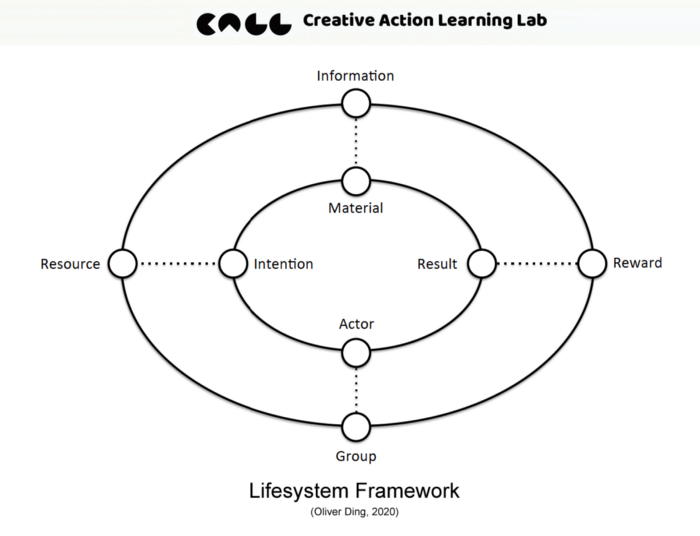
The above diagram is the Lifesystem Framework which defines eight operational concepts for empirical research. I use this framework to connect the Ecological Practice approach and social practice studies. The Lifesystem framework is inspired by several thinkers’ writings about individuality. I realized the issues of individuality and complexity should be understood as a dynamic and reciprocal process. Social appropriation of individuality is the foundation of social complexity. You can find more details from the original article about Lifesystem.
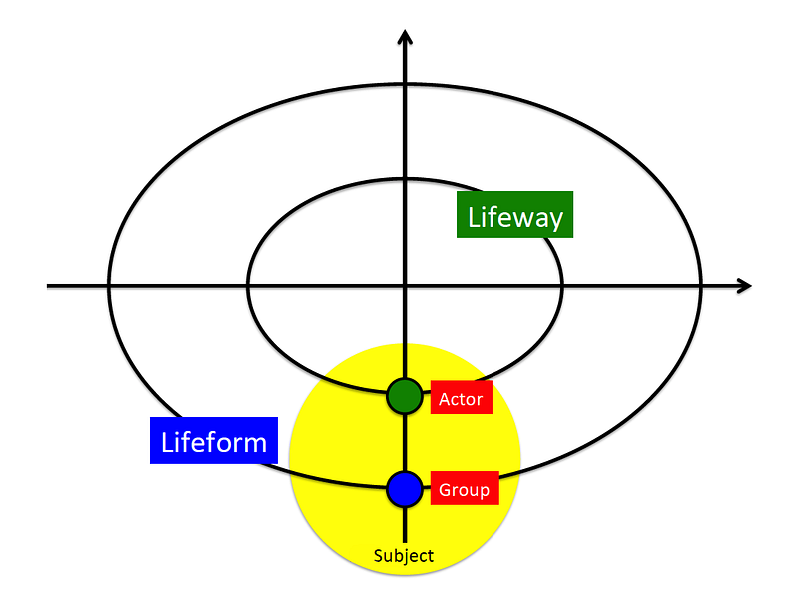
The concept of Actor is located at the loop of Lifeway while the concept of Group is located at the loop of Lifeform. The Actor refers to the primary subjects while the Group refers to secondary subjects.
We can use the Curative Mind to support the Lifesystem framework for discussing the individual mind and social mind.
10. Contexts (Mind)
Finally, I’d like to return to the “Flow — Story — Model” triad and connect it with the Ecological Practice approach.
In a broad sense, the Ecological Practice approach has its philosophical roots in traditional Pragmatism and contemporary embodied cognitive science. The primary concept of the Ecological Practice approach is Action, Experience, and Environment.
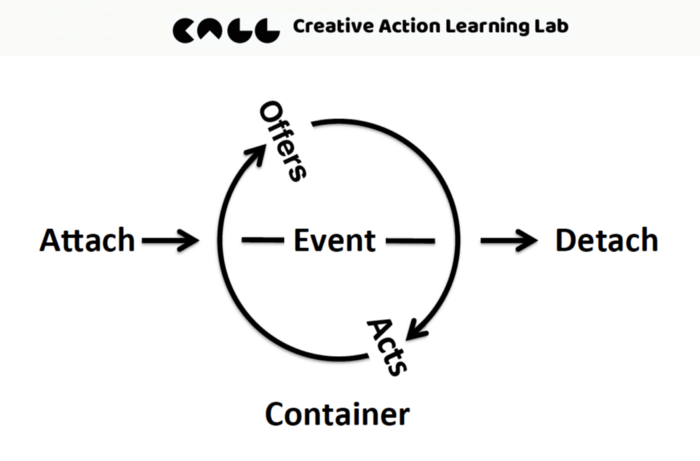
The above diagram is the basic model of the Ecological Practice approach. It combines three core concepts of the Ecological Practice approach: Affordance, Attachance, and Containance. The term “Offers” is an affordance-inspired concept, it refers to opportunities afforded by the Container. The group of “Offer — Act” forms “Event” which changes the status of the Container. The new status of the Container affords new opportunities which guide the new acts and events.
The above diagram also represents the concept of Attachance at the level of the Container. We can consider Entering the Container as an Attaching act and Exiting the Container as a Detaching act. However, the diagram doesn’t represent the second attachance which is inside the Container. The Ecological Practice approach considers the “Form of Act” as “Attach” or “Detach”. Any act is either an attaching act or a detaching act.
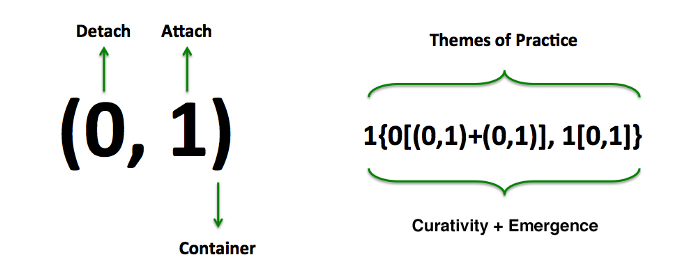
The above picture is another way of representation of the germ cell of the Ecological Practice approach. The two forms of the act are represented by binary numbers. The 0 represents detaching act and the 1 represents attaching act. The parenthesis represents the Container. The right diagram shows an example of complex status which brings out other two concepts: Curativity and Themes of Practice.
A Germ Cell of a theoretical approach is the starting point of any creative thinking project. By adjusting the quality and quantity of the Container, we can create advanced frameworks for discussing complex phenomena. Based on the concept of Container, I coined two related ideas: Network and Platform. The Network refers to the pre-container status which means pieces loose coupling outside the container. The Platform refers to the post-container status which means pieces loose coupling within the super large container. These three ideas form a triad: Network — Container — Platform. I consider the triad as a basic form of collective context.
The “Network — Container — Platform” triad is an abstract epistemological framework, it is a meta-framework. We can use it to generate a framework for discussing social life, and use it to generate a framework for discussing other things.
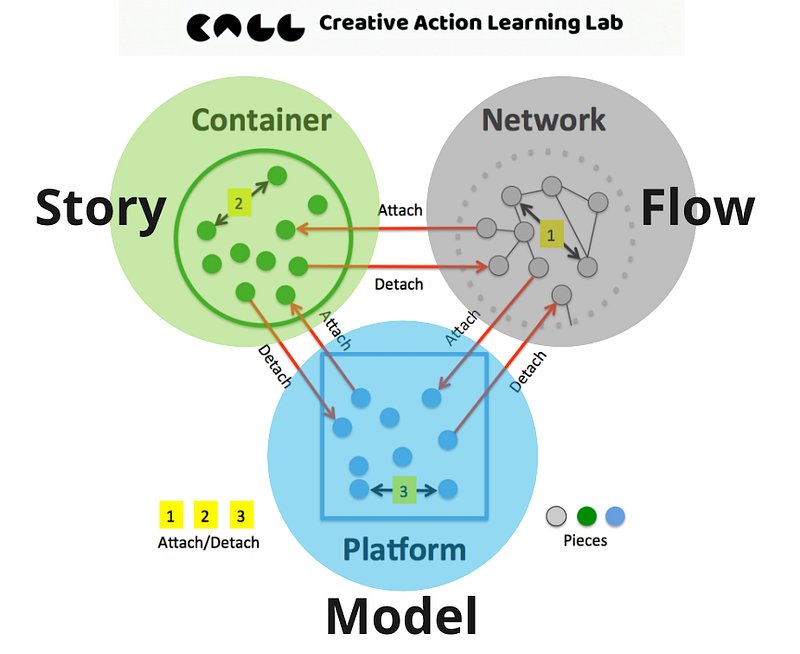
The above diagram applies the “Network — Container — Platform” meta-framework to understand the “Flow — Story — Model” triad.
- Flow: daily experiences are pieces.
- Story: a story is a container of pieces of experiences because it offers a theme and defines a boundary.
- Model: a model is a container too, but a strong container that requires hard work of cognitive abstraction.
There are six movements between these three states and each movement refers to a specific type of Attachance. The Curated Mind can be understood as the outcome of curating Attachances.
On Sept 27, 2021, I published an article titled Possible Practices: Attach, Detach, and Opportunities and discussed the Theory — Practice gap and the Attachance perspective. I said to a friend, “You just need to reach the point in which you can easily connect theory and practice. You will realize that the world is only one world without a boundary between theory and practice.”
Every domain has its own needs and practices which set frames for our minds and actions. The Meta-theory domain usually belongs to theorists such as philosophers, scientists, and other academic scholars. The General Practice domain belongs to ordinary people. However, this theory-practice gap is guided by mind-matter dualism.
The Attachance perspective emphasizes the value and meaning of the attaching acts and the detaching acts, especially the cross-boundary actions. My passion behind the Attachance perspective is: I want to encourage people to practice the detaching acts and the attaching acts. This is the only way to remove the boundary between your life and the world. A new theory should give people hope and help.
Both Attachance and Curativity are core concepts of the Ecological Practice. While Attachance refers to the level of acting, Curativity refers to the level of thinking. Any value, meaning, and experience could be curated as a meaningful whole.
Now we can use the perspective of Attachance to understand the “Proximal Mind — Pervasive Mind” relationship. We can detach from Proximal Mind and attach to Pervasive Mind, and vice-versa.
The Curated Mind is the outcome of the curating of Attachances.
11. Every Mind A Curated Mind
In a recent article about Life Discovery Canvas, I emphasized a basic principle called “Curativity as Creativity”.
Life is a real practice. How do we apply various theoretical knowledge to such a practice?
This question leads to a significant gap between Theory and Practice. Knowledge heroes create various theories, frameworks, models, etc. Their creativity drives them to make unique and general ideas. Eventually, they build a highly fragmented knowledge ecology that is not accessible to ordinary people.
On the other hand, more and more people share their life stories through various channels such as social media platforms and traditional events and meetings. We are living in an age of information overload. There are more and more cognitive needs coming from social environments such as our friends, teams, communities, and society. We need a curated mind to respond to these cognitive needs.
In 2019 I developed Curativity Theory for understanding general curation practice and wrote a book. In 2020, I started the Knowledge Curation project which aims to apply Curativity Theory to connect Theory and Practice. From the perspective of Curativity Theory, ordinary people need to add “Curation” to develop their minds.
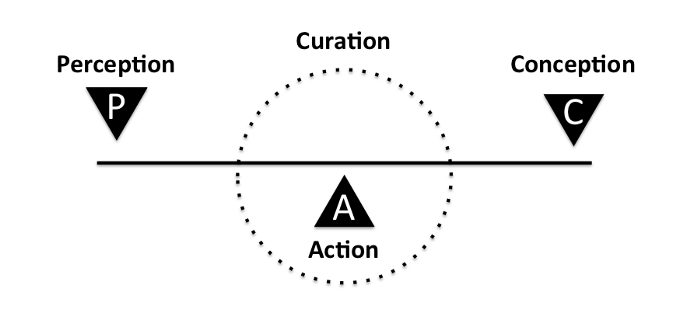
Traditionally, researchers tend to use “perception, conception, and action” as three keywords to discuss mind-related topics. From the perspective of Curativity Theory which is about turning pieces into a meaningful whole, I want to expand the foundation of mind-related topics from three keywords to four keywords.
Originally, I called this notion “the Epistemology of Curation” and use it to refer to considering pieces of perceiving experience, pieces of concepts, pieces of actions at a level and moving to a higher level to curate these pieces into a meaningful whole.
For Life Discovery, this theoretical consideration leads to two meanings: 1) we can adopt Multiple Perspectives to understand One Thing, and 2) we can adopt One Perspective to understand a Group of Things.
Now we can integrate the notion of “the Epistemology of Curation” into the model of Curated Mind.
12. The Curated Mind and Possible Practice
The vision of the Ecological Practice is expanding the existing practice to possible practice. Since 2001, a group of philosophers, sociologists, and scientists have rediscovered the practice perspective and used it as a lens to explore and examine the role of practices in human activity. Researchers called it The Practice Turn in Contemporary Theory. As Schatzki pointed out, “there is no unified practice approach”(2001, p.2).
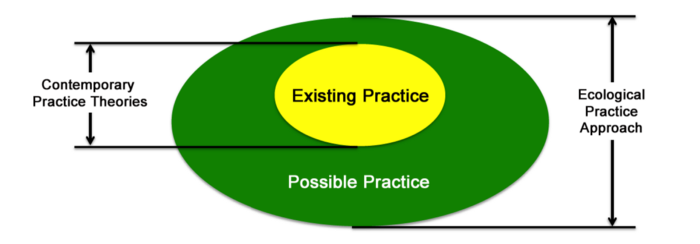
I suggest “Possible Practice” as a new term that expands the scope of contemporary practice theories from “actual actions and existing practice” to “possible actions and possible practice.” I consider “Possible Practice” as the special unit of analysis for the Ecological Practice approach. Again, the Ecological Practice approach is not an alternative to contemporary practice theories, but expands their scope and contains more theoretical concepts such as James J. Gibson’s Affordance.
The Ecological Practice approach claims that the source of all human actions is affordances and imagination. Affordance refers to material engagement while imagination refers to linguistic engagement. If we accept the ideas from cognitive linguistics which claims that the source of linguistic conceptual metaphor is our embodied experience, we can reduce the linguistic engagement (imagination) to material engagement (affordance). We can learn more from philosophists of embodied cognitive science. They consider affordance as an essential concept for rethinking the mind from the perspective of embodied cognitive science.
While the Lifesystem framework is developed for understanding action and practice, the Curated Mind is developed for understanding mind and cognition.
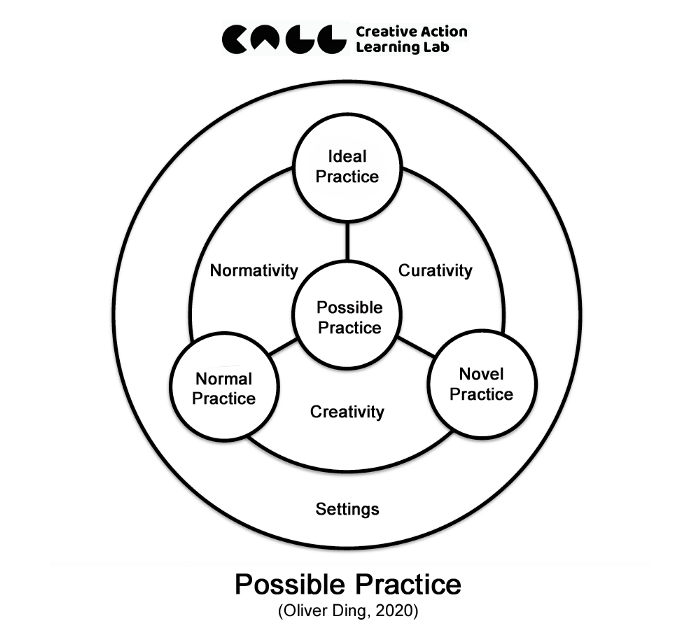
I consider actions at the individual level and practice at the collective level. The four types of social practice correspond to four types of actions.
- Possible Practice — Possible Actions
- Normal Practice — Normal Actions
- Novel Practice — Creative actions
- Ideal Practice — Exemplary Actions
Why do I place Possible Practice at the center of the new framework? I consider the possible practice as the origin of all types of practice. If we trace back to the historical development of any social practice. We can always find that their sources are possible actions.
The Curated Mind is a holistic view of the mind and it considers individual actions (that refers to proximal mind) and collective practices (that refers to pervasive mind) as a meaningful whole.
You are most welcome to connect via the following social platforms:
Linkedin: https://www.linkedin.com/in/oliverding Twitter: https://twitter.com/oliverding Polywork: https://www.polywork.com/oliverding Boardle: https://www.boardle.io/users/oliver-ding