
Possible Practices: Attach, Detach, and Opportunities
A Twitter chat about career development and the Attachance perspective
Today (The draft of this post was written on Sept 24, 2021), I had a chat with a friend on Twitter. It’s both a strategic discussion and an emotional conversation. The friend is an independent design researcher and a student who is thinking about building portfolio projects in order to look for career opportunities. Our discussion started from the strategies of portfolio projects and moved to general strategies about career development.
Based on the Attachance perspective and the Ecological Practice approach, I share four strategies for developing career opportunities. This conversation echoes my passion for the Life-as-Activity framework and Adult Development in general. So I’d like to share the whole conversation here and offer more relevant pieces about my theoretical approach.
Contents
- The Portfolio Projects
- The Career Opportunities
- The Value and Meaning of Attachance
- Exploring Possible Practices
1. The Portfolio Projects
The friend asked the following question on Twitter yesterday:
What kind of portfolio projects can a student learning UX independently (neither affiliated with bootcamp or d-school or any org) work on?
A person replied to him with the following idea:
2 ways —
1. observing problems you encounter in your own life and trying to solve them.
2. (advance) trying to design a feature for an existing app, it helps in designing w consistency w the existing visual design, and also product & experience aspect of the new feature.
I replied to the first way:
RE: 1. observing problems you encounter in your own life and trying to solve them.
I often find bugs and problems from using products such as Medium, Google Wifi, Homedepot, etc. I can’t solve their problems.
What should I do? Should I create an app for reporting bugs publicly?
This morning, I realized that I should share a real case of my experience. Thus I posted a tweet with several pictures.
I am working on Activity Theory. At the empirical study level, I follow Clay Spinuzzi’ s approach: Topsight 2.0: A Guide to Studying, Diagnosing, and Fixing Information Flow in Organizations.
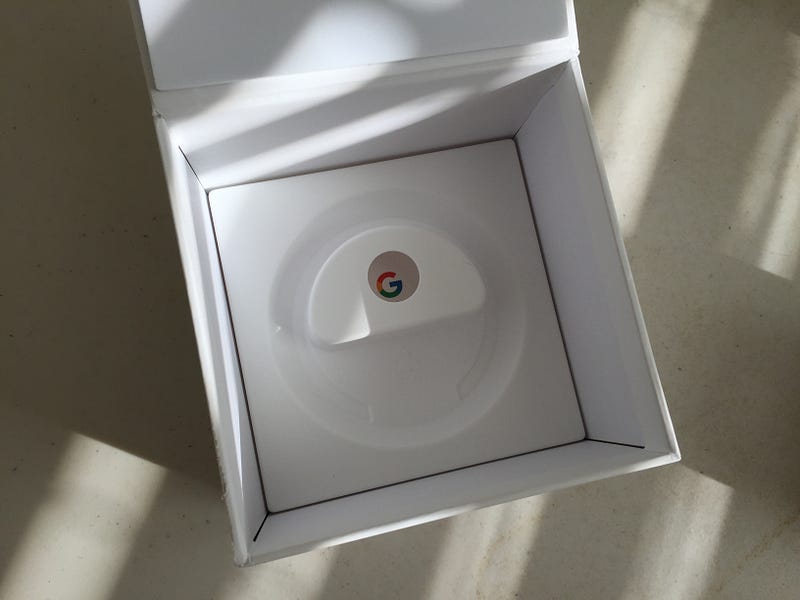
I recently moved to a new house and I detached from an old environment and attached to a new environment. This brings me various opportunities of watching local services and finding “bugs” of life world. For example, we recently added Google Wifi to our house.
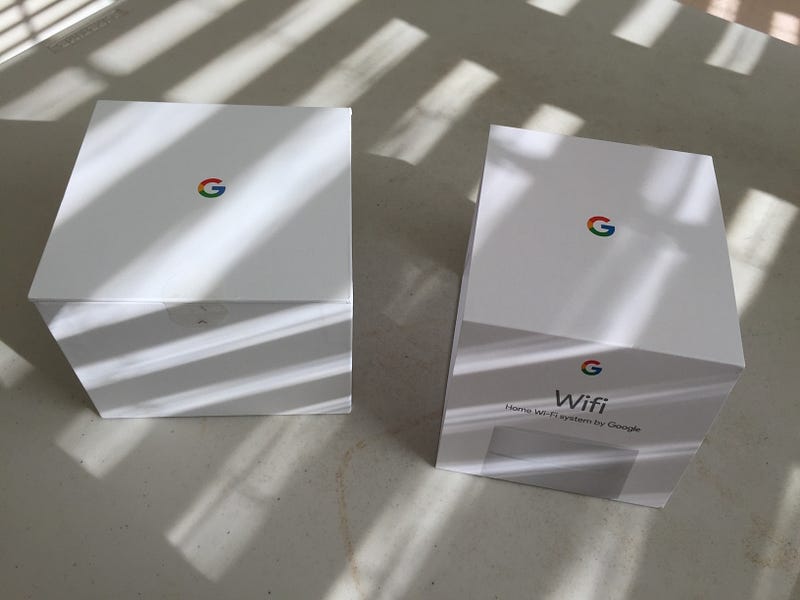

Great design!

The only bug is the text “Google Wifi” within this simple one piece of paper which is their self-installation guide.
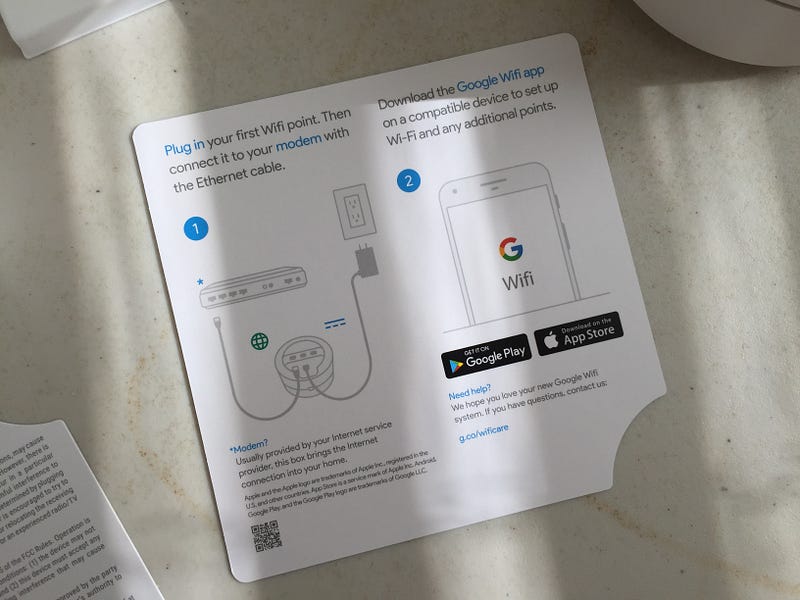
I followed the guide and searched “Google Wifi” on the Apple Store. However, I couldn’t find it.
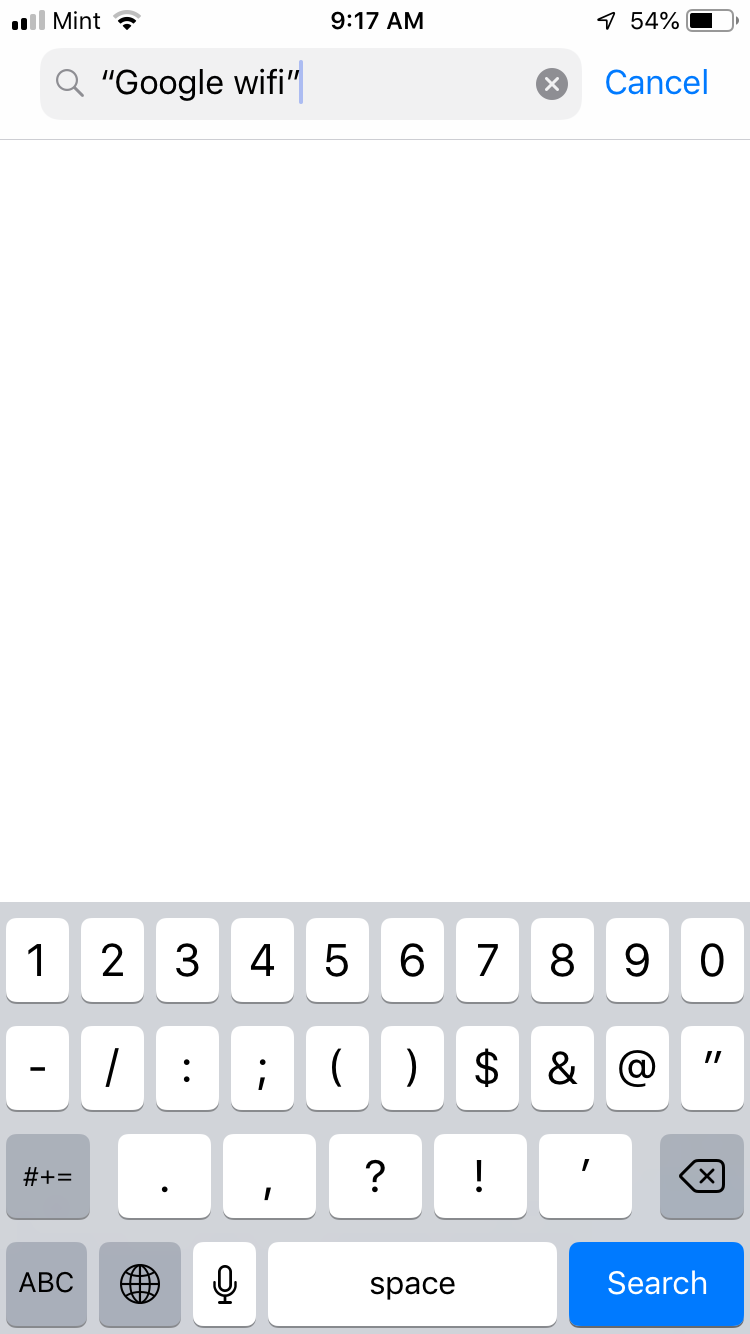

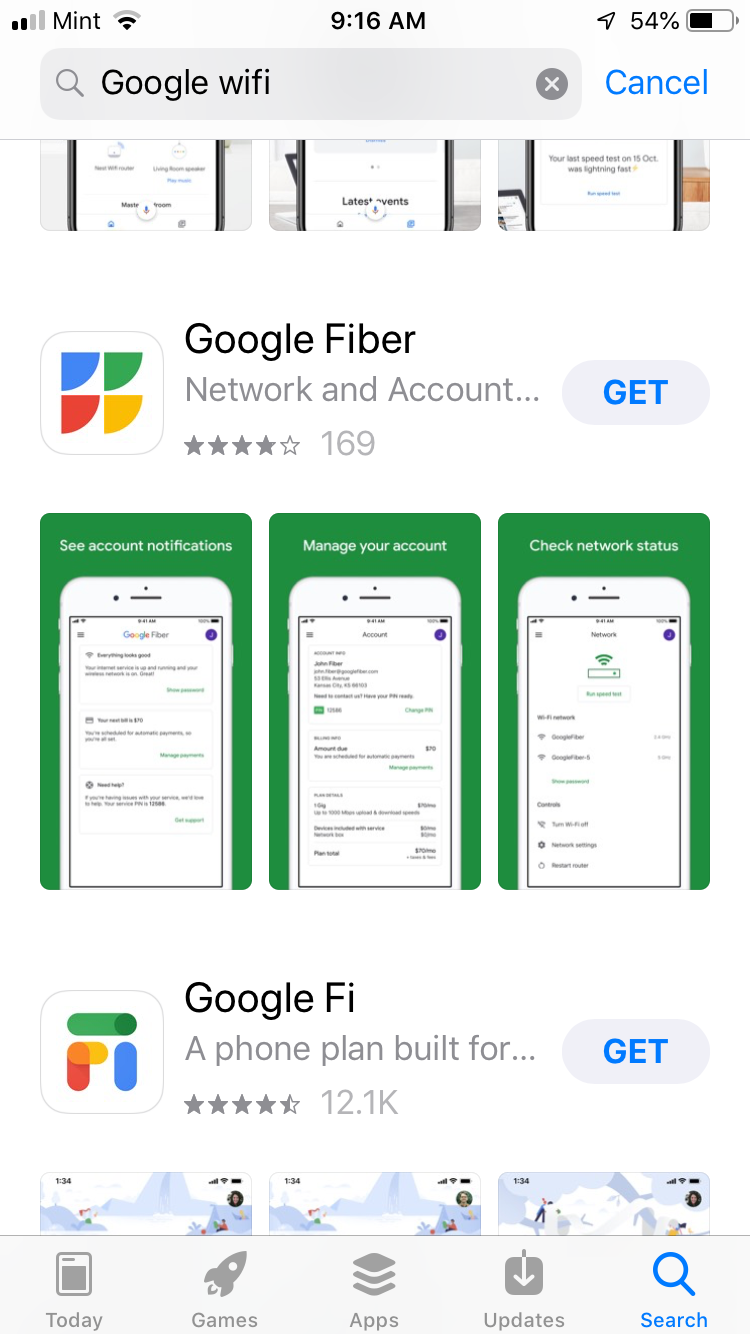
What’s the problem? They changed its name to “Google Home”.
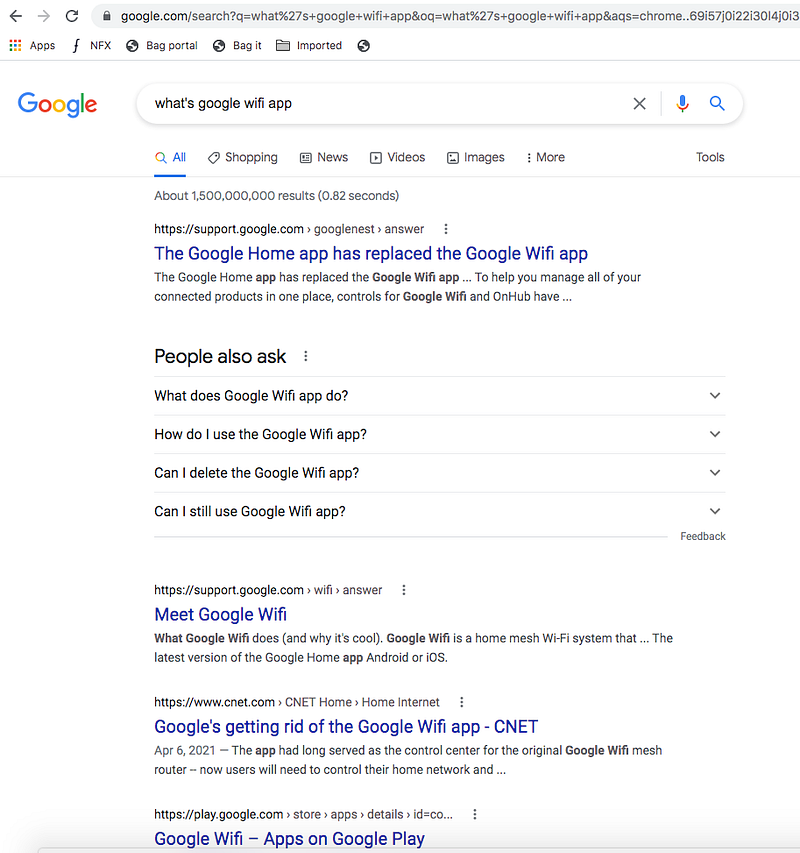
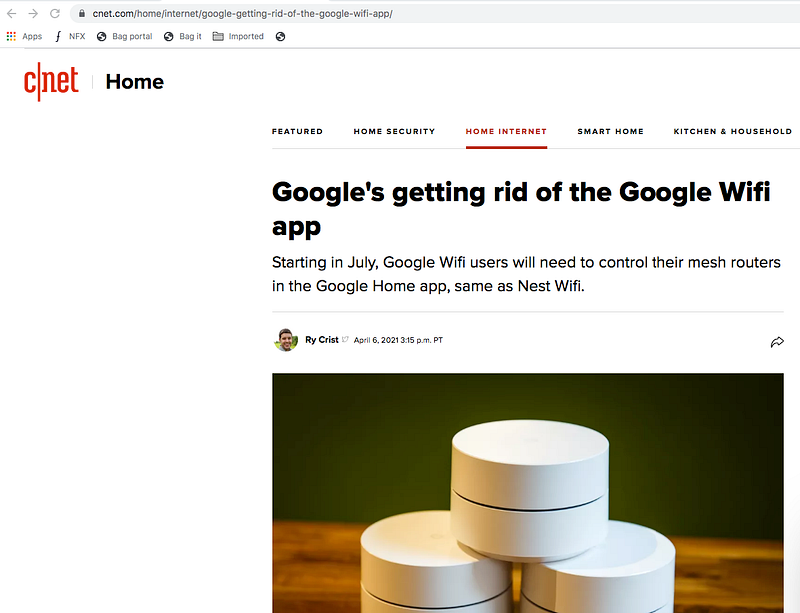
This experience encouraged me to reflect on the following issues:
- How to design a good UX of the Self-Installation Activity?
- How to manage the Paper-based Activity and the Bit-based activity?
- What kind of tech news should be considered as common sense?
The friend replied:
This is a great example for coming up with small research questions prompts for self-initiated design projects.
He also mentioned a related paper:
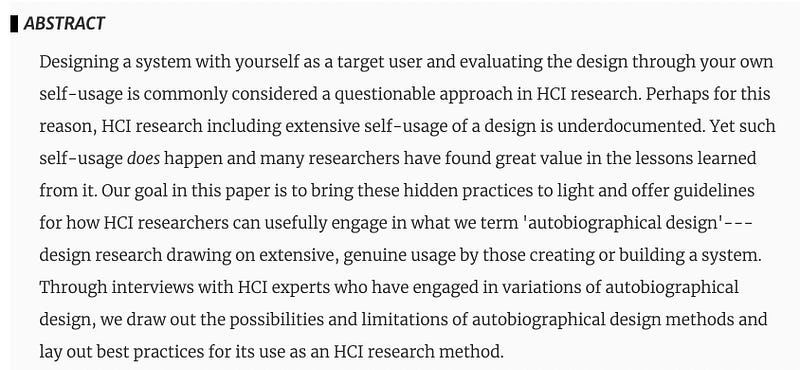
Nice! I also came across something relevant to yesterday’s discussion on using 1st person perspective for design.
Literally in tears for having come across something that’s been swirling in my mind for months Autobiographical design in HCI research: designing and learning through use-it-yourself.
Also:
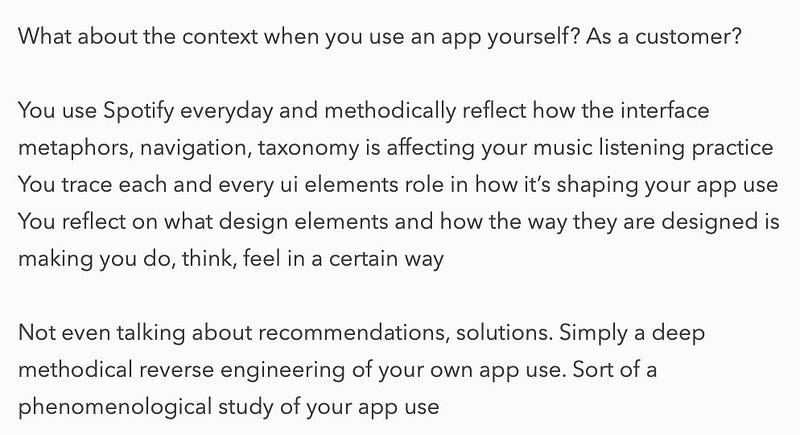
TIL about “design analysts” via @ryanrumsey
Designers who can methodically deconstruct how an interface’s components are shaping their social practice via reflections of their app use and can articulate it in detail via writing.
The above discussion is about case studies. The second thread of our discussion is about career opportunities.
2. The Career Opportunities
The friend askes:
Oliver, don’t you sometimes feel that a “portfolio” style of presenting our research and our approaches required by industry to get a job is so limiting and constraining.
I reply him with three strategies:
I’d like to suggest three types of strategies for searching for career opportunities.
1. The “site” approach: display your past experience in a “portfolio” stype. This means HR are readers only.
2. The “app” approach: run a developmental project which is a social activity.
3. The “theme” approach: define a new career theme and work on the theme. become a thought leader. You can create career opportunities for others.
The “site” approach and the “app” approach are inspired by a metaphor I used for a previous article: D as Diagramming: The Attachance Perspective.
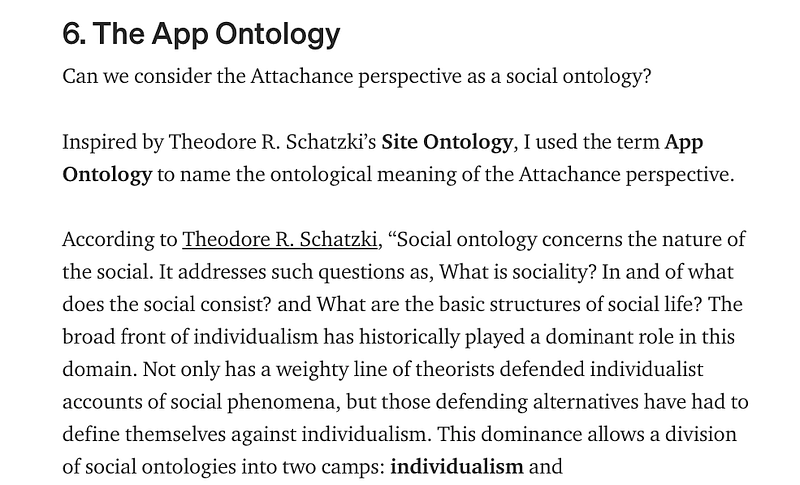
Inspired by the historical development of Internet, I considered the Site — App switch as a metaphor of paradigm shift. In the age of Web1.0, websites are a significant element. However, the mobile internet relies on mobile apps. The major shift of two paradigms is the relationship of devices and users. The PC paradigm requires people to follow devices while the mobile paradigm allows devices to follow people.
If we apply the Site-App metaphor to the social ontology, then the new paradigm after the Site ontology should be the App ontology which allows actors attaching to a site and detaching from the site. The App ontology gives more possible opportunities to actors while remaining the reality of containers.
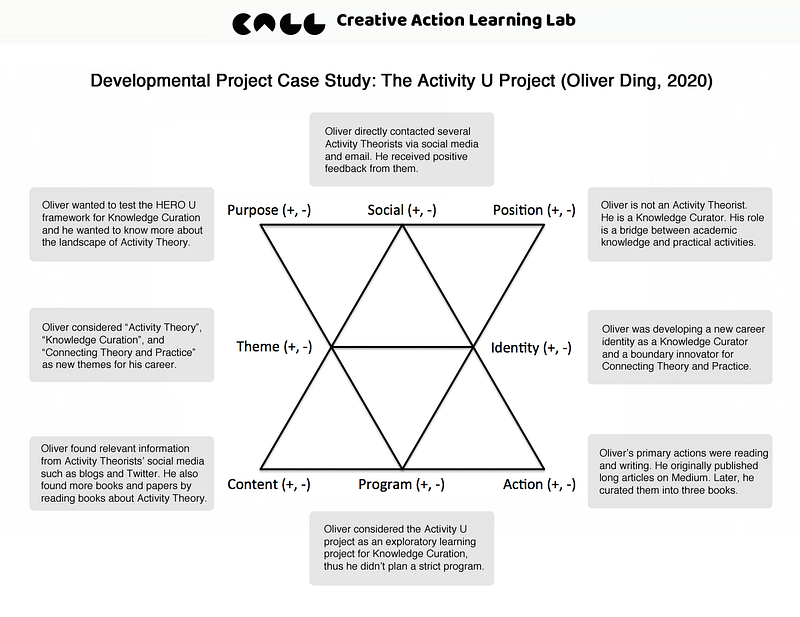
Also, the term “Developmental Project” refers to the Developmental Project Model. You can find more details about the model here. Also, the diagram below is a case study of Developmental Project Canvas. You can find more details about the canvas here.
The “theme” approach is inspired by Themes of Practice and Career Theme. I started developing the concept of Themes of Practice in 2019 for the Curativity Theory. I have mentioned the concept in my previous articles many times. The purpose of the concept is connecting “life theme” and “culture theme”.
A major progress of the project happened four months ago. On May 25, 2021. I wrote an article titled Personal Innovation as Career-fit.

The article made three impacts to the development of Themes of Practice. First, it introduces several new concepts: Career Themes, Pairs of Opposite Themes, Meta-themes, and Development of Themes. The idea of Pairs of Opposite Themes refers to significant differences between career themes. The idea of Meta-themes refers to using one high level theme to curate similar career themes. The idea of Development of Themes refers to the transformation of career themes. I emphasized the significance of Pairs of Opposite Themes in the article, “If we want to explore personal innovation, the great starting point is Pairs of Opposite Themes because they could lead to Structural Tensions such as boundary, distance, difference, heterogeneity, contradiction, and complementation. If we can turn one or more structural tensions into creative opportunities, then we could find the way of personal innovation.”
The recent works on Career Themes focus on the “Practice” part of “Themes of Practice.” This experience inspired me to review the historical development of the idea of “Themes of Practice.”I collected all my writings about Themes of Practice in past years and edited a Table of Content for a possible book. To my surprise, I have written over 440 pages about the idea of “Themes of Practice”.
One insight about Career Themes is a metaphor:
In the career market, a career theme is a stock!
Now we should adopt investment strategies for career development. A common sense of investment strategy is “Buy Low, Sell High” which means you buy stocks at a low price and sell them at a higher price.
How to apply the “Buy Low, Sell High” strategy to career development? Let’s talk about the case of “UX(User Experience)”.
Is UX a good stock?
I have developed a Career Theme Canvas and use UX for a case study. See the diagram below and the original article for more details.
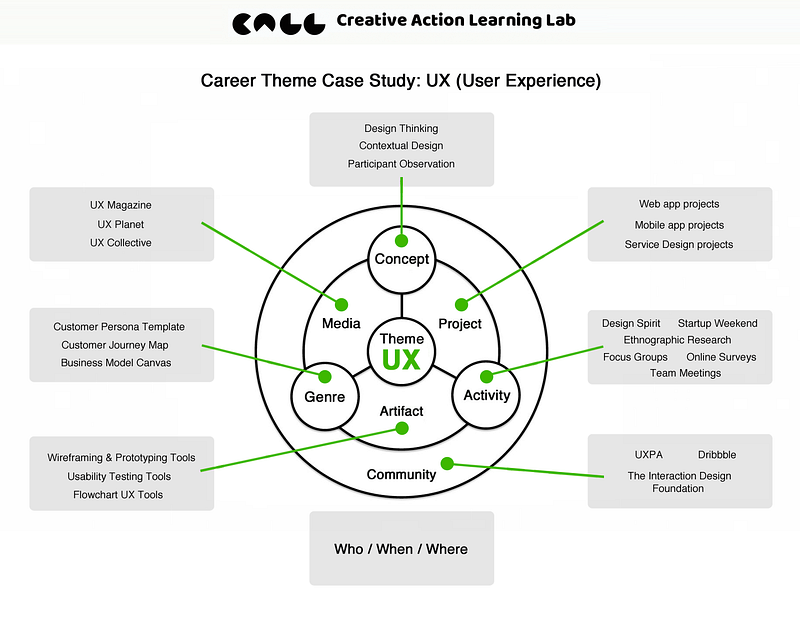
The core of the Career Theme Canvas is the Themes of Practice framework which highlights seven directions of “practice” around a career theme. It suggests that you can work on a particular theme by focusing in one direction. If you can’t find any opportunity from seven directions of a theme, you should consider detaching from the theme and attaching to other themes.
A radical strategy is defining a brand new career theme. And, we have a theory for this strategy! The Project-oriented Activity Theory is about “Formation of Concept” which is about building social movements. The formation of a new career theme is a social movement.
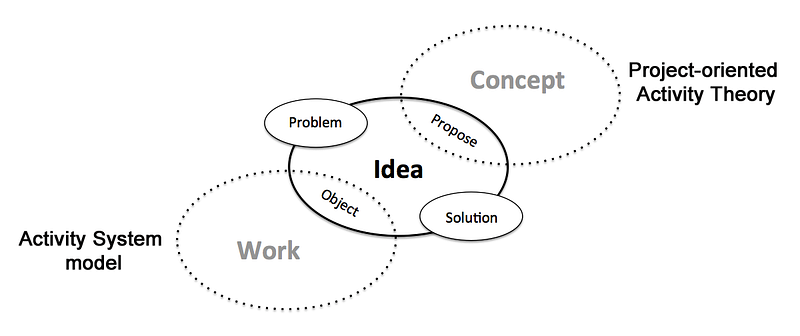
I made a distinction between Idea and Concept from the perspective of Project-oriented Activity Theory. I have emphasized that we have to think of the “project” as “formation of concept”, not a regular project such as a work. The above diagram represents a path in which the idea defines an object and the object defines the work or regular activity. This path is covered by the statement of “Object-orientedness” which is initiated by Leontiev’s approach and supported by Engeström’s Activity System model. On the other hand, the “Idea” is a pre-concept process which can lead to the “Concept” and the “Project”. This path is the focus of Blunden’s approach.
It is clear that the statement of “Object-orientedness” is a sub-statement of the statement of “Formation of Concept” because the “Idea” process which leads to the object-defined regular works or activities is the pre-Concept proces.
For more details about Project-oriented Activity Theory and Radical Innovation, you can check out Part 7 of the article Activity U (VIIII): Project-oriented Activity Theory.
From the case study, I think the “UX” is not a good stock for new investors because it is too popular. You should notice that some experienced professionals have been starting to use a new term “CX”.
We should learn a similar lesson from the historical development of IA (Information Architecture).
Let’s look at an example of dynamics of professional domains. In recent years, new professional domains emerged and grew fast and also disappeared quickly, especially web/mobile practice related domains. Information Architecture (IA) as a professional practice went popular in the mid 1990s and changed in the mid 2020s. In 2002, the Information Architecture Institute was registered as a nonprofit (501c6) organization. In 2019, their board of directors decided to dissolve the IA Institute as a legal business entity. Before the final announcement, insiders have discussed reframing the domain of Information Architecture in order to adopt the change of context. In 2013, 42 researchers, educators, and practitioners attended a workshop called “Reframing Information Architecture” in ASIS&T Information Architecture Summit in Baltimore, Maryland. Later, they collected papers and published a book. One author suggested reframing Information Architecture as a sub-section under the User Experience umbrella. Then, we see another professional organization: User Experience Professionals Association.
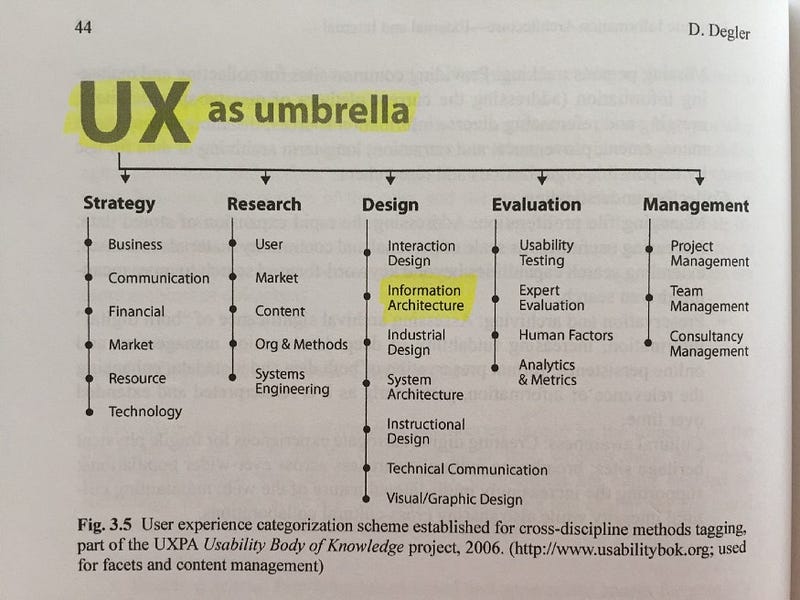
I was an information architect. Now I move to the direction of curation and work on Curativity Theory. I’d like to share two examples of detaching from IA too. One IAer moves to the direction of Planning, the other one moves to the direction of Sensemaking.
If a term can’t accurately refer to a professional practice, It loses its value of anchoring a body of professional knowledge. It becomes a buzzword and an orienting concept. We should notice that buzzwords and orienting concepts are Themes of Practice too. However, if you choose a buzzword or an orienting concept as your primary career theme, you need to invest time against the noises because so many people are competing for attention around buzzwords. In the other situation, a career theme became too stable that it doesn’t offer any room for knowledge innovation. For example, Project Management.
From the perspective of Project-oriented Activity Theory, the dynamics of professional domains can be seen as a process of Concept Competition which echoes the competition of career themes. If you want to know more about concept formation and innovation, you can find examples such as “Passion Economy” from a previous article: Platform for Innovation as Concept-fit. The term Passion Economy is coined by Li Jin who is building her venture capital career around the concept of Passion Economy. She definitely chose an innovative way of a VC career.
Can you do that even early on in your career? Like even when you’re starting out?
The friend asks the above question. I reply it with the fourth strategy:
the 4th strategy: the “follow” approach. If you find a person who is using the above #2 and #3 strategies, you should be the first follower.
This strategy is inspired by Derek Sivers’ TED talk.
Every movement starts from two people. One is the shaper, the other one is the supporter. This insight echoes Andy Blunden’s archetypal unit of project and activity:
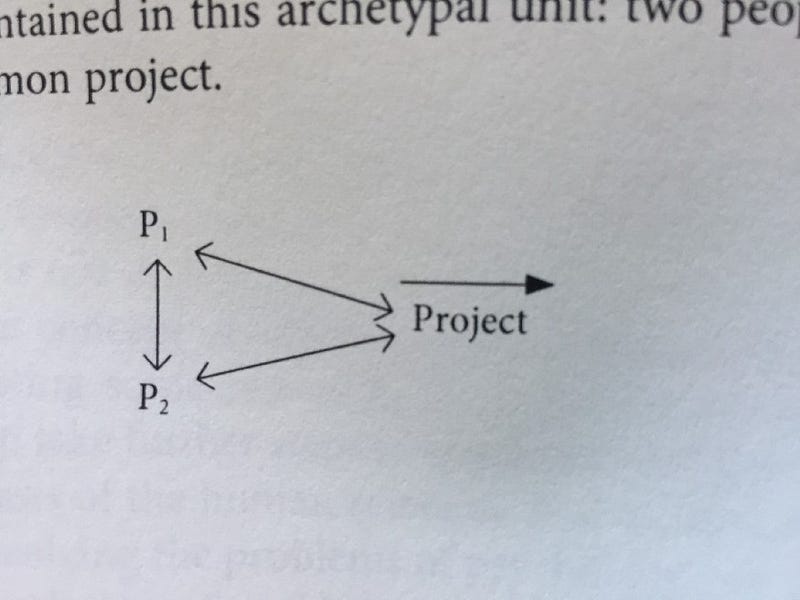
He says, “The rich context of the notion of collaboration also brings to light more complex relationships. The notions of hierarchy, command, division of labor, cooperation, exchange, service, attribution, exploitation, dependence, solidarity, and more can all be studied in the context of just two individuals working together in a common project. And yet almost all the mysteries of social science as well as a good part of psychology are contained in this archetypal unit: two people working together in a common project.” (2020, p.315)
If you want to know more about the archetypal unit of collective activity, you can find more details from a previous article Activity U (XI): Process, Position, and Zone of Project.
3. The Value and Meaning of Attachance
The last topic is about perceiving opportunities and self-initiated projects.
The friend saies,
This is a great example for coming up with small research questions prompts for self-initiated design projects. Oliver, thanks for sharing.
I reply to him,
You just need to reach the point in which you can easily connect theory and practice. You will realize that the world is only one world without a boundary between theory and practice.
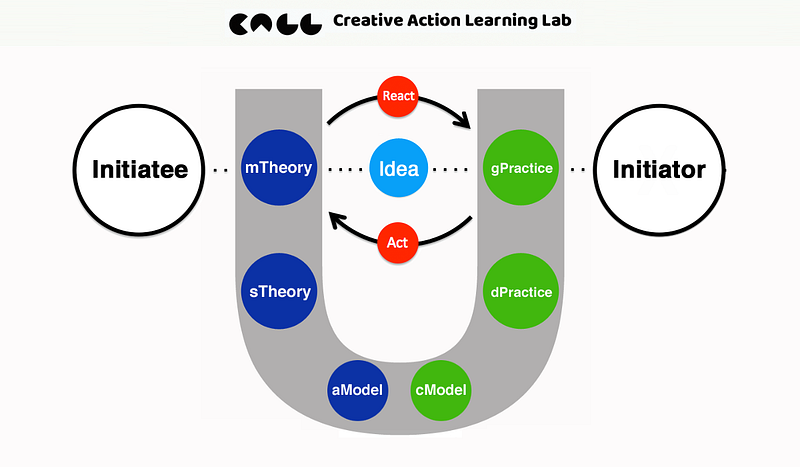
The above diagram is quoted from a previous article: D as Diagramming: Meta-theory and General Practice. The term mTheory refers to Meta-theory while the term gPractice refers to General Practice. Last year I designed the diagram which highlights several mediations between Meta-Theory and General Practice. However, I changed my mind recently. I realized that it is possible to directly connect Meta-theory and General Practice. You can find the details from the article.
Every domain has its own needs and practices which sets frames for our mind and actions. The Meta-theory domain usually belongs to theorists such as philosophers, scientists, and other academic scholars. The General Practice domain belongs to ordinary people. However, this theory — practice gap is guided by the mind — matter dualism.
The Attachance perspective emphasizes the value and meaning of the attaching acts and the detaching acts, especially the cross-boundary actions. Let’s use the Attachance perspective to reflect on the above Google Wifi example.
The diagram below is called Career API which describes three types of cognitive domains for career development.
- A: Agenda of the Times.
- P: Problems of Domain.
- I: Personal Issues.
The diagram is made with the Tripartness meta-diagram. The A (Agenda of the Times) is located at the “Organization — Community” zone, the P (Problems of Domain) is located at the “Person — Community” zone, the I (Personal Issues) is located at the “Person — Organization” zone.
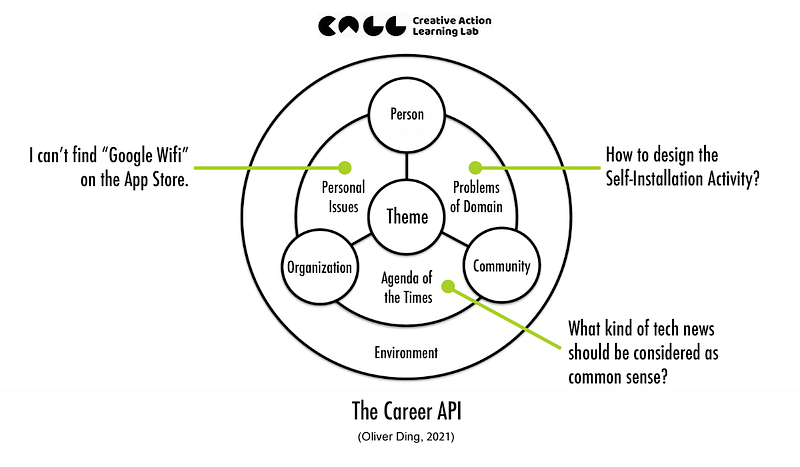
The purpose of the Career API is for discussing career development. If we define Career as a broad concept including non-paid work such as writing this article, then we can use the Career API to discuss my Google Wifi experience.
- Personal Issues: I can’t find “Google Wifi” on the App Store.
- Problems of Domain: How to design the Self-installation Activity?
- Agenda of the Times: What kind of tech news should be considered as common sense?
We should notice that the above three cognitive domains are located at three different zones. In one particular situation, I detached from one cognitive domain and attached to another cognitive domain. It also means I detached from the social role of “customer” and attached to another social role of “researcher”.
This is an example of Attachance.
From the perspective of the Ecological Practice approach, the above three cognitive domains are understood as Containers. Three are three types of containers:
- Physical Containers
- Social Containers
- Cognitive Containers
The real life world is full of such containers. The above three cognitive domains are cognitive containers. The concept of Attachance can be applied to physical containers and social containers too. For example, the “agency — structure” debate is a major topic of social theories. We can understand social structure as social containers.
The concept of Attachance is planned to develop as 1) an ecological practice concept for practice studies such as interaction design and startup innovation, 2) a philosophical concept for developing a social theory. The book After Affordance only achieves the first goal and it focuses on the following acts:
- Attaching to an environment
- Detaching from an environment
- Attaching to an object
- Detaching from an object
I use the Attachance Perspective to refer to its philosophical meaning. To be honest, this task is a tough challenge. I have not developed a solution for discussing social containers yet.
My passion behind the Attachance perspective is: I want to encourage people to practice on the detaching acts and the attaching acts. This is the only way to remove the boundary in your life and the world. A new theory should give people hope and help.
4. Exploring Possible Practices
Why do we need to pay attention to cross-boundary mindset and actions?
Because it refers to potentials, possibilities, and opportunities. I use a new term “Possible Practices” to describe such a tendency of looking for these ecological values and meaning.
Based on my study on Creative Actions, I developed a new framework for discussing social practice. The diagram below represents the new framework in which the possible practice is placed in the center.
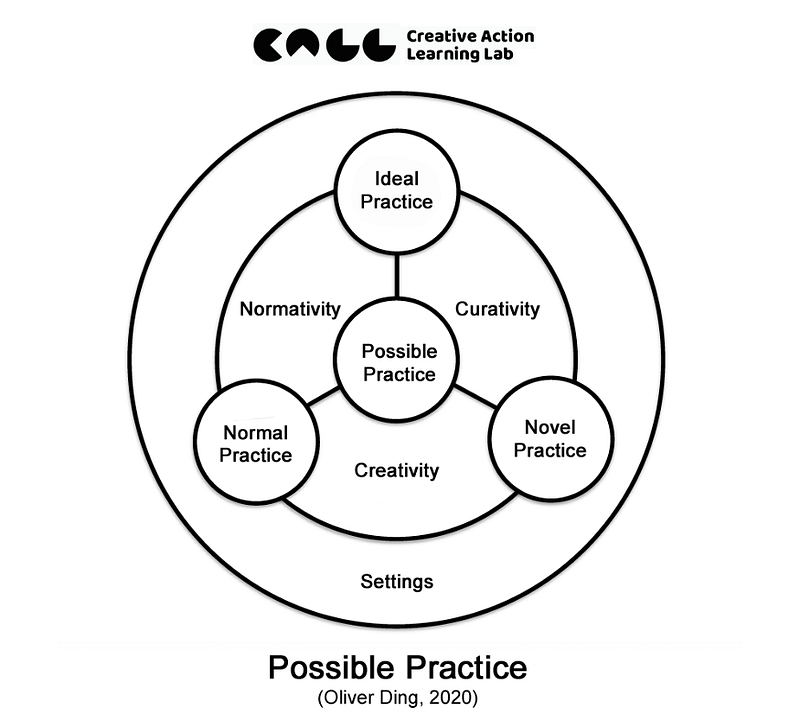
I consider actions at the individual level and practice at the collective level. The four types of actions correspond to four types of social practice.
- Possible Practice — Possible Actions
- Normal Practice — Normal Actions
- Novel Practice — Creative actions
- Ideal Practice — Exemplary Actions
Why do I place Possible Practice at the center of the new framework?
I consider the possible practice as the origin of all types of practice. If we trace back to the historical development of any social practice. We can alway find that their sources are possible actions. I consider affordance and imagination are two sources of possible actions.
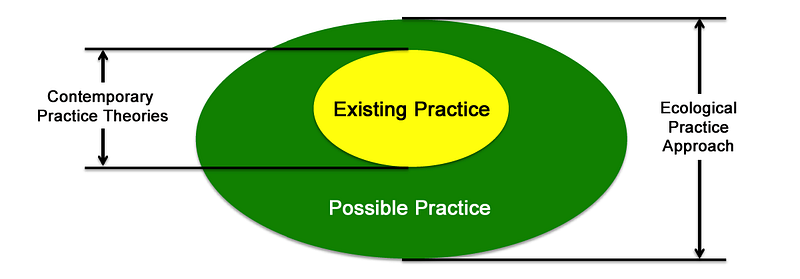
If we put Normal Practice, Novel Practice, and Ideal Practice into one category: Existing Practice, then we can get the diagram below.
Since 2001, a group of philosophers, sociologists and scientists have rediscovered the practice perspective and used it as a lens to explore and examine the role of practices in human activity. Researchers called it The Practice Turn in Contemporary Theory. As Schatzki pointed out, “there is no unified practice approach”(2001, p.2). Davide Nicolini adopted a way of toolkit to introduce the following six different ways of theorizing practice in his 2013 book Practice Theory, Work, & Organization:
- Praxeology and the Work of Giddens and Bourdieu
- Communities of Practice (Lave & Wenger, 1991)
- Activity Theory / Cultural-historical activity theory (the Marxian/Vygotskian/Leont’evian tradition)
- Ethnomethodology (Harold Garfinkel, 1954)
- The Site of Social (contemporary developments of the Heideggerian/Wittgensteinian traditions, by Theodore R. Schatzki)
- Conversation Analysis / Critical Discourse Analysis (the Foucauldian tradition)
Nicolini also pointed out, “Practice theories are fundamentally ontological projects in the sense that they attempt to provide a new vocabulary to describe the world and to populate the world with specific ‘units of analysis’; that is, practice. How these units are defined, however, is internal to each of the theories, and choosing one of them would thus amount to reducing the richness provided by the different approaches.” (2012, p.9)
I suggest “Possible Practice” as a new term which expands the scope of contemporary practice theories from “actual actions and existing practice” to “possible actions and possible practice”. I consider “Possible Practice” as the special unit of analysis for my approach “Ecological Practice.” Again, the Ecological Practice Approach is not an alternative to contemporary practice theories, but expands their scope and contains more theoretical concepts such as James J. Gibson’s Affordance.
The ecological practice approach claims that the original source of all human actions are affordance and imagination. Affordance refers to material engagement while imagination refers to linguistic engagement. If we accept the ideas from cognitive linguistics which claim that the source of linguistic conceptual metaphor is embodied experience, we can reduce the linguistic engagement (imagination) to material engagement (affordance). In fact, we can learn more from philosophists of embodied cognitive science. They consider affordance as an essential concept for rethinking the mind from the perspective of embodied cognitive science.
My focus is action and practice, not mind and cognition. The goal of the ecological practice approach is building a new unit of analysis for discussing action and practice.
Let’s explore Possible Practices together.
You are most welcome to connect via the following social platforms:
Polywork: https://www.polywork.com/oliverding Twitter: https://twitter.com/oliverding Boardle: https://www.boardle.io/users/oliver-ding Linkedin: https://www.linkedin.com/in/oliverding
License
This work is licensed under the Creative Commons Attribution-NonCommercial-ShareAlike 4.0 International (CC BY-NC-SA 4.0) License. Please click on the link for details.


