
So what is it with UX, CX, EX and Service Design?
We felt almost fashionable when we first used one of these terms, and if you are in the design field, you’ve probably asked at some point, what is the difference between them? I recently heard someone saying that they were all the same, even Design Thinking, just different names. Are they?
Last month, I ran an introductory session to Service Design to my UX and UI colleagues at work. I knew that defining it would be important, but highlighting the differences with what we know as UI/UX was necessary. So I’ll use this post to cover the highlights of that session and to explain in very simple words what is the focus of each one of these fields, where are the boundaries and when is appropriate to use each one of these terms.
I’ll start grouping User Experience (UX), Customer Experience (CX) and Employee Experience (EX). I will continue with Service Design and finally Design Thinking.
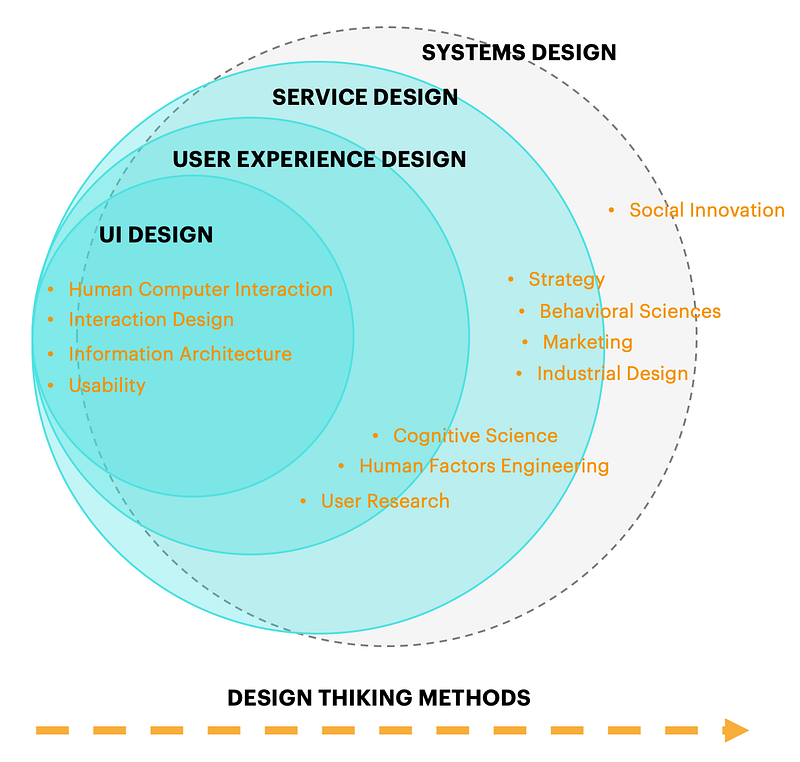
User Experience (UX)
In academic literature and industry context, UX is known to be concerned about human experiences when interacting with digital devices: phones, Smart TV’s, computers, video games or any kind of digital platform. Some people call it information architecture, since one of its main focus is the logical and hierarchical processes of human thinking. UX Designers are concerned about the what, how and why of a digital interaction.
An important part of a digital experience is usability and aesthetics. That’s where User Interface (UI) comes into play. Attributes like Accessibility and consistency are defined here. However, it is possible to have mismatches between UX and UI. You can have a nice looking, accessible app (good UI) but complex flows (bad UX) that ultimately create poor experiences . Therefore, it is expected that both UX and UI always work together.
Most UX and UI Designers have a background in Graphic Design, Interaction Design and even Industrial Design.
Customer Experience (CX)
Some people call it the new Marketing. As the name says so, it is concerned about the Experience of the Customer. CX is not only concerned about digital interactions, but about everything that the customer touches upon when interacting with a service, either physical or digital. CX is about how your customers engage with your product, service or brand.
Marketing old practices of generating insights from hard data and surveys to a large number of people have been complemented with qualitative methods to connect better with the customer and empathize with it.
Since professionals in this field don’t necessarily have an academic background in Design, job titles vary from CX Specialist, CX Expert to CX Designer.
Employee Experience (EX)
Easy to guess. It is about the Experience of employees within an organization. In the past, HR was the only department concerned about employees wellbeing, social benefits, medical services, savings accounts, social security, etc.
The scope of employees wellbeing has evolved tremendously in the last 15 years. Nowadays, it is the whole organization concern to create an environment where employees feel they belong to, let them see that they are appreciated and valued. The two most common goals when looking at EX are:
- Retaining talent by stimulating sustainable growth within the company.
- Boost productivity by having happy employees.
Professionals in this field can be varied from HR Specialists, Psychologists and other behavioral sciences.
So far, in the three fields explained , UX, CX and EX, qualitative methods are used to understand people’s expectations, needs and frustrations in order to define courses of action that will improve the current state of a defined context to a preferred one.
Service Design
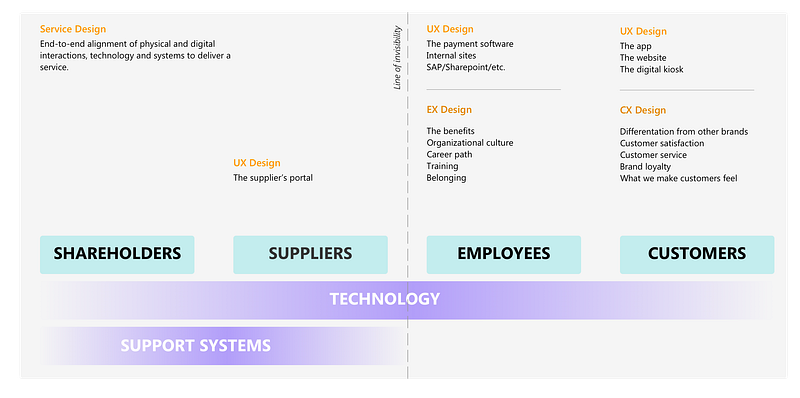
When we hear that an organization states that they put the user at the center of their process, what user are we talking about? We covered in the sections above different kind of experiences for different kind of users, internal and external. So, who should be in the center? The customer, the employee, the supplier, the end user, the person who pays for the service?
No matter which one we chose, neglecting the needs of the others could have serious impact in the business. Besides, putting “the user” at the center of the process sounds nice, but if value is not being created for the business, it is not longer a business.
Then, how can organizations make sure that they are creating value for all groups? Customers, suppliers, employees, society and shareholders.
That is what Service Design approach is about. In short words, Service Design is concerned about everything and everyone that touches upon the delivery of a service. Birgit Mager, president of Service Design Network defines it like
“…the choreography of processes, technologies and interactions within complex systems in order to co-create value for relevant stakeholders.”
Service Design looks at a sequential end-to-end process for delivering a service. It is not only human experiences, it aligns processes and systems that need to be in place in order to deliver seamlessly.
This means that Service Design is concerned not only about digital interactions (UX and UI), or customer interactions (CX) or employee experience (EX), but about how all of them fit together to create value.
A key characteristic of Service Design is the fact that is co-creational.
There is a difference between collaboration and co-creation. Collaboration can mean the involvement of users and other stakeholders in interviews, workshops, and then user personas are created, customer journeys, etc. Still, the design activity is usually left for Designers.
Co-creation however means that the creative activity is not restricted to Designers. All users (being customers, suppliers, employees, etc) work together during all the process to create solutions.
Service Designers design WITH users, NOT FOR users.
Then, who is a Service Designer? The discipline was first approached by Industrial Designers back in the early 2000’s. However, the multidisciplinary nature of the field has created a big umbrella of people with varied backgrounds such as designers, marketers, psychologists, human factors specialists, sociologists, engineers, etc, who have acquired a collaborative and human-centered mindset, who have been trained in design thinking methods and have worked in the development of connected ecosystems in the physical and digital world.
Design Thinking
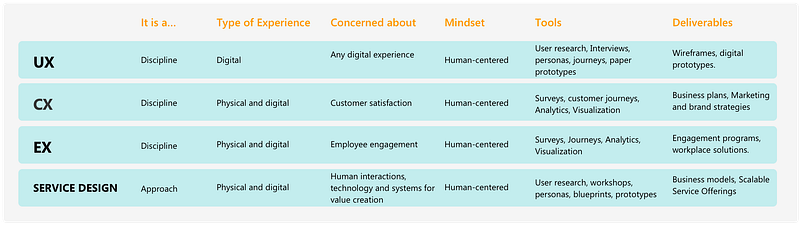
Finally, were is Design Thinking in this equation? Professionals in the above fields use similar tools such as User Research, Interviews, Affinity mappings, Analysis, Prototyping, Testing, etc. This is where it’s easy to get confused. The fact that you as a UX Designer have used these tools does not make you are also a CX, EX or Service Designer. Why? Because those tools have been applied in different contexts, for different users, with a different goal.
The user of a CX is the customer, the user of a EX is the employee, the user of a UX can be anyone who interacts with a digital product, the users of a service are customers, employees and/or suppliers.
Then, why do we use similar tools? Because we all try to understand human behavior, we try to get into the deepest motivations of people and then appeal to those motivations when we design. We try to empathize with our user (whoever that is). Whether you are a UX, CX, EX or Service Designer, you place YOUR user at the center. That is a Design Thinking mindset. Design Thinking is about empathy and human centricity. The aim of it and and its tools is to innovate whether it is a physical product, an app, a service, a way of working, social initiatives, or any process that involves human interactions.
So, is Design Thinking the same as CX, UX, EX and Service Design? No. Design Thinking is the mindset and the set of tools that we use to understand OUR particular users.
Conclusion.
All fields of Design aim to create better experiences. The difference is in the kind of experience and whose experience we are trying to improve. Hopefully this brief explanation of these often confused terms help you in your current or future path in the amazing world of Design.
Priscila Avila is a Research and Service Design Consultant @Accenture Technology. She enjoys writing personal reflections and professional learnings but often leaves them as Drafts.


