
Python 4 Engineers — Keeping It In The Short-Term Memory
Test Yourself! Coding in Python, Again!— #PySeries#Episode 15
Short-term memory (STM) is the capacity to keep a small amount of information in mind in an active, readily available state for a short period of time.
This is the goal of this article. Keep python alive!
I enrolled myself in a program, supported by Huawei, and here is the test that I’ve got through to pass for my AI course.

How about to Test Yourself?
Here we go!
Go to Google Colab and open a new notebook and answer these questions (or click bellow:):
Python 4 Engineers — Ep#15 — AI — Huawei.ipynb01#PyEx — Python —List:
Which of the following matrices will throw an error in Python?a) X = [[1, 2, 3], [4, 5, 6], [7, 8, 9]]
b) X = [[3, 3, 3] [4, 4, 4] [5, 5, 5]]
c) X = [(1, 2, 4), (5, 6, 7), (8, 9, 10)]
d) X = [2, 3, 4, 3, 3, 3, 4, 5, 6]Hint: In Python, List is used to store collections of data.
Lists are created using square brackets.
Lists are separated by comma, so now it is easy to get a sense, right?
02#PyEx — Python — List — Range():
What will be the output of the following Python code?A = [[1,2,3], [4,5,6], [7,8,9]]
[A[i][i] for i in range len(A))]a) [1, 5, 9]
b) [3, 5, 7]
c) [4, 5, 6]
d) [2, 5, 8]Hint: range() is a built-in function of Python. It is used when a user needs to perform an action for a specific number of times.
Note that the code snipped is inside a List.
03#PyEx — Python — Print():
The print function in Python 3 is enclosed in parentheses?a) Trueb) False04#PyEx — Python — Functions:
Functions are organized code segments which cannot be reused to implement single or related operations?a) Trueb) FalseHint: Reusing code is key to building a maintainable system. And when it comes to reusing code in Python, it all starts and ends with the humble function. Take some lines of code, give them a name, and you’ve got a function (which can be reused).
05#PyEx — Python — Matrix:
Matrix A and matrix B can be added only if they have the same number of rows and columns?a) Trueb) FalseHint: In statistics two matrices may be added or subtracted only if they have the same dimension; that is, they must have the same number of rows and columns.
Addition or subtraction is accomplished by adding or subtracting corresponding elements. Is that true for python?
06#PyEx — Python — Matrix:
The determinant of a NxN matrix is a scalar?a) Trueb) FalseHint: For any N x M matrix, the determinant is a scalar value equal to the product of the main diagonal elements minus the product of it’s counter diagonal elements.
07#PyEx — Python — List:
Lists in Python can be delimited by square brackets [ ], with the first element at index 0?a) Trueb) False08#PyEx — Python — Dictionary:
Which of the following format can define a dictionary in Python 3?a) {“John”: ‘Paris’, “John”: ‘London’}b) {“Jane”: ‘London’; “John”: ‘London’}c) {“Jane”: ‘London’, “John”: ‘London’}d) {“John”: ‘Paris’; “John”: ‘London’}Hint: Dictionaries are written with curly brackets, and have keys and values.
As of Python version 3.7, dictionaries are ordered. In Python 3.6 and earlier, dictionaries are unordered.
The key repetition will consider only the last input.
09#PyEx — Python — Immutable Data Type in Python 3:
Which of the following is unchangeable in Python 3?a) Tupleb) Setc) Arrayd) ListHint: Besides the different kind of brackets used to delimit them, the main difference between a tuple and a list is that the tuple object is immutable. Once we’ve declared the contents of a tuple, we can’t modify the contents of that tuple.
Some of the mutable data types in Python are list, dictionary, set and user-defined classes. On the other hand, some of the immutable data types are int, float, decimal, bool, string, tuple, and range.
10#PyEx — Python — Indexing in Python 3:
Which of the following statements about Python 3 index are true?a) Default index from right to left is numbered from 0b) Default index from right to left is numbered from -1c) Default index from left to right is numbered from 1d) Default index from left to right is numbered from 0Hint: The list index starts with 0 in Python, from left to right
11#PyEx — Python — Indexing in Python 3:
What is the output of the following Python 3 code?import numpy as np
A = np.matrix([[1,2],[3,4],[5,6]])
B = np.matrix([[12,11, 10],[9,8,7],[6,5,4], [3,2,1]])
C = np.matmul(B, A)
print(C.shape)
a) (2, 2)b) (4, 4)c) (3, 4)d) (4, 2)12#PyEx — Python — Functions in Python 3:
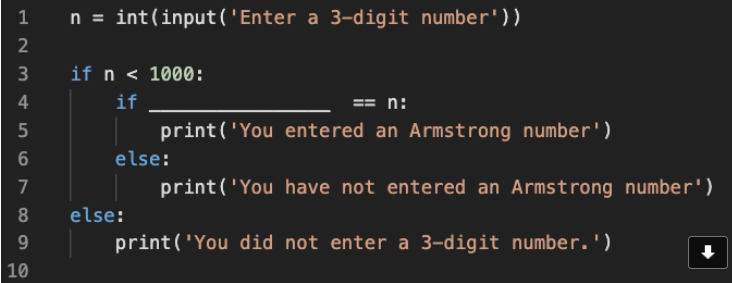
A three-digit integer number is called an Armstrong number if a sum of the cube of its digits equals the number itself. For example, 153 is an Armstrong number because 1 ^ 3 + 5 ^ 3 + 3 ^ 3 = 1 + 125 + 27 = 153. Mark the item that completes the IF statement in Python 3 code above and inform correctly if variable n is an Armstrong number.a) n[0] ** 3 + n[1] ** 3 + n[2] ** 3b) n[0] ^ 3 + n[1] ^ 3 + n[2] ^ 3c) (n // 100) ** 3 + ( n // 10 % 10) ** 3 + (n % 10) ** 3d) (n // 100) ** 3 + (n // 10) ** 3 + (n % 10) ** 313#PyEx — Python — Functions in Python 3:
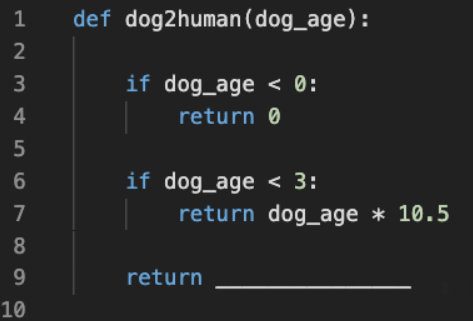
During the first two years, a dog year is equal to 10.5 human years. After that, each dog year is equal to 4 human years. Given the following code above in Python 3, what correctly completes the last return statement?a) dog_age * 4b) dog_age * 4 + 21c) (dog_age - 2) * 4d) (dog_age - 2) * 4 + 2114#PyEx — Python — Functions in Python 3:
What is the output from the following code in Python 3?from functools import reduce
def abs(x):
if x < 0:
x = x * -1
return x
print(reduce(lambda b, a : abs(a) - abs(b), [-5,-4,-3, -1]))a) 1b) -1c) 15d) -1515#PyEx — Python — Functions in Python 3:
What will be the output of the following Python 3 code?b = [2,3,4,5]
a = list(filter(lambda x:x%2, b))
print(a)a) [2, 4]b) []c) [3, 5]d) Invalid arguments for filter function16#PyEx — Python — Functions in Python 3:
What will be output after we run the following Python 3 code?vec = [0,1,2]
i = 30
while (i > 0):
if i > 16:
vec.append(i)
elif i < 16:
vec.pop()
elif i == 16:
vec.append(0)
i-=1
print(len(vec))a) 1b) 0c) 3d) 217#PyEx — Python — Functions in Python 3:
What value of “val” will be printed after we run the following Python 3 code? vec = [2,5,1,9,3,7]
val = 0
for idx, x in enumerate(vec):
if val < x:
val = vec[idx]
print(val)a) 3b) 9c) 5d) 718#PyEx — Python — Dictionary in Python 3:
Which of the following options is a Python dictionary?a) {‘image_file’ = ‘./my_dir/imgs/img_258349xh3’, ‘image_len’ = img.shape[0] * img.shape[1]}b) {‘id’: 7, ‘pass’: ‘password_key’, ‘width’: 250, ‘height’: 250}c) (a: 7, b: ‘word’, c:numpy.arange(15))d) [‘files’: ‘./my_files/tensorflow_files’, ‘folder_tam’: 15]Answers
1-b; 2–a; 3-a; 4-b; 5-a; 6-a; 7-a;8-a & c;9-a; 10-d; 11-d; 12-c; 13-d; 14-b; 15-c; 16-c; 17-b; 18-b
Credits & References
INTRODUÇÃO A MACHINE LEARNING PARA CERTIFICAÇÃO HCIA-AI by crateus.ufc.br
Posts Related:
00Episode#PySeries — Python — Jupiter Notebook Quick Start with VSCode — How to Set your Win10 Environment to use Jupiter Notebook
01Episode#PySeries — Python — Python 4 Engineers — Exercises! An overview of the Opportunities Offered by Python in Engineering!
02Episode#PySeries — Python — Geogebra Plus Linear Programming- We’ll Create a Geogebra program to help us with our linear programming
03Episode#PySeries — Python — Python 4 Engineers — More Exercises! — Another Round to Make Sure that Python is Really Amazing!
04Episode#PySeries — Python — Linear Regressions — The Basics — How to Understand Linear Regression Once and For All!
05Episode#PySeries — Python — NumPy Init & Python Review — A Crash Python Review & Initialization at NumPy lib.
06Episode#PySeries — Python — NumPy Arrays & Jupyter Notebook — Arithmetic Operations, Indexing & Slicing, and Conditional Selection w/ np arrays.
07Episode#PySeries — Python — Pandas — Intro & Series — What it is? How to use it?
08Episode#PySeries — Python — Pandas DataFrames — The primary Pandas data structure! It is a dict-like container for Series objects
09Episode#PySeries — Python — Python 4 Engineers — Even More Exercises! — More Practicing Coding Questions in Python!
10Episode#PySeries — Python — Pandas — Hierarchical Index & Cross-section — Open your Colab notebook and here are the follow-up exercises!
11Episode#PySeries — Python — Pandas — Missing Data — Let’s Continue the Python Exercises — Filling & Dropping Missing Data
12Episode#PySeries — Python — Pandas — Group By — Grouping large amounts of data and compute operations on these groups
13Episode#PySeries — Python — Pandas — Merging, Joining & Concatenations — Facilities For Easily Combining Together Series or DataFrame
14Episode#PySeries — Python — Pandas — Pandas Dataframe Examples: Column Operations
15Episode#PySeries — Python — Python 4 Engineers — Keeping It In The Short-Term Memory — Test Yourself! Coding in Python, Again! (this one:)
16Episode#PySeries — NumPy — NumPy Review, Again;) — Python Review Free Exercises
17Episode#PySeries — Generators in Python — Python Review Free Hints
18Episode#PySeries — Pandas Review…Again;) — Python Review Free Exercise
19Episode#PySeries — MatlibPlot & Seaborn Python Libs — Reviewing theses Plotting & Statistics Packs
20Episode#PySeries — Seaborn Python Review — Reviewing theses Plotting & Statistics Packs